Total Pageviews

Showing posts with label Hostelling. Show all posts

Saturday, 27 April 2024

Travel Biography - Week 97.

San Diego - Hostel Life.

After arriving in San Diego following a 13-hour Trans-Pacific flight from Sydney, then a short 30-minute hop from Los Angeles, I approached the hostel where I would stay for the next ten nights, the HI AYH San Diego Downtown. Since 1995, the hostel has moved from the third floor of the YMCA building on Broadway to an unoccupied three-storey block on Market Street, in the heart of the Gaslamp District. Since the hostel owners, consisting of two or three young men in a business partnership, no longer had to share the building with another organisation, they imposed their own rules. This included a new security system. Instead of a metal key that gave me access to the bedroom, a code was typed onto a keyboard fixed outside the main entrance door, along with a bell for first-time arrivals.

Horton Plaza, San Diego.


Sandy the Tyrannosaur, Horton Plaza.


Sandy's mate, Horton Plaza.


Another change made was a curfew imposed in the hostel member's kitchen. Instead of 24-hour access, as was with the former site, the kitchen closed for the night around 11.00 pm and opened at 7.00 am.* There was even talk among them of introducing a duty for all members, but this was scrapped. With competition, especially from rivals Rucksackers North America with their Banana Bungalows, introducing a morning duty would have eventually paralysed the business.

And all this I became aware of due to forming a good standing with the owners, one whom I befriended. Hence, I was able to ask questions, including why they decided to move. His answer was that the YMCA building was a hundred years old, and they were concerned about how much longer could the building have been useful. In addition, I was the only guest who was shown the unoccupied 2nd floor. During normal use, the elevator never stopped at this level. Instead, everyone was lifted to the 3rd from the 1st-floor reception. In 1997, AYH San Diego Downtown was a single-floor hostel as was its previous site on Broadway.

By showing interest in the business, one of the owners led me to the lift, and I watched him unlock the second-floor push button. The elevator halted at the second storey and its doors opened to reveal an unfurnished floor consisting of a central aisle leading off to rooms on each side. The bareness of the interior indicated that it hadn't been used for some time, and it was like looking into a new house immediately after being given the keys.

The room I bedded down in was a typical hostel dormitory like most other hostels. Sharing the room was a young Dutch backpacker, around half my age, and like me, travelled solo. However, after crossing the States by Greyhound, he was due to take a bus to Los Angeles Airport to board a flight to Hawaii. I had to admire him for covering such distances at a young age. In 1973, when I was twenty, my parents allowed me only by the skin of their teeth to backpack on my own to Italy, and that was with the persuasion of a family friend (Week 3 of this Biography.)

This young Dutchman, I assume a student, was quiet, kept himself to himself, and apparently a loner. However, one evening, he opened up to me and recommended the indoor swimming pool and sauna located in the basement of the YMCA building on Broadway. Indeed, I knew the place, as I had already visited twice in 1995. But for his benefit, I pretended that I knew nothing of it and asked him to throw some light on the facility, so I too could visit. Like in 1995, and two years later, I paid another visit to the sauna, then thanked the student afterwards for suggesting it to me. Indeed, in 1997, the basement facility was still there before closing down permanently a few years later.

In all, the atmosphere in this new hostel on Market Street never held a candle to the 1995 experience in the old YMCA building. There was less camaraderie in this new place than in the old. In 1995, I made friends easily as they suggested various local venues to visit. Locations such as Mission Beach, SeaWorld, the Old City, and even Little Italy were all suggested by different people, all in the member's kitchen and adjoining dining room. I hadn't forgotten the Australian builder and two Scottish brothers, whom I played table football with. Also, I haven't forgotten the young Jewess whom I protected on the bus journey from San Diego to Santa Monica.

But here, the guests kept themselves to themselves and I was left to fend for myself. Fortunately, there was a wall advert for La Jolla and I was already aware of the zoo at Balboa Park.

Another view of Horton Plaza.


This species of Palm Tree seems unique here.


A U.S. Navy ship is a Public Museum.


New Plans, New Sights - And Trouble.

Since 1995, I have rated San Diego as one of my favourite cities, along with Jerusalem in Israel. Abundant with palm trees, some species seemed to be unique to southern California. The weather was warm and balmy and contrasted with the winter coolness of Sydney. Especially in clothing. Gone were the tracksuit bottoms and woolley tops. They were packed away in my rucksack. At last, shorts and button-up summer shirts or tank tops became the norm once again, the same dress style I wore in Singapore and Northern Queensland.

Having visited San Diego already, it was easy to revisit the popular sites again, such as the SeaWorld and Mission Beach, as well as the Old City. However, I also wanted to visit somewhere new, some "virgin" locations I have yet to see. North of San Diego, for example, is the coastal town of La Jolla (pronounced La Hoya) and the city's zoological gardens, an area of outstanding beauty. The hostel also hires out a bicycle, and renting it for the day was also on the cards, but this time without the soaking I received from the stormy weather at Byron Bay. 

I have yet to visit other locations outside San Diego, including the town of San Luis Obispo with its coastal Arroyo Beach, a ten-mile cycle ride from the town. Also, Santa Barbara with its wide, sandy beach backed by the mountains of Rattlesnake Canyon with its hiking trail and a creek with the same name.

In the city itself, there has been little change since 1995. Except for one issue. The railroad track that runs through the gardens and which was easy to cross was now fenced off on both sides. I could imagine youths playing on the track, even walking along it and putting their lives at risk. A tram could appear suddenly and with hardly any warning, as these carriages tend to run quietly. 

However, it was one afternoon while I was walking along the Embarcadero that fronts Ruocco Park that I saw something extraordinary. That is, stones balancing precariously on a beach sloping into Tuna Harbour. A very skilled artist created these stacks with remarkable ease and I watched as he balanced one stack after another. There was nothing magical about these stones nor any adhesive used. Each stone was balancing on another.

Horton Plaza on Broadway was a colourful square that once included a superstore where I did my grocery shopping in 1995. However, two years later, after some searching, I saw that the store had closed down, but the surroundings had retained its beauty. It was a few hundred metres from the YMCA building. When I paid another visit to the plaza, there was a huge sand model of a Tyrannosaur. Hence, I nicknamed the model, Sandy the Tyrannosaur. Next to it was a sand model of another lizard, along with a few other models.

It is those artistic skills that delight the eye and have made San Diego unique, along with its abundance of Palm trees, all flourishing in balmy subtropical sunshine. But should the reader begin to think that Paradise Lost was at last found in southern California, unfortunately, there was a bit of a dark side, mainly at Ruocco Park, a small area of greenery west of Market Street and fronting the stony beach at Tuna Harbour, south of the main wharf.

One evening, I was walking along the wharf towards Tuna Harbour as I was making my way back to the hostel. In the park were several police officers standing around, talking on their phones. However, lying on the ground were some youths, handcuffed and protesting as the officers kept them under restraint. Whether they were tourists or locals, I couldn't tell, but I wouldn't be surprised if they were local. Then again, British tourists, especially football fans, always had a shady reputation whilst overseas, tainting all of us with a UK passport with the same tarbrush.

What they did to attract the attention of the Police, I would never know, for I had no right to ask or to interfere with their duties. Neither had I learned of the fate of those arrested. Therefore, I kept a safe distance and minded my own business as I made my way to the hostel to prepare dinner.

It amazes me, coming to think of it, that there are those in a group under arrest, and the Dutch backpacker sharing our hostel dorm. Both were very much the same age, yet their behaviour and their fates couldn't have been more different. As the Dutch backpacker prepares to fly to Hawaii, these young men could be facing a least a night in a cell. And so, the ins and outs of international travel.

However, it was on another evening, long after dark, that I was taking a walk along the wharf. It wasn't very late, but as I arrived at Ruocco Park, I saw how deserted it was. I paused to look around. Presently, a police officer approached to ask me some questions. He wanted to know my name, where I came from, and where I was staying. I gave them my name and explained that I was staying at an AYH hostel on Market Street.

Did you know that you're on privately owned property? And the park is now closed for the night? the officer asked.

Of course, I never knew. During the day the park was open to the public. I was trembling inside. Would I end up like those men did the other night?

When the officer learned where I was staying, he told me to beat it, and I was free to return to the hostel. I had already eaten earlier, before the late evening walk, and all I wanted to do was relax in the lounge, safe from whatever was happening outside. I suppose these officers were well-trained to tell the difference between ignorant innocence and deliberate trespassing.

These stones were carefully balanced.


The artist performs his skill.


Then again, funny things could occur with the authorities in San Diego. On the same evening after arriving from Australia, I was strolling casually along Broadway, feeding memories of my previous visit two years earlier and pitying the closure of the YMCA hostel I loved so much. Walking a few metres in front of me was a uniformed security officer with a large bag of popcorn. Suddenly, and perhaps believing that nobody was looking, he threw the bag onto the sidewalk and carried on, leaving the food abandoned and in good condition.

I waited a moment to see if he would return for it or whether another passerby would pick up the bag. But neither occurred. So, I picked up the bag of perfectly good popcorn and enjoyed a feast free of charge!
----------------------------------------------------------------------------------------------------------------
*This was in 1997. According to the Internet promotion, the hostel has come a long way since then.
Next Week: A cycle ride to La Jolla.

Saturday, 20 May 2023

Travel Biography - Week 49.

A Day in Tel Aviv.

Having arrived in Tel Aviv into the night, I was glad to lay my head on a bed in a hostel dormitory. I had mixed feelings - one of sorrow that six hours of the holiday were severed due to a delay in the outgoing flight from London Gatwick to Tel Aviv Ben Gurion, and the other the anticipation of what's to come in the next two weeks. And that includes a visit to Silwan, east of Jerusalem, to see whether the Spihu family from 1976 was still around.

After wakening up, showered and dressed, I made my way to the dining room, where I enjoyed a Hebrew breakfast, consisting of some cheese, olives, flatbread, and yoghurt. Interestingly enough, coffee with milk wasn't Kosher, therefore, I had to drink it black. The hostel was affiliated with ILH or Israel Hostels, their equivalent of our Youth Hostels Association, or YHA. However, like on the European Continent, there was no duty.

A comparison - inside Hezekiah's Tunnel, 1976.


Exiting the Tunnel in 1993.


After checking out, I spent some time in Tel Aviv before boarding a bus to Jerusalem.  The weather was warm, and the sun shone. I had my rucksack hanging from my shoulders. This was different from the 1976 visit to Israel when I had a suitcase. It was during the 1980s that I was given an old Army rucksack by one of Tim's housemates. It served well for the years to come. I recall the last full day here in 1976. I spent that day on the beach. However, this time around, I was more interested in staying dry and checking out the city.

As I walked along through a quiet street, I saw ahead an Orthodox Jew struggling to lift a shopping trolley onto the kerb, after crossing the road with it. I approached him, and together, we lifted the trolley onto the sidewalk. He thanked me heartily, and I made off feeling exuberant. Somehow, I feel blessed just to be here in Israel and lending a hand to an Orthodox Jew in distress.

As I walked on, I came across a busy street market which was crowded with people. However, amid the crowd, there was a loud and threatening verbal disagreement between two middle-aged men, and their shouting at each other carried through the rows of stalls. No one else seemed to have been distracted, as if such disputes were pretty common here, a normal everyday occurrence. The altercation finally ended when the two men parted in opposite directions, with one still shouting at the other whilst the distance between the two increased. Indeed, it hardly took any time at all to realise that I was in a foreign country. I am yet to hear of such altercations in a typical English High Street during shopping hours!

On to Jerusalem.

My heart was in Jerusalem, Israel's capital since 1949. So, after a few hours spent in Tel Aviv, I boarded an Egged Bus to Jerusalem Bus Station from the terminal in Tel Aviv. As I sat by the window, I could see what appears to be the early stage of a railway construction project linking Jerusalem to Tel Aviv. After travelling across what the Bible called the Plains of Sharon, we started to ascend a series of hills, on which Jerusalem is built.

The bus Station was located on Jaffa Road. Back in 1993, the street was a normal traffic thoroughfare, but at present, according to Google Maps, the road is now closed to traffic and laid with tram tracks heading towards the Old City. I passed the Ron Hotel (now a hostel) where I spent the first night in Israel in 1976. I looked around. My first task after arriving in Jerusalem New Town was to look for a budget hotel. I then noticed what could be a suitable place to stay as I headed towards the Old City. I made a mental note of the hotel.

At last, I saw the wall of the Old City ahead with the Jaffa Gate in view. I crossed the main road to reach it and walked through. Almost immediately, I have noted some changes over the past 17 years. One of these changes was the modernisation of the souks, the narrow streets with many sections roofed over. They no longer had a central gutter where donkey's excrement was regularly flushed into. Instead, the outline of the central gutter could be seen within the new paving. Where donkeys once pulled truckloads of merchandise to the shops lining the souk, by 1993, narrow tractors, built specifically for the souks, pull the carts along, and the engine noise and pollution from these vehicles had spoiled, if not destroyed, the Middle Eastern spirit of the past centuries, including the 1970s.

Added to this was the change of music that was played out from the radio sets that appeared here and there. Gone was the traditional Arab singing that reverberated through those ancient streets and was still listened to as recently as 1976. Instead, by 1993, a Western-style beat vibrated the air within the souks.

One other feature that had changed was the monetary currency. In 1976, the currency was the Israel Pound, a throwback from the days when Palestine (as it was known then) was under the British Mandate. When the British withdrew their mandate on May 14th, 1948, thus giving rise to the birth of the sovereign State of Israel, the Pound was retained until February 24, 1980. From that day onwards, the Shekel became the permanent currency of Israel.

ILH Hostel, Tel Aviv.


Entrance to the New Swedish, Jerusalem.


New Swedish Interior. My bed is with a blue towel.


All this goes to show how wonderfully fortunate to have visited the Holy Land in 1976, and then to return 17 years later to see such changes. It was as if I was divinely sent there to absorb the ins and outs of the Holy Land, to learn of its changing culture and to see for myself the truth in the historicity of the Bible, in which Jerusalem, as a city, dominates.

However, some religious and cultural heritages remained. Such were the Islamic calls to prayer sounding from the minarets of mosques in and around the city. Not only do these calls sound through the city souks, but also echo through the Kidron Valley south of the city. One other custom was that a lone backpacker remain the ideal target of Arabic salesmen who persuades the visitor to be escorted around the historic sites for a fee. Since 1976, I have learnt to resist their advance without being rude. As one middle-aged gentleman protested, I have a wife and family to support. We too must eat. Feeling helpless, all I can do was hope all will be well with him. Not that he looked hungry. Rather, he appeared to be well-fed, clothed, and housed.

However, from one shop selling trinkets, including photographic film, the owner emerged and asked if I was looking for a hotel. When I said yes I was, he pointed down the souk and recommended the New Swedish Hostel, just a little further down the street and well within the Old City walls. I arrived at an insignificant doorway between the shops. Over it read New Swedish Hostel.

I entered, and I was faced with a flight of stairs leading up to reception. I was met by a young Arab who replied that a bed in one of the dormitories was available and there was no limit on how long I can stay. Indeed, this was one of many privately-owned hostels that weren't affiliated with any association, one of several I would come across in the years to come. I paid in advance for the entire two weeks, allowing me to check out on the morning of the day I take off for home. It was after I claimed my bed that I began to feel great again.

The dormitory was medieval built with a domed ceiling, giving the place an authentic historic look and a feeling of stepping back into history. Just two or three doors away there was a currency exchange centre. With a book of US Dollar Traveller's Cheques, I made frequent calls to the exchange throughout the holiday. As with other hostels I stayed in, this too had a guest kitchen which doubles up as a lounge. Opposite was the bathroom containing two shower cubicles and other conveniences. Also very convenient was a minimarket close to the exchange. It was here that I did my daily shopping for both breakfast and evening meals, and like all other times, I managed to store my groceries in a locker assigned to me for the whole stay.

Being such a small, compact hostel, there was only one cooking stove, therefore there were times when I had to wait my turn to use the stove. But once I got going, these times, when I cooked and ate my own meals, were also the times for social interactions with other backpackers from around the world, especially South Africa.

Experience has shown that these establishments were shunned by committed Christians. And that was a shame, as this was the right kind of environment to share different points of view, including why we were here in the Holy Land in the first place, and what we were doing here. Also, oddly enough, I can't seem to recall seeing any American backpackers there, either. There were some Europeans, including the Irish, Dutch, Scandinavian, and Austrian. And also from South Africa, and if I remember rightly, a couple of Brazilians too. But none of them confessed to being regular churchgoers. And I feel that through their absence, Christians in general were missing out. At least with me anyway, as an independent rather than part of a tour group, all I had to do was to listen carefully and I felt the land as if talking back to me. And it had a lot to teach me!

A busy Souk.


The same Souk at night - Creepy!


Back to Hezekiah's Tunnel after 17 years. 

One afternoon, I took a stroll to the Kidron Valley. I spoke to a group of young Arab men who were gathered near Gihon Spring and the entrance of Hezekiah's Tunnel. I asked whether they had known the Spihu family who lived around here, then explained that they were hospitable to me some years ago. Yes, one or two of them used to know the family. Abed was still around, selling street trinkets, but his younger brother, Ghanem, studied medicine before migrating to New York. Apparently, the parents had passed away, although this was not confirmed.*

They asked if was interested in a wade through the Tunnel. Despite already having waded through - in both directions - in 1976, I was given a lighted candle and allowed to walk in, straight from the street, as I did before. At that time the Tunnel was free to enter without any fees, but I had to pay for the candle. Now, at present, one has to buy a ticket for admission to the City of David Archaeological Site and Museum which include a walk through the Tunnel. Also, at present, the original Pool of Siloam is in the process of excavation and is earmarked to be refilled with water once the excavation is complete. Indeed, the tourist of tomorrow will visit a far more Biblically authentic site than I could have ever done in the past.

Back in 1993, I approached Gihon Spring and descended the ancient stone steps leading into the conduit. In 1976, the water flowing through was ankle-deep. This time, it reached just above my waist. As I walked in, a drought threatened to blow out the candle. I was wondering whether the air current was blowing through the entire length of the watercourse. Had the candle gone out whilst midway through, I would be stuck in absolute pitch darkness half-submerged in water and surrounded by solid rock in a very claustrophobic environment.

So I turned back to the lads at the Spring and explained the situation. One of them offered to accompany me, also with a lighted candle. I accepted his offer.

With me leading, we both went in. Further in, the drought suddenly stopped. Then I realised that I had passed the junction with Warren's Shaft, a well dug by the Canaanites hundreds of years before King Hezekiah's day, and the shaft used by King David's army to enter the fortified city of Salem, then defended by the Jebusites.

As we wade further in, the ceiling got lower until my chin wasn't far above the surface. My companion started to panic (to my surprise) and I had to reassure him. The two candles were carefully kept above the water during this section, and my head was turned to an angle in the tight space between the water and the solid rock ceiling.

Eventually, the ceiling rose to a far more comfortable height and stayed that way until the exit at the Pool of Siloam. However, just before the exit and in clear view of the daylight, the floor sunk, creating a sump. It was here that I swam out, fully clothed, with jubilance, knowing that it would not take long for the warm Middle East sunshine to dry me out.

After some photos, I made my way, dripping wet, back to the hostel in the Old City.
----------------------------------------------------------------------------------------------------------------
*To read about my 1976 experience in Israel, go back to Weeks 5-8 of this Biography.

Next Week: First-hand experience of Jewish life and why the Dome of the Rock is a necessity.


Saturday, 18 March 2023

Travel Biography - Week 40.

The Decline of Traditional Hostelling.

A long-standing friend and accountant, Tim Kingcott, introduced me to Youth Hostelling in 1985, when he, along with another friend, Keith White, and I stayed at Totland Bay Youth Hostel at West Wight. However, after my first experience there, I returned home with some reservations. After travelling across Europe, the Middle East, and the North American Continent for the past thirteen years, I had always stayed in a hotel room and enjoyed the privacy of the night sleeping alone. And nobody had ever told me it was time for bed, either!

What I had found off-putting about the idea of hostelling, and particularly the Totland Bay Hostel, was precise that - the warden's announcement that it was time for lights out. For an adult in his thirties, this was basically an insult. As far as I'm aware, a child is told it's time for bed, not an adult. Then added to that was the mandatory chore assigned to every hosteller by the warden.

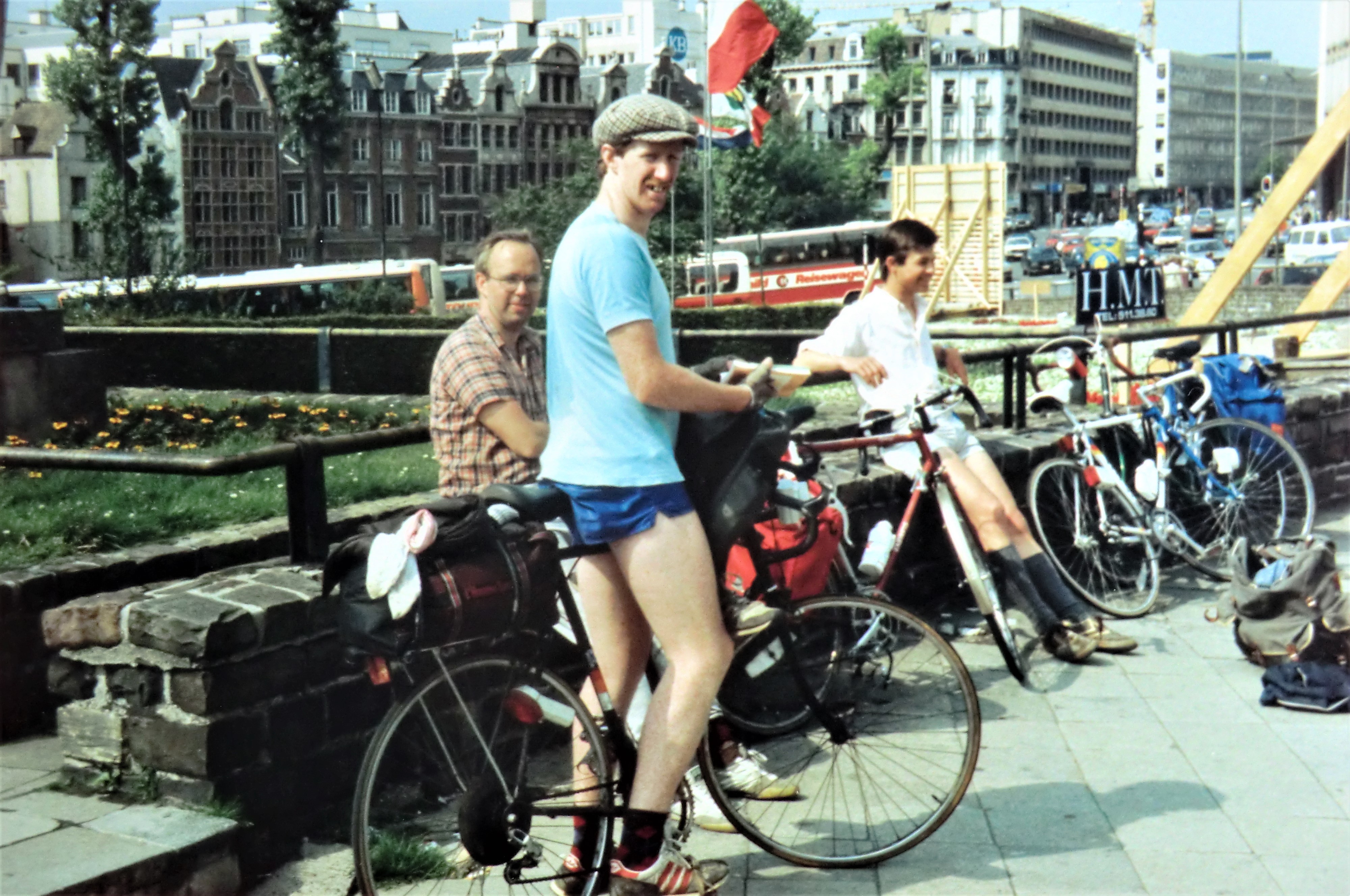
Bruges, Belgium, 1987.


Mine was hand-washing all the evening meal dishes, quite a big task lasting the better part of thirty minutes, whilst Tim and Keith shared in the drying and the packing away. You may wonder: Why did I find the mandatory duty unsettling?

As stated last week, these duties involved mainly cleaning in one way or another - which happens to be my full-time occupation. In principle, I have always believed that a manual task is good for the well-being of one who sits at a desk all day - whether at school, college or work. I have also read what psychologists and psychiatrists say, that pushing a broom, hoovering the carpet, or even emulsifying a room could aid in beating depression or even combatting mental illness. Indeed, for someone who is academically minded, shovelling snow in the winter most likely will do him some good. But for me, as a window cleaner, the idea of going on holiday or taking a break was to be free from such full-time responsibility. However, in the years to come, YHA England & Wales was about to see some changes. 

The average age of the hosteller increased throughout the late eighties and into the nineties. As older people began to replace the school-agers, they tend to have more money in their pockets, and therefore less keen on the mandatory duty "to keep running costs down." The 1985 Totland Bay experience looked to me to have been the charity's last attempt to keep the system compatible with school-age youngsters arriving from urban sprawl and retain the title of Youth Hostel.

All the hostellers at Totland Bay were adults of varying ages. At the same time, the YHA was beginning to feel under threat. That threat was realised when the YHA began closing their hostels and selling off the property that housed them. Winchester was one of them, and up north, Chester also closed. And Totland Bay itself was soon deleted from the map. And several more, one after another. Indeed, unless some house rules were changed, the whole charity would eventually go under.

Patrons no longer considered themselves as youths. They were generally older and more independently-minded. They had money and were willing to pay a little more, enough to scrap the mandatory duty but still pay less than a hired hotel room if they were to sleep in a dormitory. And I was around to see these changes - such changes eventually motivated me to use the hostel rather than a hotel as a base for both cross-country and international travel.

At Ghent, Belgium, 1987.


It was during the nineties and looking through some travel magazines, especially Trailfinders, that I saw that this decline of the YHA was happening on a global scale. It was about that time when an umbrella organisation, Hostelling International, or HI, was formed to administer each nation's particular YHA. Countries included in this scheme were the countries of Western Europe, the USA, Canada, Australia, New Zealand, and the UK with YHA England & Wales, Scottish or SYHA, and YHA Northern Ireland.

In each edition of Trailfinders, YHA New Zealand had the approximate words blazing out of its advert page: WELCOME TO OUR HOSTELS IN NEW ZEALAND: NO DUTIES. This says it all. Youth Hostels Associations around the world were attracting clientele who were older, more independent, and ready to boycott the charity if their hostels still insisted on the chores. Hence, to stay afloat, the clientele was no longer from a school in the city. Rather they were backpackers arriving from as far as halfway around the world. In turn, the Warden became the Receptionist and the hostel itself became the Backpacker's Hostel, but the initial for Youth was retained to keep the YHA logo recognisable. 

In Australia, their YHA-affiliated hostels didn't go all the way as New Zealand, instead, they held the Dollar-or-Duty scheme. To anyone other than one with an ultra-tight budget, everyone else, including me, was willing to pay the extra Australian dollar. At the time, I never bothered to calculate that if I were to spend every night at a hostel for six weeks, the additional expense would have totalled A$42 - enough at the time for a full week's grocery shopping for two or even for a family. A student on a gap year break would have paid an extra A$360 to avoid a daily chore for the whole year. Yet, I never thought that way and neither did the other backpackers, as the majority of Australian hostels in 1997 simply assumed that we weren't interested in carrying out any duties.

 Here, I'm with Gareth, Keith, and Tim, 1987.


In America, their HI AYHA, along with HI Canada, had in 1997 a popular rival across the continent: Rucksackers North America with their Banana Bungalow Hostels, based mostly in California but also found elsewhere across the more touristy areas of the States back then. With such a popular rival, the AYHA had long withdrawn their mandatory duties as they watched their clientele flock to the more casual Banana Bungalow with its no-curfew stance and even parties stretching into the night. In 1997, at one non-affiliated privately-owned hostel at Hervey Bay, Queensland, backpackers who, during the day would hike a trail or gaze at the corals of the Great Barrier Reef, were that night dancing in the hostel bar to loud music with even some of them dancing on the large, sturdy tables. I didn't. Instead, I just sat there and watched, wondering how a YHA hostel in Southern England would have thought!

In contrast to this, there was one American hostel where I had to do a mandatory duty, and that was a HI AYHA-affiliated hostel in Pheonix, Arizona. For the record, this was the only hostel duty I ever carried out outside the UK. And that was on my 43rd birthday, of all days! This task was to wipe down the inside of a shower cubicle. It only took five minutes, yet, it was not much of a birthday present.

International Hostelling gets Underway - with Friends.

The decline of the duty and the rise of adult membership in both the UK hostels and those around the rest of the world was enough for me to eventually swap the privacy of a hotel room for that of a hostel dormitory. And there were swings and roundabouts. The advantage proved a benefit for the budget. Hostelling had opened the door for much longer holidays. The longest continuous time spent backpacking outside the UK was ten weeks from June to August 1997 whilst on a Round-the-World trip. That wouldn't have been possible had I stayed in hotels or even American motels. So, what was the secret? The member's kitchen is found in all hostels whether affiliated with the YHA or not. Buying my own groceries saved me from the expense of restaurants and even coffee bars. Then cooking the food in a communal kitchen was the epicentre for meeting people and forming new friendships.

A bit of playful banter in Belgium with Gareth and Keith.


The downside was the lack of privacy. And this reared its ugly head in several ways. One was during the night whilst sharing the dormitory with a loud snorer. The remedy for this, out of trial and error, was to make temporary earplugs from a double sheet of toilet tissue, two adjoining sheets for each ear to prevent the plug from going too far in the canal, and soaked in water before insertion. Despite the slight discomfort, this made quite a difference and allowed me to sleep soundly despite the loud snore.

The late eighties were quite different from the past travelling experiences. Instead of travelling on my own, I started to team up with four other eager friends. All five of us were single, all of us attended a church regularly, and all of us were keen cyclists, with me with the added credentials of a triathlete. One rider was Paul Hunt, an architectural assistant, and who already had a girlfriend back home, Kelly. Then there was Gareth Phillips, a banker. Next was Keith White, at the time a kitchen porter, and Tim Kingcott the accountant. Finally, I was a self-employed window cleaner who completed the group. As I saw it, this interclass mix on the social level was a wonderful ethic, a demonstration that acceptance and friendship were not based on our status, occupation or level of education.

In 1987, we loaded our bikes onto a train at Liverpool Street Station for Harwich port, from where a ferry sailed us to the Hook of Holland. We then spent a week cycling through Holland, into Belgium, and then into Germany, where we turned around at Cologne (that is, Koln in German). We stayed at hostels throughout the trip and for the first time, at Amsterdam our first overnight stop, none of us was assigned a duty by the warden. We talked about it and at first, we simply assumed that duties were non-existent on the Continent, or simply in Holland. Or was the duty confined only to the UK?

We didn't use the member's kitchen (if there was one there.) Instead, a buffet was accessible and we chose our own food items for breakfast. And this seems to be the norm of all the hostels we visited in all three countries. No duty, no member's kitchen and a buffet service for breakfast. As for other meals and refreshments, we relied on restaurants, adding extra expense to the holiday.

I found Brussels, in many ways, to be a twin sister of London with very similar architecture. I was curious when we arrived at Brussels Central Station, housed in a large building. Thinking that it was the city terminus, Gareth and I went downstairs, underground, only to find that this was a through station.

But Brussels, to my opinion, wasn't the loveliest city we stopped at, even if we spent a night at the hostel in the capital. Rather, I think the prettiest town in Belgium was Bruges, where we spent a night at a hostel there. 

Tim, Gareth and Paul at Ghent.


In Germany, we spent at least two nights at the city's Deutz hostel, a loud, chaotic venue. One morning, after breakfast at the buffet, we returned to our dormitory - only to find that all the cash was missing from my wallet, even though my credit and debit cards were intact. With no traveller's cheques, rather than mess around using my banking cards in a foreign country, all my mates gave me a share of their cash, and until the end of the trip, I was able to live on their generosity. This a reminder of when my traveller's cheques were stolen whilst on the train from Pisa to Florence six years earlier in 1981.
--------------------------------------------------------------------------------------------------------------------
Next Week: More Adventures with Friends.