The Journey to and Arrival at Coffs Harbour.
Byron Bay, my first stop in New South Wales, was remarkably different from the venues I called in Queensland. The latter represented warm sunshine and tropical vegetation along with the corals of the Great Barrier Reef to add to the other-worldly feel of the environment. Although the coastline around Cape Byron was spectacular (in my view), the weather was different - cooler, a lot wetter, and a feel for the Australian winter in June was becoming more of a reality the further south I travelled.
When caught in heavy rain whilst cycling along the coastal road towards Byron Bay, I wore shorts and a button-up shirt, the same garment I wore during the Low Isles snorkelling swim. This was an advantage with hostelling, whether the hostel was YHA-affiliated or not. Nearly every hostel I called had its own launderette. Indeed, although the weather became unsettled, the air remained comfortably mild.
After three or four days at Byron Bay, I boarded a Greyhound Bus for the 233 km or 145-mile journey to Coffs Harbour. This day trip enabled me to arrive at my destination around tea time.
At Byron Bay Bus Station, I had to take special care when choosing when to board Sydney-bound buses. Some buses didn't stop at Coffs Harbour but carried on cruising along the highway, bypassing the town centre. In 1997, Coffs Harbour was not particularly an international tourist venue, and the majority of backpackers ignored its presence while they journeyed to Sydney. And that was a shame. For someone like me who enjoys the natural environment unfamiliar at home, there are some sites of special interest around the town.
The bus halted for a service stop at the small bus station and here I alighted to search for the YHA-affiliated hostel in town, which wasn't far from the bus station. At least I already had a bed pre-booked.
I found the hostel and checked in. The receptionist, a young Englishman who had decided to spend a gap year in Australia, greeted me with friendliness at the reception, and I was assigned a bed. This time, no choice of dollar or duty was offered. I just paid the set price per night with no questions asked. I chose a bed in one of the dormitories.
 |
| The crown of Coffs Harbour - Mangrove Boardwalk. |
 |
| Coffs Harbour town centre shopping precinct. |
The town centre of Coffs Harbour was about two miles or three km or so inland from the coast, but it was built along Coffs Creek, a river winding through mangrove banks to the sea. Near the mouth of the river, Muttonbird Island Nature Reserve sits around 400 metres off the mainland coast. However, a breakwater connecting the island to the mainland, along with a jetty just south of it, encloses a marina which gives the town its name. A natural peninsula which looked to have been quarried, known as Corambirra Point, juts out south of the harbour, from the air, giving the entire harbour area the appearance of an open mouth with wide lips.
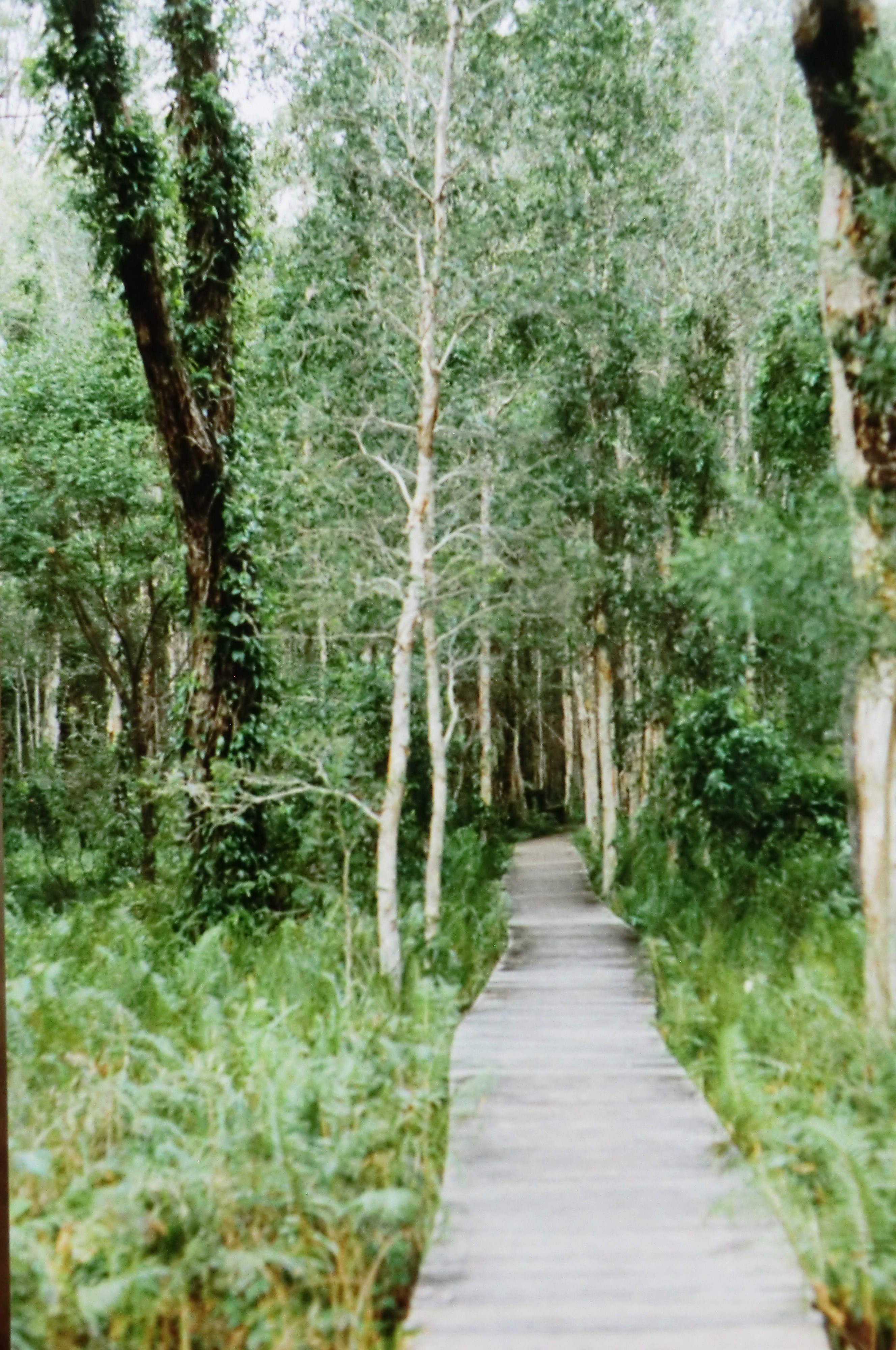
But what has delighted me above everything else was the boardwalk over Black Mangroves. The breathing roots, or pneumatophores, cover the beach with a dense spikey carpet, even more widespread than its counterpart at the River Brisbane. The boardwalk was longer, between five to six hundred metres, and without guide rails. Although I heard this through the grapevine, apparently, the boardwalk was built by convicts. My only regret, if I could call it that, was that during my stay at Coffs Harbour, the neap tides made little difference in submerging the carpet. On the other hand, a full king tide would have submerged the board itself, making it almost impassable.
At The Hostel.
As I have expressed earlier in this Travel Biography, a mountainous landscape consists of both high ground and low valleys. As anyone would agree, a mountainous landscape is far more spectacular than acres of flat fields stretching to the horizon. And so, with Travel, the full experience involves both emotional highs and lows, hence bringing out the full spirit of adventure.
 |
| As I travel further South, I need winter clothing. |
 |
| General view of Coffs Creek |
 |
| Boardwalk detail at high neap tide. |
After buying groceries in town and preparing the evening meal, as was the custom, I was invited by the receptionist for a game of snooker outside in the hostel garden. There were several tables, perhaps three or four in all, arranged under a canopy to protect them from the weather. There were a number of us, but dominating the group was a young aggressive female, chubby, about my height, and with an apparent unhealthy dislike or envy of men.
Not only did she remind me of Josephine of Stella Carmel in Israel when I was a volunteer there three years earlier in 1994,* but she looked a little like her too. At least Josephine knew how to have a laugh at the right occasion. The best this one could do was sneer at our failures. Worst of luck, it turns out that she was a champion snooker player.
And so, I played the first round with another male backpacker, a fellow roughly half my age, and believe it or not, I won that round - but only just. But rather than listen to this female's tirade, I returned to the hostel and sat alone in the TV room. Here, I found a cassette video of Superman the Movie. I set up the system and started watching.
A short while later, the receptionist came for me and since I won the first round, I had to play the second round. This time, I played the receptionist himself. He allowed me the first shot to break up the triangle. No ball was pocketed. So it was his turn. At each and every shot, he pocketed a ball. I just stood there and watched as one ball after another disappeared. With the black ball finally shot, I was free to return to the hostel without scoring a single point and to endure the mockery thrown at me by the chubby Aussie woman for my poor performance.
Sitting alone in the TV room, I resumed watching the video after being set on Pause for the duration of the second round of the snooker. As I watched the movie, a tear rolled down my cheek. I was alone. From outside, I could hear the social chatter surrounding the final round of the snooker competition. Here, my full character is revealed. Big boys don't cry. So says the lyrics of the 10cc song, I'm Not In Love, released in 1975. But according to Eden Kane in 1964, Boys cry when no one can see them. And no one saw me. Instead, I put on a painted smile for the benefit of my fellow hostellers and never gave our chubby friend the type of satisfaction she was craving. She has all the satisfaction she wants, as she wins the snooker competition outright, beating all the men. Much to my relief, the following morning she moved on. Yet, I had time to think of her after she had gone.
I have wondered what man would fall in love with her and take her as his wife? And why her dislike of the male gender? Could it be that she wanted to be born a man herself? Therefore taking on a masculine attitude, especially here in Australia, a country reputed for its tough-skinned, ranch-owning outbackers? I wonder how she really would have thought of me, one who was poor at school games, hardly watched a football match, let alone played, couldn't box out of a paper bag, lousy at snooker, yet loved the natural world with its tropical vegetation, dynamic cliffs, rivers, marine life, and starry sky? Would she see me as a cissy? Quite a point, that! Except whether she would accept the challenge of a cycling contest.
And such natural wonders I set off to see - the mangrove shores of Coffs Creek from a boardwalk. How I would have loved to see the trees partly submerged in high tide. But I considered myself fortunate enough just to be there, walking along a raised wooden pathway as it twists and turns as it flies over the vegetated river bank.
Like in Brisbane, I visited the boardwalk more than once. I recall one early morning at the hostel when a radio was broadcasting the local news and other useful information, including the weather and tidal times. It was announced that high tide would be around eight in the morning. Around 7.00 am, I got up, washed and shaved, had breakfast, and then made my way quickly to the Mangrove boardwalk in time to see the full tide. I expected a flood to reach the level of the boardwalk if not actually submerge it. After all, I would have been keen to remove all footwear and paddle ankle-deep along the boardwalk if it meant taking dynamic photos of this fascinating phenomenon.
But it was a neap tide, with the platform at least half a metre above the surface of the river. It was a bit of a disappointment. Yet, much of the carpeted riverbank was underwater, leaving only the trunk and branches of all the trees above the surface. As I strolled along the boardwalk, I was alone, having the platform to myself. It rounded a clearing as it went out to the river itself. Nearby, the boardwalk widened for a few metres and a safety rail allowed for an overlook, leaning to peer into the water beneath. The platform was also probably used for rod fishing, as this was allowed here.
A school of fish was swimming happily beneath me, undisturbed by my presence. Whether they were expecting to be fed by the human standing above them, I couldn't say, but the peace was suddenly disturbed when a pelican flew in and landed on the water directly above the school. Instantly, the entire school of fish vanished, leaving the bird all alone and hungry on a stretch of water devoid of any life.
When the pelican realised that he wouldn't succeed in feeding its stomach, it took off and flew away. I then watched as the school of fish gradually returned to its favourite spot in the river when they saw that all was clear.
The boardwalk became a normal path as it made its way towards the beach where the river passed under a road bridge, then a rail bridge, before emptying out into the Pacific Ocean. The estuary was a short distance north of the harbour itself, and totally separate. Unlike at European ports, the harbour was not at the mouth of Coffs Creek.
 |
| More Boardwalk details. |
 |
| The Boardwalk takes a turn into the Creek. |
 |
| Pneumatophoras exposed at low tide. |
The Town of Coffs Harbour.
The town is about two miles inland from the coast, hence a 45-minute walk from the harbour or beach. Therefore, throughout my stay at Coffs Harbour, I'm either in town or at the coast (or on the boardwalk.) Hence, going from town to the harbour more than once a day was unlikely.
The main shopping street of Coffs Harbour town centre is Harbour Drive. It's a traffic thoroughfare leading to the harbour, flanked by a wide walkway on each side of the road. The shopping precinct had a strong resemblance to the Broadway in my home town of Bracknell. At that, I affectionately refer to this Australian town centre as "Bracknell-with-palm-trees". Before our town centre in the UK was demolished and a new centre was built in its place, the Broadway featured two-storey buildings on each side, each with shops facing into the street. Coffs Harbour's development took the same form of architecture, except that Harbour Drive is open to motorised traffic. Bracknell's Broadway was, and is, fully pedestrianised. The hostel I was staying in was just a block away from the precinct, at Albany Street.
Thus, I set a day aside to check out the town. But without any historical venue of special interest, at least to my knowledge, it was basically a New Town, hence this could have been the reason why the majority of international backpackers skip Coffs Harbour. Yet, it still attracts the indigenous, like our Aussie lady friend who succeeded in rolling a teardrop down my cheek. Like her, I too like to hostel around the UK, and I have done so. She was no different.
---------------------------------------------------------------------------------------------------------------
*For details of my reaction with Josephine in Israel, 1994, it's on Week 54. Click here.
Next Week: The Big Banana, Whale Migration, preparing for Sydney.


