Earlier in the week, the AA (Automobile Association) released a eleven-minute video of a young couple, he as an aspiring musician and with big promises for his future, and her occupation unspecified, although she had a wealthy background. On one occasion he came across a pregnancy test strip in her handbag and took a look at it while her back was turned. The expression on his face told us immediately that the strip showed a positive result. The prospected of fatherhood had certainly lifted his mood to even higher levels. The smartly dressed couple presented themselves at certain high places, including a wedding. Then, on another occasion, the pair were out on a drive through a narrow country road.
He was exuberant and confident of his superb driving skills. So whilst driving, he took out his mobile phone and started texting. After all, his skills behind the wheel were so finely tuned, he knew that nothing bad could happen to them. He started his sentence with something like:
I'm so happy to have such a wonderful partn...
He failed to see that his vehicle has swerved on to the adjoining lane. A car was fast approaching in the opposite direction. The other driver had no time to stop or swerve. As our driver continued texting, there was an almighty head-on collision. The music-loving driver survived, as did the oncoming driver. His partner however, remained unconscious in her front passenger seat. After climbing out of the wreckage and ensuring that both the other driver and himself were reasonably okay, he turned his attention to his girlfriend, still sitting unconscious in her seat. As the other driver dialled for the ambulance, he managed to free her from the wreck, and carefully laid her on the ground. He kept on calling her name and pleading to wake up as her life slowly ebbed away. When the ambulance arrived and the paramedic confirmed that she was gone, he cried aloud and calling out her name whilst cradling her head in his hands, with his broken mobile phone lying on the ground next to him, still displaying his unfinished text. His life forever changed, including his promise of parenthood suddenly snatched away. All because of a grossly inflated confidence of his driving skill, along with persistent optimism that "It will never happen to me."

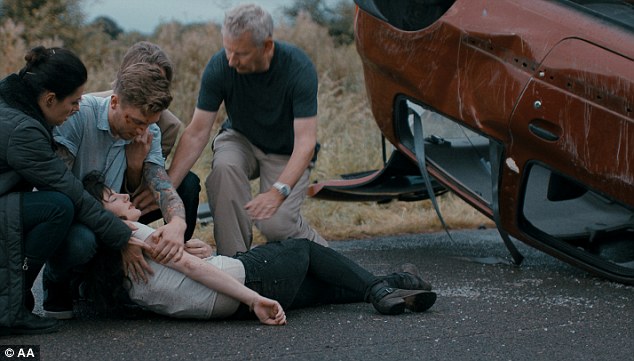 |
| Above and below: Stills from the Video. |
Although the cast in the film were all brilliant in their acting, I still felt deeply moved over the whole incident, especially if she was my wife who was laying unconscious on the road, then slowly passing away as I watched. This video has hit me hard when considering that in real life, Alex was actually unconscious for a couple of hours one Sunday evening, and like in the video, she too was attended by paramedics as well as a GP who all arrived in an ambulance, as fully documented in my previous blog When The Unexpected Happens...and like with the film, I too was filled with dread of the possibility of her passing away.
The video appeared in the Daily Mail Online page. The forum which trails the article was full of comments about answering a call as being the instinctive reaction when the mobile rings whilst at the wheel. At first I thought that his decision to text at that moment was totally without any prompt, except a feeling of exuberance of his future career in music and parenthood, along with his confidence while he was in charge of a vehicle. But a closer watching of the film on the second view shows that he was distracted by an alert from the phone. But then, when as a passenger, she should have dealt with the alert, instead, she allowed him to take the call, with full confidence in his skills. She was one of the 6% of all passengers who does nothing when the driver answers a call on his mobile. That is a total of 2,000,000 passengers of the UK population. But according to an AA poll result, of the 23,141 drivers polled, 59% would ask the driver to stop, and a further 30% would offer to take the call on their behalf. Of drivers who insist in answering the phone, eight out of ten of passengers had said that they would snatch the phone away, while a further one in twelve would refuse to get into the driver's car ever again.
In the days when I earned a living cleaning windows, seeing drivers on their mobiles while they were on the move was very common. Actually I could say that I have even seen up to two vehicles, one behind the other, drive past whilst the driver was on his mobile - that is fully hand-held. Young career women in particular were just as bad as the men, and I have watched them drive rather large vehicles such as the Volkswagen Caravelle, the Toyota Pro-ace Verso, or the Peugeot Traveller, sometimes even with children inside, using a mobile while they were at the wheel.
I guess there are times when it's good to have some optimism and confidence. Like how the surgeon must have felt when last year he carried out open-heart surgery on me to replace a faulty aorta valve with a new one. If I had doubted his abilities, I would have ran to the exit of the hospital - and still kept on running! But considering so many inventions, such as the TV, the telephone, the radio, recorded music, not to mention horseless chariots themselves, and a vast host of other commodities which has made our lives far more comfortable - all must have been invented with a certain level of optimism. But all these projects, I think, were achieved with a level of cautious optimism, that is with the awareness that the project in mind could well have failed.
Cautious optimism should have been shown on both sides of the June Referendum. The Brexiteers said with full confidence that Leaving the European Union would make Britain great again with a booming economy and a remarkable reduction of immigrants, and up to now this confident optimism is daily splashed across the front pages of our newspapers. The proverbial "I told you so" uttered with pride and smug satisfaction. And that's the way it looks at present with the news just in, that the car makers Jaguar has plans to open a new plant here in the UK, with the creation of 10,000 jobs. Yea, victory for Brexit! Lest it be forgotten, we are still at the moment within the Union, and according to the Media, Article 50 won't get under way until March 2017, and even then it could take two years or more for the "divorce" to be completed. And this is where I feel that cautious optimism would be far more sensible, allowing room for any potential downturn of events after leaving the Union.
On the other side, "Britain Stronger in Europe" Remain supporters, especially within Parliament, were equally optimistic with confidence. This was well demonstrated by our former Prime Minister, David Cameron, feeling smug with optimism during the early half of that night when the votes were counted, with the Vote Remain looking to be in the lead. It was only later, when the numbers for Vote Leave, particularly from the Northern working-class area of Scunthorpe, brought a shocking defeat to the over-confident Government which ushered in the Prime Minister's resignation - a crashing down, not without parallel to the auto-crash which featured in the video.
It does look to me that cautious optimism is okay for achieving many things, whether its governing a country, inventing a product, running a business, performing a surgical operation, climbing a mountain, running in a race, and especially within the Arts. After all, for example, there are many entries for a photography competition, there will always be only one winner, and the same is true in the sporting world. Cautious optimism seem to be the best line of thinking to hold on to - except using a mobile phone whilst driving, or for that matter, driving under the influence of alcohol or drugs.
There is only one area where a more confident optimism is allowed for, and that is with a revelation from heaven. Biblical prophecy is a good example of this. If Isaiah wrote that, way in the future from his point in time, God's servant will be, "Oppressed and afflicted, yet did not open his mouth; he was led like a lamb to the slaughter, and as a sheep before her shearers is silent, so he did not open his mouth." (53:7) - then Isaiah, who wrote this prophecy, can be confident that this will certainly happen in its proper time. Likewise, when Jeremiah and Ezekiel both wrote that the nation of Israel will be gathered to its own land and experience a universal conversion to Jesus Christ as their Messiah, and then Jesus himself will return to Jerusalem to reign as King on his father David's throne - still future from our point in time - then we can be confidentially optimistic that this series of events will take place. The only thing we don't know is when - only God himself knows (Jeremiah, chapter 33; Ezekiel, chapters 36-37).
Then the Lord Jesus Christ had every reason to be confidentially optimistic. From eternity past, he knew that one day he would be born of a virgin woman for the specific purpose to die a criminal's death, and three days later rise bodily from the dead - the very first person in the whole of human history to do so! So at exactly the right time he made the journey to the Cross, completely refusing to be swayed from his mission - despite that at least on one occasion, Peter tried to dissuade him (Matthew 16:21-24). Jesus was confident and optimistic that after his Resurrection, he will be richly rewarded by the giving to him of countless saved souls by the Father (John 6:37; 17:1-6), as the Bride of Christ, before returning to his Kingdom here on Earth crowned with glory and splendour.
After his Ascension, the Apostles, along with all believers, were confidently optimistic that salvation is in no other than through the risen Jesus of Nazareth. And because of the very omniscient nature and character of the Eternal God who never changes, we can be confidentially optimistic about our Once Saved Always Saved imputation of Christ's righteousness into our accounts. We as a church can have optimistic confidence that through the promises of God, we will be the Bride of Christ, as we are his body already. That's why I always like to say, that after his Resurrection, Jesus had two bodies: he took one to heaven, leaving the other behind - for now.
We can have full optimistic confidence in the promises of God, even if at this point in time there is little to see of it. But God is gracious, very gracious. If faith - the hope in things still unseen (Hebrews 11:1) is weak or failing under doubt or confusion, then a trip to the Holy Land, for me anyway, was a tremendous faith booster, especially walking through the Old City of Jerusalem, watching the Jews gather at the Western Wall at the start of every Sabbath, and visiting other ancient and Biblical sites across Israel and Palestine.

So I would say: Be totally confident and fully optimistic about God's promises; let's be cautiously optimistic in daily business affairs, allowing room for error or failure, and don't be optimistic at all about something as incredibly stupid as using a mobile phone whilst driving.
In the days when I earned a living cleaning windows, seeing drivers on their mobiles while they were on the move was very common. Actually I could say that I have even seen up to two vehicles, one behind the other, drive past whilst the driver was on his mobile - that is fully hand-held. Young career women in particular were just as bad as the men, and I have watched them drive rather large vehicles such as the Volkswagen Caravelle, the Toyota Pro-ace Verso, or the Peugeot Traveller, sometimes even with children inside, using a mobile while they were at the wheel.
 |
| Peugeot Traveller |
I guess there are times when it's good to have some optimism and confidence. Like how the surgeon must have felt when last year he carried out open-heart surgery on me to replace a faulty aorta valve with a new one. If I had doubted his abilities, I would have ran to the exit of the hospital - and still kept on running! But considering so many inventions, such as the TV, the telephone, the radio, recorded music, not to mention horseless chariots themselves, and a vast host of other commodities which has made our lives far more comfortable - all must have been invented with a certain level of optimism. But all these projects, I think, were achieved with a level of cautious optimism, that is with the awareness that the project in mind could well have failed.
Cautious optimism should have been shown on both sides of the June Referendum. The Brexiteers said with full confidence that Leaving the European Union would make Britain great again with a booming economy and a remarkable reduction of immigrants, and up to now this confident optimism is daily splashed across the front pages of our newspapers. The proverbial "I told you so" uttered with pride and smug satisfaction. And that's the way it looks at present with the news just in, that the car makers Jaguar has plans to open a new plant here in the UK, with the creation of 10,000 jobs. Yea, victory for Brexit! Lest it be forgotten, we are still at the moment within the Union, and according to the Media, Article 50 won't get under way until March 2017, and even then it could take two years or more for the "divorce" to be completed. And this is where I feel that cautious optimism would be far more sensible, allowing room for any potential downturn of events after leaving the Union.
On the other side, "Britain Stronger in Europe" Remain supporters, especially within Parliament, were equally optimistic with confidence. This was well demonstrated by our former Prime Minister, David Cameron, feeling smug with optimism during the early half of that night when the votes were counted, with the Vote Remain looking to be in the lead. It was only later, when the numbers for Vote Leave, particularly from the Northern working-class area of Scunthorpe, brought a shocking defeat to the over-confident Government which ushered in the Prime Minister's resignation - a crashing down, not without parallel to the auto-crash which featured in the video.
It does look to me that cautious optimism is okay for achieving many things, whether its governing a country, inventing a product, running a business, performing a surgical operation, climbing a mountain, running in a race, and especially within the Arts. After all, for example, there are many entries for a photography competition, there will always be only one winner, and the same is true in the sporting world. Cautious optimism seem to be the best line of thinking to hold on to - except using a mobile phone whilst driving, or for that matter, driving under the influence of alcohol or drugs.
There is only one area where a more confident optimism is allowed for, and that is with a revelation from heaven. Biblical prophecy is a good example of this. If Isaiah wrote that, way in the future from his point in time, God's servant will be, "Oppressed and afflicted, yet did not open his mouth; he was led like a lamb to the slaughter, and as a sheep before her shearers is silent, so he did not open his mouth." (53:7) - then Isaiah, who wrote this prophecy, can be confident that this will certainly happen in its proper time. Likewise, when Jeremiah and Ezekiel both wrote that the nation of Israel will be gathered to its own land and experience a universal conversion to Jesus Christ as their Messiah, and then Jesus himself will return to Jerusalem to reign as King on his father David's throne - still future from our point in time - then we can be confidentially optimistic that this series of events will take place. The only thing we don't know is when - only God himself knows (Jeremiah, chapter 33; Ezekiel, chapters 36-37).
Then the Lord Jesus Christ had every reason to be confidentially optimistic. From eternity past, he knew that one day he would be born of a virgin woman for the specific purpose to die a criminal's death, and three days later rise bodily from the dead - the very first person in the whole of human history to do so! So at exactly the right time he made the journey to the Cross, completely refusing to be swayed from his mission - despite that at least on one occasion, Peter tried to dissuade him (Matthew 16:21-24). Jesus was confident and optimistic that after his Resurrection, he will be richly rewarded by the giving to him of countless saved souls by the Father (John 6:37; 17:1-6), as the Bride of Christ, before returning to his Kingdom here on Earth crowned with glory and splendour.
After his Ascension, the Apostles, along with all believers, were confidently optimistic that salvation is in no other than through the risen Jesus of Nazareth. And because of the very omniscient nature and character of the Eternal God who never changes, we can be confidentially optimistic about our Once Saved Always Saved imputation of Christ's righteousness into our accounts. We as a church can have optimistic confidence that through the promises of God, we will be the Bride of Christ, as we are his body already. That's why I always like to say, that after his Resurrection, Jesus had two bodies: he took one to heaven, leaving the other behind - for now.
We can have full optimistic confidence in the promises of God, even if at this point in time there is little to see of it. But God is gracious, very gracious. If faith - the hope in things still unseen (Hebrews 11:1) is weak or failing under doubt or confusion, then a trip to the Holy Land, for me anyway, was a tremendous faith booster, especially walking through the Old City of Jerusalem, watching the Jews gather at the Western Wall at the start of every Sabbath, and visiting other ancient and Biblical sites across Israel and Palestine.

So I would say: Be totally confident and fully optimistic about God's promises; let's be cautiously optimistic in daily business affairs, allowing room for error or failure, and don't be optimistic at all about something as incredibly stupid as using a mobile phone whilst driving.


