Total Pageviews

Showing posts with label Holy Communion. Show all posts

Saturday, 20 August 2022

Travel Biography - Week 11.

Flight to Toronto 1977.

At the Gatwick Airport departure lounge, my flight came up on the screen on time with the words, "Boarding. Gate xx." I made my way through the corridors until I found the appropriate gate. It wasn't long before I settled into my window seat on the starboard side of the aeroplane. Shortly after taking off, I saw that the scenery was so dramatic under clear skies, I paused a passing stewardess to ask the pilot exactly where we were flying over, as the view below looked so spectacular.

In Toronto. On a ferry to Toronto Island.


The voice of one of the crew members crackled into life with the announcement that we were flying over the Scottish Highlands, just as I've unpacked the camera that was given to me by Dad, who had it for many years. It mainly was a metal contraption covered with a dappled light grey plastic jacket. It accepted a paper-backed size 120 film. Onto it, twelve square negatives were snapped, each one was 56mm by 56mm. It was this camera that accompanied me to Italy in both years 1973 and 1975, along with Israel in 1976. Now, I was using it on this American trip Part1.

But as I released the shutter to permanently record the dramatic scenery below, the mechanism made a strange noise. Looking through the lens, I saw a mechanical failure. The camera, loaded with an unused film, could no longer be used, even when I tried to release the shutter several times. My heart fell. Next to the passport, the tickets and the book of traveller's cheques, the camera was the most important item for a backpacker, even more so than all the contents in the suitcase or rucksack stashed away in the hold.

Suddenly, I felt vulnerable. I was flying to a faraway land, a different continent to Europe, and unlike the Middle East which is connected to Europe by land bridges and international borders, this one I was heading for was across a wide expanse of ocean.

When the stewardess arrived wheeling a trolley loaded with in-flight meals, I had an idea as she handed a tray to me. It contained a small bowl of soup, the main course tray, a dessert bowl, a small glass of red wine and a bread roll. An excellent serving, in my opinion, for one who flying on such a cheap economy ticket.

After the meal, would I dare to consecrate the bread and the wine into the Body and Blood of Christ? As I was doing this, I felt apprehensive, fearful even. I was aware that the Catholic Church (in which I grew up) took this sacrament so seriously that only the priest had the authority to perform the consecration. But what did God think? Would an engine explode, sending the plane into the ocean? Would I just die before touchdown at Toronto? Would something terrible happen sometime after arrival? After all, I was performing a sacrament without authority and as such, incurring the wrath of the Church. This was my worldview in 1977.

However, after praying over the two substances, I performed the sacrament, only to realise that I have done the right thing and everything would turn out fine.

As the plane approached the runway, a conversation I thought was odd occurred between two middle-aged females sitting across the aisle, and me. Just before the touchdown, one of them asked why the plane was going so fast just before landing, whilst going much slower in full flight.

When I saw that both looked baffled, I explained that at this moment, the plane was moving around 200 mph (whether that was true or not) - whilst in full flight, it was doing up to 600 mph. When I saw her puzzled look, I tried to explain the parallax phenomenon.

Imagine you are walking along the street. I said, Along the sidewalk, there is a fence or a safety barrier. Across the road, there are some bushes. Now, as you walk, the fence seems to overtake the bushes, as if moving faster. But actually, neither is moving. You are moving. That's why in full flight, it appears as if we're moving more slowly than at touchdown when we're much closer to the ground.

The two were wide-eyed with astonishment!

One of them exclaimed, My word! You must be a doctor or professor!

A good ego-booster, no doubt. For someone who left school on just a wing and a prayer, one can learn a lot just by observation.

Completed 1977 route across N. America.


Arriving in Toronto.

A bus from the airport dropped me off at the city centre. The first facility to look for was a hotel. Walking along Queen Street, I came across one that didn't look too expensive. After all, it was a place to sleep, and I didn't need the opulence of Buckingham Palace. I entered and asked if there was a room. I was offered one, and taking the key offered to me, as before, made my way upstairs, and once settled in, I found it difficult to remain awake. Although it was evening in Eastern Canada, I was five hours behind British Summer Time, and my body clock still believed it was time for lights out.

However, having settled in, one of the first things to get off my mind was to buy a new camera, and a cheap one at that, as my budget didn't allow for a proper camera replacement. I found a photography shop and I managed to find a convenient tideover, a Kodak 110 Instamatic. This produced negatives only 13mm by 17mm in size, hence once the photos were enlarged, the outlines appeared as if slightly out of focus, giving a soft outline to all details. However, unlike the 120, the size 110 film came in a cartridge or cassette, it was very easy to load, and there was no need to rewind at completion.

However, although the camera was convenient, it was also cheap, an unexpected need to buy, and used for this trip as a tideover. But owning such a device, in a way had brought repercussion - if you want to call it that, with photos of the 1978 hike into the Grand Canyon turning out disastrous. For example, Riverside photos were taken at daybreak. According to my eyes, the features bathing in the semi-dark were stunning! But all the camera saw were blackened silhouettes against a pale blue sky, hence spoiling what were otherwise lifelong memories. Hence, the need to re-hike the Canyon in 1995, using a better camera.

The City's most impressive Square.

That evening, I walked along the main thoroughfare just to stay awake. Even after dark, the street was alive, bustling with people, very much like the West End of London on a Saturday evening (after all, this was a Saturday.) Shops were open, and the whole environment was welcoming, the weekend spirit not any less felt than in London.

The following morning, the street was quiet. As with Canadian and American hotels in general, they don't serve colazione, therefore, I had to find somewhere else for a coffee and bread. And so it was like this throughout all my two American trips of the 1970s - a reliance on cafeterias and coffee bars. However, I tended to avoid restaurants, simply to avoid overspending. One of the lessons learned with backpacking, and that there is a need to count the pennies (or cents in this case.) Rather than see this as soul-destroying, as tempting as that was to me, rather, I saw this as a vital lesson in economic long-haul travel as an independent.

City Hall, Toronto. Stock photo.


Even better and more economical than relying on cafeterias is hostelling, but I wasn't introduced to this until 1985, and that was when I travelled with Tim and Keith to the Isle of Wight. Thereafter, rather than relying on the cafeteria, it was the supermarket where I bought raw food to be cooked in the hostel's membership kitchen. But that is later.

Along Queen Street from the hotel is Nathan Phillips Square, perhaps the main attraction of the city. It features two curved skyscrapers, one taller than the other and facing each other as if (in my view) they're about to embrace. This is the New City Hall, actually just a pair of office blocks, but it's their unique architecture that has made these twin buildings unique and appears on the front cover of Canadian holiday brochures across the UK. A low, circular structure nestles between the two skyscrapers, and I wonder whether that is the hall itself, while the two curved structures are administrative towers. In front of the square, three arches dominate a fountain fronting the square with Queen Street, adding further aesthetics to the environment.

I also walk South towards Lake Ontario, perhaps along University Avenue. Nearby stands the Canadian National (CN) Tower, a structure over 533 metres high, with an indoor observation deck 346 metres high - 102 metres higher than the observation deck of the Shard, London, which is 244 metres high. During my three-day stay in Toronto, I took the elevator to the lookout at the CN Tower and spent some time there, absorbing the spectacular panorama of the city still dominated by the twin office blocks of the City Hall.

I eventually arrive at the harbour, where a boat ferried me to the Toronto Islands, enclosing a lagoon separating the islands from the mainland. It featured a permanent amusement park, including a water log flume and a sky chair. Okay, at the log flume, I got wet, but what the heck? I was on holiday, and if getting unexpectedly wet whilst enjoying myself, to me, it's all part of the fun. By contrast, the slow-moving, relaxing and noiseless sky chair in full flight offered lovely views of the park as well as the lake and the city skyline.

Under one of the arches, City Hall.


I quite liked Toronto, and to my opinion, this Canadian city in Ontario might have been considered better and more handsome than Downtown Los Angeles, if it wasn't for the balmier Californian climate, Hollywood Studios, Disneyland, its coastal features such as Long Beach, Santa Monaco, and its abundance of palm trees. However, Toronto is on the northern coast of the rather ribbon-like Lake Ontario, with its southern coastline within New York State. The lake is around 76 metres above sea level, and it's fed via Niagara Falls from Lake Eire, which is 174 metres above sea level.

Log Flume, Toronto Island.


And my third and last full day in Ontario was spent at the Niagara Falls resort. The main reason for my visit to Toronto was originally meant as a consolation for my inability to visit California before I managed to receive a US entry visa. Instead, my visit to the Falls turned out to be one of the greatest experiences I ever had, and I have no regrets.

-----------------------------------------------------------------------------------------------------
Next Week: A day at Niagara Falls is followed by my entry into the USA - to coincide with the premature death of a world-famous pop icon.

Saturday, 21 July 2018

Wow! A Fossilised Pocket Watch.

As the plane soared above the stunning Scottish mountains, I sat there by the window with a sense of astonishment of the view as the airline soared some 35,000 feet 10,670 metres into the clear sky, with the sunshine contrasting the land with the almost black sea and lochs. But with the stunning beauty way below, I also felt a sense of apprehension on what would lie ahead, for this particular 1977 journey from London to Toronto was my first long-haul flight I had ever taken. 

Not that I hadn't flown before. The last trip I took was only a year earlier in 1976, a flight to Tel Aviv. But was that particular flight the longest short-haul flight classified, or the shortest long-haul? After all, a flight from London to Amman, only a small fraction longer, was - and I guess still is - categorised as long-haul. The two preceding flights out of London, one to the Spanish airport of Girona in 1972, and the other to Milan in 1974, were indeed short-haul. Even though I was already nineteen years of age when I first ever boarded a plane, due to my late father's averse to flying combined with his love for the steering wheel, I had never flown with any of my family members.

Therefore sitting alone inside a sealed capsule among complete strangers, I felt a need for divine assurance. And so, during the in-flight meal, I took the bread roll, broke it, and quietly proclaimed,
This is the body of Christ broken for me. And I ate whilst meditating. Then I took the glass of red wine and said,
This is the blood of Jesus Christ that was shed for me. I'll shall drink it in memory of Him, which I proceeded to do.

I did ponder whether I had bestowed a blessing on myself, or whether I had committed a deadly sin, for according to the Catholic Church, I have violated a sacred sacrament by taking it without priestly authority.

And if all that was not enough, a year later in 1978, once again I found myself on board a transatlantic flight, this time from London to New York. And during a mid-flight meal I repeated the sacrament of eating a piece of bread and drinking red wine symbolising the body and blood of Jesus Christ broken and shed whilst hanging on that cross.

Dripping with sweat, inside head of Statue of Liberty, 1978.

I'm glad to say that no harm had ever came to me as a result of these mid-flight self-administered Holy Communion meals, despite what the Church of Rome might think. So far I didn't die and then finding myself tumbling into the eternal fires of Hell. Rather, on both these backpacking trips I felt as if I was blessed. Being close to God, feeling his protective presence where ever I went, never coming across any difficulty in finding a room at every hotel reception I called at.

However, as I sat in the aeroplane full of strangers, there was another important reason on why I self-administered a Communion meal other than for seeking assurance. As a son of Adam and Eve, I was unfortunate enough to inherit original sin from them, which has caused spiritual death and separation from God, with physical death to follow, and a lost eternity spent separated from God's personal presence. But because of the death, burial and resurrection of Jesus Christ, through faith in him I was acquitted from the penalty with all my sins forgiven - past, present and future - and the Righteousness of Christ was credited to my account, and I was adopted into his family as a son of God.

The righteousness credited to my account was Christ's righteousness, not my own! As the Scripture says, 
Now when a man works, his wages are not credited to him as a gift, but as an obligation. However, to the man who does not work but trusts God who justifies the wicked, his faith is credited as righteousness.
Romans 4:4-5.

Therefore the truth of Eternal Security of the Believer, or Once Saved Always Saved, must stand with this truth of justification by faith because such emanates from this truth of the Gospel. Therefore the eating of the Body of Christ and the drinking of his Blood by means of bread and wine attest of eternal salvation gotten through Jesus Christ - a glorious truth in the face of the uncertainty facing me after landing.

But to take Holy Communion mid-flight with such conviction on both trips - surely such a sacrament must be based on factual history. Did Jesus Christ really exist some two millennia previously? Did the Last Supper, on which my in-flight Communion was based upon, itself actually took place? Furthermore, was it him who was crucified and died while still fastened to the cross? After all, Islam insists that it was Judas Iscariot who hung there. And after burial, did he actually rise from the dead? According to one national newspaper, it was thought that Jesus Christ did not actually die, but instead fell unconscious, and was buried in that state, as if he was suffering from catalepsy. Then after waking up, somehow with unimaginable strength, he managed to move the stone covering the mouth of the tomb, and then walked away, probably to a remote desert, never to be seen again.


If any of these things occurred, all which differed to what is recorded in the four Gospels, then really, our faith is in vain, remaining futile, there is no salvation, and all that time spent in church - even if I enjoy singing, praising, praying to God, and listening to sermons, as well as trying hard to love one another despite our different opinions - it would have turned out to be a total waste of time and effort. If I attend church for up to two hours every Sunday for fifty weeks of the year, that would be as much as an annual top up of a hundred hours, or four full 24-hour days where I would be better off spending at a luxury hotel by the seaside. Furthermore, those sacraments taken whilst mid-flight would serve no other purpose but to make a fool of myself in view of anyone watching.

All these things came to mind while we were watching a television documentary about the Jurassic Coast, presented by Dan Snow, Lucy Cooke, and wheelchair-bound Niall Strawson. This three-part series occupied an hour-long slot on BBC Four, therefore down from peak evening viewing of BBC One. As we were watching the third programme, I felt my spirit sink into sadness and hopelessness as the words evolve, evolution, and evolutionary were constantly repeated. Throughout the entire three hours of broadcast, not one word about God, Supernatural Creation or Noah's Flood was mentioned. However, it was Lucy Cooke who, with a moment of hesitation, used the word designed in her description of a fossil with intricate detail.

Perhaps the Lord, with a sense of humour, does allow the presenter to let her guard slip on occasions. And no doubt, as I see it, the Jurassic Coast is a testimony of the Biblical Deluge, which stretches from Old Harry Rocks which are the chalk stacks east of Swanage, all the way west to Exmouth, on the River Exe estuary. The resort of Lyme Regis, where many fossils are displayed and sold, lies on the Dorset side of the border with Devon, itself midway along the Jurassic Coast.

And so the public is fed to the hilt with how these fossils of mainly marine creatures, are out-and-out proof of organic evolution - despite that these lifeforms look to all have died together at one instance. And how my spirit sank in very much the same way those creatures sank to the bottom of the ocean. Because, like the newspaper testimony above, if evolution is a scientific fact, then my faith in Christ is a sham and the Christian faith is a worthless ideology. For Darwinism is a direct denial that Jesus is the Christ who atoned for our sins.

While Dan Snow dealt mainly with human history around that stretch of coast, particularly of wartime tanks and submarines, Lucy Cooke narrated on the fossils so frequently found here. A fossil expert who was with Cooke picked up what looked like a large rounded limestone pebble. He then struck it with a hammer, and the two halves came apart to reveal a beautifully-detailed fossil ammonite. When asked how he knew that this ordinary-looking pebble contained such a intricate fossil, his answer was that by looking at the surface, some detail of the edge can be seen. I guess this can be referred to as a ham-roll effect. Only the edge of the ham at the outer surface can reveal its presence between the two bread roll halves.

The ammonite remains represent the ideal fossil of a creature which lived in the Jurassic Period somewhere between 145,000,000-200,000,000 years ago. That's pretty old, and such remains found embedded in limestone are classed as a true fossil, a thought-view which carries the notion that it takes millions of years for a dead organism to fossilize. And this theory of tremendous longevity is essential for Darwin's evolutionary theories to hold true. And such theories are spoon-fed to the public which in turn accept without any ado. And furthermore, no one in his right mind would dare throw a challenge. If the challenger is a man in the street, he would simply be ignored. If a graduate or a university professor and civil engineering, such as the late Henry M. Morris, then its likely that he will be ostracised by the scientific community, who will write papers debunking his Creationist stance. 

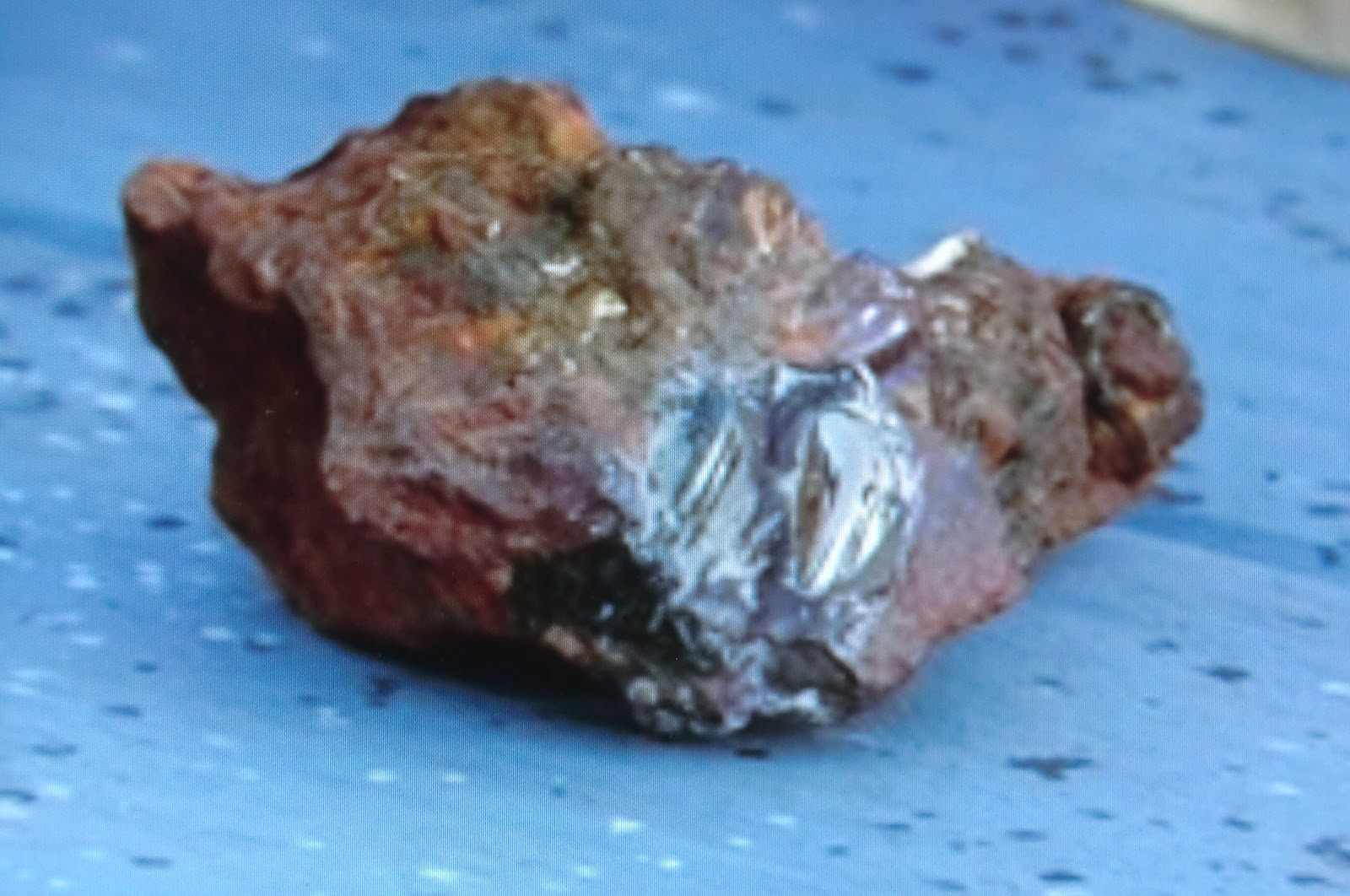
It was within the first fifteen minutes of the second show when something I consider to be very remarkable. Here stood Lucy Cooke talking to an expert about some sealed bottled perfumes, together with a couple of china vessels and statuettes, all of them around a hundred years old, found at a shipwreck off the coast of Dorset. And next to the porcelain was an insignificant-looking lump of rock. And fully embedded in the rock was what looked like a man-made artifact. After thorough cleaning and examination, the artifact turned out to be a pocket watch, almost entirely entombed in solid rock in virtually the same way the ammonite was entombed in a limestone pebble.

The rock featured on the BBC: A watch "fossilized".


A pocket watch embedded in "crud" - solidified mud.

Interestingly enough, Cooke remarks that it will take a further 130,000,000 years before the watch will be a "proper" fossil. But going by the hardness of the rock, isn't it a fossil already? What is the real difference between it and that of the ammonite? Except for its age and of different rock composition? The rock in which the watch is embedded is given a name "crud", which is mud consolidated into rock. What I find so fantastically remarkable about this exhibit is that if a man-made artifact of little more than a hundred years of age can be entombed in solid rock at an amazingly quick time, then why does the ammonite need millions of years to achieve the same result?

It is as if God is desperately trying to tell us something, and just by looking at all the fossils found around the coast and elsewhere, one obvious conclusion can be drawn, and that is all fossilised organisms - whether its marine life, plant and trees, birds, or land animals including Dinosaurs, must have died very quickly, were buried and preserved as fossils over a very short duration. At is as if God is saying, Hey, look guys. What I have written in my Book is historic and true. There was a universal Deluge in the days of Noah, and you are looking at the evidence right now. Oh, so you want more proof that fossilization is quick and recent? Well there you are, a watch preserved in stone. There you have it.

As I stand, this revelation is vital for the Christian faith. Mythologize any part of the Bible, especially the early chapters of Genesis, and the Christian faith will go down like a house of cards. But even the reality of Noah's Flood isn't by means all and end all. Rather it's the historical truth of Adam and Eve. For the reality of Jesus Christ can only stand if Adam and Eve were real too, along with Divine Creation and the Fall, as well as the Deluge, the cause of the formation of fossils. Because through their transgression sin entered the world and death to all men. This concept, which is within the very heart of the Christian faith, can only stand if there was an Adam and Eve, and they were created direct from the ground as the Bible teaches, and were not descended from a human line gradually going back to the primates, as all of these must have died already, before the Fall, therefore nullifying the purpose of Jesus Christ and the Atonement he made on the Cross. 

Saturday, 26 March 2016

Contradictions...Contradictions...

Good Friday came and went, that's it for another year. At the time of writing, Easter Sunday is yet to come. Our worship celebration at our church was excellent. Contrary to wider culture, our worship of Jesus Crucified was not shrouded with glum faces and mournful dirge, weeping over the unjustifiable demise of an innocent, righteous man. Rather, it was a celebration of what the Lord accomplished while he hung there - an atonement made for the sins of the whole world, and a victory over the Adversary who held the whole of Adam's descendants captive. Little wonder, that on his very last breath, he shouted out, It is finished! Not the kind of reaction made by anyone else with his dying breath. But Jesus did it because his was a cry of victory, and not of defeat.

Mosaic at the Church of the Holy Sepulchre, Jerusalem.
No other human endeavour in history has ever eclipsed this event. Yes, for an example, we may think that putting a couple of men on the moon in 1969 was a great achievement in the quest to conquer the Final Frontier. It might well have been a "giant leap for mankind" - which reminds me in a way of the post-deluge descendants of Noah attempting to "Reach to the heavens" by constructing a giant ziggurat in the plains of Shinar, later to be the site of the ancient city of Babylon. This was an attempt to reach the stars by their own pride-driven efforts. Their efforts with the ziggurat took them no closer to the stars in a literal sense than if their self efforts would have brought to God! But no matter how great mankind's achievements might have been, the intervention of God himself into human affairs at such a manner will always remain unique, unattainable by any other human who ever lived.

I greatly thank and praise God for such a wonderful demonstration of his love and mercy for us all who is without strength. Here is the Divine Trinity - Father, Son, and Holy Spirit - having a council in eternity past, most certainly before anything was created:-
"Whom shall I send? Who shall go for us?"
"Here am I. Send me."
Isaiah 6:8.
And such was the response of the Second Person in the Godhead. And all three partied in great joy, before commencing with creation. Such as I like to imagine the unity within the Holy Trinity, with their love for each other so strong, it was, and will always be, unbreakable.

Except for one brief moment.

That was when Jesus, the incarnated Second Person of the Godhead, while hanging in agony on the cross, cried out, My God, my God, why have you forsaken me?  Just imagine it! For the Son to be separated from the Father and from the Holy Spirit for the very first time in all eternity. This must have had a soul-crushing effect to a much greater intensity than the physical pain he was suffering. Yet he still cried out with a powerful tone of voice, It is finished! Father, to you I commit my spirit.

Since this is the Easter weekend, I felt that it was a good idea to look into some of the seemingly apparent contradictions found in the four presentations of the narration, as our very souls depend on the veracity of the story, which holds the only true hope for salvation. It's basically set on just one verse in the entire New Testament.

After his death, since this was the Preparation for the Passover, the lambs slain all over Israel had to be roasted and eaten later that night, the body of Jesus (along with the two others crucified with him) had to be taken down, and buried in an unused tomb which has only been hewn out recently. There the body was laid to rest for three days and three nights. Three days and three nights? Yes, according to his own words recorded in Matthew 12:40. Here Jesus was quoting from the prophet Jonah. When the prophet ran away from a commission God had assigned to him, he boarded a ship which was caught in a storm, and was threatening the lives of the crew. The only life-saving solution was Jonah to be thrown overboard. In the sea, Jonah was swallowed up by a large fish or whale, and in its stomach the prophet spent three days and three nights before being spewed out alive onto the beach. This was the same duration the body of Jesus remained in the tomb.

The awkwardness of this lies in the fact that this statement made by the Lord does not appear in any of the following three Gospels, or for that matter, anywhere else in the New Testament. It is just one, single, solitary verse, yet has a powerful effect in the way such things should be thought through. If Jesus was crucified on a Friday, as all church traditions demand, then the duration of three days and three nights cannot be taken literally. Even the acceptance of the last three hours of Friday daylight after his death, all day Saturday, and just a few moments of Sunday morning, would give only two nights rather than three, that is, what we today would refer as Friday and Saturday nights. Checking through various commentaries on this verse, I have not come across any explanation which is satisfying to my soul. Coming to think of it, the idea of a Friday crucifixion had always seemed at odds with what I perceive as common sense, even going back to pre-converted adolescence.


That's why, as an independent free-thinker, I prefer to believe in a Thursday crucifixion.* That is, the last three hours of Thursday daytime, all day Friday, and all day Saturday, along with Thursday night, Friday night, and Saturday night (i.e. the small hours of Sunday morning, as the new Hebrew 24-hour day always begins at sunset). Jesus was already resurrected before daybreak on that Sunday. I am fully aware about going against the grain of all church tradition, which places the crucifixion on the eve of a typical Saturday Sabbath. It was John who gave us a hint that the Sabbath which followed the crucifixion was "a high day" (John 19:31) - meaning the first day of Unleavened Bread, which fell on a Friday. Therefore it would have followed that the two days after the Crucifixion were both Sabbaths - the first day of Unleavened Bread, followed by the normal Saturday Sabbath.

This means then, that at the moment Jesus gave up the ghost, Passover lambs were being slain right across Israel. John backs this idea up in his narration of the Jews not wanting to defile themselves by entering a Gentile palace, "for they wanted to be able to eat the Passover" (John 18:28-29). So at this point in time, when Jesus was brought before Pilate, not only was the Passover not yet eaten, but the lambs themselves were not yet slain. This could explain Paul's statement in 1 Corinthians 5:7 that Christ is our Passover Lamb, who was slain at the same time all other lambs were killed. Therefore, during the Last Supper, which took place after dark, and as such, at the commencement of the day of Preparation, the Passover lambs across Israel were still alive.

But why not assume that the first day of Unleavened Bread fell on the Saturday, the normal Sabbath? After all, doesn't it all make sense? What better day of the week to have the first day of Unleavened Bread to fall on the normal Jewish Sabbath? What is the one obstacle to this idea? The one solitary verse of Matthew 12:40. For as Jonah was three days and three nights in the belly of a huge fish, so the Son of man will be three days and three nights in the heart of the earth.

However, it does leave one very apparent contradiction. Such an example is found in Matthew 26:17-19, where Jesus instructs his disciples to prepare a place to eat the Passover. Mark 14:12-15 tells the same story, as does Luke 22:7-20. Each of the three tells us that it was on the first day of Unleavened bread that the Last Supper took place, and they ate the Passover there. This seems to contradict John's version, which insists that the Passover was not yet eaten when Jesus was brought before Pilate.

Yet in Mark 15:42, Luke 23:54, and a hint from Matthew 27:62, it was the Day of Preparation when Jesus was crucified, died and was buried. Preparing for what? For the Passover, which included the slaughtering of the lambs and the roasting of the meat. When did Jesus instruct his disciples to prepare the upper room? Apparently, it was soon after sunset, and the start of the Day of Preparation, also called the first day of Unleavened Bread, because that was the day all leavened bread had to be cleared out of every house in Israel before the Passover Lamb is killed. The Last Supper was on the same day as the Crucifixion. But did they eat the Passover Lamb? No, they couldn't have done, for the lambs weren't yet slain. So what was the "passover" they ate during the Last Supper?

Matthew gives us a clue here, (26:26-29) so does Luke (22:7-20). They write that the disciples "prepared the Passover". Then we read about all of them sitting at table when Jesus took the cup of wine and had it passed around to all who sat there. He then said that how he was eager with desire to eat the Passover with them before he suffered, and he will not eat it again before finding fulfilment in the Kingdom of God. He then initiated what we call the Holy Communion - to remember his body broken and his blood shed in order to be "passed over" from judgement and eternal death. His announcement that the bread and the wine will not be eaten until finding fulfilment in his Father's Kingdom is narrated in Revelation 19:1-10, known as the Marriage Supper of the Lamb, which takes place shortly before his return to Earth.


Just as the original Passover was for Israel to remember how, by slaying a lamb and dubbing the door lintels of their homes with its blood, delivered them from the Angel of Death which struck Egypt, so this "New Passover" is for us to remember the body broken and the blood spilt to deliver us from eternal judgement. The bread will be broken and the cup drank in Heaven, I think, as a reminder that every saint present there, would not be there if the Lord had not atone for them on the cross (Revelation 19:1-10). Just imagine! Every single redeemed human in Heaven, both from Old and New Testament times, together with us as well, would be reminded that they are only there because of the death, burial, and resurrection of Jesus Christ. In Heaven, every saint will be compelled to partake in the Supper, which will, apparently, be carried out with exuberant joy and worship. The entire angelic host will also be there, but they will only be allowed to watch, while offering their praise to God as well.

Most, if not all in my church, and in other churches as well, will disagree with me on the issue of a Thursday crucifixion. But that won't stop me from worshipping God with them and celebrating his redemption for us. My fellowship is my spiritual home. I belong there, and I'm willing to submit to my Elders, as God would want me to do, and I would be the first to say that God's presence was felt during the Good Friday meeting. Yet if I'm branded as one of "the lunatic fringe" so be it. My final authority is the Holy Scriptures, and it's my passion to uphold its truthfulness and historical veracity. Even if some may scoff at me for believing, in addition to a Thursday crucifixion, a six literal-day Creation over Darwinism, as well as my passion for Eternal Security of the Believer. But in our land and its culture, it's very unlikely that I would ever be scoffed. This is because I'm from a low background in education, occupation, and social status. Not only would I be ignored, but to be seen as irrelevant and totally disregarded.

Fine, as long as they don't disregard the Bible and the Gospel of salvation either.

I wish you all a happy Easter. God bless.

----------------------------------------------------------------------------------------------------

An excellent, scholastic reference source for a Thursday crucifixion is in the book:
How Close Are We? by Dave Hunt, Copyright 1993, Harvest House Publishers.