Total Pageviews

Showing posts with label Noah's Ark. Show all posts

Saturday, 17 June 2017

Angry at God.

Poor Noah! He was pretty well screwed up during the years following the Flood. How just one or two verses can reveal a great deal about a saint's personal life. No matter how faithful a believer can be, God is always patient and accepting.

When I first started to read the Old Testament book of Genesis, three issues had crossed my mind. First this Noah in a large houseboat featuring the long necks of two giraffes peering over the parapet wasn't quite a complete fairy tale after all, since the narrator writes with serious historical intention. Secondly, Noah appears to be alone, rather like an orphan, in a hostile antediluvian society. And thirdly, I assumed that his father Lamech has been dead for decades, and he is the last of his generation, alone with his wife and his three already-married but still childless sons. However, back in those days a question still loomed in my mind, recently asked by a sneering atheist at work, on where Cain had gotten his wife.


Getting stuck into this first book of the Bible, it is the provision of carefully-preserved genealogical records which has thrown much light into the narration. Not only can the question of Cain's wife be adequately answered, but the issue also hints of a massive population explosion not long after the Fall. Adam must have fathered far more than just Cain and Abel before the birth of Seth. Within the first 130 years of his life, an unspecified number of unnamed sons and daughters must have been born from Eve's womb. Not to have done so would have violated the specific commandment given to them by God himself - to procreate and populate the Earth (Genesis 1:26-28).

By the time Noah was born, both his father Lamech, along with his unnamed mother were alive and well, together with his peculiarly-named grandfather Methuselah, and his unnamed grandmother. The name Methuselah might well have raised the curiosity of young Noah, combined with the revelation given at his birth that he is destined to bring relief from the hard toil resulting from the cursed ground. Even from a young age, Noah already knew that the name Methuselah means At my death comes the waters. Combined with his own destiny, he was aware that something drastic will happen later in his life. Just a casual reading of the genealogical records narrated in the fifth chapter will reveal that right up to the start of the Flood, Noah was not the lonely orphan I first perceived him to have been. Here we are told that apart from the birth of Lamech, Methuselah had other sons and daughters, therefore the youngster growing up into a family of aunts and uncles. Then Lamech himself had other sons and daughters, supplying Noah with brothers and sisters, and perhaps nephews and nieces too. Indeed, if cousins are to be included, Noah grew up in a very large family.

The sudden death of Lamech after a comparatively moderate age of 777 years might well have answered Noah's begging question: Would his parents drown in the Flood? With the Ark nearing completion, all eyes were on his grandfather Methuselah. As the white-haired and white bearded grandfather's face displayed more wrinkles by the day, Noah had no option but to ensure the timely completion of his vessel, and that despite the ridicule thrown at him by those he loved, and the shaking of heads by other relatives who had confined him to the realm of lunacy. Then suddenly one morning, Methuselah was found dead in his bed. Noah flew into panic. His ark wasn't quite ready. That was when God revealed to him that seven more days were to elapse before the waters arrived, enough time to cross the t's and dot the i's, five years after the death of his father Lamech.

As the storms raged outside, Noah must have felt very lonely and disturbed as the ark rocked about whilst afloat on the shoreless ocean. It wasn't that long after the door finally closed, sealing them in, when massive earthquakes, roaring rumbles of thunder, water and even volcanic lava gushing out of the ground, that he heard his own panicking brothers and sisters, along with their screaming offspring, grandchildren, and maybe even their great grandchildren, together with his aunts, uncles, and cousins, all calling out his name and begging for the door to be opened. But as fists punched the outside of the hull, Noah knew well enough that the door cannot be opened. Such would jeopardise everyone else within, along with all the livestock. His own wife tried to comfort him, along with attempted encouragement from his three sons and their wives. But as the livestock drifted into hibernation for the duration, a certain stillness ensued, save from the turbulence of the waters outside. If only his relatives believed his message and entered the Ark whilst there was still time, instead of mocking and ridiculing! Now it was too late. 

It was over a year later, after having received reassurance, that Noah, his family, and all preserved livestock disembarked somewhere on a high mountain. But even with the happy announcement of the birth of his first grandson Canaan, sired by Ham, he could not alleviate his sorrows as he looked around the deserted land, bereft of all humans other than his own family. Even though he busied himself farming and harvesting grapes, his combined twist of torrid emotions of loneliness and family loss caused him to drink to excess. Whilst lying drunken in his tent, it was likely that his grandson Canaan sexually molested him, making him believe that it was his wife who was trying to revive the old man, while the boy's father looked on with some amusement before calling in his brothers Shem and Japheth.

Then there was no Government ministers to lay the blame on, no street protests, no media, thus there was nobody to blame. As it was, Noah and his family survived a natural disaster, this one so grand that it wiped out the entire human population. Because of their wickedness. And yet, as God made a covenant of the rainbow with Noah and his descendants, God also makes a statement that although the whole of humanity was given a fresh start, the human heart remains evil from youth (Genesis 8:20-22). It was as if the Flood has failed to reform the heart over the coming generations. So why promise never to bring another deluge, despite the natural heart remaining unreformed? I believe that an invasion of fallen angels interbreeding with antediluvian women had very nearly eliminated the Messianic Line, starting with Adam, through Seth, Noah, and through to Jesus Christ (Genesis 6:1-4). This interbreeding between fallen angels and human women produced a race of Nephilim - giants, and maybe together with those weird, cone-headed offspring who had high, above-average intelligence and greater evil, and therefore grew up to be men of great infamy. If the entire human population became infected with such offspring, the Promise of Genesis 3:15 would not have been fulfilled. Since after the Flood, the birth of such offspring apparently remained restricted to the line of Ham through Canaan, and they were to play a role in the discipline of the fledgling nation of Israel, which eventually eliminated them entirely, particularly from Joshua's day through to King Saul's reign. If all this is true, the need for a global Deluge has played a role towards our salvation. 


Since then, natural disasters as unleashed its powers throughout history, although never again to wipe out the entire human race. The natural phenomenon which demolished the Tower of Babel was a natural disaster, along with the eruption of Mt. Vesuvius in AD 79, wiping out the cities of Pompeii, Stabiae, Oplontis, and Herculaneum. Then there was that explosive eruption of Mt. Krakatoa in the Sunda Strait, on August 26, 1886, which wiped out at least 36,417 people at surrounding coast-lands. Then not to mention the San Francisco earthquake in 1906, killing around 3,000 people and flattening 80% of the city. Then within our lifetimes there was the tsunami which epicentre took place in the Indian Ocean on Boxing Day 2004, taking up to 280,000 casualties. Then there was the destruction of New Orleans by a tsunami stirred up by Hurricane Katrina on August 29, 2005. This disaster took at least 1,245 lives.

Here in the UK nature is far less harsh, befitting the gentle rolling hills and pastures green of rural England. Therefore, disasters here tend to be man-made rather than from the pure wrath of nature. Perhaps the worst was the bubonic plague which struck London between the years 1665 and 1666, taking 100,000 lives, about a quarter of London's population. This disease was spread by fleas biting people after being in contact with infected rats. Natural disaster? In a way, yes, but easily avoidable if only a better knowledge of sanitation was in force. The Bible teaches that human excrement, for example, should be buried in a hole already dug in the ground outside the camp, and then covered over with the soil (Deuteronomy 23:12-13). Instead, human excrement, rotting food and other sources of filth were thrown out from the windows to the street below, festering vermin which spread such fatal illnesses. The Great Fire of London of 1666 was, as I see it, an act of God's grace and mercy. This disaster took very few casualties, but destroyed property in abundance - along with the rats which carried the bubonic plague.

However, other than terrorist attacks occurring in America, Europe and Britain alike, the latest disaster now dominate the news bulletins. That is the fire which quickly consumed Grenfell Tower, a residential block occupying the poorer area of London North Kensington, with the wealthy area of Notting Hill just a stone's throw away. Here, the poorer, hard up residents lived cheek by jowl with the mansions owned by the rich. When I read about this, yes I was angry at God himself for allowing the fire to rage the way it did. Why always the poorer people suffer like this? And why such a special favour shown to the better off? Like as in most evangelical churches where the Gospel is shared among the middle classes, graduates and professionals, while at the same time, Islamic and other non-Christian refugees, immigrants, struggling families, and the plebs of society are left to burn alive or die from smoke inhalation without ever a chance to hear the Gospel for themselves. Salt is further rubbed into the wound when I consider that many of the wealthier occupy the pews of Anglican churches - giving the impression that God favours the wealthy and the better educated.


This craziness, this unfairness, this picture of a posh lady praying to God over her choice of a new dress while two to three thousand miles down the road the life of a starving child ebbs away while his mother looks on helplessly. Ditto of another child suffering from malnutrition and AIDS, with no fault of his own, slowly passes away while at that same moment over here, the patriotic Englishman and churchgoer prays and even fast for England to win the World Cup. Something seems rotten here.

Until the full truth comes out.

That is: The fire at Grenfell Tower was the result of cheap flammable cladding covering the outer masonry, so that this 1970's built structure will look more appealing to the nearby wealthy residents. The result of shoddy administration of the authorities plus the sheer greed of the contractors - putting profit above the safety of these pleb residents - extricates any accusation from man's perception of divine unfairness.

Noah had no reason to feel deluded by God's apparent injustice, especially to his wider family. Neither was there a need to harbour and feed those twisted emotions which tormented him. Rather, he should have realised that the terrible catastrophe he was saved from was brought upon antediluvian mankind by their own evil deeds and their own unbelief.

Sunday, 13 April 2014

Come Unto Me...

This has been quite a week. Last weekend Alex and I went to see the movie Noah, and since then I have given a lot of thought throughout the working week. But it was the Biblical Noah which stuck on my mind, not the Darren Aronofsky's version which has populated cinemas across the UK. But the Scriptural account which drew much of my attention was the drunkenness which followed sometime after the Flood. We as Christian believers tend to frown at such behaviour, tut-tutting with either a threat of losing salvation and facing the prospect of Hell after death, or proving that one was not really saved after all, and that despite the devotion shown to God and the church over the years. In other words, whether you believe in Probational Salvation or Once Saved Always Saved, it is impossible to imagine a believer in such a state without involving the issue of sin.


But by taking a closer look on the lifespan of Noah, (i.e. the Biblical version) it is not difficult to read that for the first six hundred years of his life he had supportive family members. For a start, he had his good old grandpa, Methuselah, who died just a week before the fountains of the deep burst open. Just five years before that, his dad Lamech died. But he had his wife and his three sons, and their wives. Then his mother and grandmother - were they still alive when the Flood was ushered in? Probably not, for it looks likely that by God's grace, they were laid to rest some time earlier. But the parents of the sons' three wives were most likely still alive, along with their brothers and sisters. Then not forgetting Noah himself had brothers and sisters from his parents, and aunts and uncles from his grandfather Methuselah. For all this, just read the fifth chapter of Genesis, where we assured that Noah was by no means all alone before the Flood as one might first suspect.
 
However, Noah was by no means the first to know of the coming Deluge. Rather, God had already revealed this to his great-grandfather Enoch, who in turn named his eldest son "Methuselah," meaning When I die the waters will arrive. So Enoch knew of the future catastrophe, obviously Methuselah did too, and of course, so did Lamech, Noah's father. Yet all of them had "other sons and daughters." Enoch was a father of many, his son also, so was Lamech, by seeing how old his father was becoming, yet had other sons and daughters who would all drown in the deluge. Odd, I would have thought. So with all those relatives - the numbers unknown but they seemed many - only eight finally made it into the Ark and were saved.
 
This led me to conclude one of two ideas, or both may apply to a certain extent. One was that all family members loved Noah as one of their own, but believed him to be rather delirious, or a bit of a nutter, and very eccentric with the revelation of the forthcoming catastrophe. They looked with wonder and stunned unbelief as the Ark was under construction. The other idea was that they had followed the way of Cain's descendants, and therefore turned hateful and violent, even among themselves. Which ever way, I can't be sure, but the fact of Noah's drunkenness seemed to have indicated the former attitude. They loved him, and proper support was given to him by his parents and grandparents.
 
And according to 2 Peter 2:5, Noah was a "preacher of righteousness." The Greek word used for "preacher" in this verse was keruka, a herald, which seems to indicate that during the building of the Ark, Noah was warning the antediluvian world that the Flood was on its way, and this was enforced by the ageing of Methuselah, and if anyone wants to be saved, he must enter the Ark with him and his family in order to be spared. This was a matter of believing. The Ark might have been ready for use sometime before the Flood, maybe by weeks or even months. The vessel was open to anyone. Any family, either from the line of Seth or of Cain, could have gone in. But this required faith, the believing in the coming judgement was necessary, and such faith acted upon. Noah's answer for the cry, "What must I do to be saved?" would have been, "Believe in the revelation of the coming Flood and enter the Ark, then you shall be saved, you and your house." (Acts 16:30-31.)
 
Noah would have welcomed anyone who had faith. This is the proper meaning of repentance. A change of mind from unbelief to believing. The same is true at present. God has already reconciled the world to himself through the death and resurrection of Jesus Christ. A change of mind from unbelief to believing is all that's required for salvation. Once having believed, he is safe in Christ and no threat of eternal death awaits him, just as anyone inside the Ark cannot be touched by the waters of the Flood. That is the wonderful thing about the Gospel. Just as the structure of the Ark was strong enough to protect all those inside, so Christ, who is even stronger, is able to protect us and keep us safe as well, for God is a strong tower where all the righteous run into, and they are safe. The enemy forces cannot touch them.
 
Yet it is an unfortunate reality that the common belief among Christians is that our lives must be blameless and without sin, regardless of the circumstance, or either he is in danger of losing his salvation, or mere proof that he was never saved in the first place. Both are nonsense! If you are a believer in the death and the resurrection of Jesus Christ, then you are eternally safe in him, just as all those in the Ark were safe from the deluge outside. Later, long after the waters had receded, the narration states that after planting a vineyard, Noah drank of the wine (fermented grape juice) and became drunk. It is worth looking at his set of circumstances that brought this on him.


For the first six hundred years of his life, Noah had support from his family, perhaps including his wider family of brothers, sisters, aunts, uncles, cousins, and maybe the brothers and sisters of his three daughters-in-law, along with their parents and wider family. It was certainly a crowd, and despite the evil and raw wickedness and violence among the descendants of Cain, it was likely that Noah was loved. But instead of believing his message, they probably thought that Noah was crazy, and no flood will occur. After all, no rain had ever fallen in the last 1,600 years or so since Creation. So why should it rain now? So although he was in the midst of Methuselah's wider family, shortly before the Deluge, none of them believed the revelation except Noah, his grandfather, his wife and his three sons and their wives. With the death of Methuselah, there were just eight believers among Seth's family line altogether, and no believer at all from Cain's descendants, which by then, most likely would have numbered into the billions in world population.
 
What crushing loneliness Noah must have suffered, perhaps while still in the floating Ark. Like with many Christians today, it would not have been unnatural for depression to have set in. Such emotion was likely present even when Noah offered a sacrifice on a makeshift altar after disembarkation. Noah's first grandson, Canaan, was born from Ham's seed maybe even during, or shortly after, the flood. It was during this time when sons and daughters were soon to be born to all of his three sons, but none of this soothed his depression. It must have been a few years later, when Canaan was growing up, when Noah fell into a drunken stupor, and probably, while the rest of the family were out and about, young Canaan sexually molested him, while his father called his two brothers, Shem and Japheth, to his attention, and the two sons of Noah acted appropriately in honouring their drunken father.
 
Noah woke up, and found out about his grandson's misdeed. He cursed Canaan, taking away the birthright and the Messianic lineage from Canaan and giving both of these to his uncle Shem, to be passed down through Arphaxad, one of Shem's sons and Canaan's younger cousin. So we see a righteous man lying in his tent, drunk out of his mind, perhaps mistaking Canaan's assault for his wife's endearments. Yet no one, as far as I know of, had ever condemned this man to Hell for such a misdeed, on the contrary, he is included in the faith hall of fame in Hebrews 11:7.

In the last forty years as a believer myself, I have not come across any other Christian in a state of drunkenness. As for myself, I have hardly ever allowed myself to become intoxicated, although I am not a teetotaller, I like a tipple on certain occasions. Christians, especially advocates of Probational Salvation, tend to quote 1 Corinthians 6:10 - ...nor drunkards...shall inherit the Kingdom of God. And whether verbally or by writing, such a quote is usually wrapped in a judgemental attitude. This to me, does not present a pleasant atmosphere, nor emphasise the love of God, especially to someone who is depressed. And here is the irony, by the looks of it. If an intoxicated unbeliever was to stagger into a group of Christians, chances are that he would be lovingly approached and counselled to receive Jesus as Saviour. But if an established believer with one too many is seen staggering around, he would most likely be reprimanded and quite possibly be questioned whether he is saved. It would have been interesting if a typical group of church-goers were transported back in time to witness Noah in such a state. How would they have re-acted?

Paul writes in 1 Corinthians 6:12:
Everything is permissible for me - but not everything is beneficial. Everything is permissible for me - but I will not be mastered by anything.

In other words he did not allow "horrible religious restrictions" get in the way in his walk with God.  If he wanted a alcoholic drink, he did not allow himself to be judged by the Law, nor allowed anyone to condemn him or to pass judgement. But if he did not see anything beneficial in alcohol consumption, then he refrained rather than risk dishonouring Jesus Christ, whom he so fervently loved. Paul's mission was to expound the love of God to a helpless, sinful world, yet at the same time warn of the coming judgement. Since mercy had triumphed over judgement, his emphasis was to exhort people to repent, to change their minds and embrace the risen Jesus.

But to portray God in a punitive manner is a big turn off from conversion, and from the faith altogether. While this blog was written, I had a chance to watch a short movie about two black teenagers in South London who wanted to band together to produce their own Rap music. Ah, Rap! Not very church-like with its traditional hymns and spiritual songs, and already some Christians would be tut-tutting over such an idea. So did the mother of one of the lads, who was a devout believer. At the dining table she delivered Christ's disapproval of his project in front of his siblings. The look on the adolescence's face was so thunderous, that it would not be any different had a husband received news of his nagging mother-in-law's sudden and unexpected arrival.


The vast majority of the unbelieving world perceives God in exactly the same way. Punitive, picky, constantly watching our performance, very much like how Santa is portrayed to children - that he only gives presents to good children for Christmas, while ignoring naughty children. It would be enough for the child to angrily respond that Santa can keep his presents! Isn't that familiar? Let's face it, if God was portrayed in the true character of love instead of the punitive personality he is often portrayed, then there wouldn't be so many influential atheists such as Bertrand Russell, Richard Dawkins, Sam Harris, and others who had swayed the public general thinking by their theories. I personally think that Christians who advocate Probational Salvation (known better as Arminians) have done enormous damage to the minds of many. And I dare say that the doctrine of Lordship Salvation had always been equally damaging. But even among those who believe in Once Saved Always Saved, or Eternal Security, are not let off the hook either. If they see a depressed saint on the bottle for instance, they would poo-poo with the idea that perhaps he wasn't saved after all. What psychological damage such thinking could bring.

Jesus always preached a message on love. Just a short while before his crucifixion, he stood on the Temple porches and cried out to the blustering crowd during the Feast of Tabernacles:

If anyone is thirsty, let him come to me and drink. Who ever believes in me, as the Scripture has said, streams of living water will flow from within him. John 7:37.

Earlier he also said,
Come to me, all who are weary and burdened, and I will give you rest. Take my yoke upon you and learn from me, for I am gentle and humble in heart, and you will find rest for your souls. For my yoke is easy and my burden is light. Matthew 11:28-30.

One particular day, Jesus found himself sitting opposite a Samaritan woman at a well. Feeling thirsty, and having no vessel of his own to draw, he asked the woman if she would draw for him as well. It was a simple request any person with a small amount of decency would have happily obliged. But instead, she looked at him with a startled expression and asked,
"Who are you, a Jew, to ask of water from me, a Samaritan, a woman at that, and the lowest of the low?"
In other words, You Jews have always been judgemental and punitive pigs towards us for centuries past. Are you expecting me to show you kindness now? (See John 4.)

The woman had a point. Despite her previous five husbands, none of whom she was able to keep an ongoing healthy relationship, she was looked down upon and condemned by the Jews, who believed that they alone held the oracles of God, and kept his laws. Really, it wasn't too different from the attitude of many Christians today. But Jesus loved her as she was and she could see it. His exposure of her past life was not to condemn, nor even to convict, but to demonstrate to her that he was the Christ. When she believed, she went out, deliberately leaving the water jug behind so he could have a drink, and encouraged others to come and hear him. Such was the wonderful display of love.

Jesus said, "Come to me." To this day, his plea to everyone is, "Come to me, and live."
If only those who stood at the Ark in unbelief heeded the message of Noah, who would have said the same thing:
Come to me and live, you with your wife and children. Who knows. Their distant descendants might well have been with us to this day. It only needed faith in God's love.
 

Sunday, 6 April 2014

Noah, The Movie

Ever since I became a Christian believer in 1973, one of the most inspiring parts of the Bible that took hold of me in a big way was the early chapters of Genesis. Before reading these chapters, I was a staunch Darwinian, who took the Theory of Evolution as serious historical fact. Then one evening of that year, when I was alone in the house (I still lived with my parents back then) and while there was a thunderstorm outside, I wanted to see for myself how the Bible began, so I turned to Genesis chapter one, and began reading. By the time I got to chapter three, I began to tense, as one would when reading a novel, and I thought, "No, don't eat the fruit of that tree!" But Eve gave way to temptation, she gave the fruit to her husband to bite a piece off, and my own heart dropped!


So this begins the chronicling of the first world which ended with the Flood of Noah. After reading these chapters, I was no longer believing in Evolution, and became a Young-Earth Creationist. It was an all-out conversion, and I apologised to God for accepting Evolution as history, and began to embrace Creationism as historical fact, despite entering a way of life which would involve being ridiculed, even by my own father, for believing in what they thought was a moral-based fancy story.
 
Because I wanted to learn more about this revelation, I bought books on the subject, including the highly academic volume, The Genesis Flood, co-authored by John Whitcomb and the late Henry Morris, which gave me a good insight into the science of the Flood and of historical geology, both from the uniformitarianist and from the creationist points of view, along with the history of Uniformitarianism, which involved names such as Charles Lyell, William Buckland, Georges Cuvier, Fred Hoyle, John Pye Smith, Jean Baptiste Lamarck, the better known Charles Robert Darwin, and others.  
 
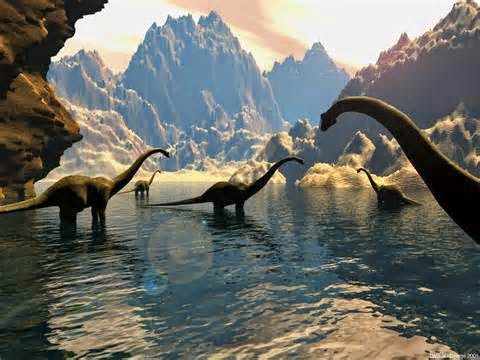
This insight also gave me a perception on how antediluvian mankind lived alongside dinosaurs, giants such as the Brontosaurus, Triceratops, Tyrannosaurus Rex, along with flying creatures with massive wingspans, such as the pterosaurs. I have received taunts from secularists, even mockery on this blogging page for upholding such an idea of dinosaurs of the Triassic, Jurassic and Cretaceous periods actually co-existing with mankind, which were not meant to come into existence until the Late Quaternary period - some 25,000 years ago - which was supposed to be some 69,975,000 years after the death of the last dinosaur! Yet the Bible hints at such a co-existence, and I found no problem with this, even when I visited the London Geological Museum in South Kensington, where there was a display of fossils arranged in chronological order - with the Cambrian group looking much, much older than the bones or shells embedded in the comparatively recent Pleistocene period. The Cambrian variety certainly looked old and tattily preserved, although the very idea that all were fossilised at the same time at a very recent epoch does not seem far-fetched, according to how I saw them. And many noted scientists of a not-so-distant past would have fully agreed with me. For example, author Charles Gillispie of Cambridge University, wrote Genesis and Geology, fully supporting the Biblical narrative, and it was published by the Harvard University Press as recently as 1951.


The Genesis narrative of  the Noachian Deluge has always been at the forefront of my mind ever since I first read the Biblical account. As I go out to work each morning, I sometimes wonder how this very spot I'm standing on would have looked before the Flood. Would it have been a tropical jungle, with dinosaur giants roaming about? Or would it be covered by the shallow waters of a tropical sea? Or even deeper waters of a primeval ocean? Or for that matter, be snack-dab in the middle of a Cain-built city? What was the sky like? Was it forever blue throughout the day? Or the cloudless sky even possibly have been red at daytime, due to a higher moisture content in the upper atmosphere? If the daytime sky was red, was there a possibility that the colours of all creation were brighter, more intense? It was a world I find so fascinating, that I'm hoping to watch a heavenly video of it in the next life, if God will let me. Or at least have a chat with Enoch, Noah or one of his sons who were alive before the Deluge.
 
And it was this fascination of this "world that once was" which drew me to the cinema with my wife Alex to watch the movie Noah, written and directed by Darren Aronofsky. We picked a Saturday morning showing, as my wife being in a wheelchair, we did not particularly want to be in a theatre packed with viewers. We got what we desired. There were only three or four other people in otherwise an empty auditorium, and I have wondered whether this movie will be a box-office disaster.
 
I have seen quite a number of Bible-based movies in my lifetime, including The Ten Commandments, Samsom and Delilah, King David, Jesus of Nazareth, The Passion of the Christ, and even Ben Hur, which was based at the time of the Crucifixion, were as true to the Bible as they could have been. Unfortunately, Noah fell short of the Biblical narrative in quite a few details. For example, the very plot in the film differed from the Biblical narrative in a way that while the Bible insists that the Flood was to preserve the Messianic Line from Adam to Jesus while destroying a corrupt race which posed a threat to the bloodline, in the film, Noah was given the task by God to preserve all animal life, but then allow all mankind to become extinct in order to prevent the repeat of the anthropological disaster which blighted the first world. In other words, the movie adaption of the Deluge was to re-create the lost paradise for the animal and plant kingdoms, never again to be destroyed by human wickedness and greed.

The effects of this was quite startling. Only Noah's eldest son Shem had a wife, and she was a young girl rescued by Noah himself after being found abandoned and wounded in a ravine containing bodies of the slain. As this girl grew up into a beautiful woman, it was discovered that the wound she had received as a child took away her fertility. Later, while the Ark was under construction, she was blessed by Methuselah who himself was drowned in the Flood, and while on board the floating Ark, she gave birth to twin girls, whom grandfather Noah believed that God told him to slay them. The result was a non-Biblical drama of screaming hostility from all of Noah's family as he attempted to kill the two infants. Fortunately, while he stood over the two infants held by their mother, Noah looked up to heaven and reluctantly declared that he did not have the heart to fulfil his duty, and by sparing the infants' lives, felt as if he betrayed God by having failed in his task.

Other departures from the Bible included the idea that Noah and his family were the only descendants left of the line of Seth, the second son of Adam, while the whole world was from Adam's firstborn, Cain. Even the king of the earth, Tubal-Cain, successfully stowed away in the floating Ark, and after a fight with Noah, he was stabbed to death by Ham, who himself had no wife. The film included a scene of Ham's girlfriend left to die by Noah as he escorted his son to board the Ark. The movie portrayed Noah as heartless to the screams of Ham's abandoned girlfriend. It was these scenes which spoilt the Biblical narrative.

The Bible was clear that Noah's family was by no means the sole survivors of Seth before the Flood. In the Bible, Noah's father was Lamech, who himself had other sons and daughters. Lamech's father Methuselah also had other sons and daughters (Genesis 5:26-30). This gave Noah a full family of brothers, sisters, aunts, uncles and cousins. This might have played on the emotions of the Biblical Noah, and why he got drunk after the flood waters had receded. The death of his family because of unbelief must have been very distressing for Noah, and most likely for his wife too. Although the narrative is silent on this, there is no reason why Noah's wife, along with the wives of his sons, didn't have any unbelieving brothers or sisters, aunts, uncles, or even in their case, parents, who banged on the hull of the vessel after the door was shut. It is this sort of situation affecting many believers at present, who have family members who don't know the Lord. With myself in this situation, I can understand how Noah and his immediate family must have felt.

Noah's upbringing in the Bible was quite different from the Noah of Darren Aronofsky. In the Bible, Lamech, Noah's father, died five years before the flood. Therefore, nearly all but the last five years of Noah's 600 years of his life were spent in close intimacy with his Dad. His grandfather, Methuselah, actually outlived his own son by five years, and according to Genesis 7:4, Methuselah died of old age - just one week before the floods came, which demonstrates the omniscience of God, as the name Methuselah means When I die the waters will arrive. In the film, Lamech died many years before the Flood, while Methuselah was drowned while hunting for berries. This goes to show what a tremendous impact the flood must have had on the Biblical Noah and his family, and the terrible loneliness he must have felt after disembarkation. Right up to the moment he boarded the vessel, he had his good old grandpa to lean on, and might well have received support from his in-laws. Now, as the head of the entire human race, his emotions called for alcohol.

It goes to show the wonderful mercy and the omniscience of God calling for Once Saved Always Saved, especially in the light of today's believers in Probational Salvation. They teach that salvation can be lost if a believer in Jesus Christ indulges in wanton drunkenness. But with Noah, we see no sign of him losing his salvation. Instead we read of his humanity, his infection with sin, yet the grace of God's love which was guaranteed his name in the Hebrews Faith Hall of Fame (Hebrews 11:7.)

And this is why I don't believe that Aronofsky's Noah should be the basis to establish the truth of God. What I have seen was that the Creator, as he was always referred to in the film, was perceived as a cruel, vindictive deity who wanted to eradicate a race of corrupt men without the protection of the Messianic bloodline through Seth, Noah, and his son Shem. Instead, the Creator inspired Noah to let Ham's potential girlfriend to be trodden to death by Tubal-Cain's men, and then what I thought to be the most emotional moment - the birth of twin girls from Shem's wife, and Noah's commission to slay them in order to prevent the earth from re-population.


I came away feeling that the Creator in the film reflected Aronofsky's faith. He was born of Jewish parentage and although I read elsewhere that he could be an atheist, nevertheless, his principle was salvation by works, and that entirely without the Messiah's intervention. And this is what I believe many who would watch this film will come away with. Or simply not believe in God at all. And for Christian believers who, like us, who went to see the film, we should not base any theological analysis on the film, nor from it, define doctrine.

Darren Aronofsky's Noah was an enjoyable film to watch, I certainly liked it, and maybe, when the DVD version comes out, I may well purchase it. But for me, and I recommend every true believer who goes out for the evening to watch it, it must be categorised exactly for what it is - entertainment.

Sunday, 21 August 2011

Noah's Flood Just a Folklore? Then No Salvation For Us!

Richard Dawkins stood on the podium at the middle of the stage, addressing a large audience inside the Sydney Opera House. He was purposely making mockery of any historical credit given to Noah and his family remaining safe by floating in a barge while the whole world lies underwater in a global flood.


He ridiculed those "religious nuts" who still believe in the reality of this folklore, while the better educated and the enlightened had long discarded such fables and adhered to scientific facts of organic evolution which had shaped us for the last 200,000,000 years, give or take.

The audience chuckled. Every hearer took delight in the speaker's ridicule of the Biblical narration. And I doubt that anyone in that audience had given a moment's thought on the repercussions if Dawkins was right all along and the Noachian Deluge (as the Biblical Flood is often addressed) was pure fiction after all.

As we shall see, the early chapters of Genesis hold the key to first, the very existence of the Jewish people and the nation of Israel. Along with this, the Bible tells us that Jesus Christ himself was born into a Jewish family. At his very birth, his final destiny was to become King of Israel (Matthew 2:6, Luke 1:32-33). But before this, Jesus Christ had to die a criminal's death on a cross to atone for the sins of not only Israel but for the whole world.

After his death and his resurrection, he would become head of the Church, consisting of all people (mainly Gentile but open to any Jewish believer as well). In other words, us - all those who believe in him for our redemption and the eternal enjoyment of eternal life in God's presence. So we need to ask, where is the connection between Adam and Eve and the Noachian Deluge, the nation of Israel and the Church at present? Through what is called the Messianic Line, that is, from Adam his descendants includes Seth, Enoch, Methuselah, Noah, Abraham, Isaac, Jacob (i.e. Israel), Judah, King David, Joseph husband of Mary (thus a legal guardian) and Mary herself, also a descendant of King David, who became the mother of Jesus, future King of Israel and the head of all true believers who make up all the churches in the world to this day.

Which leads to a major problem. If the Noachian Deluge, along with all the people and events recorded in the early chapters of Genesis, were fable and simply folklore, then all the churches we see around us to this day would have been non-existent, since the birth, death and resurrection of Jesus Christ would not have occurred either. And without the Crucifixion of Christ, there would be no hope for any of us. Our lives would be extremely futile. Educated? Yes. Ambitious? Yes. But we would just live for a short while, die and tumble into Hell wondering just where we've gone wrong. Instead of blaming sin, inherited from the Fall of Adam and Eve, the explanation would be that something went seriously wrong in the final, explosive stages of our evolution, resulting in that all wrongdoing is not our fault, but due to "environmental factors".

Is this beginning to sound familiar?

As for the Summer riots which took place just a couple of weeks before this was written, one Politician, "Red" Ken Livingstone, ex-Mayor of London, began to blame the riots with an attractive explanation of "Government draconian cuts, lack of youth clubs and rising costs and unemployment." Not sin then, but shortfalls in the environment.

In this article I wish to discuss the plausibility of the Noachian Deluge and ask, is such an event scientifically viable?

In the last blog, we looked at the feasibility of Adam and Eve, Cain, Abel, the time of the murder amidst a growing population. Here we'll look at the narrator's chronology leading to the Flood, and ask, why such detail? Then we take a brief look at the animals within the Ark, and then the genealogical line from Noah to Abraham.

Genesis chapter 5 gives the genealogical record from Adam to Noah, which is also part of the Messianic line from Adam to Christ. If Jesus Christ existed, died for our sins and risen from the dead three days later, then not only the beginning of his origin and the source of our salvation detailed, but also for existence for the nation of Israel, and its justification for its existence in the Middle East at present, to which Jesus Christ will return as its King sometime in the future. In short, without the historical truth of the events recorded in the early chapters of Genesis, the whole of the two Abrahamic faiths - Judaism and Christianity, together with the existence of the nation of Israel, would all crumble to dust.

The antediluvian chronicle is as follows:

Adam fathered Seth at 130 years of age, lived 800 years more, died at 930
Seth - Enosh at 105 - 807 years more, died at 912.
Enosh - Kenan at 90 - 815 years more, died at 905.
Kenan - Mahalalel at 70 - 840 years more, died at 910.
Mahalalel - Jared at 65 - 830 years more, died at 895.
Jared - Enoch at 162 - 800 years more, died at 962.
Enoch - Methusalah at 65 - 300 years, - was taken to Heaven alive at 365.
Methusalah - Lamech at 187 - 782 years more - died at 969.
Lamech - Noah at 182 - 595 years more, died at 777.
Noah - aged 600 when the Flood arrived.

It is interesting to realise that Methusalah is a prophetic name. It means, "The Flood comes when I die." By calculating the figures given above, we can see that Noah was 600 years when the flood came. Methusalah was 187 when his son Lamech was born, and Lamech was 182 years when Noah was born. So we can work out:

182+187=369 years - the age Methusalah was when Noah was born.
Noah's antediluvian lifespan right up to the Flood - 600 years.
Thus 600+369=969 years - the total age of Methusalah at the time of the Flood.

As for Lamech, he was 182 years old when his son Noah was born. He died at 777 years of age. Therefore Lamech lived 595 years after Noah's birth, which is five years short of the Flood which occurred in Noah's 600th year of his life. In other words, Methusalah outlived his own son by five years.

There is a likelihood that at the death of Methusalah, Noah panicked when he saw that the Ark was not quite ready. Therefore God assured him of seven more days before the catastrophe (Genesis 7:4). It seems odd to me if the event was merely folklore, why the narrator took so much effort in chronicling the age of each patriarch and the timing of the Flood since Creation.

But did every species of animal as we know them today entered the Ark. Unlikely. For a start, there was no need for marine life to enter the Ark. This not only include fishes, but marine mammals - Whales, Dolphins, and Porpoises. Also animals that have survived outside the Ark included Crustaceans, coral, sponges, along with insects and possibly amphibians.

Then it has been demonstrated that many species of animal could have arisen from as little as one pair. Let us give a couple of examples:

There are up to nine related to the horse family. They are
Horse
Quagga
Zebra
Zebroid (cross between Horse and Zebra)
Onager
Kiang
Ass
Kianger (cross between Onager and Kiang)
Mule (cross between Horse and Ass)

Likewise, the Canine family has eight varieties:
Artic Fox
Grey Fox
Red Fox
Wolf
Dog (with its many varieties and sizes)
Coyote
Jackal
Hyena

Source: John C. Whitcombe and Henry M. Morris, The Genesis Flood.

The point is, each of these two families could have each arisen from a single pair.

This raises the likelihood that out of the total of seventeen animals listed above, only four entered the Ark, two of each family, the male and female. If this is true, then the number of species in the Ark would have been much fewer than the varieties we see today. Then again, it was very possible that the animals within the Ark would have spent much of their time in hibernation during the duration of the Flood.

After the Flood abated, and Noah's family along with all the life stock had disembarked from the Ark, we are told that Noah planted a vineyard and became drunk with the wine the fruit the harvest produced. This seemed to be out-of-step with the normal character of Noah! What made him turn to alcohol, after experiencing the salvation and deliverance God had performed for him? His loneliness.

We seem to forget that right up to the Flood itself, Noah had brothers and sisters, aunts and uncles and many cousins. This we know because in Genesis 5, we are told that Methusalah became the father of Lamech, and fathered other sons and daughters. (v.26). So Noah had aunts and uncles. And in verse 30, we are told that Lamech had other sons and daughters. Therefore we can assume that Noah, prior to the Flood, was surrounded by his family. They most likely loved him enough to care for him, even if they disbelieved in God's revelation, perhaps thinking that their brother was a little nutty. Noah's heart must have been pining for his wider family to believe God's revelation and act accordingly. After the Flood, Noah and his seven adult family members were the only humans on the planet. His loneliness and loss of his wider family must have hit him hard! Little wonder he turned to alcohol. But does this mean that he has fallen away and lost his salvation? A pretty silly question to ask. Rather, his name appears in the Hall of Fame of faithful men in Hebrews 11:7. But the Scriptures show how human even the greatest saints can be.

Next, we shall take a look at the genealogy of post-deluge patriarchs, and how their longevity declined rapidly after the Flood. Although there may be several reasons for this, it is believed that the vast change of global climate had played a role in this, namely, the collapse of the antediluvian vapour canopy during the Flood which played a role in filtering out the more harmful of the sun's rays.

The list is as follows, and it's found in Genesis 11:
The lifespan of Noah - 950 years.
Of son Shem - 600 years.
Of son Arphaxad - 438 years.
Of son Shelah - 433 years.
Of son Eber - 464 years.
Of Son Peleg - 239 years.
Of son Rue - 239 years.
Of son Serug - 230 years.
Of son Nahor - 148 years.
Of son Terah - 205 Years.
From there we need to go further into the book to record the ages of Abraham, Isaac, Jacob and Joseph.
Abraham - 175 years (Genesis 25:7).
Isaac - 180 years (Genesis 35:28).
Jacob (Israel) - 147 years (Genesis 47:28).
Joseph - 110 years - (Genesis 50:26).

So we see the dramatic drop of longevity from Noah's 950 years to Joseph's 110, which is much closer to today's reality than Noah's and his forefathers. But we see the continual lines of both the formation of the nation of Israel from Adam, and the Messianic line from Adam to Jacob, who was renamed Israel. Only Joseph branched off from the Messianic line, as this passed through his brother Judah, the fourth son of Jacob with his first wife Leah.

So the early chapters of Genesis are absolutely vital for the existence and survival of Israel, for the believing on Jesus Christ for our salvation and for the survival of the churches. Also, as was discussed in the last blog, the teaching and institution of marriage, children and the family are based on these early chapters.

Educated professors such as Richard Dawkins, Sam Harris and Christopher Hitchens do us no favours whatsoever in their books and theatrical speeches. It is about time too that Christians study and believe these chapters to strengthen their own faith and to encourage others.