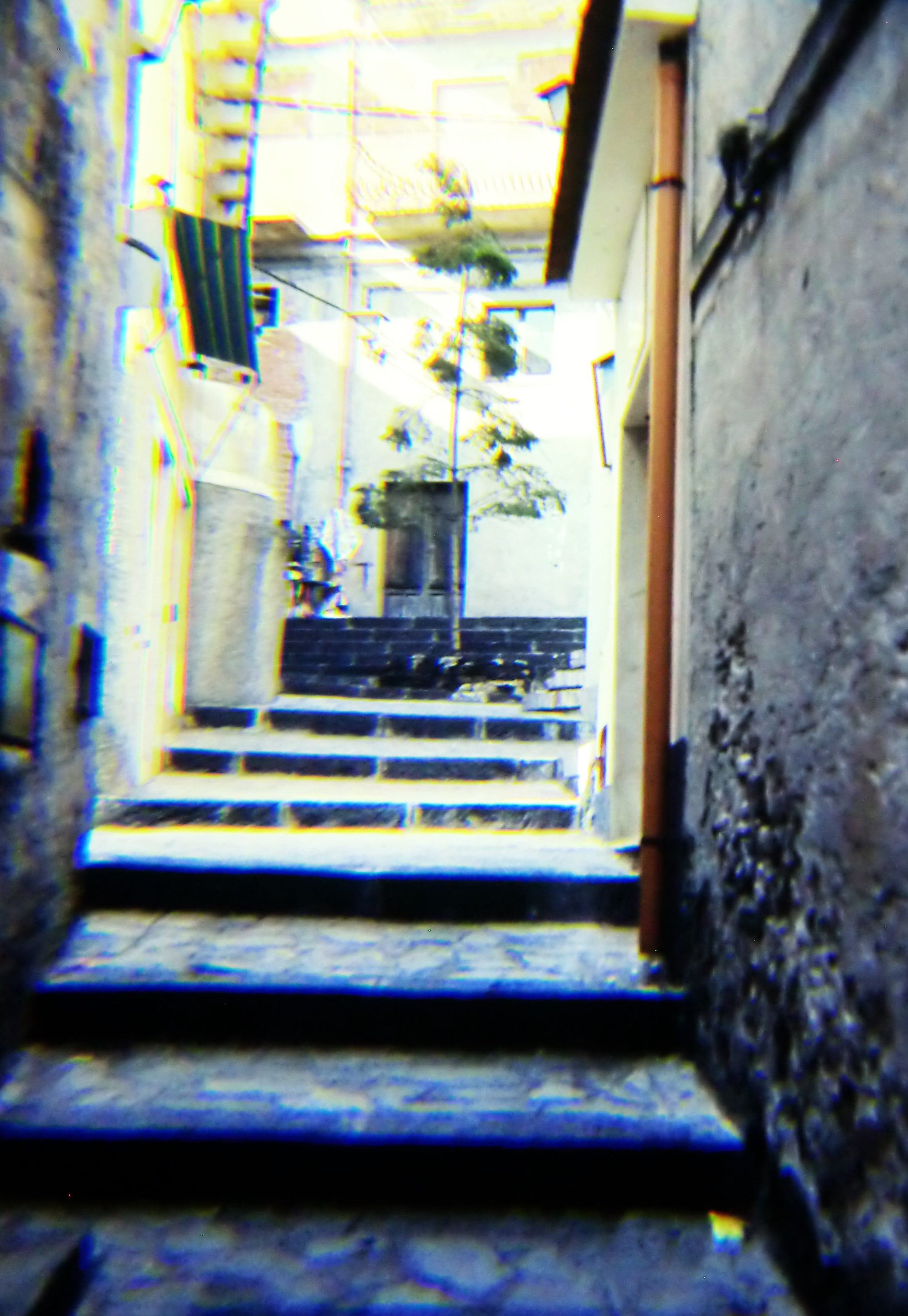
Ortigia island, Siracusa.
Although I have tended to visualise Siracusa as the New Town on the mainland, and the island of Ortigia as the Old Town, the Neapolis Archeological Park, dating back to the ancient Greek culture around 2,500 years ago, is located on the mainland. For example, the modern apartment blocks lining Corso Gelani are just across the road from the Neapolis with its 2,500-year-old Greek theatre, and nearby, there is a modern hospital, along with civic administrative buildings.
By contrast, Ortigia is an island off the mainland, separated by a very narrow strait. From the air, the waterway looks so much like a wide canal, one would be convinced that mainland Siracusa and the island of Ortigia were once a continuous peninsula before it was cut straight across. Two road bridges link the island to the mainland. Arriving in Ortigia from Siracusa, especially on the Corso Umberto, one is faced by a large archaeological site, the remains of the Temple of Apollo. Small excavated areas are also found in the middle of the street, yet they don't hinder the flow of traffic.
 |
| Ortigia is separated from the mainland by a strait. |
Although the entire island is surrounded by water, there were no beaches. Instead, a wall enclosed the island entirely, with the Mediterranean lapping gently at the base of the wall. Since the Med doesn't have tides, the water level remained constant throughout. In 1982, from Port Victoria Emanuelle on the west side of Ortigia, a small ferry carried foot passengers to the port city of Valencia in Malta (with the car ferry setting sail from Catania.) Unfortunately, I never took the opportunity to board the ship due to the tightness of funding, lack of time, or both. Besides, I was happy just to be in Sicily itself.
The streets of Ortigia, unlike in mainland Siracusa, were laid during Medieval times and therefore tend to be narrow. However, there was a widening of one street, Via Saverio Landolina, into the Piazza Duomo. This was fronted by the Duomo di Siracusa, that is, the Church of the Birth of the Virgin Mary, and the seat of the city Archdiocese. I remembered sitting inside the duomo. Although built in the 7th Century AD, it's actually founded on an ancient Greek Temple of Athena, itself built in the 5th Century BC. Surrounding me were the original columns of the Temple, left there when the church was built some 1,200 years later.
I sat inside for a while until an escorted tourist group entered, and the ranger disturbed the silence as he began to narrate to his group. Although I could see that I was in his way since I was already seated at that spot, he had no power even to ask me to move, and so, he continued his discourse in the central aisle and in my presence.
Many residents of Ortigia sat outside their front doors and neighbours chatted with each other, with groups lining the street as they sat outside their homes. All that has made me feel that I'm indeed in a foreign country, with a culture so different to ours in Britain. Here in Sicily, the Mediterranean climate brought these residents outside to chat casually, whilst our British cool temperate climate keeps the Englishman confined within his home he calls his castle.
One warm evening, as I was strolling through Ortigia, I arrived at the Piazza Duomo, to see a live band playing directly opposite the cathedral, and apparently a public street party. The event was orderly, the people were enjoying themselves and, as I could see, there was no alcoholic abuse, no sign of any drunkenness, no bare torsos, and no vomit on clothing or the ground. Instead, a large group of mostly young men were dancing the Conga to the music from the band.
As I approached the rotating circle of young men, each with both his hands resting on the shoulders of the one in front, one of them who was nearest to me beckoned me over to join the dance. I was happy to and joined the rotating human circle that spanned the width of the square under the beat of the music.
However, I was struck by the absence of women. Yet, all the young men looked happy, contented, and fully committed to the dance. But, at least in 1982, this was the culture of the region. And that was when I was glad to be single and not have a girlfriend. This was a culture where many, if not all, dating couples were accompanied by a chaperone, sometimes the girl's brother or sister, or even the girl's uncle, aunt, or father himself.
A Visit to Taormina
I believe that one of the most spectacular resorts in the whole of Europe is Taormina, north of Mt Etna. The town is built on a mountainside, starting with the Spiaggia di Isola Bella, or Beautiful Island Beach, and with a cable car up the mountainside to the town centre. Even from the town, the commune of Castelmola reaches 529 metres towards the sky about a mile inland from the town, and I managed to hike uphill to this village. Resembling a molar tooth when seen from both the beach and the town centre, the streets were so narrow that all motorised traffic was banned. And so, I spent a whole day at Taormina after boarding a train at Siracusa Station early in the morning. The day included a swim in the sea before exploring the town centre and then Castelmola. The day also took in a visit to the Greek Theatre, although most of the ancient masonry making up the theatre was Roman.
 |
| The Greek Theatre, Taormina, 1982. |
 |
| My surname is very common in Italy. Taormina, 1982. |
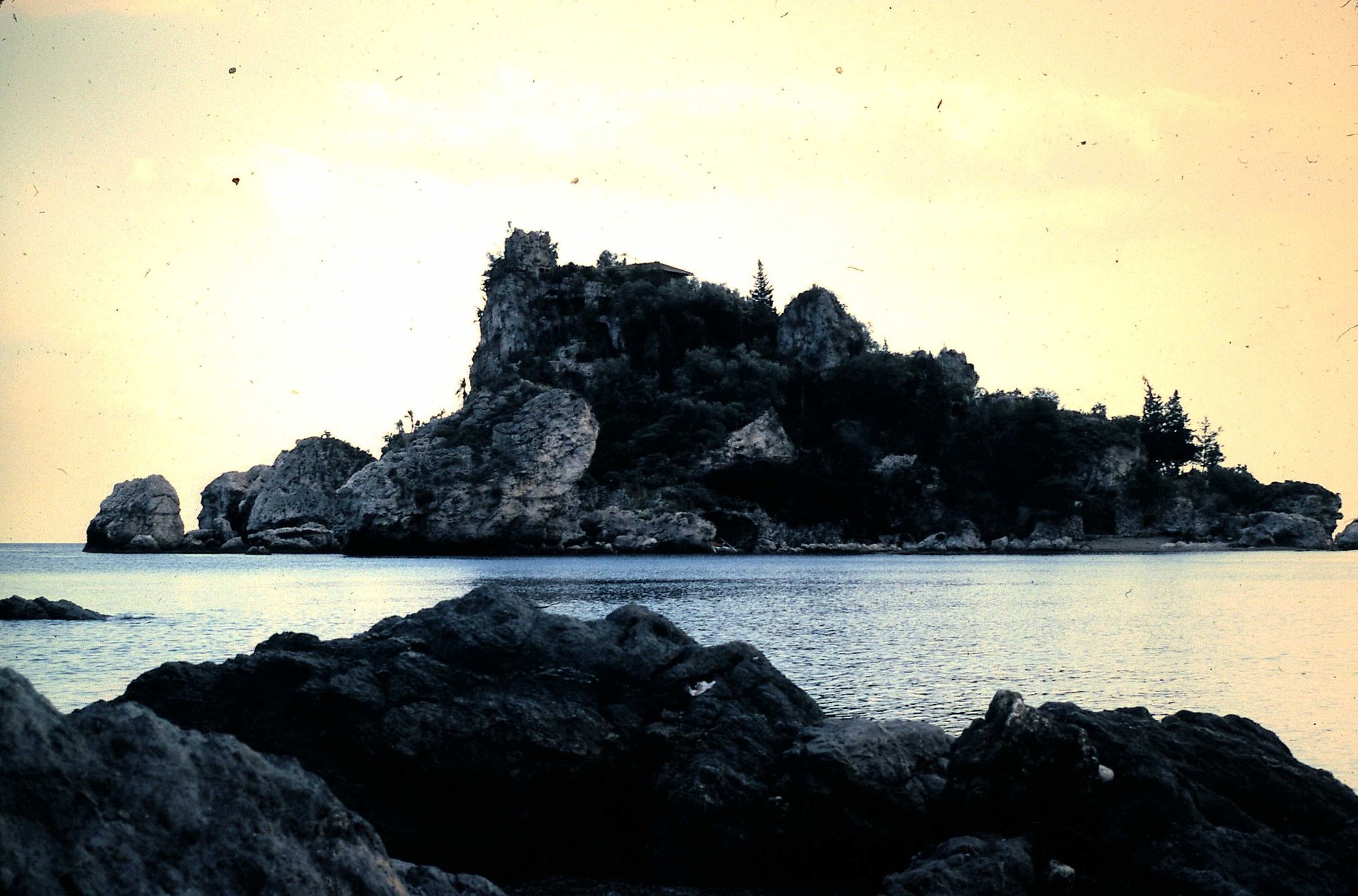
Castelmola offered fantastic views of Taormina and the Sicilian coastline, especially of the tiny isle which gave the beach its name. The privately owned islet was connected to the beach by a sandy causeway which was barely above the water level. Just above the level of the beach but below the height of the town, the Messina-Siracusa railway line passes through one tunnel after another as it heads south, passing along Naxos Beach, skirts the base of Mt Etna before passing through Catania Station on its way to Siracusa.
Palermo and the Catacombe dei Cappuccini.
I spent at least a week in Siracusa before vacating my hotel room to board a train to Palermo, the capital city of Sicily. In 1982, there were two ways to travel to Palermo from Syracuse. The "proper" way was to take an express train and change trains at Messina for the Palermo branch which runs along the northern coast of the island. Alternatively, there was a slower, more scenic route cutting through the middle of Sicily, stopping at the inland town of Caltanissetta before proceeding to Palermo. I chose the latter route, changing trains at Catania.
The train eventually pulled into Palermo Terminus by early evening, and I found a suitable hotel to stay in for the next three days.
I wasn't so impressed with Palermo as I was with Siracusa and the east coast of Sicily. As I saw it, the capital was like most others, a sprawling city with a large international port with ships sailing to Tunisia as well as other ports such as Naples, Cagliari, and Civitavecchia. However, there was one place of interest which stood out, the Catacombe dei Cappuccini, over a mile west of Central Station.
I have already visited the Catacombs of St John in Siracusa, and now I'm about to visit the underground crypt of a church that was used as a resting place for the faithfully rich, all placed there by the Capuchin monks approx between the years 1600 and 1920 AD. Within a couple of years later, I visited the equally macabre Paris Catacombs. All three were underground. Furthermore, I was alone in all three burial sites.
But it was the Catacombe dei Cappuccini that not only impressed me but shocked me into the reality of life and death. Believe me, it's not the place for the squeamish, the fearful or with a nervous disposition.
I arrived at the church (having already known about the catacomb long before 1982) and I paid the entry fee. I then went downstairs into the church crypt. There were a few people in there to start with, but they soon left altogether, and I found myself alone in this subterranean vault.
The walls all around were lined with well-preserved corpses, many standing upright, others lying horizontally. There were several corridors, all lined with these dead bodies, many of them staring straight at me as I walked past and looked up at them. There was only one public notice, and each was fastened in each corridor, VIETATO FUMARE, the signs shouted. Okay, I fully understand why smoking was prohibited, such pollution gotten from tobacco would have been detrimental to the corpses. But there were no signs forbidding photography, as there are at present. Therefore, I felt free to take pictures, like I did at the Catacombs of St John, without any awareness of breaching the rules.
Although I wasn't aware at the time, I later learned that there was a reputation that these corridors were haunted by the discarnate souls whose bodies were on display they once inhabited. However, there was no supernatural incident whilst I was down there, yet the vaults weren't entirely silent. Rather, a fan was blowing through an air vent, and one of the hinged covers had worn loose. As the air current was circulating, there was this constant clunk, clunk, clunk, clunk - a continuing rattling of metal against masonry, powered by the air current. But to me, in this morbid environment, the sound of a fully functional air fan also reminded me that the world of living is just above the ceiling.
However, there is a legend many visitors may not be fully aware of. It concerns one of the bodies standing upright in one of the corridors. On one occasion, this deceased individual fell from his place in the corridor to land directly on a passing visitor, almost as if the dead actually leapt on the living. The figure was put back in its place and chained in for greater stability.
 |
The individual in the centre fell on a passing visitor.
|
 |
They grinned as they stared down at me...
|
 |
This guy, I felt a special affection for.
|
 |
| General view of one of the corridors. 1982. |
So you can ask, or even I should ask myself: What is this obsession with the morbid, the macabre, the mortal? and that's not confined to the catacombs I had visited on the Continent, but the most interesting gallery in the British Museum in London is the Egyptian mummy gallery. In the last blog, just before I started this Travel Biography series, I wrote about how I spoke softly to one of the Egyptian mummies on display at the museum. I think such an obsession - if that's what it is - is borne from my upbringing. By not doing well at school to my parent's satisfaction, pride and joy, I held low self-esteem.
Church life, rather than allowing me to grow my faith in Christ, instead, turned out more of an emotional hindrance by mixing with graduates who shared my age. Deep in my mind, and with little verbal expression, I have wondered just how proud the parents of these graduates must be, the joy felt over the upbringing of their offspring, to see them off to University, and then to see them land useful careers with a respectable income. And then watching them find girlfriends, marry, and have children while I remain sitting alone on a shelf with my legs swinging alternatives back and forth like a child.
Looking up at those corpses as they gaze back down at me has shocked me into the reality of eternity. There is something terribly wrong with God's plan of Creation! Mankind was never created to end up in such a sorry state. Yet there they are, on display for us to look at, think, meditate, and find a rationable reason, which is the entry of sin into the world, and through sin, death. And to kill off any argument that a person is evaluated by his level of social status, his education, his wealth, his family background or his occupation. Indeed, the emperor and the humble worm both share the same fate.
I make my way back to the hotel with my mind spinning. Ah, that is what travel is all about.
-------------------------------------------------------------------------------------------------------------
Next week: The start of the journey home.




.jpg)