Total Pageviews

Showing posts with label Hostels. Show all posts

Saturday, 6 May 2023

Travel Biography - Week 47.

Arrival at the Lake District National Park.

With the 1991 bicycle ride of over 380 miles completed, there remains one more "staycation" before setting off overseas again: for two weeks in the Lake District National Park. This was inspired by our first visit to the park in 1990 when we, Gareth Philips and I, cycled through the park as part of our John O'Groats to Lands End bicycle ride.

Gareth and I wanted to return to the Lake District, and we had an opportunity to visit in 1992. But this time, our bicycles remain safely locked away at home whilst we did some trail hiking. 

I believe that Gareth had been to the Lakes before, that is, before 1990. That same year saw me passing through the park for the first time in my life. I was immediately impressed with the contrast between the mountains and the lakes. These, along with the streams feeding small-scale waterfalls that make the sound of rushing waters such a delight, especially whilst out on a picnic. The National Park is unique in having some English superlatives all within a few miles of each other. Examples of these are England's largest body of freshwater, Lake Windermere; England's highest pond from sea level, Red Tarn at Helvellyn; England's highest mountain, Scafell Pike; and England's largest National Park after Scotland's Cairngorms National Park, the largest in the UK. Therefore, it shouldn't be too surprising that my wish to include the Lake District National Park in this Biography.

Before I go any further, I would like to say that I visited the Park once again in 1999, just before I married Alex, where I hiked and went hostelling between Ambleside, on the northern end of Lake Windermere, to Keswick, just north of Lake Derwentwater. It was whilst I was on a hill overlooking Lake Bassenthwaite that the whole area darkened to twilight during mid-afternoon. I stood among others with me, looking through special glasses at a partial solar eclipse. However, that was 1999, thus, I'm jumping ahead here. Instead, I prefer to stick to 1992 when Gareth shared the experience with me.

It was quite unusual for us to take the National Express coach from London Victoria Bus Station rather than the train out of London Euston, but the ride was not only a pleasant experience but the journey was much cheaper on the road than on the rail tracks, hence, compatible with our budgets. But it took considerably longer and it was evening by the time we arrived at Windermere Hostel.

At the Lake District with Gareth.


Lake Derwentwater.


This trip was a hiking holiday. That means that on some days we walked from hostel to hostel. Other times, we completed circuit walks, starting and ending at the same hostel. Hence, on one of the days, we set off from YHA Helvellyn to reach the summit of Mt Helvellyn. This included a precarious balancing act on Striding Edge, from which we had a superb view of the Red Tarn, the highest lake in the park, and the whole of England, at 718 metres above sea level. 

The summit of the mountain was marked by a triangulation point, around 950 metres high. It was whilst we were here that the weather took a turn for the worse, with rain driven by a strong gale-force wind. Fortunately, we were both prepared and wore appropriate clothing to suit that kind of weather, but in turn, there wasn't much to see from the summit. The atmospheric conditions obscured what would have been glorious views.

The Throne of England.

Then our attempt to ascend what we affectionately called the Throne of England, Scafell Pike, at 964 metres, England's highest mountain. On our first attempt, we made our way from YHA Longthwaite Hostel towards the mountain (a fairly long trek) but I was feeling discouraged for two reasons. First, the inclement weather was hiding much of the mountain in low clouds. Secondly, We didn't pack enough food in our rucksacks, and I was anticipating the feeling of hunger during the trip, with no shop on the summit to restock. And so, It was I who asked to return back to the hostel if he agreed to try again the next day.

The fog lifts from Scafell Pike.


On the Throne of England.


The next day, we made a second attempt to hike our way up the mountain. Although the summit of the Pike was still in the clouds, I felt through instinct that all will be fine. We walked along with heavier rucksacks on our backs. This time, we made sure we were adequately supplied.

As we ascended, the trail cut into the side of the mountain, with a wall of rock on one side and a sheer drop on the other, very much like one of the trails leading into the Grand Canyon. However, the summit was still bathed in clouds but with the clear visibility of the trail in front of us, we pressed on. Eventually, we arrived at a flat level under thick fog. Another hiker, looking distressed, approached us moaning that he had climbed this mountain already several times and on each occasion, the summit was wrapped in clouds. He told us that he never got to see the views the peak offered.

Gareth thought that we had arrived at the summit. But through the fog, I was able to just make out a wall of rock ahead. I insisted that we need to press on. I was right. There was a significant length to ascend before we reached the summit proper, which was marked by a large cairn.

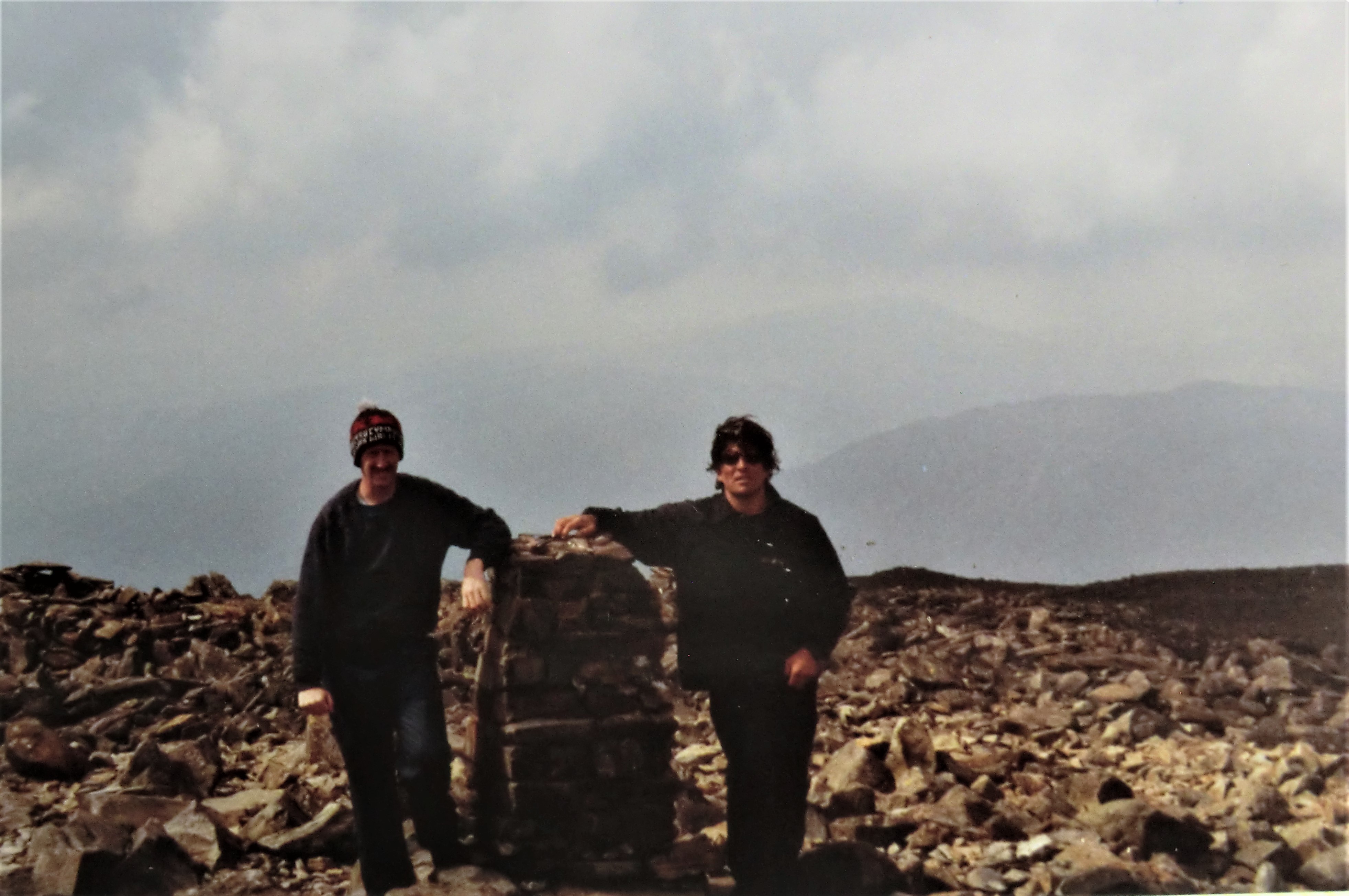
We weren't alone. There were several other hikers already on the summit before we arrived. However, it was soon after we arrived at the summit cairn that there was a drastic change in the weather - for the better! The fog started to lift, looking like huge plumes of steam rising from the valleys around us. Presently, the view of Styhead Tarn became visible, about a mile and a half north of where we were standing, nestling in Borrowdale Valley and overlooked by the Great Gable. However, to our south, Scafell rises, and it looked to our eyes that this peak was higher than the one we were on. However, after we descended to Lingmell Crag, by looking back up the mountain, we could see that the peak we were on, Scafell Pike, was the higher of the two. We stayed on the summit of Scafell Pike for a considerable time, admiring the views and having a picnic whilst sitting with our backs leaning on the cairn. Indeed, this was the Throne of England.

Lingmell Crag provided a wonderful view of a major body of water, Lake Wastwater. By then the sky was clear of all clouds and fog, the sun was shining, and the general panorama of the Lake District was at its best. I felt sorry for the hiker who gave up shortly before we had arrived at the summit and was beginning his descent. If only he stayed at the summit for a little longer.
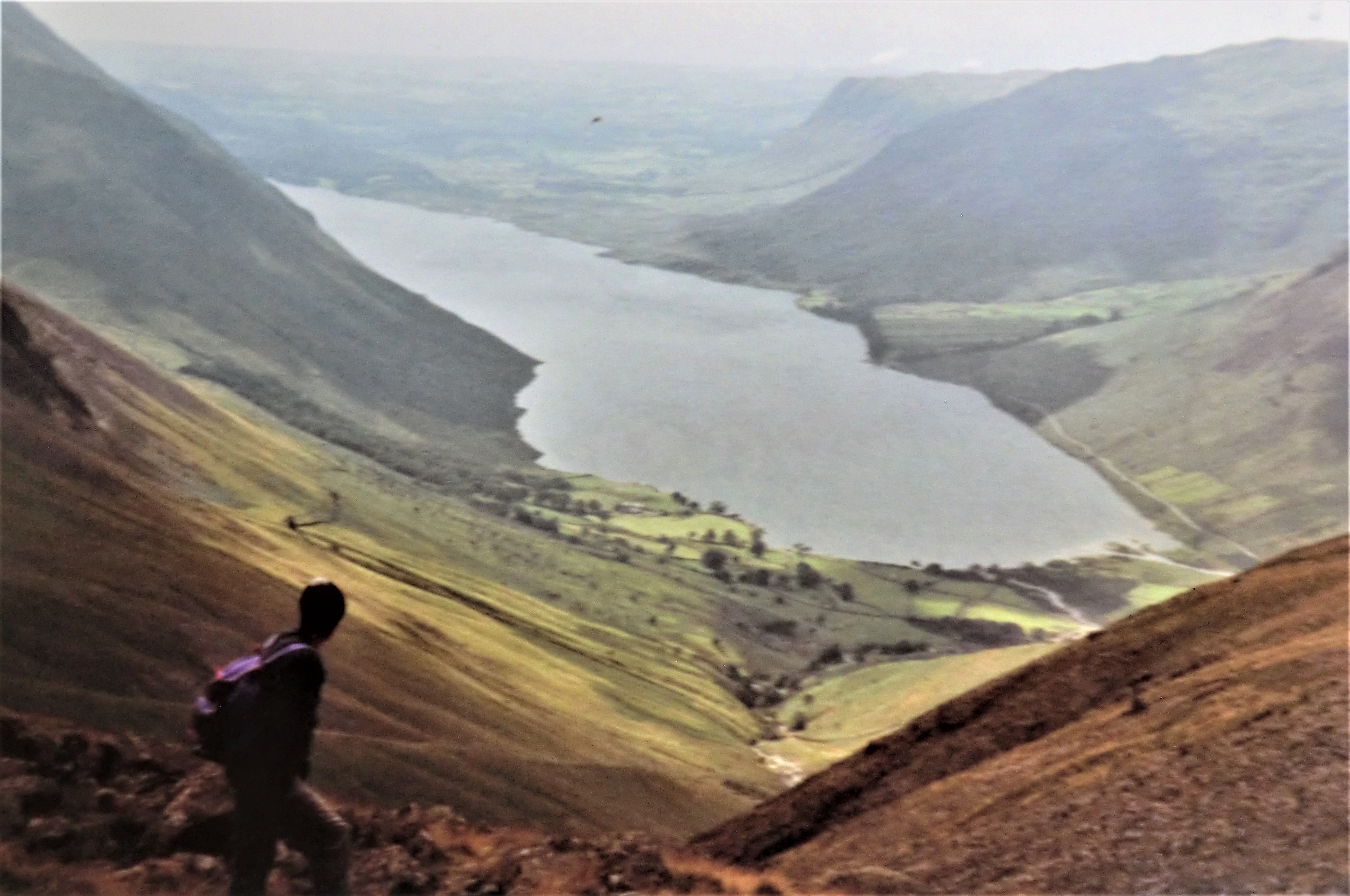
Lake Wastwater as seen from Lingmell Crag


Lake Windermere.


Other Areas in the Lake District.

Along with mountain hiking - not mountaineering or mountain climbing by the way, as that is totally different - we walked through gentler terrain. Lake Grasmere was one example, that boasted two YHA hostels nearby, YHA Butharlyp How and YHA Thorney How. We managed to stay at each one at different times throughout the holiday. The lake itself was shallow enough to see the floor less than a metre below, yet it was an excellent venue for boating. One afternoon, Gareth and I hired a rowing boat for an hour.

Another site that was worth exploring was Lake Thirlmere, a ribbon lake that was once a natural body of water before it was turned into a reservoir to supply fresh water to Manchester. To the west of Thirlmere, we found a trail that took us up Armboth Fell, a hill covered in purple heather, to the beautiful Lake Derwentwater on the other side. This natural lake, just south of the town of Keswick, is rounder than most of the other ribbon lakes in the District, which makes the whole park resemble the spokes of a wheel when seen from the air. Also, Lake Derwentwater has an island that rises and sinks slightly, the last remaining evidence of volcanic activity in the UK.

Lake Ullswater is another lake  I was impressed with, as it was surrounded by higher mountains. The road that runs alongside this lake heads south over the Kirkstone Pass towards Lake Windermere, the largest body of water in England, eleven miles long and one mile at its widest, it's also the lowest lake in the National Park, just under 40 metres above sea level. It is also heavily commercialised, unlike most other lakes, with cruisers plying its length and a home for various water sports, including rowing and water skiing.


Wantendlath Tarn.


Red Tarn, the highest lake in England.


However, it was our accent to England's highest mountain that impressed me. There are two higher mountains here in the British Isles. Ben Nevis, at 1,344 metres, is not only Scotland's highest mountain but is also the highest in the whole of the United Kingdom. Then there is Mt Snowdon, the highest mountain in Wales at a height of 1,085 metres. I guess this makes the UK so ironic in a geographical sense. England might have the largest land area, but its crowning glory is the lowest of the three. There is no English mountain higher than a thousand metres in height. Yet, Wales, which has a considerably lower land area than either England or Scotland, can boast a mountain higher than a thousand metres.

And all that has impressed my friend Gareth Philips.


Dramatic contrast: A stream and Great Gable mountain.


It was 1992, and somewhere in the Lake District, Gareth proposed a very challenging idea. That was to ascend all three mountains - Ben Nevis, Mt Snowdon, and Scafell Pike - within 24 hours. Would I rise to his challenge? Indeed, I would! After we had returned home, his proposal was put to Tim Kingcott and Keith White. Like me, Tim accepted the challenge while Keith volunteered to provide the transport necessary to meet the challenge.

And so it was agreed. 1993 was to be the year of the greatest physical and mental challenge we could ever face.

I returned to work, as Gareth returned to the bank he worked for. My window cleaning business trundled on, making enough to eat, drink, clothing, keep a roof above me, and stay warm. It was the phase of my life when little was put away towards savings.

I had a customer who was a close friend. I also cleaned his windows every month as I do with all other customers. One October morning, before starting the day's work, I had coffee at his home, as I usually do, and have done for some time. However, a wordy disagreement arose between us, and then not only had he terminated our window cleaning contract, but our friendship was paused for a couple of years, and I was seen as an object of disdain. I sauntered off to the next street feeling very down, defeated, and busted, where the rest of the day's work was to commence.

That morning, I was feeling very low. It was while I was up on the ladder that I had to pause, an incredible feeling came over me. In my mind, I saw clearly the city of Jerusalem from the summit of the Mount of Olives. With the vision came a request for me to go to Jerusalem, stand on the Mt of Olives, and pray over the city. I was given a week to stay there. I had less than a year to save up for the trip.

I prayed there and then, asking if I could have two weeks in Israel instead of just one. I felt that the request was granted. I felt excited. Once again, I would walk in the Holy Land after 17 years since my last visit there in 1976. Forget the Three-Mountain challenge. I'm going for better things!

From that morning onwards everything changed. Each week for the next ten months, I was able to put away £20 without any tightening of the weekly budget. The sum of money saved up by August 1993 paid for the whole trip nicely, with ample spending money.

And the start of a new era in my life.
----------------------------------------------------------------------------------------------------------
Next Week: A problem at the Airport tests my character.

Saturday, 16 April 2016

A Trail Incident of Perseverance.

After two weeks away it's good to be back on this website. No, we have not been strolling arm-in-arm along at a faraway tropical beach backed by palm trees, neither did we bronze our torsos under the hot equatorial sunshine, nor did we gently wade into the coral-rich turquoise waters of the Indian Ocean.

No, it was better than any of that.

Because the above description of long-haul travel belonged to a past epoch when I was single, living in my own bachelor pad with scarcely any responsibility other than to keep myself fed, clothed, and to keep a roof over my head. Such travel suited me perfectly back in those days, as I had no one else to love, cherish and care for. But now as a married man whose spouse is partly lame, I have found that the windswept, drizzly, leaden-grey skies over the Lake District National Park in Northern England to be just as equally enthralling, if not more so, than the Round-the-World backpacking trips which characterised the 1990's.

What has made such a trip enthralling? Watching my wife take in the Park's dramatic scenery with continual delight. Her delight in the lakes surrounded by mountains (known locally as fells) is what make the week long break equally fulfilling as any long-haul or Mediterranean trips. As well as being close to something that has always excited her, seeing for herself one of the many waterfalls which features abundantly across the park.

The Lake District National Park is the largest area under protection from development in England (second to the Cairngorms National Park in Scotland, the largest in the U.K.) It is roughly circular, more than thirty miles, 50 km across, with elongated lakes radiating out like spokes of a wheel, each of the lakes surrounded by mountains. England's highest mountain, Scafell Pike, is located here, rising to 3,029 feet, 978 metres. Maybe just a bump on the ground compared with other mountains around the world, but that did not hinder me from enjoying such spectacular views from its summit back in 1992, with Styhead Tarn not far below, along with a view of the Cumbrian coastline on the Irish Sea, and just after a short walk from the summit, a distant view of Lake Wastwater. Also on that same break, I recall standing on the summit of Helvellyn, the District's third highest mountain at 3,120 feet, 950 metres under leaden skies and a gale force wind nearly blowing me away. Just below, Red Tarn, the park's highest lake, was seen as a dark grey circular splotch on the landscape, the howling winds causing the tarn to quiver by the roughened water before the rain started to fall, obliterating any views the mountain would have otherwise offered.

Summit of Helvellyn, 1992.

I had another visit to the Lake District during the Summer of 1999, just a few weeks before marrying Alex. This was a fell-walking hike from Kendal, a town just outside the park boundary, to Keswick, on the northern region of the District, and the gateway to Lake Derwentwater, one of the loveliest lakes in the park. It took three to four days to complete the thirty-plus mile trek over the hills. During one of the days a near-total solar eclipse was on the cards. So I made sure that I was on the summit of one of the mountains which looked across Lake Buttermere. As the moon began to eclipse the sun, the whole mountainous area became gloomy and dark, which seemed to have startled the wildlife. Almost directly above a sliver of a solar crescent was the only source of the dim sunlight. 

Hosteling was the best way for me to spend the nights at the District, both in 1992 and in 1999. This included a night at Ambleside Y.H.A. hostel, the largest in the UK outside London. But it was Y.H.A. Keswick 1999 which really struck a cord throughout that trip. Nothing special about the hostel itself, except that it would be the very last hostel I would ever spend a night in a all-male dormitory. It ended fourteen years of hosteling experience, which I have not only enjoyed in the UK, but also experienced overseas, such as in France, Holland, Belgium, Germany, Israel, United States, Singapore, and Australia. It was like having a mental video passing through my head. I recalled the best hostel I ever stayed in. It was five nights at San Diego, Southern California, in 1995, which back then shared the same building as the YMCA at Broadway, before moving out to occupy another property at Market Street, where I stayed in 1997. Sharing a room with just one other fellow, he was a builder from Australia, who was the inspiration behind my own journey Down Under two years later. Then not to forget the small New Swedish Hostel in the heart of the Old City Jerusalem, where in 1994 I lived there for a full month, after spending nearly two weeks at the same place in 1993. But as I lay on a typical bunk bed that night at Keswick, I knew that marrying Alex would change things forever. During our short courting days, she made it clear to me that she would never spend a night at a female-only dormitory. Same-sex dormitories are, and will be, forever past.

Lake Grasmere, taken April 2016 

And so brings us up to this month, where we spent a week at a wheelchair-friendly hotel at Windermere, just a short downhill walk to Bowness-on-Windermere. Alex is not totally wheelchair-bound. She is able to get out of the chair and walk independently for a few metres at a time. Not only does this make her day-to-day housework possible, but also proved to be a great advantage on one of the days of our trip. It was to a spot called Aira Force, a 65-foot high waterfall about half a mile 1 km from the bus stop where we alighted, which is by the shore of Lake Ullswater. At the adjoining car park, the warden warned us that the trail to the waterfall is not wheelchair-friendly at all, as there are steps and boulders to navigate. 

We were both determined to see the waterfall for ourselves, especially Alex, as she is particularly keen on waterfalls of all kinds. I did not want to be disappointed after a full hour's bus ride over Kirkstone Pass, neither did I want to let my wife down. So while she was in the wheelchair, I started pushing, as I always do, as we took to the footpath.

The trail was brutally tough for a wheelchair user. Not only were there steps and large boulders, but tree roots as well. If Alex had been totally wheelchair-bound, the warden at the car park would have been right all along. There is no way to navigate an occupied wheelchair along such a trail. But instead, each time we came to such an obstacle, Alex rose from her chair and walked, while I carried the vacant chair, until the path became relatively smooth again. Then she climbed back in. So the journey progressed. And we didn't go about unnoticed. Instead we had attracted the attention of quite a number of walkers, some even offering help. The warmth of such people up there in the North is quite a contrast to the South where we live. This, I believe, is that people in the Lake area don't have that "feeling rushed" mentality - the idea that much has to be accomplished in such a short space of time. The population up in the rural North, as I have noticed, are far more relaxed. A couple of middle-aged ladies actually remarked, after completing the trip,
You should make a film about this!

Aira Force Waterfall, taken April 2016

Such perseverance had its rewards. We were both awestruck at the sight of the thundering waterfall! And that was only after finding out about its existence by accident, while checking over a booklet of local bus timetables. But one point did bother me somewhat. That is the inability to wonder at such a marvel of nature due to nothing more than physical disability. But remarkably enough, wheelchairs in the Lake District are very far and few between, according to our observation.

Yet we won over the odds by perseverance. This is not to be big-headed, or anything like that. My original plan after visiting the waterfall, was to wheel my wife to the village of Glenridding, over a mile along the shores of Lake Ullswater, into which the Aira Beck, which features the waterfall, was making its way into. We couldn't do it, because the amount of time it took just to navigate the trail to the waterfall, as well as the amount of time we spent there.

But the exhilaration we both felt at the conclusion of the trip was at a level which not even any of my own long-haul trips were able to accomplish as much. Why was this? I think that on my own I had only myself to make happy. But in this case I was endeavouring to make somebody else happy. And once successful, I can't help conclude that this is the reason why we are here. To put the interests of someone else's welfare above our own. The walk to Aira Force Waterfalls is such a fine example. Supposing I was on my own and had just learnt of the waterfall's existence. Sure enough, I would have hiked the trail rapidly, to arrive with hardly any sweat in my brow, spend up to an hour taking zillions of photos, then head back to the bus stop. Great. It would have been quite easy for an able-bodied person as myself to make the trip. But to have a partially disabled spouse who you love dearly, and you know that she wants to see the falls too - well that puts everything in a totally different perspective. I have discovered that by making the effort to make her happy, the reward returns to me. It is far more fulfilling. 

Of all the mysteries of life, since Alex went down with the illness nearly three years ago, I have often wondered why we are in this state, why the doctors have no ability to bring a cure, why she has to be in a wheelchair. And why, if Jesus, after having healed so many himself, sent his disciples out to do the same, have we not benefited? But such experience has taught us both that for me to love my wife while in this state, to take care of her, and to fulfil her wishes, is a kind of honour. Yes, I do feel honoured in taking on the responsibility of marriage and all that's involved.

And I would never trade away my beloved wife for a lifetime of long-haul travel, even if given the choice. My love for her is far, far deeper. I know my need for her as much as she needs me. Rather like the love of Jesus Christ has for his bride, the Church, I believe. 

Sunday, 8 May 2011

Vagabond!

Sitting at the cafeteria at Coral Reef Water World, close to my home, I was at a state of half-slumber after a gym workout and sauna session. Then I suddenly perked up, as if someone had tapped me on the back of the head.
In sauntered one off-duty staff member, who made his way to the buffet to queue up with the other customers for some refreshments.
This bodybuilder actually worked in the kitchen of the very buffet he was waiting at. In a few years he could have a superb, Truly-Ripped physique, if he steers his weight training gym workouts in the right direction alongside a proper, high protein diet.
My emotion started to rise. As I put out my hand to reach his, he took it, and I held it tightly. After a short conversation, all I could say was,
I've been to Santa Monica as well.
For instead of the characteristic blue uniform which distinguishes every Coral Reef staff from the public, he sauntered in wearing a black tee shirt with the lettering blazing across his chest:
SANTA MONICA.

Santa Monica

Why the emotion? Because seeing his tee shirt image brought back memories of this Californian resort which is actually a district of Los Angeles.
There were questions I would have wanted to ask this guy. Did he go as a backpacker? If so, did he stay at the superb H.I. Santa Monica Backpackers Hostel on 2nd Street, close to the famous pier? The same place where I stayed in 1995 and 1997? Did he stroll though 3rd Street Parade, a traffic-free avenue with bushes trimmed to look like Dinosaurs proudly showing off to the crowds? And did he wander through the excellent indoor shopping mall with a wide choice of attractive eateries? And did he stroll to the end of the pier to watch the sunset while the gulls encircle the air above, and then occasionally perch on one of the safety barrier posts, along with a pelican on another? How I would have loved to hear his stories.
But the more I got to know this fellow, the less convinced that he had ever set foot on the Californian coastline. As many of these working men, as opposed to gap-year students, he would have much preferred to fly out for a break in such places as Iberia with a group of mates to what really amount to a glorified boozing session. And the tee-shirt? Either somebody else brought it back as a present, or it was bought at a fashion boutique in the West End or even at a nearby town of Reading.
And that's what seem to be the experience I have seen of Britons traveling overseas. In groups. And booze, plenty of it. I'm not talking about escorted tours here. Rather, I'm referring to an informal group of mates flying out to have a good time. In a group, each feels safe in the company of others. Whether someone falls ill, or drank too much and is sick on the sidewalk, or has picked up a bug from the hotel pool, or suffered a bout of diarrhea, or for that matter had his wallet or bank cards pick-pocketed, in a group there is that assuring feeling that with such support, a crisis overseas is minimal and one can ride it much better in company.
It is very different to what I call travel.
When I say travel, I mean TRAVEL!
One term I came across while browsing an American website, was the word vagabond. It simply means to travel aimlessly, without too much planning, or even no planning at all. It describes a lone backpacker. A lone backpacker is vulnerable to anything that goes amiss. There is no support from others. Just a piece of paper called an insurance policy making him believe that he has peace of mind.
If you click on this page, December 2010, one of my articles, on being single, describes some of my experiences as a "vagabond", along with a later article, Jerusalem which detail some extraordinary experiences as a lone backpacker in the Middle East.
But this sort of travel does carry risks which are not felt so badly by those who travel in a group, whether escorted or informal. These are my experiences:
1976 - Catching a bug while in Israel. I was down with a fever for three days in bed at a home of an Arab family who offered hospitality.
1981 - Having all my travelers cheques pick-pocketed while standing in a packed train on route to Florence from Pisa. When I arrived at Florence, I came across this pensione, a hotel with shared, dormitory-style bedrooms. There was a bed available and I took it. Later that day I noticed all my money gone, and it could not have happened on the worse moment, Friday evening, after all the banks closed for the weekend. So instead of "living it up" in this artistic city, I spent more than an hour feeling very foolish at a police waiting room to register the loss, a necessity before I would be eligible for a refund from the bank.

Florence, Italy

When I told the hotel proprietor of my plight, she was kind enough to give me a panettino for prima colazione, at a hotel which don't normally serve breakfast to its guests, and she gave me a few lire to buy something to eat during the day. Such was a weekend which I had absolutely nothing to live on until the Monday, when I had the bank refund, after which together with the hotel tariff, I had to pay for the bread and repay the loan. Was I pleased to board the train for Viareggio, a random stop on the west coast of Italy.
1995 - I would think that booking a hostel in New York City would have been easy-peasy. After all, it was September, the kids were back at school, the students had returned home. So after being told over the phone that there were no places left, after arriving in New York, I went from one hostel to another, until I came across this seedy hotel on 8th Avenue and West 52nd Street. I had already knew of this hotel, I had spent a night there soon after landing at J.F.K. Airport that evening in 1978, after a good search around.
As before, I looked out across the avenue at a deli, closed for the night, as I was unable to sleep at one in the morning. Outside, a group of young Afro-Caribbeans were having a brawl, their loud voices carried through the street. In my room, the floor was populated with cockroaches scurrying across and under the bed.
Yet I was happy. Another adventure as a vagabond was about to begin, including sleeping at the Huckleberry Hostel in the suburb of St Louis, Missouri, where there were dead 'roaches in the food pigeonholes and a live mouse scurrying across the kitchen. And yet I made friends with someone who gave me a spare Greyhound map of the USA.
It was that same hostel which had toilet cubicles fronted by those Old West Saloon double swing doors. So the embarrassment I felt answering a call of nature and risking having other people looking straight in!!! Door-less loo cubicles I also came across in the San Diego area. Maybe the discomfort I felt in using them shows that I'm very British after all.
And the year 2000. That's when Alex, my wife and I decided to celebrate our first wedding anniversary by doing perhaps the last backpacking holiday in Israel. She was 18 weeks pregnant with our first daughter Rosina when we touched down at Lod Airport. Two days later, we began to make a bus journey from Tiberias to Haifa, then on to our hotel in Ishfya, some miles away on top of the Mt Carmel ridge, which separated the port of Haifa from the Mediterranean coastline.

My wife at Eilat, Israel

What I didn't realise as we arrived at the bus depot in Haifa was that the Rosh HaShannah or the Jewish New Year was about to start, and with just about the whole of Israel shutting down, the city was like a ghost town. The only form of transport still running were taxis.
As if to echo Florence of 1981, we were absolutely penny-less. But this time not as a victim of a pickpocket, but from my own lack of foresight to visit a bank while we still had the chance. Stuck with a wedge of useless travel cheques, Alex and I made our way across the city, and began the long ascent up the stairs passing through narrow alleyways as we slowly made it to the summit of Mount Carmel, allowing us a terrific view of the coastline below us. But with heavy rucksacks and an unborn child to boot, we made our way along the road which was meant to take us to Ishfya, eventually.
When we realised we still had a long way to go, we sat on a roadside bench, my face in my hands, in despair. Not so much for myself, since I had spent many nights away from home under the stars. But I was concerned for my wife and her condition.
Soon a taxi pulled up in front of us and the driver leaned out and asked in English where we want to go.
"To Stella Carmel in Ishfya! But we have no money on us whatsoever!"
"Get in!" The driver ordered as he got out to open the trunk to accommodate our luggage.
Inside the car, the driver actually gave us ten shekels! He then explained that he pastored a church nearby, and could not pass by two stranded travelers without lending a hand.
Backpacking. There is something about it which no group travel can match.
There are highlights in the experience, like from the bottom of the Grand Canyon in Arizona, after a day's hiking, looking up at the magnificent display of stars in the clear night sky, seeing thousands of stars I was never able to see from above the UK! Or likewise in Australia, looking up at the Southern Cross, directly overhead. And snorkeling above the corals of the Great Barrier Reef. But the most astonishing moment was in 1997, when the Greyhound bus I was on took a service stop between Townsville and Cannonvale, on the East Australian Pacific Highway linking Cairns with Brisbane and Sydney. As I sat alone at a table at the cafeteria, another bus pulled in for the same reason, and its passengers lined up at the buffet counter. Presently, while meditating, a voice calls out:
"FRANK!"
I looked up. I was alone, over 10,000 miles from home. Nobody knew me here. As such, I did not recognise the stranger standing right next to me.
"Yes, I'm Frank, but who are you?"
"You don't remember? I gave you the spare map of the USA in St Louise two years ago. Remember? That dingy hostel?
Yes, I remember that well. Backpacking - or Vagabond. With all its high points, it is an unforgettable experience.
But it's coping with the low points which turns travel into a real, true-to-life adventure.
Oh well, I guess it's off to the boozer...