Total Pageviews

Showing posts with label Apostle Paul. Show all posts

Saturday, 8 May 2021

"Boring" Sea Grass of Maltese Beauty.

We're going a-b r-r-o-o-a-a-d for our h-o-a-l-lidays!

Such was my mother back in the 1960s when Dad drove us to Italy in our family saloon. Typical of her to mimic the dialect of a snooty aristocrat who always believed that foreign holidays were reserved for the rich, she felt satisfied that we as a family had managed to "encroach" onto the privilege reserved for the wealthier echelons of society.

But any wealthy aristocrat having taken a look into our situation would have laughed, albeit lightly and with a dash of modesty. She would have seen a small car travelling on a French highway to meet with my maternal grandparents who have happened to live in an untouristic city of Turin, tucked in the northwest corner of the Italian peninsula. The trip involved two overnight stops. With Dad leaving the rest of us in the car, he would walk around the French town to look for a hotel for us to spend the night. After a short while, we see him run towards us with excitement. He had found a hotel that was happy to accommodate us at such short notice.

He drove us around the streets of the town. But we never ended up in comfortable beds. Instead, having forgotten the location of the hotel, we ended up spending another night sleeping rough in the parked car.

Sea Grass (stock photo)


The next day we arrived at our Italian destination where, as an adventurous teenager, I had to put up with the ultimate boredom of family confinement at an upstairs apartment where not a word of English was spoken, except when directed to us (my brother and me.) Fortunately, I was allowed out to visit the city centre on my own by taking a tram, itself a novelty to me, sitting inside "a coach on railway lines."

At least I can say that my father did his best. But international travel or family holidays was never his forte. Part of that was due to financial limitations. However, he was also a motoring fanatic. To him, to drive a car across France, across the Alps into Italy was his ultimate life's fulfilment.

And so, with the last two blogs written about Travel, this looks like a developing series of blogs on this topic. There was no original intention to create a series, but having started, I decided to carry on to see how far this would get without repeating or overlapping between blogs. There was no original planning.

And we both (my wife and I) love watching YouTube travel videos. YouTube presenter Rick Stevens on his exploration of Europe including Britain and also Egypt, has been watched extensively by us, along with presenters Gabriel Traveler and Jason Billam, all three are university graduates. Then there are the former BBC reporters, such as Craig Doyle, Kate Humble, and Simon Reeve. Only Gabriel and Jason had ventured out on their own with a high-quality video camera and a laptop. The others all had a camera crew with them. 

This goes to show how popular such documentaries are. With viewing numbers reaching into the millions between them, I have wondered what extra benefit my contribution would bring, especially if there are countless more YouTube travel presenters not mentioned here. But with me, there is an extra dimension. While all the other productions are secular, I acknowledge that all my trips taken throughout my life were a blessing from God, gotten from grace and undeserved mercy. God has blessed me richly in something I enjoy most, and throughout, he has kept me out of harm's way.

Watching Gabriel Traveler's video on Malta had brought wonderful memories of our own trip to the archipelago in 2012. His video included that of the small island of Comino, between the main island of Malta and its northern neighbouring island of Gozo. Comino features the beautiful Blue Lagoon, which is a very popular tourist spot and also the site where the film The Count of Monte Cristo was shot.

The boat trip to the Blue Lagoon included the hiring of snorkelling gear. Once the boat was moored for the rest of the day, we made our way to the beach, and while Alex preferred to remain onshore, I went into the sea to check out the underwater scene. Reminiscences of the Great Barrier Reef, Eilat's Coral Beach and the basalt reef of Lanzarote, an island of the Canaries!

But at the Blue Lagoon, the entire seabed was covered by a submarine lawn of seagrass, and there were small jellyfish swimming everywhere. Here, I had to admit, the presence of jellyfish did make the underwater scenery more interesting. But the sight of a small child on the beach screaming in pain in his mother's arms after being stung on the leg had lowered my evaluation of the Blue Lagoon. Indeed, it's a beautiful scene when viewed from the surrounding clifftop, but the underwater view failed to match the views of the other locations I snorkelled at - and in itself was not worth the price for hiring the snorkel.

Seagrass, just seagrass covering the sandy seabed, with no sea life to add enhancement to the subaquatic environment. And to carefully avoid being stung by the jellyfish, I decided to take off my snorkel after just a short time and wade back to the sandy patch of beach. 

Blue Lagoon, Comino Island, taken 2012. 


We then took a stroll along the cliff-top. The views were spectacular! After the walk and before reboarding the boat that would take us back to Malta, we called at one of the many kiosks lining the beachfront, selling refreshments at an inflated price.

That's the trouble with tourist's hotspots. Even refreshments are expensive, but this did not deter the long queues for the most popular traditional English fish-and-chips kiosk, and we were both hungry. So I lined up to wait my turn to be served. Having bought two trays of chips (that is, home fries or potato wedges) and giving one tray to Alex, we settled down to enjoy the snack.

Only for my beloved to accidentally drop her tray without taking her first bite, and the tray landed face down in the sand.

With every wedge covered in sand and little money left in my pocket, my heart fell at the sight of the queue. Oh, why must life be like that? She refused any offers I made from my own tray, instead, insisting that I must eat. Yet, any idea that by eighteen months later, she would be confined to a wheelchair had never crossed my mind. Not even for a moment.

However, before she was confined to the wheelchair, Alex was a good swimmer. Malta's rocky coast provided excellent natural lidos without the nuisance of beach sand clinging all over us. But I was more fascinated with the cliffs, caves and stacks of its coastline. One area where I found to be so inspiring was the Blue Grotto on the south coast of Malta. Here, natural chemicals interacting with the sunshine causes the seawater to turn a deep turquoise as if illuminated from beneath its depths. Fishermen at a nearby port double up to take paying tourists to the bay, which boast deep caves, a huge arch and stacks. It was at one cave that the effect was so striking, I was sure that there was artificial lighting somewhere below the surface.

Swimming in the cave was allowed, or at least the fishermen turned a blind eye, and among a boatful of tourists, I was the only one who jumped off our boat, after watching someone on another boat do the same. Alex stayed on board, keeping a firm eye on me. There is something about allowing the boy in me to take over, to forget all responsibilities, even to act as a nuisance among the other more reserved tourists remaining in the boat. However, at the back of the cave, there was a submerged rock onto which I was able to scamper and from it, climb effortless back into the boat. It was as if the fisherman was shaking his head and wondering if these tourists will ever grow up as we sailed back to harbour.

The seawater at Blue Grotto, taken 2012.


And so we celebrated our 13th wedding anniversary. No, not with champagne, nor in a ballroom dressed in a suit, nor at a house party, but by enjoying a semi-independent holiday in Malta, and to this day, the very last one which involved a return airline flight. Semi-independent, as I call it, means that the flight and hotel involved separate bookings, unlike with a package where, as the name implies, flight and hotel are both in one booking. On this trip, we vied for self-catering. This is a cheaper option than the use of the hotel restaurant. Self-catering also holds memories of those great days of backpacking, when hosteling includes the use of member's kitchens. 

However, when we arrived at the reception, we were told that all the self-catering apartments were overbooked, and so we were given an upstairs double room with a balcony and full access to the restaurant without any further payment. That meant every day of the holiday we enjoyed a full breakfast and evening meal on the cheap.

But the glory of Malta and its two neighbouring islands of Comino and Gozo lies with the rugged yet haunting beauty of the coastline. What a phenomenon! Especially that massive arch at Blue Grotto. The arch was large enough for the boat to sail through. As I see it, our God the Creator loves aesthetics. And all this must give Him pleasure when a believer sees such beauty and acknowledges His power. The same power that opens the bud of a delicate flower and how it attracts a bee or other insect to feed on its nectar whilst at the same time, collecting pollen to fertilise another flower elsewhere.

Natural arch at Blue Grotto, taken 2012.


Finally, it's worth mentioning here that Malta was the scene of a famous shipwreck as recorded in the Bible. In the New Testament book, The Acts of the Apostles chapters 27 and 28, we read of a ship carrying both cargo and prisoners ending up beached near the island during a winter storm. Paul was on board that ship, and it was down to him to order all crew and prisoners to swim to the nearby beach. They were all welcomed by the indigenous Maltese people who had a bonfire blazing despite the rain. As Paul was gathering more wood for the fire, a snake hidden in the bush reached out and bit him. But he just shook the reptile into the fire. Everyone was watching, believing that justice was served and Paul will soon die. But as he carried on, perhaps talking amongst the group, the people began to believe that Paul was a god.

And that's not the first time either. Sometime earlier, Paul and Barnabas were preaching the Gospel of Jesus Christ to the crowds of Lystra (Acts 14:8-20) when he ordered a cripple to stand up and walk. As he stood up, the rest of the crowd gasped in astonishment and believed that Paul and Barnabas were gods incarnate.

This same Paul firmly believed in the historicity of Adam and Eve and referred to him as the First Adam, and to Jesus Christ as the Last Adam (Romans 5:12-21.)

The statue of Paul now stands at the site in Malta. Nearby, the remains of an ancient shipwreck lie on the seabed at the traditional site of the Biblical shipwreck. Could these remains be the very ship Paul was on? If so, it goes to show the historicity of the Bible. And Paul taught the historicity of Adam and Eve. Such was necessary for his Gospel to be effective.

Saturday, 18 April 2020

Illness - Christians Not Immune.

Within the last few days, I was pouring through Paul's letter to the church at Philippi when I came across a little-known character by the name of Epaphroditus. He was sent by Paul and Timothy from Rome to the coastal city located on the eastern tip of Macedonia. It was while still in Rome itself that he fell ill, "almost to the point of death" according to Paul's own testimony (Phillipians 2:25-30.)

There was a good chance that Luke, the physician, might have been there with them, according to 2 Timothy 4:11, and with prayers and supplications, Luke might have helped the sick believer back into recovery sometime before the apostle sent him on his way to visit the Philippian church. Unfortunately, we are not told of the nature of Epaphroditus' illness, but going by Scripture, it looked to have been a bacterial or viral infection rather than an external injury.

What was the treatment of illnesses like so long before the advancement of modern medicine and the rise of the National Health Service? And with the supposed non-existence of antibiotics? It was on our 12th anniversary trip to the Greek island of Kos, of the Dodecanese, that some light was shed during a trip to the Asklepieion ruins, where around 400 BC, Hippocrates practised his medicine, and it was also the birthplace of the Hippocratic Oath, still taken today by medical students. When we visited, I was surprised at the Roman walls on one side of the site. Apparently, they were the remains of hospital wards where patients were kept in during their course of treatment, which included the taking various herbs reputed to having medicinal properties to hasten recovery.

Bust of Hippocrates.


But the main feature of this ancient hospital were the temples of worship, one on each level of the three-tier edifice. The upper level held the temple where patients with a terminal illness can go to and pray to his specific deity for a heavenly afterlife or even for miraculous healing. The sites on the other two levels were also for patients to pray and offer sacrifices for their healing. What I find remarkable is the parallel between this ancient establishment and the multi-faith chapel featured in all major NHS hospitals of our day. Medicine and religion were bedfellows back then as they still are, to some extent, at present. The head photo of this Blogger page features partially-restored pillars of a Roman temple at the Asklepieion, with my wife standing between them.

Therefore, it comes as no real surprise that Epaphroditus received medical care, most likely, in the form of medicinal herbs prescribed by Luke. And this, coupled by prayer, making his path to recovery with hardly any difference to that of Hippocrates and his form of healing at Kos some four centuries earlier.

Except for whom to pray to.

I am wondering whether Luke, who is the author of both his Gospel and Acts, had received his medical training from the students and followers of Hippocrates. Since he was a Greek, I am even pondering on whether this great man of God had even trained at the Asklepieion. Too bad that I had never attended a theological college or seminary to have learned more about Luke's background. As such, I can only speculate. But on one issue I can be more certain. For Luke to qualify as a physician during his pre-conversion days, he too most likely had to take the Hippocratic Oath, just as today's graduates do. The only difference lies that throughout ancestry, the names of various pagan deities were included in the Oath. Since then, this has been omitted from the rest of the Oath. Those were some of the details we learnt during our visit to the Asklepieion archaeological site.

I can understand why some Old Testament saints fell ill from time to time. The ancient tent-dweller Job was one good example. King Hezekiah was another. He was a godly king of Judah who fell ill, seriously enough to cry out to God when he was told of his imminent death. Back then, the Crucifixion with its atonement for sin had not yet taken place. But even after the Crucifixion and the Resurrection of Jesus Christ, if Epaphroditus' experience had anything to go by, then having the righteousness of Christ imputed does not make the believer immune to illness, an issue which may be more difficult to understand.

In support of this, I can cite more believers as examples. Timothy is one. According to 1 Timothy 5:23, this lover of God had frequent stomach problems throughout his life, and apparently had never experienced real healing, not as far as I know, anyway. Here I'm beginning to see a similarity between Timothy and my wife Alex, whose sufferings remain ongoing to this day. With the drinking of wine to replace water, Paul was not a medical student, but Luke, who most likely was with them, probably advised them on this matter, who in turn might have learned from the writings of Hippocrates.

Trophimus was another disciple who had suffered some illness, as mentioned in 2 Timothy 4:20. He was one of several believers who accompanied Paul on his missions (Acts 20:4) but the apostle left him behind at Miletus because he fell ill. Apparently, no prayers were offered, at least none were recorded, but Paul instructed Timothy to send greetings nevertheless.

Then there is the Apostle Paul himself, who was thankful to the churches in Galatia for giving him moral support for an illness he was suffering from, as recorded in Galatians 4:12-15. Apparently, it was at his eyes which followed his dramatic conversion in Damascus. Paul saw that his illness was "a trial" to the Galatians. In other words, it was offputting. If these believers were put off by the Apostle's eyes, this may indicate a mucus discharge, suggesting conjunctivitis. If this ailment has impaired his eyesight, then his need to write in large letters of Galatians 6:11 was necessary to see properly what he was writing. With his other letters, they were written by others directly under Paul's dictating.

An example of conjunctivitis.


This "thorn in the flesh" of 2 Corinthians 12:7-10 could be his referral to the same ailment of his eyes. I have a good longstanding friend who once disagreed with me over this during a discussion we had back in the 90s. He believed that "the thorn in Paul's flesh" was a mischievous person who was constantly following the Apostle, persistent in his harassing of him where ever he went. The disadvantage with this argument was that this tormenter would have boarded every ship Paul had sailed, as well as being present at every preach he delivered. All Paul had to do was to ask one of the ship's crew members to order the person to disembark at the first chance. The case of an ailment in his eyes, possibly conjunctivitis caused by either bacteria or virus, is far more plausible.

Experience with my wife's illness over the years, along with this present Coronavirus pandemic, has shown me not to be so independently minded which is part of my natural character, but to rely on God's goodness and mercy, thanking Him for all our provisions and not to worry about the future. Where worry is concerned, that is one of my obvious weakness, and it's tied to my quest for independence. But to be given the responsibility as my wife's carer is what I see is a privilege rather than a burden. Even then, I still panic whenever she suffers intense pain.

I can understand the opinions of some Christians who are into the healing ministry. First of all, let me say that they are my brothers in Christ, and therefore I love them and accept them as they are, sons of God and fellow believers. However, they will quote a command Jesus gave to his disciples when he sent them out during his own ministry, recorded in Matthew 10:8, that we were given authority to heal the sick and to drive out demons, that is to tell them to leave the person in the Name of Jesus, and to be healed in the Name of Jesus. The trouble with that is in the past when Alex was prayed for in this manner, it made things worse. As I see it, this kind of ministry looks to be very dangerous, and as such, I much prefer not to take part in it.

Therefore how can all the healings Jesus had performed, and by his disciples after his Ascension? Here is where those in healing had missed the point. According to the Bible, particularly in the New Testament, whenever a miracle is performed, whether it's to heal the sick and infirm, to drive out demons, even to raise the dead, or to supernaturally feed a large crowd - it's always done to bring glory to God. That is, to persuade people to believe that this Jesus of Nazareth is the Christ, their Messiah, who will atone for their sin and rise again from the dead. A conversion of a person from sinner to saint always glorifies God.

And so the miraculous healing of a crippled beggar by Peter, recorded in Acts 3. The rest of the chapter and into chapter four records the explanation for the miracle and disputes over it by the Pharisees. The point of the miracle? To prove that this Jesus of Nazareth crucified is the risen Christ.

Then there a case between Peter and a female believer named Tabitha or Dorcas, depending on the language, Aramaic or Greek (Acts 9:36-42.) A devoted disciple of Christ, she still fell ill and died. Those in the healing ministry would point out that this is a classic example of compassionate healing. And indeed, it was. But the real purpose of the entire episode is found in verse 42, where it says:

This became known in all of Joppa, and many people believed in the Lord.

Even Paul's raising of Eutychus, a young man who fell asleep during Paul's long sermon and fell from a ledge and died, was raised to life to glorify God (Acts 20:7-12.) With very long sermons, it's quite tempting to feel bored after a while and being late at night too, to doze off. It just shows how human they really were, and not spiritual super-giants! I know full well that if I was in that situation, I would have dropped off to sleep too. There is no record of new conversions recorded after this incident, but the interruption has kept his audience awake until daybreak and they were able to take Eutychus back home. It looks as though God allowed such an incident to occur for his audience to hear the word he has for them.

During these troubled times, when news of other 800-plus deaths with Coronavirus here in the UK within the last 24 hours, everything looks so hopeless as the NHS seems to be fighting a losing battle against the virus. Where is God in all this?

When adding everything together, I have come to this conclusion. And that is, to the unbeliever, illness and pandemics like our present one is meant for people to call upon God and fall at his mercy and to receive the eternal life for all who believe. How I long to see many, many people saved through the redemption Jesus Christ has already provided.


For believers in Christ, God allows sickness, infirmities and illnesses to infect their lives. But as Paul had already explained, it's to keep us from becoming conceited. It's not necessarily a punishment for sin, as sin has already been dealt with on the Cross, and the imputed righteousness of Christ into our accounts makes us seen by God the Father as one with his Son. Rather, illness ravaging believers are part of the discipline God needs to bring us into maturity in Christ. And the Apostle Paul had quite a lot of suffering, not only from illness but also from persecution, flogging and imprisonment too. Conceit can be pretty difficult to quell!

Saturday, 14 September 2019

Invited to Pray? Why I Declined...

Whenever the alarm clock radio turns itself on every weekday morning, or I turn on the television for the evening news bulletin, or go online to browse its version of the daily newspaper, my spirit tends to sink under the weight of the political dross I constantly hear or read. As I write this line, a song is playing in the background, by Mr Mister, an American pop band of the 1980s with Richard Page as the lead vocalist. The song is titled Broken Wings, and it's about taking these broken wings and learning to fly again, a reference about a broken relationship and pleading for its restoration.

It's a beautiful song, with a regular beat and an intense tune conveying a sense of longing for forgiveness and a revival of a love which once bonded their hearts together. The sort of desperation, a sense of blasted hope, an aimless drift towards desolation. Lost without direction and not knowing what lies in the future. It's this feeling of uncertainty which we as a nation is feeling at the moment. 

The country is split into roughly two equal halves - those who want to leave the European Union and those who prefer to remain. Both sides are left with a feeling of frustration after a series of complications having arisen which had turned the straightforward course to leave the EU into a convoluted labyrinth of confusion and dead-end turns and making us wonder just when the longed-for exit from the maze will finally appear.

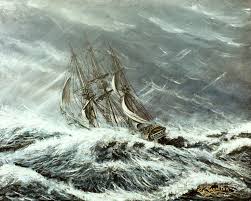
As the Bible likens a restless nation to a stormy ocean, Parliament can be likened to a tall ship caught in this storm, and as the waves sweep over the deck, every crew member is under full strain to keep the sails in position, yet the threat of sinking is never far away, let alone straying off-course. How the thought of land appearing on the horizon stirs the imagination of each crew member as he visualises the safe harbour welcoming them with open arms.


But the harbour is not only out of sight but the stormy ocean seem to be forever shoreless. That is until the captain thinks he could see something on the horizon. Land ahoy? He directs the ship towards it, but as it draws closer, it turns out to be a jagged reef, and dangerous at that, according to the fear lurking in the minds of all on board, the jagged rocks of the reef would tear the hull into shreds, and at best, the ship would run aground, at worse, sink to the depths below, taking the life of all of them.

Therefore, considering the political situation we are in, it comes as no surprise that prayer meetings are arranged by local churches, pleading with God for special wisdom to direct our leaders in the right direction. Although I was told about the strict neutrality of these meetings - neither for Leave or Remain - just godly wisdom bestowed on our leaders in making the right decisions.

On the outside, this seems like a wise move, a proper course to take. Christians praying for their Government and political leaders, for kings and for all in authority is Biblical (eg, 1 Timothy 2:2-4, 1 Peter 2:7, 2 Chronicles 7:14.) Also, Paul wrote in Romans 13:1-7 that there is no authority which has not been established by God, and therefore everyone in authority should be obeyed, as they are servants of God in use to keep evil in check.

Therefore I don't find it wrong to pray for the goodness of our country. For example, our beloved National Health Service (NHS). Intercessory prayer includes thanking God for the NHS and asking him for the NHS to be properly staffed with people who are motivated more with compassion rather than with a career drive. Prayer also including thanking God for our excellent communication infrastructures. This includes transport, TV and radio, newspapers and the internet. By thanking God for these and other institutions designed for both public and individual benefit, and asking God that these infrastructures and institutions can run efficiently by a properly motivated staff and workers is not a bad thing.

But my main concern is not whether we leave or remain in the EU. Rather, I mourn as I witness a country which once had a Christian-based Constitution turn away from God, towards atheist-based secularism, which is fed each day by a constant stream of Darwin's evolutionary theories which undermine the truth of the Gospel and denying its historicity.

EU Headquarters in Brussels.  


As such, if I pray, then it's not whether we leave or remain in the EU. Rather, it's for the Spirit of God to be poured out on a national scale. 2 Chronicles 7:14 says it well: If my people, who are called by my name, humble themselves and pray and seek my face, and turn from their wicked ways, then will I hear from heaven, forgive their sin and heal their land.

The phrase, my people, can only refer to the nation of Israel at the time that was written, and it was written at the time King Solomon was dedicating the newly-built Temple to the Lord. Literally speaking, the full forgiveness of sin and the complete healing of the land remains in the future, after the risen Jesus Christ returns and begins his reign from Jerusalem. Under this Kingdom age, not only sin would be forgiven but eradicated, and the whole of the earth will be restored to an Eden-like paradise, an event which had never occurred since the Fall and the Edenic Curse.

But a partial application can be made in this era. The history of ancient Ninevah and its repentance under the preaching of the prophet Jonah is so outstanding, that the whole book of Jonah was written, dedicated to that particular event. During his first advent, Jesus has remarked that even the people of Ninevah will rise to condemn the Pharisees, who had rejected the Lord's ministry, including his miraculous works which the men of Ninevah had never seen.

During the days of Paul the apostle, the Roman Empire reigned supreme, with its Pax Romana allowing its citizens to live in peace and enjoying freedom from wars and skirmishes. However, Emperor Nero was as corrupt as most other emperors were, including having both male and female lovers, a way of governing which would be scandalous in Britain at present! But he never prayed for any political change. He never prayed for the Roman Empire to be dissolved or taken over by foreigners, nor did he pray for the Emperor to be ousted. Rather, his main concern was that the Gospel may spread unhindered throughout the Empire.

The whole of the 26th chapter of Acts is focused on the discourse between Paul and the three rulers, Festus, Agrippa and Bernice. His desire was not to revolutionise and clean up the Empire but to desire that they would become Christian believers too. "To become as I am, except for these chains."  v. 29. Paul desired that all would repent - to change their minds - and believe that this Jesus of Nazareth is the risen Christ, and turn to him.

There are times when I pray for this nation in the quietness of solitude, whether at home or outside. But those prayers are never about whether to leave or remain in the EU, neither whether our Prime Minister should be ousted, or resign. Nor whether he should attempt to pass a deal with the EU, or to leave without a deal, or to further a delay. It's none of these things. If I was to deliver a prayer for our nation, it's always to do with salvation for all, whether it's for the ministers or the electorate alike.

Therefore when my good friend, Dr Andrew Milnthorpe, invited me to pray for the nation at his church, I first hesitated, then refused.

The regular readers of my blog posts may already be familiar with Andrew, for I have mentioned him several times before. Our friendship with each other is quite unique. Here is a holder of PhD degree, happily united with a retired window cleaner. Culturally, the difference not only couldn't have been wider but very unusual too, for it crosses all social class barriers, a cultural-divide system held dearly by the English. Yet we remain close, perhaps seeing me as an older brother or even a father, as he is young enough to be my son. We, along with my beloved Alex, have spent a couple of weekends away together. The two of us often go swimming and the sauna together, as well as days out in London, to attend a Christian conference or visit museums.

Dr A. Milnthorpe at the London Transport Museum, Aug 2019


As such, he delights in my company during midweek church meetings, such as Encounter, a weekly lunchtime meeting held throughout the school term. And he invited me to this prayer meeting. So why did I decline his invitation this time?

While I voted to remain in the EU during the 2016 Referendum, he voted to leave. And we have both polarised in our opinions ever since! It's amazing, coming to think of it because our differences in political opinion do not get in the way of our friendship and our activities. Except for intercessory prayer for our nation. 

Andrew is a committed Leave advocate, and he has other close friends in his church who are also committed advocates of Leave. At this point, I don't want to appear critical or judgemental, but I cannot help notice that his fellow Christians, nearly all graduates, appear to be far more committed to these political issues than they are of Jesus Christ. And there are Christians in my own church with the same political opinion. I even heard the idea that the European Union is the forerunner of the coming Revived Roman Empire ruled by Antichrist of Revelation 13. To think that leaving the EU is a way to escape the clutches of Antichrist is certainly a sign of ignorance of the full significance of Biblical prophecies! There is no way power-hungry Antichrist will grant the Brits their own independence or their own sovereignty, yet upon such assumptions have these Christians voted to leave the EU.

Of course, there is the imperial mentality prevailing many leave-voters, both inside and outside the church. One elderly gentleman actually explained why he voted Leave. It's so Britain not only becomes an independent sovereign nation but also to revive its former Empire.

Intercessory prayer is a matter of the heart between himself and God. No man can look into the heart in the same way God can. During such prayer meetings such a Christian may pray aloud for God to grant our Government wisdom to carry out His will. But silently, in his heart, he is probably thinking, of course, I meant the right way to leave the European Union. In such company, I doubt if I can settle well, let alone pray together in full harmony.

Maybe it's because I'm passionate about the UK remaining in the EU, neither am I ashamed to admit this, to allow myself to be identified as a European, one who wants to identify myself as one with my fellow citizens in Christ who happen to live just across La Manche.