Total Pageviews

Showing posts with label Fossils. Show all posts

Saturday, 16 April 2022

A Remarkable Story from the Past.

Easter Weekend. And when the Spring weather is here, with the sunshine warming the air and our neighbours enjoying their backyard socials - or garden parties if you prefer to use a more posh language. Wise on them. At least they knew better than to end up stuck in a motorway traffic snarl-up. Should a man be seen walking along the opposite carriageway and enough drivers rubbernecking to create a traffic standstill, this would be more likely to occur during a bank holiday.
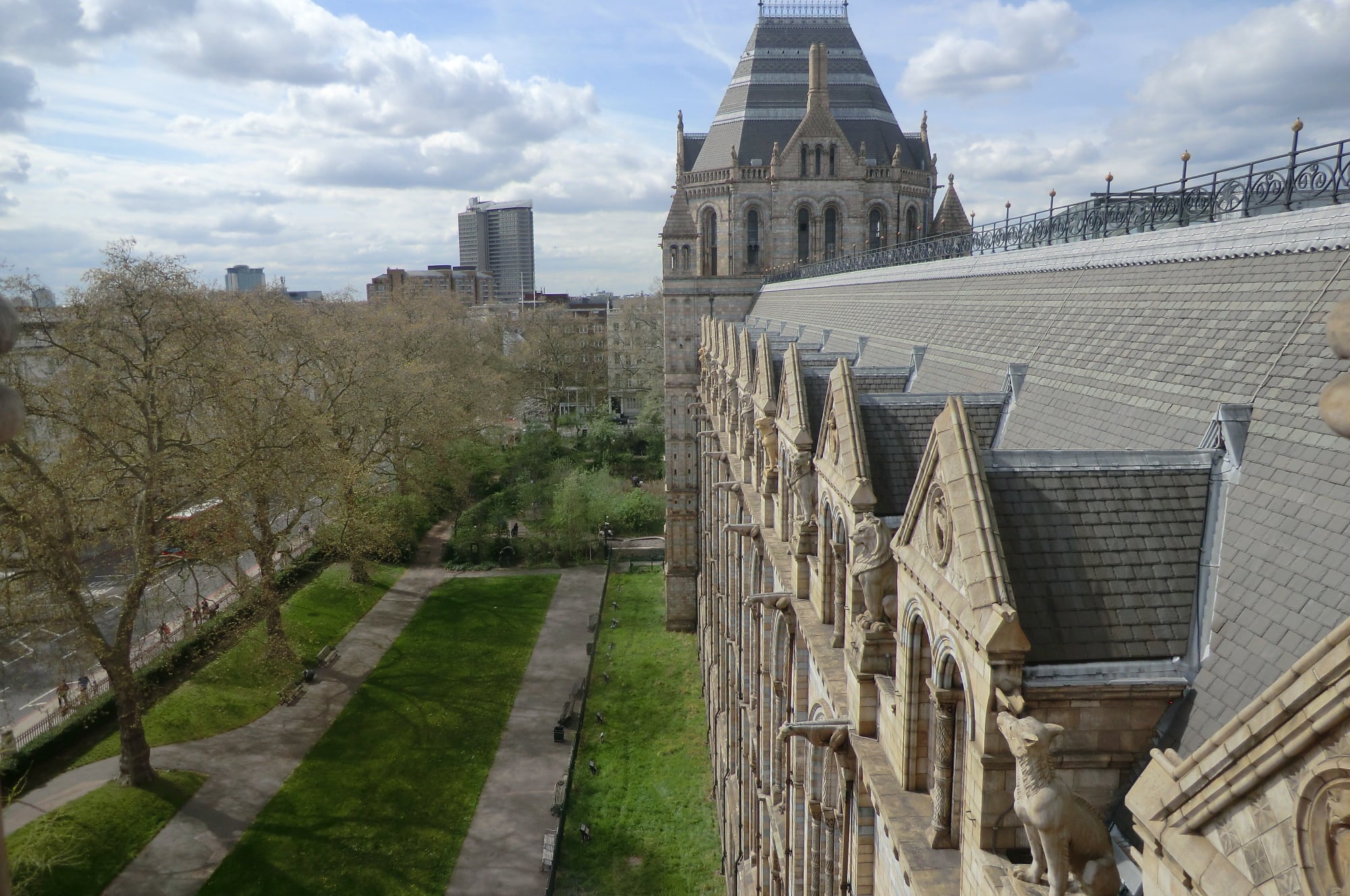
View of the Natural History Museum from the Member's Lounge.


Or at the airports. Indeed, what has happened to travel? For example, I remember 1993. That was the year I flew out to Israel for a two-week stint in Jerusalem. However, I was stuck in the departure lounge at Gatwick Airport for six hours while waiting for a small lubricating oil tube to be fitted somewhere inside the plane. And so, I sat for six hours among a group of Orthodox Jews who took in the situation quite calmly, with several falling asleep. Good for them. At least they weren't showing any near panic like I did by pacing from one end of the lounge to the other every now and again.

But at least, there were no queues when I arrived at the check-in desk. Instead, I was able to walk straight to it and deposit my rucksack. Then within minutes, I made my way to the lounge after passing through security. This easy, no-queue check-in occurred at the start of other trips, including check-in for New York at London Heathrow for both 1975 and 1998 trips and the flight to Singapore in 1997. On one occasion, I recall an almost deserted terminal with the appropriate desk clerk waiting for the next passenger to dispose of his luggage at the conveyor. 

Then again, all these flights were booked for take-off whilst the kids sat in their classes at school and the majority of the population commuted to their workplaces during the middle of the week. Oh, the joys of self-employment where I can choose any time of the year to travel.

And so, as this is the first Easter break without any Covid restrictions for two years, people seem desperate for a holiday, especially overseas. And so, families are told when they can go by both their employers and their children's school term regulations. In addition, the closure of the railways for the holiday period means that the replacement bus is enough to deter anyone from approaching the station and deciding to drive instead. Or to stay at home. Not that the closure of our particular line is unusual. Whenever our trains are running at any weekend, then this must be heralded across the nation!

And so, other lines are closed over the Easter break for track maintenance, including London Euston to Milton Keynes, the main corridor linking our capital to the Lake District National Park, a popular holiday destination.

And so, here in the UK, on the first Easter holidays since the end of the pandemic, travel dominates the news. Crowded airports, road traffic congestion, no trains running, and oh yes, lest I forget, restricted ferry crossing over the Channel, as one company, P&O Ferries, have their two ships detained at port. Thanks to a clever executive who had all 800 trained employees crewing the two ships, fired. Just to save money. Thus, miles of vehicles snake inland away from the port of Dover, and I wonder how many now have regrets about booking a Channel crossing at this time of the year?

Far better to remain at home and in this good weather, enjoy a garden barbeque. At least, that is what our neighbours are currently doing. And when Easter weekend used to be a time of melancholic rumination over the Crucifixion of Jesus Christ two millennia in the past, and then to celebrate his Resurrection on Easter Sunday, instead, spoiled or ruined leisure trips are brooded over by many, others stay at home and barbecue, others go out on an egg-hunt, still, others make every effort to ensure all enjoy a good respite from the daily work routine. But the thought of the intense sufferings endured by a condemned Jew such a long time ago barely receives a thought from the secular-minded, let alone any thoughts of resurrection.

Just the previous evening, my wife and I watched the BBC programme, Dinosaurs: The Final Day, presented by David Attenborough. Although an excellent presentation, I have wondered whether it was merely a coincidence such a documentary was broadcast on Good Friday. It was about how an asteroid plunged into our planet and in a single stroke, wiped out the dinosaurs some 65,000,000 years ago. As a petrified skin of a Triceratops was excavated, even I was amazed that the sandy beach of an ancient river on which the beasts thrived, was overwhelmed by a flood caused by a tsunami created by the asteroid strike, itself a thousand miles away. And the fossil, like all other fossils, bears witness to having been laid by water.

Therefore it was the day before, Maundy Thursday, that I made a second visit to the Museum of Natural History in London, about a month after my first visit. The purpose of this was to examine more fossils that seem to tell a story that differed from Attenborough's presentation.

As I noted the skull of an Ichthyosaur fossilised with a morsel of food still between its jaws, on my first visit, I also examined a Coelophysis that died with a stomach full of a recently eaten meal, believed that of a small crocodile. But on this visit, I managed to examine a full-bodied fossil of another Ichthyosaur. What's extraordinary about this specimen was that it was not only pregnant with three embryos at the moment of death, but a fourth offspring was in the process of being born, tail first, at the moment of death. And nearby, another smaller fossil of an Ichthyosaur had died suddenly with its stomach full.
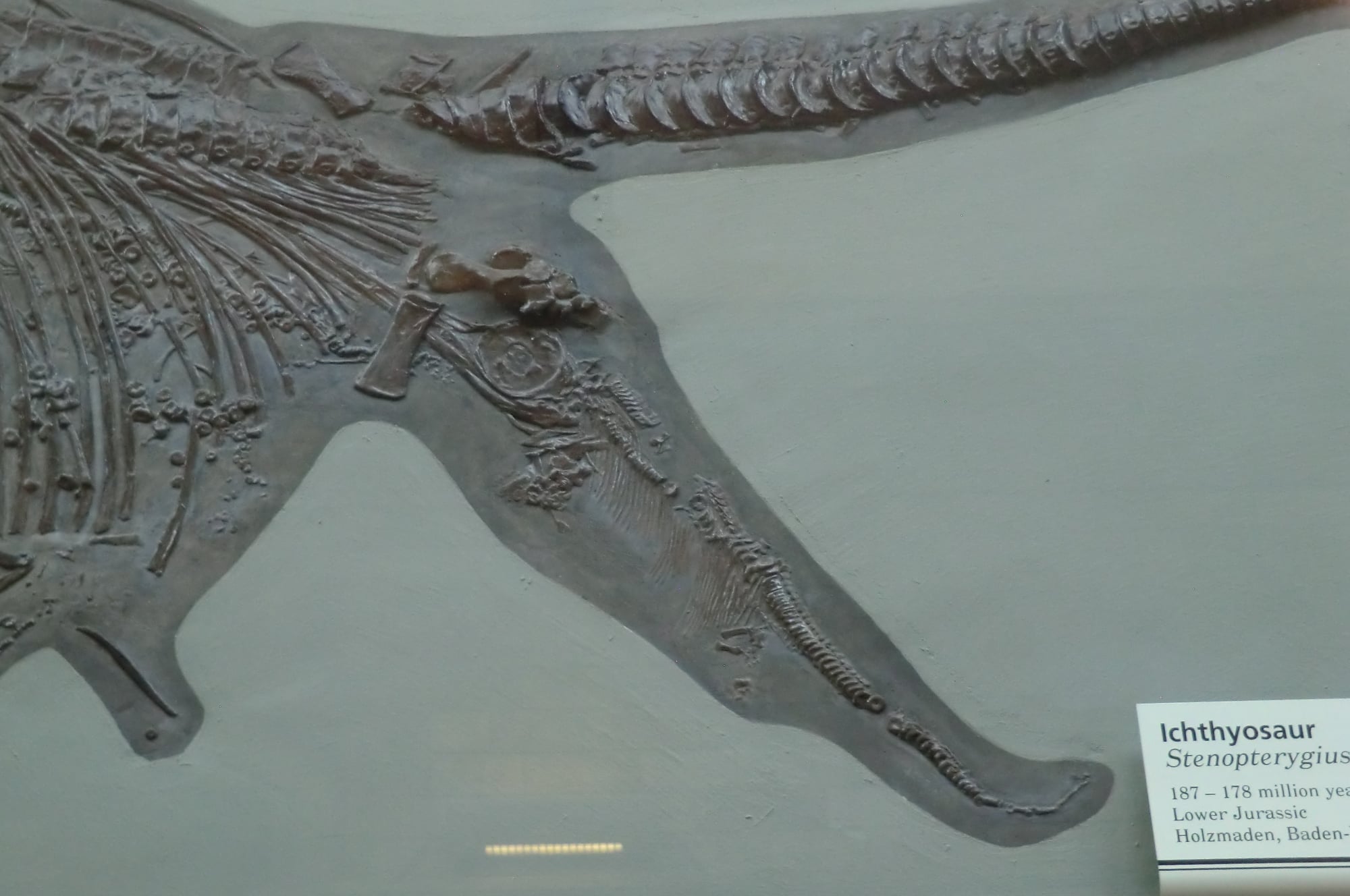
Detail of a baby Ichthyosaur in the process of birth.


What's going on? If the fossil record indicates that the three Ichthyosaurs, along with the Coelophysis, all died suddenly whilst "business as usual" - then was there another catastrophe long before the asteroid strike? For, according to the palaeontologists who dated these fossils, these submarine beasts all died some 178,000,000 years ago, along with the Coelophysis, which died around 196,000,000 years ago. If their calculations are correct, the "slight discrepancy" in their deaths before the date of the asteroid strike is at least 113,000,000 years difference! 

I am astonished by the fossil record. No matter which fossil I examine, they all tell the same story - sudden death and instant burial, although I wonder whether these organisms were actually buried alive. Whichever may be, these visits I have recently made to the museum seem to indicate to me that all these fossils occurred at one moment of catastrophe.

But who am I to make such an analysis? I, a retired window cleaner who had never seen the inside of a university? How could I compare myself with such great academia whose authority is respected worldwide? How could I compare with the likes of Sir David Attenborough? Here am I, a creationist of whom the secular world would class me as one committed to a pseudoscience, especially of the Noachian Deluge dismissed as a fantasy, a legend or even to the point of being ridiculous.

Yet, I live in a country whose Constitution is founded on the Christian Gospel, the good news is that Jesus Christ came to save sinners by dying on a cross, was buried, and three days after burial, he rose physically from the dead. Hence, Easter is celebrated annually to remember this threefold set of glorious events, along with Christmas, the holiday that celebrates the birth of Christ, and also Whitsun, the holiday commemorating the descent of the Holy Spirit at Pentecost. Three Christian holidays define a nation's Constitution, even our monarch, Queen Elizabeth II, profess a strong faith in Jesus Christ as her personal Saviour.

This same Jesus Christ speaks of both supernatural creation and the Noachian Deluge as factual history. I'm then left with a threefold choice: Either I accept, question or reject outright what Christ taught during his ministry. If I accept, which is my lifelong position, then it's imperative that I also accept the early chapters of the Biblical book of Genesis as factual history. Even if such chapters contain a supernatural Creation of all things, the Fall, and the Flood - issues taught with equal certainty by the apostles, Paul and Peter and endorsed as historic by all the other apostles and the early church.

And all that was the standard thinking of a typical Briton before the rise of Charles Darwin. Church attendance was all but compulsory during these annual holidays and they were attended by a majority. Easter was all about Jesus Christ.

Indeed, one Jehovah's Witness-turned-atheist YouTuber asked three rational questions. One was, how could all the animals which are naturally carnivorous and have all the biological and genetic attributes of meat-eating design possibly be created originally as herbivores? The second question was: In the new world to come, how could Jehovah possibly take a naturally carnivorous animal such as a cat, and then transform it into a plant-eater and still be recognised as a cat? And thirdly, if Noah was 500 years old when his three sons were born, then how could Noah and his wife had no children in the 480 years preceding the quick and the repeated birth of Shem, Ham and Japheth?

To all three, as a Creationist, I can't give any convincing answer. But after the Fall, the Edenic Curse seemed to have involved a dramatic change in Eve's anatomy, making childbearing now a painful issue, whence before, it was to be with minimum pain or even no pain at all. If this was true, then it looks as if the curse affected all of creation, with the sudden change in the appearance of all carnivorous and even many herbivores. This might have appeared rather terrifying to both Adam and Eve to have watched this rapid transformation take place in front of them, as the consequential reality of his sin takes hold. Such anatomical changes may have involved the need to defecate for the first time, although I am aware that other Creationists will disagree with me on this. Also, both initial creation and the curse are once-for-all dramatic events that happened at the time and nothing of the kind is happening now.

Just as secular scientists admit that there are gaps in their knowledge of some specific subjects and these gaps will eventually be filled by dedicated research and experimentation, I, in turn, admit that I can't answer the three questions above with any dogmatism. All I can do is speculate. For example, how old Noah was when he met and married his wife, we're not told. He could have married as young as twenty years, but equally, if not more likely, he might have remained single for hundreds of years. This isn't unreasonable. I have known people to have reached old age and never married.

Indeed, such debates can drag on, and it won't bring even the honest doubter to conversion, let alone a staunch atheist. Yet, these questions are broadcasted to any listening members of the public with the resulting conclusion that the Bible is a fictional book written by ancient men who had very little or no knowledge of science and therefore were bound by superstitions and religious beliefs.

Easter is about the Resurrection of Christ.


And so we have a national celebration of Easter. As our neighbours continue to party outside in their back garden, this happy socialising isn't likely about Jesus Christ at all. Rather, it's more likely a celebration of a long weekend, a respite from work, to be glad that the days are getting longer, the weather warmer, the onset of Spring, followed by Summer. The social could also be a means to forget the sorrows of the world, such as the war in Ukraine or the sharp rise in living costs.

But when the egg hunt gets underway among families, and even in churches, my strongest desire is that such enjoyment will be centred on Jesus, for Easter is all about Jesus, who died a torturous death to bring real life to all of us.

I wish you a happy Easter.

Saturday, 26 March 2022

3x2 Witnesses In Darwin's Basilica.

The Basilica San Darwin is one location in the UK I have been familiar with since I was a boy. Equally majestic in its interior structure as St Paul's Cathedral, Southwark Cathedral, il Basilica San Pietro, Westminster Cathedral, or even Westminster Abbey, I ask you which of the six basilicas is the odd one out?

Why, it's il Basilica San Pietro, of course! It's at Vatican City in Rome. The other five are all in London.

Indeed, I can classify the Basilica San Darwin, aka the Museum of Natural History, as a religious building, as its imposing Central Gallery, now known as the Hintze Hall, resembling the interior of a cathedral, with stained glass windows at the far end that's characteristic of any large Christian church, and even surrounded by cloisters. On the landing above a flight of stairs stands a white statue of Charles Darwin sitting rather alone and dwarfed to miniaturisation by the immense structure built in his name.

Hintze Hall, Natural History Museum, Stock photo.

The exhibits dominating the Central Hall had changed at least twice since my first visit as a boy (at first with my parents and then with the class of our primary school.) Back then, if my memory hadn't fazed, I recall a circular platform in front of a dominating skeleton of a Diplodocus, on which stood two lifesize elephants on one side, and two rhinos on the other, also lifesize. Then, afterwards, these mammals were moved elsewhere, and the plaster-cast skeleton held dominance, symbolising the entire museum until 2017, when the skeleton was dismantled to begin a tour of the UK, to be replaced by the real bones of Hope, a young Blue Whale.

Talking of primary school children, I actually saw several lines, all young boys and girls under the age of ten in their school uniforms, walking along in pairs with their supervisors. I was quite surprised. I can recall being in a line myself at that same museum, about age ten, and the leading teacher instructed me to read aloud the words on a sign next to one of the exhibits. I responded with, Please Don't Touch. Then the supervisor told the rest of us to heed my instruction. At least, if this is of any comfort to me, I didn't wear a tie at primary, neither did the other children. I also found myself wondering how those kids really feel about having to wear such stiff uniforms whilst all the adults and teenagers around them wore what they liked and felt less rigid and more at ease. However, they all seemed to have been okay with it.

And so, the statue of Charles Robert Darwin sits enthroned in the Hintze Hall, gazing through its entire length to the doors leading out to Cromwell Road. This very man takes the credit for literally revolutionising our minds from accepting the authority of the Bible as a guidebook for daily living to atheistic secularism. Yet, according to a book written by Christian author and Creationist, Jerry Bergman,* Darwin's book, On the Origin of Species, he was accused of plagiarism by his writings being so similar to that of his contemporary, Alfred R. Wallace - not to mention his predecessors Jean Baptiste Lamarck, George Buffon, Robert Chambers, Patrick Matthew - to these authors giving little, if any credit when Darwin wrote On the Origin of Species.

Yet, here am I standing on the third-floor balcony, looking down into the gallery. The bones of Hope, the Blue Whale partly obscuring the comparatively small statue of Charles Darwin, to whom the museum is centred upon. I make my way to the mineral gallery, a collection of specific rocks, meteors, and ores, including a couple of rocks containing jasper.

I was very impressed with the striking beauty of this mineral in its original form. Despite that it was in shadow, the rock still shone in turquoise-blue candescence, as if illuminated from within like a light bulb. I tried to imagine how the stone would have looked had the rays of the sun had shone directly at it.

Jasper. Isn't this mineral mentioned in the Bible? Furthermore, isn't jasper one of the minerals with which the heavenly Jerusalem will be built, the radiance shining with the very glory of God? Jasper, topaz, emerald, gold, sapphire, and other minerals make up its construction. It's while looking down at the exhibits in front of me that I allow my mind to dwell on the afterlife. As the Scripture says, nobody had ever seen the glories that await all who loves God through faith in Jesus Christ. Yet, not only are such glories promised, according to Scripture, God's will is for all men everywhere to have faith in the Atonement made by Jesus Christ on the Cross, his Burial and Resurrection, and eventually have eternal access to this city.**

And the fate of the lost. According to the Bible, everyone who refused to believe in Jesus in this life will still be able to have a glance at this glorious, candescent city and see for themselves the rapturous joy in all its inhabitants. Their source of torment could well come from the eternal question spinning around their heads: Why didn't I believe when I had a whole lifetime of opportunity? Like this, they will no longer be able to blame God. Instead, they will have only themselves to blame.

Two rocks containing jasper, Natural History Museum.


It's amazing how just two rocks containing jasper can be so inspirational, and for the Christian, allow his imagination to run wild. Yet, their radiant beauty, even in its raw uncut state, inspires me. They had also added further confirmation why I have taken the decision to board a train to spend the day at the museum in the first place - to examine some marine fossils, especially one highlighted by one popular YouTuber, ex-Jehovah's Witness Harrison Cother, in his attempts to disprove the historicity of the Bible, especially around the Noachian Deluge.

There were quite a number of both real fossils and plaster-casts of the originals. Therefore, in the Dinosaur gallery, where a model of a Tyrannosaur comes to life via computer tech, in a nearby cabinet there were two fossilised dinosaur eggs. There are examples of fossilised eggs found around the world. Unless eggs hatch, they tend to perish very quickly, often by predators making a meal of them. They simply don't naturally petrify. At least not at such a frequent rate as the fossil record seem to testify.

Walking a little further in the same gallery, I come across a plaster cast of a fossil skeleton Coelophysis. But what's so striking about this fossil was that within its ribcage were the skeletal remains of a small crocodile in the region where the lungs use to be, apparently still on its way to the stomach just below the lungs. Perhaps for the creature to die suddenly immediately after its last meal could have been merely coincidental. Perhaps the meal was poisonous, or it could have asphyxiated the reptile, or the crocodile, still alive, might have bitten through the stomach, killing its eater. Unlikely. The meal looked thoroughly crushed as if well chewed before swallowing. Then how and why did the Coelophysis die so suddenly? 

Coincidental such an incident might have been. Until, a little later on and in the Marine Fossil gallery, I came across what I call "the star fossil" - the very specimen highlighted by the YouTuber. It was very thoughtful for the Museum to display this particular fossil on the lowest tier, as there are others higher up on the wall which is more difficult to examine closely.

The fossil here is the skull of an Ichthyosaur. But this one still had a morsel of food between its jaws when it suddenly died. The morsel apparently was that of a smaller Ichthyosaur. Wondering whether cannibalism was common among this species, earlier that weekend, we watched a David Attenborough documentary on the Puma, and how often an adult male would consume a rival sire's cubs. And this is common among a wide variety of species - a lone male arrives and attacks a rival male's young, then mates with their mother to procreate its own offspring. Was this the case with the Ichthyosaur?

Such interesting thoughts and ideas. And as Darwin looks with a level of eternal seriousness into his own Hintze Hall towards the entrance doors, beyond those doors the world beats, the traffic moves through the street outside, regulated by traffic lights - red, amber, green. Pedestrians minding their own business. Some are in a hurry, so they stride at a fast pace to get to where they need to go. Others are far more casual, strolling along, chatting lightly, laughing at a joke, all taking advantage of the balmy Spring weather where there's hardly a cloud in the sky. The outside seating at cafes and coffee houses filled with happy-go-lucky people enjoying the good weather to the full, with not a moment's thought of the elderly gentleman sitting eternally inside the museum.

And yet it was mainly he who had influenced their thinking, accepting evolution as a scientific fact and relegating the Bible as legend and myth. Even a student says to his fellow student companion whilst sitting outside at a coffee table, reminding him that Charles Darwin is the central figure of the Natural history Museum. But his friend is one of the very few students who are fully aware that Darwin is not the real father of evolution, contrary to the thinking of the majority, but has plagiarised the writings of his contemporary, Alfred Wallace, who also believed in macro-evolution even before Darwin wrote his famous book. 

Who would have ever thought that while the statue of Charles Darwin attempts to dominate the interior - even if back then, Dippy the Diplodocus and at present, Hope, the Blue Whale now have the greater dominion. Yet, like in any religious building, visitors bow to honour the statue, believing how wonderfully clever and intelligent the man was when alive, Just as Jesus was, so some of them may think, in his day. 

Skull of Ichthyosaur with food in its jaws.


But this week, I have seen three sets of witnesses, two of each, to disprove the very man the museum is dedicated to. They were, 

1. The two rocks containing the precious mineral Jasper.
2. The two fossilised Dinosaur eggs.
3. The two fossil skeletons of preditors who died suddenly during or immediately after eating.

Maybe these three, especially the two fossils, don't sit well with Darwin's macro-evolutionary theories. Rather, they may indicate a sudden worldwide catastrophe, such as the Noachian Deluge. If so, then the day out was to verify the truthfulness of the Bible, and not to disprove it as Darwin intended. 

-----------------------------------------------------------------------------------------------------
*Jerry Bergman, The Dark Side of Charles Darwin, 2011, 2017, Master Books.
**Revelation, chapters 21-22.

Saturday, 18 September 2021

How an Atheist Mocks the Bible

How fortunate I was to enjoy a warm, sunny day for my birthday earlier in the week. Smack in the middle of September and just a few days before the Autumn Equinox. Officially, it's still Summer. Yet so far, September has proven to be more summerlike than August here in the UK, the latter with its daily overcast sky and almost cool enough to turn on the central heating. 

And so, a trip to London to visit a very unusual shop located right in the heart of the city, a privately-owned business, London Fossils Ltd, just behind the British Museum. Here, I bought two rather outstanding fossils to add to our four smaller specimens already at our home display.

Our Home Fossil Display, taken Sept 2021.


Perhaps, the best one of the six on display is the superb preservation of a petrified Trilobite. The specimen is exactly 7 cm long and 2.7 cm across the widest part of its head. I would say that its overall length is roughly half of a fully-grown fossil Trilobite I have seen on display at the University of Oxford Museum of Natural History. I try to imagine it when alive. Quite likely, it was fully submerged in the mud of the shallow ocean floor, and with a higher likelihood to escape the attention of predators and - had it survived to this day - also escape the attention of scuba divers.

According to the Palaeontologist, the Evolutionist, and the Historical Geologist, the Trilobite is classed as an Index Fossil, and it thrived throughout the entire Paleozoic Era, a duration of 300,000,000 years between 500,000,000 and 200,000,000 years ago. The Trilobite marks the beginning of the Cambrian Period, and it survived through the Ordovician, Silurian, Devonian, Mississippian, and the Pennsylvanian periods - only to die off during the Permian Period.* Bad luck for the Trilobite, as it did not survive long enough to appreciate the rise of the wonderful coral reefs which started to form during the Permian Period of the Geological Age! To be fair, 300,000,000 years is a long time for the species to thrive, and even over such a long span, if you place the youngest fossil next to the earliest specimen, both would look exactly the same. Indeed, the Trilobite seems to have shown hardly any signs of "evolution in action."

Along with the two Trilobite fossils, I also have one complete fully petrified remain of an Ammonite Dactylioceras, along with what looks to be a petrified mud bed with many broken Ammonite coils piled on it. It's a shame that all the shells are broken. Had they remained intact, the fossil would have looked beautiful - almost artificial.

When I was a teenager, I had an interest in fossils. I was also an atheist and a very keen evolutionist. Even then, I instinctively knew that I couldn't reconcile my love of Science with Religion. It was during my adolescence was when I hated anything to do with the church. As a Roman Catholic, I found God to be quite distant and unapproachable! How could I believe that God loves me if all he does is keep a record of my sins - unless I go to confess to a priest, take Holy Communion every Sunday and on every holy day, and do penance whenever I'm called to carry it out. Or else it would be an eternity of unbearable suffering in Hell if I were to die with even just one mortal sin in my spirit. I realised that I could be a devoted Catholic all my life - and still end up in Hell! When the priest once tried to reassure me that God loves me despite my sins, I was unable to believe it. I just couldn't see myself going to church every week for the rest of my life.

Therefore, in a way, I subconsciously perceived God as an uncaring father-figure and Science as an all-embracing mother - a comforting female deity from whom I can expand my knowledge and the pride that comes with it, to give me something to live for, and to build enthusiasm for, a reason for living. For me to look around at the natural world and marvel at how everything, including us, had gotten here by chance, the amoeba-to-man progress spanning billions of years, and wondering how our distant descendants may look like and behave. As such, fossils played a role here, and during school breaks, I used to examine each of the many pebbles placed around the perimeter of the playground to drain away rainwater. Very rarely, an imprint of a scallop shell appeared on a stone picked up at random, which I took home and added to my measly collection. 

I had never kept the original collection for long. Maybe, with tiny, insignificant-looking fossils, I eventually scattered the stones across our back garden flowerbeds (discreetly!) Perhaps, it was just as well that, back in the sixties and early seventies, the Internet hadn't yet existed. Had it, chances were I would never have become a Christian towards the end of 1972. I can now click on a video made by a former Jehovah's Witness turned Atheist. Had he been around more than half a century earlier, I would have continued to laugh with scorn at religion by following his lead that the Bible teaches a flat, disk-like Earth, supported by enormous pillars and covered with a solid dome. 

Taught in the Bible?


After just six days after publishing his video on YouTube, ex-JW Harrison Cother had collected 17,000 views on that video alone, out of the 1,748,000 total views on all his mere eleven videos he began posting on YouTube since the end of January 2021. In his latest video, he insists that the Bible teaches a flat Earth.

Using Scripture verses such as 1 Samuel 2:8; Job 9:6, Job 26:7-10; Job 37:18; Psalm 75:3; Psalm 93:1; Psalm 104:5; Psalm 148:3-6; Isaiah 40:22 - this YouTuber sets out to prove that the Bible teaches the Earth as a flat disk covered by a solid dome, or the firmament, on which the "waters above" still fully submerging the outside of the dome, according to Psalm 148:4. Although by checking out all the other verses and seeing that they're all poetic, with Psalm 148:4, he relates this to Genesis 1:6-8 - the initial Creation of the firmament dividing the waters above from the waters below, as factual history, and this water above the firmament is still there, according to the Psalmist, and therefore, never collapsed during the Flood, believed by many Christians and theologians as the source of "the windows of heaven opened" - of Genesis 7:11.

Also, that the Earth is firm and immovable, according to the YouTuber's interpretation of the Bible. By using Psalm 104:5 as a proof text, Harrison Cother then insists that 1 Samuel 2:8 (KJV) and Job 9:6 teaches that the flat Earth rests on pillars as its foundations. Also, he mocks at the Christian's attempt to read the flat, disk-like circle as a sphere in Isaiah 40:22. A thought crossed my mind. Indeed, if he's referring to looking directly at the disk at a 90-degree angle perpendicular to it, would he be actually looking at a hemisphere - if the flat Earth has a dome over it? Surely, to the uninformed observer, he'll be looking at a sphere and not at a flat disk. Yet, as a child, I thought that both the sun - seen through the thin cloud - and the moon were flat disks. How would I know they were spheres unless I was taught that they were?

Anyone watching this video would be thoroughly convinced that the Bible is so unscientific, that it's laughed at to the level of derision if used as a science guidebook. For example, how can the Earth be "firm on its foundations and immovable" when it actually whizzes around the sun at 107,208 km/hour, or 66,616 mph, and rotates at 1,670 km/hour, or 1,037 mph at the Equator? Little wonder that it takes just one atheist to mock the Bible, and the rest of the unbelieving world laughs with him.

As for the fossils, they could either testify for my faith or against it. For example, the rock strata at the Grand Canyon. They're all water-laid deposits that hardened into rock. Geologists say that each layer was gradually formed in a shallow sea, lake or river. Any thoughts about a widespread or a universal Flood is looked upon with contempt. It is as if the scientific world is hostile towards God and His Biblical testimony.

This hostility towards God by secular scientists, I think, has placed many Christian graduates in a very awkward position. I, for one, refuse to feel embarrassed and I will confess my allegiance to Biblical truth. The most likely outcome to this is to be ignored, to be brushed aside. However, throughout the seventies and eighties, I met and associated with many Christian graduates who solved the problem by embracing Theistic Evolution. It's their attempt to compromise and to look acceptable in a scientific world and not face ridicule.

But I have nothing to worry about. Nor do I need to fear the mocker. I don't have to defend the Bible either. Rather, the Bible defends itself. Anyone who reads the above verses - and many others found in Scripture - can see that much of it is poetry. It seems as if the writers had deliberately put it that way so the reader, who did not possess the scientific knowledge in the same way we do, yet can still understand that the natural world he lived in was created by God for Man to inhabit. And man was originally created for intimacy with God. God had inspired the writing of the Bible as a revelation on how a sinful man can be reconciled to a holy God and enjoy eternity with Him.


One example is the criticism made by Sam Harris in his book, Letter to a Christian Nation, concerning the measurement of a circular bath installed by King Solomon near the newly-built Temple in Jerusalem (1 Kings 7:23.) According to Harris, this ratio of Pi is the worst and the most inappropriate approximation even in ancient times. The Babylonians can do a far better job in calculating Pi than the Israelites did, and thus proves his point in the way the Bible deals with maths.

But such criticism isn't necessary. The Bible is not a science book. It was never meant to be a book on science. Rather, it's a revelation on who God is and why we are separate from Him through sin, and through faith, we can be reconciled to God in Jesus Christ, who was crucified, buried, and three days later rose physically from the dead. And He gives eternal life to everyone who believes.

And the origin of fossils? Even the Bible gives a scientific explanation for that.

---------------------------------------------------------------------------------------------------------------
*John C. Whitcombe Jr. and Henry M. Morris, The Genesis Flood, 1961, nineteenth printing, 1975. Baker Books. Page 133. The figures detailed here are American numerics.

Saturday, 7 August 2021

A "Neanderthal" Feeling Intimidated...

A typical weekday morning in August. For once, here in the UK, the usual circular area of low pressure that features the wind, the overcast sky, and the rain, which typifies an average British Summer, must have taken the day off and thus, allowed the sun to shine through the broken cloud. 

As I lay in bed beside my beloved, she made a suggestion. Why not go to Reading? The large town is now defined as a city but has little to show other than the view of the River Kennet as it passes through a modern shopping plaza before joining the River Thames, a little way north of the town. I thought, no, I was there only last week. A trip to London instead? Again, I felt little enthusiasm, but I decided to make a day out of it.

I guess that is what it's like, having retired from paid work due to both age and poor health combined. Not that I see myself as "old aged" - far from it - but being drugged to the hilt with prescribed medication to keep my heart beating at a regular pace... As for "Pensioner" - that's the name of the money I receive each week - a pension. Just as a professional receives a Salary and a manual worker receives his Wages, it's all the same thing, several names, but with equal spending power.

I picked up my camera immediately before leaving for the station. Knowing that I was carrying a camera suddenly inspired me to go to Oxford instead of London. At last, I had a specific purpose for the trip - to photograph some fossils at the University Museum of Natural History. The photos featured in this blog were all taken on this trip.

Oxford University Museum of Natural History


As far as I remember, I had visited this museum twice before. My first visit was with my beloved wife in her wheelchair, and my PhD friend, Andrew, who slowly wheeled her around the galleries while I was giving my full attention to the exhibits. My second visit was on my own a few months later. Both visits were made before the Coronavirus pandemic. On these occasions, I recall the museum having free admission. Therefore, I felt slightly alarmed when I saw what looked like a toll booth placed just outside its entrance.

While I paused, a pretty young female approached, holding a clipboard. She then asked me whether I had booked my timeslot on the Internet before arriving. I felt my skin crawl as I protested that I had come all this way and knew nothing about any online booking. Especially if I had merely walked straight in on my previous visits. Was I about to be turned away? Would I be looked upon as one refused admission by a nightclub doorman? Had I wasted thirty minutes of my life waiting at the station platform as I changed trains midway through the journey?

I think the young lady could see the shock on my face. Thankfully, she decided that I can be allowed in without any need to book. But first, I had to go to the kiosk, where a conversation was taking place between the assistant and another visitor, and I had to wait further until the visitor moved on.

The kiosk was not a toll booth but a "ping station" - where I had to give my name and home phone number. If I came into contact with an infected person, I would receive a phone call with the instruction to isolate myself for ten days. All written with a pencil on paper, as I don't even own a smartphone, let alone being a recipient of the hated "ping" app. At last, I was able to walk into the museum with a massive sigh of relief.

Petrified Crinoids, a soft body organism.


Oxford - a world-famous centre of advanced learning. The very city where young, fledgling medical doctors are in the making. Therefore, I assume that the precautions taken against the virus were more sensible at the museum than, say, all those crammed together in a sealed tube flying some 36,000 feet in the air, or even in a packed nightclub, restaurant, or bar. Indeed, the museum is probably the size of a cathedral. Or cavernous enough to have a high, vaulted roof and perhaps, an adequate ventilating system in operation, hence my freedom to question the need for advanced booking. Indeed, I'm grateful for her with the clipboard. She didn't stick to her formal protocol. Had she, I believe that I wouldn't have been alone in walking away feeling robbed, sad and dejected.

The shortest walking distance to the museum from the station was about a mile, 1.62 km, a twenty-minute trek for most people, according to Google Maps. But by having stiff leg muscles, the walk took me more than twenty minutes each way, probably up to thirty minutes. However, on the outgoing walk, I diverted into the city centre and once there, I had a lunch of tomato soup with a buttered roll, a side bowl of potato wedges and a cappuccino coffee at the Marks & Spencer cafe. Very refreshing and filling, too! But what I found most delightful was, after a fairly long wait for my meal to arrive, how my smile of relief has uplifted the waiter's spirits, enough for the two of us to hold a brief conversation.

The waiter was obviously an immigrant, although from exactly where I couldn't be certain, as I didn't ask. He looked Asian, quite likely Oriental. The incident had opened my eyes. In such a department store environment, there is usually a wait between ordering a meal and actually receiving it. This is even truer, I believe, during the busier lunch period when I chose to order. The tired expression on his face indicated that due to the waiting - complaints, moaning, and the flack thrown at him by customers constantly in a hurry had stressed him out.

Trilobites and Brittle Starfish all died at once.


For the waiter to see me grinning as I directed him to my table, and then receiving a hearty "Thank you" - out of relief that my appetite can now be satisfied - had indeed brought some spiritual refreshment into his otherwise dull existence. This, I find amazing. A smile, a word of appreciation, a gesture making him feel worthy, what an impact that can make! Sitting alone at that table made for one had brought more fulfilment than just a full stomach. After lunch, I continued my walk to the museum.

In the city centre, not a suit-and-tie was seen anywhere, especially in warm weather. But, as I walked through Parks Road towards the museum, a very different crowd passed by, walking in the opposite direction. They all looked incredibly smart. The men wore immaculate suits and ties. The women wore summer frocks or skirts. None of the females was wearing trousers. Some of the men even sported a white carnation in their breast pocket, giving me the impression that they were all attending a lavish wedding. Whatever venue they were heading to, it must have been very posh. Posh enough to arouse my curiosity.

Amazingly enough, after spending around two hours at the Museum, I saw the same posh crowd of young men and women I had seen earlier, heading in the opposite direction as I began my trek back to the station. As they walked past, my curiosity was again aroused, along with a feeling of frustration over my sense of curiosity remaining unfulfilled. One was on his own, a young man, perhaps young enough to be my grandson. As he approached, it was at the tip of my tongue to ask him what this was all about, where he had been and what he was doing. But I did not see any sign of an invitation for me to ask. Instead, he looked straight ahead as he walked past. This English-looking toff was a far cry from the Asian waiter I greeted earlier in the day.

Was I chicken? Perhaps. Or rather, compared to his tall height, slim physique, well-dressed Caucasian, I felt - and perhaps looked - more like a Neanderthal than a Cro-Magnon or simply a modern Homo-Sapien. My fear of being reproved by him was a deterrent from asking, and receiving this kind of answer:-

Where I've been or what I was doing, what business is that to you? 

Indeed, a rebuke I dreaded hearing coming from him. I have wondered whether this crowd were members of the notorious Bullington Club, a society made up from the cream of aristocracy, who attended public schools such as Eton, Harrow, Westminster, St Paul's, Winchester, and Rugby. Our former Prime Minister David Cameron and our present PM Boris Johnson were members of the Bullington Club - which was notorious for its drunken and lewd behaviour. Both leaders of our country were Etonians and former club members. Then I also remembered: the club is exclusively male, with no female members. The passing crowd of toffs at Parks Road, consisting of both men and women, doesn't fit the criteria.

My snap decision to come to Oxford instead of London, the meeting of the waiter at M&S, the sight of smartly dressed toffs marching past me and heading in the opposite direction - what is happening? The reason for visiting the museum was to take photos of some of the exhibits. It's perfectly legal. There are no notices posted anywhere within the building forbidding photography.

Close up view of petrified fish with scales intact.


This blog isn't about any attempts to disprove Evolution. There is enough Creationist's material available to do that. But here, I make a comparison between these smartly dressed Oxford University students (I assume that's who they were) and the likes of myself. Compared to them, I feel like a Neanderthal! Any idea that the Neanderthal was descended from Noah's family doesn't seem to sit well in either a physical, mental or cultural sense, at least, not with me, anyway. But here, the Bible can be reassuring. If the Cro-Magnon and the Neanderthal were both descendants of Noah, then there is nothing stopping them from interbreeding - and that is a theory supported by even the most secular of evolutionists. That means even these toffs, at the pinnacle of the most modern Homo Sapien species, are likely to have traces of the Neanderthal genome in the nucleus of each of their body cells.

The striking detail of petrified fish scales.


But had any of them were in the museum with me, he would laugh with scorn at any idea that these fossils were formed in a catastrophic flood a few thousand years ago. Can't I read the accompanying labels? They say these fossils are from the Jurassic Age, around 160,000,000 years old. That is why, although the details of the fish's scales remain intact, all these soft bodies had petrified. That is, the soft flesh had metamorphosed into stone by the infusing of minerals whilst buried beneath the seafloor.

I suppose here lies the contest between a well-educated toff and the common sense of the "Neanderthal". According to observations, most smaller fishes are eaten alive by larger predators. I would say that the vast majority of smaller fish are eaten alive. But those that die naturally very seldom settle on the seafloor, let alone buried in mud. They are either eaten by scavengers or decompose. The decomposition is normally caused by bacteria living in the water. The chance of a dead organism settling on the seafloor (or on the riverbed) is extremely rare. Yet, these fossils show multitudes of organisms that died suddenly at once and were instantly buried. A catastrophe such as the Flood, recorded in the Bible?

It was a great day out!

Saturday, 21 July 2018

Wow! A Fossilised Pocket Watch.

As the plane soared above the stunning Scottish mountains, I sat there by the window with a sense of astonishment of the view as the airline soared some 35,000 feet 10,670 metres into the clear sky, with the sunshine contrasting the land with the almost black sea and lochs. But with the stunning beauty way below, I also felt a sense of apprehension on what would lie ahead, for this particular 1977 journey from London to Toronto was my first long-haul flight I had ever taken. 

Not that I hadn't flown before. The last trip I took was only a year earlier in 1976, a flight to Tel Aviv. But was that particular flight the longest short-haul flight classified, or the shortest long-haul? After all, a flight from London to Amman, only a small fraction longer, was - and I guess still is - categorised as long-haul. The two preceding flights out of London, one to the Spanish airport of Girona in 1972, and the other to Milan in 1974, were indeed short-haul. Even though I was already nineteen years of age when I first ever boarded a plane, due to my late father's averse to flying combined with his love for the steering wheel, I had never flown with any of my family members.

Therefore sitting alone inside a sealed capsule among complete strangers, I felt a need for divine assurance. And so, during the in-flight meal, I took the bread roll, broke it, and quietly proclaimed,
This is the body of Christ broken for me. And I ate whilst meditating. Then I took the glass of red wine and said,
This is the blood of Jesus Christ that was shed for me. I'll shall drink it in memory of Him, which I proceeded to do.

I did ponder whether I had bestowed a blessing on myself, or whether I had committed a deadly sin, for according to the Catholic Church, I have violated a sacred sacrament by taking it without priestly authority.

And if all that was not enough, a year later in 1978, once again I found myself on board a transatlantic flight, this time from London to New York. And during a mid-flight meal I repeated the sacrament of eating a piece of bread and drinking red wine symbolising the body and blood of Jesus Christ broken and shed whilst hanging on that cross.

Dripping with sweat, inside head of Statue of Liberty, 1978.

I'm glad to say that no harm had ever came to me as a result of these mid-flight self-administered Holy Communion meals, despite what the Church of Rome might think. So far I didn't die and then finding myself tumbling into the eternal fires of Hell. Rather, on both these backpacking trips I felt as if I was blessed. Being close to God, feeling his protective presence where ever I went, never coming across any difficulty in finding a room at every hotel reception I called at.

However, as I sat in the aeroplane full of strangers, there was another important reason on why I self-administered a Communion meal other than for seeking assurance. As a son of Adam and Eve, I was unfortunate enough to inherit original sin from them, which has caused spiritual death and separation from God, with physical death to follow, and a lost eternity spent separated from God's personal presence. But because of the death, burial and resurrection of Jesus Christ, through faith in him I was acquitted from the penalty with all my sins forgiven - past, present and future - and the Righteousness of Christ was credited to my account, and I was adopted into his family as a son of God.

The righteousness credited to my account was Christ's righteousness, not my own! As the Scripture says, 
Now when a man works, his wages are not credited to him as a gift, but as an obligation. However, to the man who does not work but trusts God who justifies the wicked, his faith is credited as righteousness.
Romans 4:4-5.

Therefore the truth of Eternal Security of the Believer, or Once Saved Always Saved, must stand with this truth of justification by faith because such emanates from this truth of the Gospel. Therefore the eating of the Body of Christ and the drinking of his Blood by means of bread and wine attest of eternal salvation gotten through Jesus Christ - a glorious truth in the face of the uncertainty facing me after landing.

But to take Holy Communion mid-flight with such conviction on both trips - surely such a sacrament must be based on factual history. Did Jesus Christ really exist some two millennia previously? Did the Last Supper, on which my in-flight Communion was based upon, itself actually took place? Furthermore, was it him who was crucified and died while still fastened to the cross? After all, Islam insists that it was Judas Iscariot who hung there. And after burial, did he actually rise from the dead? According to one national newspaper, it was thought that Jesus Christ did not actually die, but instead fell unconscious, and was buried in that state, as if he was suffering from catalepsy. Then after waking up, somehow with unimaginable strength, he managed to move the stone covering the mouth of the tomb, and then walked away, probably to a remote desert, never to be seen again.


If any of these things occurred, all which differed to what is recorded in the four Gospels, then really, our faith is in vain, remaining futile, there is no salvation, and all that time spent in church - even if I enjoy singing, praising, praying to God, and listening to sermons, as well as trying hard to love one another despite our different opinions - it would have turned out to be a total waste of time and effort. If I attend church for up to two hours every Sunday for fifty weeks of the year, that would be as much as an annual top up of a hundred hours, or four full 24-hour days where I would be better off spending at a luxury hotel by the seaside. Furthermore, those sacraments taken whilst mid-flight would serve no other purpose but to make a fool of myself in view of anyone watching.

All these things came to mind while we were watching a television documentary about the Jurassic Coast, presented by Dan Snow, Lucy Cooke, and wheelchair-bound Niall Strawson. This three-part series occupied an hour-long slot on BBC Four, therefore down from peak evening viewing of BBC One. As we were watching the third programme, I felt my spirit sink into sadness and hopelessness as the words evolve, evolution, and evolutionary were constantly repeated. Throughout the entire three hours of broadcast, not one word about God, Supernatural Creation or Noah's Flood was mentioned. However, it was Lucy Cooke who, with a moment of hesitation, used the word designed in her description of a fossil with intricate detail.

Perhaps the Lord, with a sense of humour, does allow the presenter to let her guard slip on occasions. And no doubt, as I see it, the Jurassic Coast is a testimony of the Biblical Deluge, which stretches from Old Harry Rocks which are the chalk stacks east of Swanage, all the way west to Exmouth, on the River Exe estuary. The resort of Lyme Regis, where many fossils are displayed and sold, lies on the Dorset side of the border with Devon, itself midway along the Jurassic Coast.

And so the public is fed to the hilt with how these fossils of mainly marine creatures, are out-and-out proof of organic evolution - despite that these lifeforms look to all have died together at one instance. And how my spirit sank in very much the same way those creatures sank to the bottom of the ocean. Because, like the newspaper testimony above, if evolution is a scientific fact, then my faith in Christ is a sham and the Christian faith is a worthless ideology. For Darwinism is a direct denial that Jesus is the Christ who atoned for our sins.

While Dan Snow dealt mainly with human history around that stretch of coast, particularly of wartime tanks and submarines, Lucy Cooke narrated on the fossils so frequently found here. A fossil expert who was with Cooke picked up what looked like a large rounded limestone pebble. He then struck it with a hammer, and the two halves came apart to reveal a beautifully-detailed fossil ammonite. When asked how he knew that this ordinary-looking pebble contained such a intricate fossil, his answer was that by looking at the surface, some detail of the edge can be seen. I guess this can be referred to as a ham-roll effect. Only the edge of the ham at the outer surface can reveal its presence between the two bread roll halves.

The ammonite remains represent the ideal fossil of a creature which lived in the Jurassic Period somewhere between 145,000,000-200,000,000 years ago. That's pretty old, and such remains found embedded in limestone are classed as a true fossil, a thought-view which carries the notion that it takes millions of years for a dead organism to fossilize. And this theory of tremendous longevity is essential for Darwin's evolutionary theories to hold true. And such theories are spoon-fed to the public which in turn accept without any ado. And furthermore, no one in his right mind would dare throw a challenge. If the challenger is a man in the street, he would simply be ignored. If a graduate or a university professor and civil engineering, such as the late Henry M. Morris, then its likely that he will be ostracised by the scientific community, who will write papers debunking his Creationist stance. 

It was within the first fifteen minutes of the second show when something I consider to be very remarkable. Here stood Lucy Cooke talking to an expert about some sealed bottled perfumes, together with a couple of china vessels and statuettes, all of them around a hundred years old, found at a shipwreck off the coast of Dorset. And next to the porcelain was an insignificant-looking lump of rock. And fully embedded in the rock was what looked like a man-made artifact. After thorough cleaning and examination, the artifact turned out to be a pocket watch, almost entirely entombed in solid rock in virtually the same way the ammonite was entombed in a limestone pebble.

The rock featured on the BBC: A watch "fossilized".


A pocket watch embedded in "crud" - solidified mud.

Interestingly enough, Cooke remarks that it will take a further 130,000,000 years before the watch will be a "proper" fossil. But going by the hardness of the rock, isn't it a fossil already? What is the real difference between it and that of the ammonite? Except for its age and of different rock composition? The rock in which the watch is embedded is given a name "crud", which is mud consolidated into rock. What I find so fantastically remarkable about this exhibit is that if a man-made artifact of little more than a hundred years of age can be entombed in solid rock at an amazingly quick time, then why does the ammonite need millions of years to achieve the same result?

It is as if God is desperately trying to tell us something, and just by looking at all the fossils found around the coast and elsewhere, one obvious conclusion can be drawn, and that is all fossilised organisms - whether its marine life, plant and trees, birds, or land animals including Dinosaurs, must have died very quickly, were buried and preserved as fossils over a very short duration. At is as if God is saying, Hey, look guys. What I have written in my Book is historic and true. There was a universal Deluge in the days of Noah, and you are looking at the evidence right now. Oh, so you want more proof that fossilization is quick and recent? Well there you are, a watch preserved in stone. There you have it.

As I stand, this revelation is vital for the Christian faith. Mythologize any part of the Bible, especially the early chapters of Genesis, and the Christian faith will go down like a house of cards. But even the reality of Noah's Flood isn't by means all and end all. Rather it's the historical truth of Adam and Eve. For the reality of Jesus Christ can only stand if Adam and Eve were real too, along with Divine Creation and the Fall, as well as the Deluge, the cause of the formation of fossils. Because through their transgression sin entered the world and death to all men. This concept, which is within the very heart of the Christian faith, can only stand if there was an Adam and Eve, and they were created direct from the ground as the Bible teaches, and were not descended from a human line gradually going back to the primates, as all of these must have died already, before the Fall, therefore nullifying the purpose of Jesus Christ and the Atonement he made on the Cross. 

Saturday, 12 May 2018

An Academic Conflict at Oxford.

As one born of the Baby Boom generation (ie, born between the years 1946-1964) I was taken back by the news of three suicides committed by students at Bristol University, each within a short proximity of each other. According to one source, in 2015, 134 university students took their own lives* whilst another source gives 146 for the year 2016.** Therefore I would not be too surprised if the stats topped 150 for 2017.

And they weren't even the Millennials as we know them, as their agreed birth years were between 1980-1994, but more likely from Generation Z, who were born from 1995 onward. As I tried to work out in my mind why on earth there is such a high rate of mental disorder among students. It was then my wife Alex immediately gave the answer which eluded me - finance.


Of course, why didn't I think of that? With University courses costing around £9,000 a year, a debt of  £27,000 for a three year course does not bode well for the peace of mind every student would wish for. Instead, such a debt would hang over his head for a good spell of his lifetime. Such a situation for an individual is a vivid contrast with a student from the Baby Boomer generation, the one I was born into. Very few would have entered University in the first place. Those who did would have been a student at either Oxford or Cambridge, and then be given a grant from the Government - an income to live on during studies which had no need to be paid back.

Back then, to graduate and to hold a degree was really worth something. He was virtually a god, with any employer scrambling to have such a person, normally a male back then, on their staff roll. A doctor's authority was looked upon as on equal footing as the Gospel itself. And there is no other such vivid demonstration of this than in my schooldays. It was at the boys changing room for P.E., in the gym or for Games at the sports pitch. If a pupil fails to bring his kit, then the punishment was between one to five strokes of the slipper across the buttocks administered by the master, depending on the age of the boy. But if the student hands over a letter written by his GP, then the master would honour the pupil's abstinence from the lesson with a degree of reverence. Indeed, during the sixties, a GP was apparently credited with divine attributes, at least that how it seemed to the rest of us. By mentioning of holding a degree, this would bring out all the ooh's and the aah's, especially from the females. And that I do know. I actually saw this happening in my former church during the seventies.

And so this reverence for knowledge, and the universal desire to possess such knowledge, must be high on the minds of our present-day students who, contrary to the Baby-boomer graduates, I have found to be the targets of vitriol whenever some administration failure occurs, especially in the area of information technology. It is quite a vivid contrast to my day as school leavers. If an adolescent left school without any qualifications, he usually ended up as a dogsbody at a factory, workshop, garage, or anywhere where manual labour was held as a permanent vocation. This sort of thing was not uncommon. Yet I hardly heard of any cases of mental illness, let alone suicide among us younger set. Instead, we took everything in our stride, including scoldings and vitriol, which I, for one, saw more as character-building rather than mentally and emotionally destructive.

Therefore little surprise on why I found our present student's mental disorder statistics difficult to grasp. My wife had a sharper sense of discernment. I was still in the 1960's train of thinking. Putting it all together, I could not help but see for myself why having such level of knowledge can be contrary to Biblical faith. Of course, I'm referring to the age-old conflict between Divine Creation and Uniformitarian Geology.  

Just this morning I attended an annual men's conference at a local church (not my home church). The theme for this year was whether we as believers have the courage to take risks for the glory of God through faith in Jesus Christ. Later in the session we all split into small groups. It was during one of these small-group discussion and prayer when I felt God speak to me. I was made aware of this by God by means of a feeling of relief and joy over the revelation. I am to stand up for the truthfulness of Divine Creation as opposed to Uniformitarian Geology and Darwinism, which is believed in and accepted as scientific fact, not only by the secular world but by many Christians as well. God would not allow me to compromise. There's never been a "halfway house" with me when it comes to accepting Theistic Evolution. I either had to accept a literal 6 x 24-hour creation day, recorded in Scripture, or accept Darwinism in its purest form of secular standing. I resolve always to accept exactly what the Bible teaches.

And that may cause conflict. And my conviction did bring clashes, especially against my own father, who was a devout evolutionist. He was even too embarrassed to admit to others that he had a son who actually believe in this kid's story of Creation and the Flood. And in the factory where I worked, to believe in this raised issues for discussion with my colleagues on the shop floor, and apathy among those who were working in the office. Yet the idea of Divine Creation is very important to me. And very important to every Christian believer alive with us.

It was a gorgeously warm and sunny Bank Holiday Monday when my wife Alex and I, along with my PhD holder and Creationist friend Andrew, all made a trip to Oxford to visit the University Museum of Natural History. Considerably smaller than the sister museum in London where we had recently visited, but actually more educating in the true spirit of Oxford, I allowed Andrew to take care of Alex in her wheelchair, whilst I paid special attention to a row of cabinets on one side of the gallery.

University Museum of Natural History, Oxford.


These cabinets each housed a selection of fossils, and arranged in chronological order, from Cambrian to Cretaceous - at the most, about 475,000,000 years apart in geologic age. Unfortunately, I only took photos of the Jurassic cabinet and the Cretaceous cabinet, the two periods being next to each other on the geologic time scale, but one collection of marine fossils going back to the maximum of 201,000,000 years. The other cabinet holding the more recent Cretaceous marine fossils dating between 66,000,000 and 145,000,000 years of geologic age. Therefore, any observer would accept the vast age difference of these rocks simply because it tells him on the title label at the upper corner of each cabinet. Nearby was a display of a fair sized limestone slab, probably 18" x 12" 46 cm x 30 cm which was overlaid with scaled fish, similar to carp, if that wasn't carp. Unfortunately, I did not record or snap a picture of this particular display, and because of that, I did have plans to return to Oxford on my own to fulfil this purpose before writing this blog, had Alex been happy with the proposal!

But the point is, that anyone studying these displays would have walked away convinced of the evidence for Uniformitarian Geology and Darwinism - simply by observing the labels displayed at each cabinet. But nearly all these fossil-bearing rocks look remarkably similar, as if all these marine organisms were entombed and preserved all at the same time. All these, along with the fish on the slab.

Which presented quite an anomaly. Because whenever fish die, it hardly ever settles on the seafloor. Instead it becomes food for the scavengers. This together with the food chain, it's very seldom for a fish to die a natural death. The vast majority becomes prey for the high population of predators. But here we see fish entombed en-masse in stone, as if all perished at once and immediately preserved. And it looks as if this applied to all the fossilised organism on display, regardless of age. Basically they all looked the same, as if all died and were preserved at just one occasion. And there's supposed to have been up to 475,000,000 years in age difference between them!

Display cabinet containing fossils from the Jurassic Period.

Fossils from the Cretaceous Period, all taken May 2018.


And that is why believing in Creation and the Deluge, I think, is so vital for the Christian faith and to every believer. Because if fossilisation was meant to preserve a record of Evolution, that means one of two ideas: 

1. That Adam and Eve had never existed, but we are all evolved from primates, as secular Darwinism insists. And if our first parents had never existed, then neither the Fall had taken place and death is merely a natural phenomenon, both for human and animal alike. If death plays an essential role in the process of Natural Selection and Evolutionary process, then sin has no part except as a biological quirk developing late in the process, and therefore totally eliminates the need for an Atonement.

2. Adam and Eve existed, but each had a father and mother, all mortal. This, I believe, is a central tenet for Theistic Evolution. The problem is: Were Adam's parents human or sub-human? Or Eve's parents? If they were fully human, did they remain immortal, even after the Fall? But if they were sub-human, then how apelike did they look? And if mortal, then death was already at work in the world before the Fall, therefore making non-effect the Atonement of Christ.

Indeed, there are more questions than answers. But just by departing from the literal truth presented in the Scriptures resulting in such devastating theological concepts, including the study of Christology. But it is the denial of the truthfulness of Holy Scripture which leaves the academic community with little to go by except to make great efforts to prove that these rocks are much older than what Holy Scripture allows, and to pass this on to the rest of us.

Knowledge in itself is a wonderful quality to have, a very wonderful quality. Indeed, mental illness and even suicide is out of a potential failure to acquire this quality, and then to face the extortionate debt to pay afterwards. Little wonder many present-day students are suffering from excess stress. And I believe even my friend Andrew might have felt concern as I delved into these fossil cabinets. Concern that I may be "converted" from being a Creationist to becoming an Evolutionist, and with a possibility of heading down the road towards atheism. All by reading labels with a growing conviction that these scientists might have been right after all.
---------------------------------------------------------------------------------------------------------
*The Guardian Newspaper, 2 September, 2017.
**The BBC.