Total Pageviews

Showing posts with label Natural History Museum. Show all posts

Saturday, 16 April 2022

A Remarkable Story from the Past.

Easter Weekend. And when the Spring weather is here, with the sunshine warming the air and our neighbours enjoying their backyard socials - or garden parties if you prefer to use a more posh language. Wise on them. At least they knew better than to end up stuck in a motorway traffic snarl-up. Should a man be seen walking along the opposite carriageway and enough drivers rubbernecking to create a traffic standstill, this would be more likely to occur during a bank holiday.
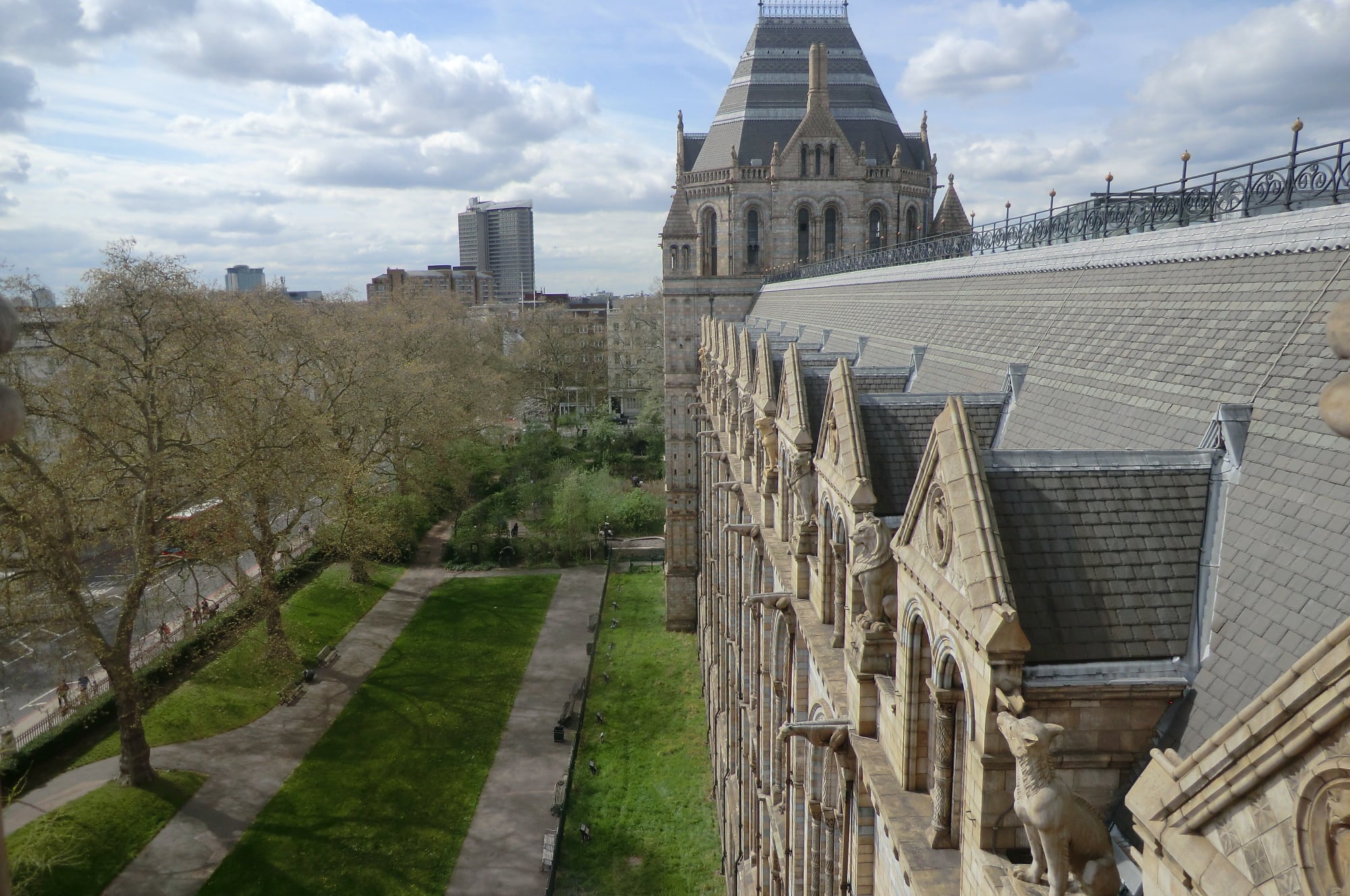
View of the Natural History Museum from the Member's Lounge.


Or at the airports. Indeed, what has happened to travel? For example, I remember 1993. That was the year I flew out to Israel for a two-week stint in Jerusalem. However, I was stuck in the departure lounge at Gatwick Airport for six hours while waiting for a small lubricating oil tube to be fitted somewhere inside the plane. And so, I sat for six hours among a group of Orthodox Jews who took in the situation quite calmly, with several falling asleep. Good for them. At least they weren't showing any near panic like I did by pacing from one end of the lounge to the other every now and again.

But at least, there were no queues when I arrived at the check-in desk. Instead, I was able to walk straight to it and deposit my rucksack. Then within minutes, I made my way to the lounge after passing through security. This easy, no-queue check-in occurred at the start of other trips, including check-in for New York at London Heathrow for both 1975 and 1998 trips and the flight to Singapore in 1997. On one occasion, I recall an almost deserted terminal with the appropriate desk clerk waiting for the next passenger to dispose of his luggage at the conveyor. 

Then again, all these flights were booked for take-off whilst the kids sat in their classes at school and the majority of the population commuted to their workplaces during the middle of the week. Oh, the joys of self-employment where I can choose any time of the year to travel.

And so, as this is the first Easter break without any Covid restrictions for two years, people seem desperate for a holiday, especially overseas. And so, families are told when they can go by both their employers and their children's school term regulations. In addition, the closure of the railways for the holiday period means that the replacement bus is enough to deter anyone from approaching the station and deciding to drive instead. Or to stay at home. Not that the closure of our particular line is unusual. Whenever our trains are running at any weekend, then this must be heralded across the nation!

And so, other lines are closed over the Easter break for track maintenance, including London Euston to Milton Keynes, the main corridor linking our capital to the Lake District National Park, a popular holiday destination.

And so, here in the UK, on the first Easter holidays since the end of the pandemic, travel dominates the news. Crowded airports, road traffic congestion, no trains running, and oh yes, lest I forget, restricted ferry crossing over the Channel, as one company, P&O Ferries, have their two ships detained at port. Thanks to a clever executive who had all 800 trained employees crewing the two ships, fired. Just to save money. Thus, miles of vehicles snake inland away from the port of Dover, and I wonder how many now have regrets about booking a Channel crossing at this time of the year?

Far better to remain at home and in this good weather, enjoy a garden barbeque. At least, that is what our neighbours are currently doing. And when Easter weekend used to be a time of melancholic rumination over the Crucifixion of Jesus Christ two millennia in the past, and then to celebrate his Resurrection on Easter Sunday, instead, spoiled or ruined leisure trips are brooded over by many, others stay at home and barbecue, others go out on an egg-hunt, still, others make every effort to ensure all enjoy a good respite from the daily work routine. But the thought of the intense sufferings endured by a condemned Jew such a long time ago barely receives a thought from the secular-minded, let alone any thoughts of resurrection.

Just the previous evening, my wife and I watched the BBC programme, Dinosaurs: The Final Day, presented by David Attenborough. Although an excellent presentation, I have wondered whether it was merely a coincidence such a documentary was broadcast on Good Friday. It was about how an asteroid plunged into our planet and in a single stroke, wiped out the dinosaurs some 65,000,000 years ago. As a petrified skin of a Triceratops was excavated, even I was amazed that the sandy beach of an ancient river on which the beasts thrived, was overwhelmed by a flood caused by a tsunami created by the asteroid strike, itself a thousand miles away. And the fossil, like all other fossils, bears witness to having been laid by water.

Therefore it was the day before, Maundy Thursday, that I made a second visit to the Museum of Natural History in London, about a month after my first visit. The purpose of this was to examine more fossils that seem to tell a story that differed from Attenborough's presentation.

As I noted the skull of an Ichthyosaur fossilised with a morsel of food still between its jaws, on my first visit, I also examined a Coelophysis that died with a stomach full of a recently eaten meal, believed that of a small crocodile. But on this visit, I managed to examine a full-bodied fossil of another Ichthyosaur. What's extraordinary about this specimen was that it was not only pregnant with three embryos at the moment of death, but a fourth offspring was in the process of being born, tail first, at the moment of death. And nearby, another smaller fossil of an Ichthyosaur had died suddenly with its stomach full.
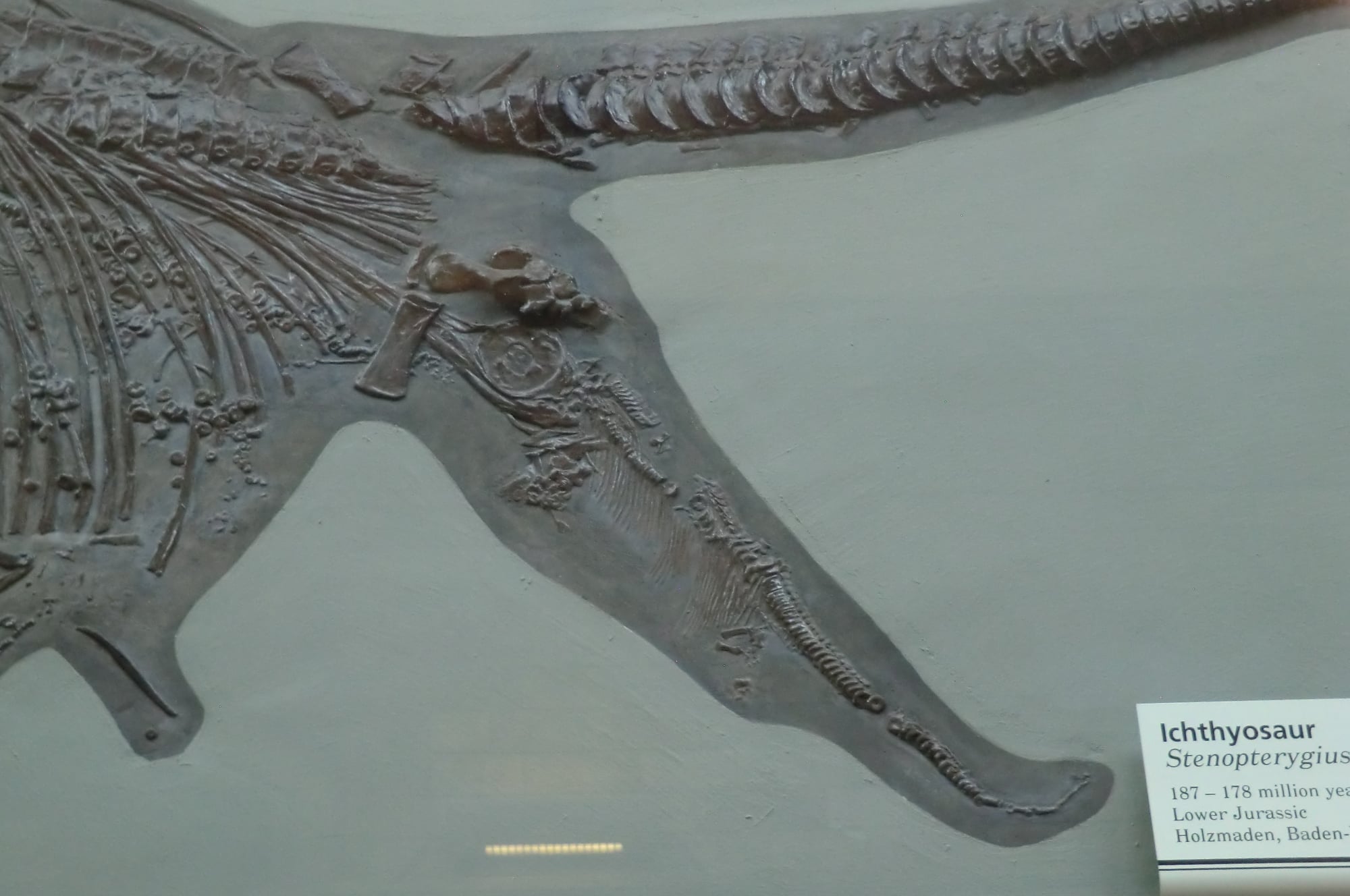
Detail of a baby Ichthyosaur in the process of birth.


What's going on? If the fossil record indicates that the three Ichthyosaurs, along with the Coelophysis, all died suddenly whilst "business as usual" - then was there another catastrophe long before the asteroid strike? For, according to the palaeontologists who dated these fossils, these submarine beasts all died some 178,000,000 years ago, along with the Coelophysis, which died around 196,000,000 years ago. If their calculations are correct, the "slight discrepancy" in their deaths before the date of the asteroid strike is at least 113,000,000 years difference! 

I am astonished by the fossil record. No matter which fossil I examine, they all tell the same story - sudden death and instant burial, although I wonder whether these organisms were actually buried alive. Whichever may be, these visits I have recently made to the museum seem to indicate to me that all these fossils occurred at one moment of catastrophe.

But who am I to make such an analysis? I, a retired window cleaner who had never seen the inside of a university? How could I compare myself with such great academia whose authority is respected worldwide? How could I compare with the likes of Sir David Attenborough? Here am I, a creationist of whom the secular world would class me as one committed to a pseudoscience, especially of the Noachian Deluge dismissed as a fantasy, a legend or even to the point of being ridiculous.

Yet, I live in a country whose Constitution is founded on the Christian Gospel, the good news is that Jesus Christ came to save sinners by dying on a cross, was buried, and three days after burial, he rose physically from the dead. Hence, Easter is celebrated annually to remember this threefold set of glorious events, along with Christmas, the holiday that celebrates the birth of Christ, and also Whitsun, the holiday commemorating the descent of the Holy Spirit at Pentecost. Three Christian holidays define a nation's Constitution, even our monarch, Queen Elizabeth II, profess a strong faith in Jesus Christ as her personal Saviour.

This same Jesus Christ speaks of both supernatural creation and the Noachian Deluge as factual history. I'm then left with a threefold choice: Either I accept, question or reject outright what Christ taught during his ministry. If I accept, which is my lifelong position, then it's imperative that I also accept the early chapters of the Biblical book of Genesis as factual history. Even if such chapters contain a supernatural Creation of all things, the Fall, and the Flood - issues taught with equal certainty by the apostles, Paul and Peter and endorsed as historic by all the other apostles and the early church.

And all that was the standard thinking of a typical Briton before the rise of Charles Darwin. Church attendance was all but compulsory during these annual holidays and they were attended by a majority. Easter was all about Jesus Christ.

Indeed, one Jehovah's Witness-turned-atheist YouTuber asked three rational questions. One was, how could all the animals which are naturally carnivorous and have all the biological and genetic attributes of meat-eating design possibly be created originally as herbivores? The second question was: In the new world to come, how could Jehovah possibly take a naturally carnivorous animal such as a cat, and then transform it into a plant-eater and still be recognised as a cat? And thirdly, if Noah was 500 years old when his three sons were born, then how could Noah and his wife had no children in the 480 years preceding the quick and the repeated birth of Shem, Ham and Japheth?

To all three, as a Creationist, I can't give any convincing answer. But after the Fall, the Edenic Curse seemed to have involved a dramatic change in Eve's anatomy, making childbearing now a painful issue, whence before, it was to be with minimum pain or even no pain at all. If this was true, then it looks as if the curse affected all of creation, with the sudden change in the appearance of all carnivorous and even many herbivores. This might have appeared rather terrifying to both Adam and Eve to have watched this rapid transformation take place in front of them, as the consequential reality of his sin takes hold. Such anatomical changes may have involved the need to defecate for the first time, although I am aware that other Creationists will disagree with me on this. Also, both initial creation and the curse are once-for-all dramatic events that happened at the time and nothing of the kind is happening now.

Just as secular scientists admit that there are gaps in their knowledge of some specific subjects and these gaps will eventually be filled by dedicated research and experimentation, I, in turn, admit that I can't answer the three questions above with any dogmatism. All I can do is speculate. For example, how old Noah was when he met and married his wife, we're not told. He could have married as young as twenty years, but equally, if not more likely, he might have remained single for hundreds of years. This isn't unreasonable. I have known people to have reached old age and never married.

Indeed, such debates can drag on, and it won't bring even the honest doubter to conversion, let alone a staunch atheist. Yet, these questions are broadcasted to any listening members of the public with the resulting conclusion that the Bible is a fictional book written by ancient men who had very little or no knowledge of science and therefore were bound by superstitions and religious beliefs.

Easter is about the Resurrection of Christ.


And so we have a national celebration of Easter. As our neighbours continue to party outside in their back garden, this happy socialising isn't likely about Jesus Christ at all. Rather, it's more likely a celebration of a long weekend, a respite from work, to be glad that the days are getting longer, the weather warmer, the onset of Spring, followed by Summer. The social could also be a means to forget the sorrows of the world, such as the war in Ukraine or the sharp rise in living costs.

But when the egg hunt gets underway among families, and even in churches, my strongest desire is that such enjoyment will be centred on Jesus, for Easter is all about Jesus, who died a torturous death to bring real life to all of us.

I wish you a happy Easter.

Saturday, 26 March 2022

3x2 Witnesses In Darwin's Basilica.

The Basilica San Darwin is one location in the UK I have been familiar with since I was a boy. Equally majestic in its interior structure as St Paul's Cathedral, Southwark Cathedral, il Basilica San Pietro, Westminster Cathedral, or even Westminster Abbey, I ask you which of the six basilicas is the odd one out?

Why, it's il Basilica San Pietro, of course! It's at Vatican City in Rome. The other five are all in London.

Indeed, I can classify the Basilica San Darwin, aka the Museum of Natural History, as a religious building, as its imposing Central Gallery, now known as the Hintze Hall, resembling the interior of a cathedral, with stained glass windows at the far end that's characteristic of any large Christian church, and even surrounded by cloisters. On the landing above a flight of stairs stands a white statue of Charles Darwin sitting rather alone and dwarfed to miniaturisation by the immense structure built in his name.

Hintze Hall, Natural History Museum, Stock photo.

The exhibits dominating the Central Hall had changed at least twice since my first visit as a boy (at first with my parents and then with the class of our primary school.) Back then, if my memory hadn't fazed, I recall a circular platform in front of a dominating skeleton of a Diplodocus, on which stood two lifesize elephants on one side, and two rhinos on the other, also lifesize. Then, afterwards, these mammals were moved elsewhere, and the plaster-cast skeleton held dominance, symbolising the entire museum until 2017, when the skeleton was dismantled to begin a tour of the UK, to be replaced by the real bones of Hope, a young Blue Whale.

Talking of primary school children, I actually saw several lines, all young boys and girls under the age of ten in their school uniforms, walking along in pairs with their supervisors. I was quite surprised. I can recall being in a line myself at that same museum, about age ten, and the leading teacher instructed me to read aloud the words on a sign next to one of the exhibits. I responded with, Please Don't Touch. Then the supervisor told the rest of us to heed my instruction. At least, if this is of any comfort to me, I didn't wear a tie at primary, neither did the other children. I also found myself wondering how those kids really feel about having to wear such stiff uniforms whilst all the adults and teenagers around them wore what they liked and felt less rigid and more at ease. However, they all seemed to have been okay with it.

And so, the statue of Charles Robert Darwin sits enthroned in the Hintze Hall, gazing through its entire length to the doors leading out to Cromwell Road. This very man takes the credit for literally revolutionising our minds from accepting the authority of the Bible as a guidebook for daily living to atheistic secularism. Yet, according to a book written by Christian author and Creationist, Jerry Bergman,* Darwin's book, On the Origin of Species, he was accused of plagiarism by his writings being so similar to that of his contemporary, Alfred R. Wallace - not to mention his predecessors Jean Baptiste Lamarck, George Buffon, Robert Chambers, Patrick Matthew - to these authors giving little, if any credit when Darwin wrote On the Origin of Species.

Yet, here am I standing on the third-floor balcony, looking down into the gallery. The bones of Hope, the Blue Whale partly obscuring the comparatively small statue of Charles Darwin, to whom the museum is centred upon. I make my way to the mineral gallery, a collection of specific rocks, meteors, and ores, including a couple of rocks containing jasper.

I was very impressed with the striking beauty of this mineral in its original form. Despite that it was in shadow, the rock still shone in turquoise-blue candescence, as if illuminated from within like a light bulb. I tried to imagine how the stone would have looked had the rays of the sun had shone directly at it.

Jasper. Isn't this mineral mentioned in the Bible? Furthermore, isn't jasper one of the minerals with which the heavenly Jerusalem will be built, the radiance shining with the very glory of God? Jasper, topaz, emerald, gold, sapphire, and other minerals make up its construction. It's while looking down at the exhibits in front of me that I allow my mind to dwell on the afterlife. As the Scripture says, nobody had ever seen the glories that await all who loves God through faith in Jesus Christ. Yet, not only are such glories promised, according to Scripture, God's will is for all men everywhere to have faith in the Atonement made by Jesus Christ on the Cross, his Burial and Resurrection, and eventually have eternal access to this city.**

And the fate of the lost. According to the Bible, everyone who refused to believe in Jesus in this life will still be able to have a glance at this glorious, candescent city and see for themselves the rapturous joy in all its inhabitants. Their source of torment could well come from the eternal question spinning around their heads: Why didn't I believe when I had a whole lifetime of opportunity? Like this, they will no longer be able to blame God. Instead, they will have only themselves to blame.

Two rocks containing jasper, Natural History Museum.


It's amazing how just two rocks containing jasper can be so inspirational, and for the Christian, allow his imagination to run wild. Yet, their radiant beauty, even in its raw uncut state, inspires me. They had also added further confirmation why I have taken the decision to board a train to spend the day at the museum in the first place - to examine some marine fossils, especially one highlighted by one popular YouTuber, ex-Jehovah's Witness Harrison Cother, in his attempts to disprove the historicity of the Bible, especially around the Noachian Deluge.

There were quite a number of both real fossils and plaster-casts of the originals. Therefore, in the Dinosaur gallery, where a model of a Tyrannosaur comes to life via computer tech, in a nearby cabinet there were two fossilised dinosaur eggs. There are examples of fossilised eggs found around the world. Unless eggs hatch, they tend to perish very quickly, often by predators making a meal of them. They simply don't naturally petrify. At least not at such a frequent rate as the fossil record seem to testify.

Walking a little further in the same gallery, I come across a plaster cast of a fossil skeleton Coelophysis. But what's so striking about this fossil was that within its ribcage were the skeletal remains of a small crocodile in the region where the lungs use to be, apparently still on its way to the stomach just below the lungs. Perhaps for the creature to die suddenly immediately after its last meal could have been merely coincidental. Perhaps the meal was poisonous, or it could have asphyxiated the reptile, or the crocodile, still alive, might have bitten through the stomach, killing its eater. Unlikely. The meal looked thoroughly crushed as if well chewed before swallowing. Then how and why did the Coelophysis die so suddenly? 

Coincidental such an incident might have been. Until, a little later on and in the Marine Fossil gallery, I came across what I call "the star fossil" - the very specimen highlighted by the YouTuber. It was very thoughtful for the Museum to display this particular fossil on the lowest tier, as there are others higher up on the wall which is more difficult to examine closely.

The fossil here is the skull of an Ichthyosaur. But this one still had a morsel of food between its jaws when it suddenly died. The morsel apparently was that of a smaller Ichthyosaur. Wondering whether cannibalism was common among this species, earlier that weekend, we watched a David Attenborough documentary on the Puma, and how often an adult male would consume a rival sire's cubs. And this is common among a wide variety of species - a lone male arrives and attacks a rival male's young, then mates with their mother to procreate its own offspring. Was this the case with the Ichthyosaur?

Such interesting thoughts and ideas. And as Darwin looks with a level of eternal seriousness into his own Hintze Hall towards the entrance doors, beyond those doors the world beats, the traffic moves through the street outside, regulated by traffic lights - red, amber, green. Pedestrians minding their own business. Some are in a hurry, so they stride at a fast pace to get to where they need to go. Others are far more casual, strolling along, chatting lightly, laughing at a joke, all taking advantage of the balmy Spring weather where there's hardly a cloud in the sky. The outside seating at cafes and coffee houses filled with happy-go-lucky people enjoying the good weather to the full, with not a moment's thought of the elderly gentleman sitting eternally inside the museum.

And yet it was mainly he who had influenced their thinking, accepting evolution as a scientific fact and relegating the Bible as legend and myth. Even a student says to his fellow student companion whilst sitting outside at a coffee table, reminding him that Charles Darwin is the central figure of the Natural history Museum. But his friend is one of the very few students who are fully aware that Darwin is not the real father of evolution, contrary to the thinking of the majority, but has plagiarised the writings of his contemporary, Alfred Wallace, who also believed in macro-evolution even before Darwin wrote his famous book. 

Who would have ever thought that while the statue of Charles Darwin attempts to dominate the interior - even if back then, Dippy the Diplodocus and at present, Hope, the Blue Whale now have the greater dominion. Yet, like in any religious building, visitors bow to honour the statue, believing how wonderfully clever and intelligent the man was when alive, Just as Jesus was, so some of them may think, in his day. 

Skull of Ichthyosaur with food in its jaws.


But this week, I have seen three sets of witnesses, two of each, to disprove the very man the museum is dedicated to. They were, 

1. The two rocks containing the precious mineral Jasper.
2. The two fossilised Dinosaur eggs.
3. The two fossil skeletons of preditors who died suddenly during or immediately after eating.

Maybe these three, especially the two fossils, don't sit well with Darwin's macro-evolutionary theories. Rather, they may indicate a sudden worldwide catastrophe, such as the Noachian Deluge. If so, then the day out was to verify the truthfulness of the Bible, and not to disprove it as Darwin intended. 

-----------------------------------------------------------------------------------------------------
*Jerry Bergman, The Dark Side of Charles Darwin, 2011, 2017, Master Books.
**Revelation, chapters 21-22.

Saturday, 7 April 2018

Enjoyment, Disaster, Reminiscences

I would consider myself fortunate to have been born in the early 1950's. Yes, rather fortunate indeed. One of the Baby Boomers, that generation who had to endure a childhood growing up in a culture where "you are seen but not heard", educated at a Secondary Modern school, sometimes referred to as the "Academic Trash Bin" by the more snobby Grammar school pupils and maybe their staff as well. And those were the days when many a male teacher and staff member had a cane in his desk drawer, ready to be whacked across the palm of anyone singled out for misbehaviour - an offence even small enough as talking whilst walking through the corridor to get to the classroom from morning assembly.

Having failed the eleven-plus, my destination to get my hands dirty in a vocational, non-academic factory job was already predetermined even before my first day at secondary school. And their predetermination came to fruition in 1968 when I joined a local all-male family-owned furniture-making factory, where my very first task was to sweep the workshop floor. But I ought to be thankful for one small matter. That is, unlike most other school-leavers with me, I did not have to make tea for the entire workforce. However, on just one morning during that five-year stint, I was told to make the teas. Innocently enough, I poured almost a third of an entire Brooke Bond packet of tea leaves into this very large industrial aluminium teapot, much to the shock of the governors, who always made the other boys use no more than half a teaspoon, which is even less than I use to make a single cup at home. It was no surprise that I was not allowed near the kettle again, although I can honestly plead, hand-on-heart, that there was no malicious intent. Thank goodness for the later invention of tea-bags!


As I see it, these initial five years of my working life as a dogsbody has never been considered harmful, bur rather beneficial in the process of adolescence, that stage in life slotted in between childhood kindergarten and an adult adapting to the brutality of the real world. And if a constant stream of swear-words and the most low-level smut contributed towards this way of growing up, so be it. At least I never had to be under this modern-day "helicopter parenting" when even unsupervised playground activities are now considered "risky". Like the case I read in today's newspaper, in which the staff at one school in Surrey have petitioned for a century-old Sweet Chestnut tree located in the schoolyard to be cut down because, "during Autumn the fallen leaves can be rather slippery". Oh dear! Elf 'n' Safety off its rocker again.

As a result of this start to life, more than once I was looked upon as "brave" - just because I had, and still have - an itch for lone independent travel, which is something I have always enjoyed immensely. A dream indeed fulfilled. Yet, how could I ever forget, for example, when preparing to hike the Grand Canyon in 1995, the "dire warnings" I received from my well-educated and well-meaning church friends, all still unmarried, about rattlesnakes, coyotes, and other forms of wildlife which can pose a threat to my well-being whilst in the desert. I replied that if I was to think this way, I might as well stay at home, even feeling too timid to step out of the front door. At least throughout my childhood living, when Mum sent me out on my own to buy one or two items of grocery, I had never developed agoraphobia.

And independent travel opened my eyes to the this big, beautiful world outside the coastline of the UK. And this is not about package hotels on the Spanish Costa, but the need to bed-hunt as I travelled from one destination to the next, particularly throughout the 1970's. Back then I wasn't aware of hostels until 1985 - traditional youth hostels that is, as backpacker's hostels were of a later development. Instead, when it came to looking for a hotel, mine was always the case of "off the street" instead of pre-booking. That is, to walk into a hotel, approach the reception desk and ask whether there is a room available. I started this towards the end of my teenage years here in the UK, but from 1973 onward, I had no trouble with overseas off-the-street bed-hunting whilst travelling through Italy, Israel, Canada and the USA. Especially across North America in 1977 and 1978 when the first thing I did after stepping off the Greyhound bus was to look for a nearby hotel, walk in and ask if there was a vacant room. And in every case I was offered a room with no qualms. 

Also to note that I stayed clear of luxury five-star establishments. Instead, with such a limited budget for every trip, I always went for one to two-star, which is a basic bedroom with shared bathroom facilities. Back in the seventies, some of these hotels, such as in Salt Lake City, San Francisco, Vancouver, Winnipeg, and Los Angeles, the hotel I chose to stay in was within view of the Greyhound Bus terminal, therefore making bed-hunting so straightforward. Like the morning in 1978 when I exited the bus terminal in downtown Los Angeles to see the imposing Hotel Cecil directly across the street. (However, if you consult Google Earth for verification, you will see big changes having taken place over the years. For example, although Hotel Cecil in downtown LA is still there, opposite where the bus station once stood, the site is now a car park, the bus station having moved to East 7th Street, I believe, to save on site rental.) 

By the nineties I have gotten fully used to hosteling. With former traditional HI youth hostels metamorphosing into backpackers accommodation in order to remain in business, I had no trouble with off-the-street bed-hunting whilst in Israel, the USA, Singapore and Australia. Oh yes, there was just one occasion after stepping off the train at Katoomba Station in New South Wales. The hostel of my choice had turned me away with an apology and an explanation that all the beds were taken by a group of students who had just arrived for field work at the nearby Blue Mountains National Park. So I had to walk around town to find an unaffiliated private hostel, and sure enough, when one appeared, I was offered a bed upon entry.
   
All this reminiscence on hotels and hostels and how easy it was to get a room for the night or for several nights. And so was I in for one heck of a rude shock on Easter Monday! This what happened. A good friend, Andrew by name, a doctor and geneticist to boot, accompanied us for a day trip to London to visit the Natural History Museum in South Kensington. The train journey was uneventful, not suffering any problems or delays, and we arrived at the museum in good time. We had a fantastic afternoon there. I allowed Andrew to wheelchair Alex slowly through the galleries while I sauntered behind to study the exhibits on display.   

Marine Gallery, Natural History Museum, taken April 2, 2018

It was when we were on our way to Earls Court Underground station that Alex began to suffer back pain of great intensity, leaving me in a panic and Andrew bewildered. Right opposite the station entrance, Alex slipped out of her wheelchair and squirmed on the sidewalk, attracting some spectators. It was then that no other option but to call for an emergency ambulance.

I must have had a bad phone signal. Because the Ambulance Controller kept asking me to spell the name of the station we were at:

"Earls Court Station. E-A-R-L-S  C-O-U-R-T," I said.
"Can you repeat that?"
"E-A-R-L-S  C-O-U-R-T," I shouted above the din of traffic.
"I didn't quite get it. Can you spell it out again?"
"E!---A!---R!---L!---S!    C!---O!---U!---R!---T!"
"There may be up to two hours before the ambulance arrives. I'm so so sorry, but we're very busy."
!!!TWO HOURS???
"I'm very sorry."

However, one of the bystanders also phoned the Ambulance Control Centre soon after getting through myself. About fifteen minutes later, whilst helplessly watching my wife squirm in agony, and could only give her some useless reassurance and comfort, the welcoming wail of the ambulance siren could be heard through the din of traffic down the busy street. When the vehicle momentary appeared then disappeared behind a bus, I went to the middle of the street to wave the driver's attention.

It took a while for the crew to settle Alex in. With an oxygen mask and a good dose of morphine, Alex began to settle as the ambulance made the short journey to Chelsea & Westminster Hospital. There she was detained for several hours on a course of morphine and Diazepam. At the start of this period of time I dismissed Andrew from the hospital A&E ward, allowing him to return home by himself.

By 23.30 hours Alex, who was feeling a lot better except from a mild ache, was ready for discharge. All I had in mind is to find a hotel for the rest of the night before boarding the train homeward the next day. Reminiscing on the past, I felt assured that, being the end of the holiday weekend, there should be plenty of empty rooms awaiting occupancy. As I wheeled my wife out of the hospital into the dark deserted street, I felt under compulsion to turn back into the A&E Reception. Two staff members were behind the screen, a middle-aged Englishman and beside him, a younger Mediterranean or Asian-looking fellow. As I spoke to the older gentleman about whether there are any hotels nearby, he just shook his head without saying anything. But the younger fellow immediately left his seat and approached us, asking whether we have booked a hotel via the Internet.

"No I didn't, because I have no present access to the Internet. Surely there must be plenty of unoccupied rooms." I reasoned.

Then the young fellow explained: Not a single hotel in London would accept us without an Internet booking. Do I have a mobile phone or tablet? When I explained that my mobile isn't connected, he then offered to book a hotel room for us, using his own mobile phone. Or else we are left to wander the streets of London all night. After a couple of moments searching, the young man suggested a Travelodge about seven minutes away by taxi. When I accepted his suggestion, he made the booking for us via his tablet and I had to pay there and then. Then we waited for the arrival of the taxi, which he also booked, which then took us to the hotel.

Alex at A&E, shortly before discharge.


All this goes to show how stuck in the past I have always been. Believing in the easy and casual life I have always known, how was it ever possible that heightened security has made living without technology virtually impossible? It is a very sad situation - the need for Internet booking before arriving at a hotel in the middle of the night. Oh, how I long for the good old days of the seventies!

And how is my perception of God throughout all this? It is very tempting to think God loves some people much more than others! For example, it looks to all the world that most Christians I know personally are in good health, middle class, financially secure, are in good jobs, able to raise ideal families, and can have anything they want. Basking in God's love. As for us, although we were looking forward for a Eurostar trip to Marseilles on the south coast of France later this year, I have decided that because we live on a constant knife-edge, it's now considered way too risky to make the trip. The chance of Alex going down in severe pain whilst overseas would be catastrophic, believe me!

Why does the Lord allow all these things to happen? And why us? Why was it Alex, my beloved wife, who was squirming on the sidewalk outside the station, among a high city population of reasonably healthy individuals? There are more questions than answers. But this I determine: My faith and loyalty to God will never fail. I will always trust him and his wisdom. I am thankful that if Alex is destined to have a "downer" as I call it, then I am thankful that it occurred on the street next to a known landmark rather than on board a train where the pull of the emergency cord would have disrupted the entire line from Waterloo to Reading.

Or what, for that matter, had she gone down with severe pain whilst on board the Eurostar halfway between London St Pancras and Marseilles St Charles? Yes, what then? Indeed, the situation would have been much worse. True enough, the London incident was bad enough, but who knows, it might have just saved us from impending catastrophe with a five-digit hospital bill to follow.