Total Pageviews

Showing posts with label Geology. Show all posts

Saturday, 20 July 2024

Travel Biography - Week 109.

The Tale of Two Cities.

All Manhattan photos posted here are from the Broadway Hike, 1998.

Between 1997 and 1998, I visited two major cities. The two couldn't be more different, yet the principle for survival remains the same - the struggle for survival and the means for living at a given location, including stiff competition and even conflict among its inhabitants. Both have their share of aesthetics, yet they also have their share of danger. Yet, each remains suited to its environment, and I, as a visitor, was delighted to see both. 

I'm making a comparison between the Great Barrier Reef and New York City. Both are established settlements.

However, the reasons for visiting these two venues were also different. I visited the Reef simply because it was there and I had easy access to it. After my first visit to Green Island Coral Cay, I became an enthusiastic convert. By contrast, my initial reason for visiting New York City was to escape from the possibility of England winning the 1998 FIFA World Cup football. For the record, one afternoon, I was walking through Greenwich Village, and from a window of a tenement, someone was shouting loud cheers across the street. I knew what the commotion was about, so I looked up and called out, Who won the Cup?

France was his answer, after defeating Brazil by 3 goals to nil. I shouted my thanks to him, feeling relieved that it was all over, and the trophy was to remain in the host country rather than cross the Channel to England.

A view of Amsterdam Avenue from the Hostel Dorm.


Starting the Broadway Hike near 104th Street.


72nd Street subway Station (right).


Columbus Circle.


How do I think of New York City? Having grown up in London and loved it, I saw some similarities between our home capital city and New York (along with Brussels and Paris). However, since London's geological bedrock is Clay, skyscrapers didn't exist until far more recently, when their foundations penetrated far deeper into the harder rocks beneath the Clay bed. In turn, the geological foundation of New York consists of Gniess, Marble, and Schiss, all three very hard metamorphic rock beds suitable for supporting tall skyscrapers. Hence, the Flatiron Building was the first skyscraper to go up, followed by the Chrysler Tower in the 1930s, then overtaken by the Empire State Building, and eventually the Twin Towers of the World Trade Center, the second at the time in world height to the Sears Building in Chicago. 

This was my fourth visit to New York, after twice in 1978 and once in 1995. All three visits lasted no more than a day, although, in 1978, I stopped in New York twice on the same backpacking trip, the first time after arriving from London Gatwick, and the second stop a month later on the same day after a long bus ride from Miami Beach in Florida, before heading to the airport to fly back home. It was during this second, end-of-holiday visit that I stood on the rooftop overlook of one of the twin towers of the World Trade Center.

What's my opinion of New York? I liked the city very much. Although busy with traffic and urban, with many of its buildings looking blocky and lacking aesthetics, there were some natural areas without the need for a long journey to reach. Indeed, Central Park, known as the lung of the city, has its own natural beauty and is man-made. However, in the Bronx, north of Manhatten, the New York Botanical Gardens features the original forest that once covered the whole of Manhatten Island before the arrival of European settlers. However, for anyone into ancient history, New York is not the place to be. Even in London, there are remains of Roman ruins dating back to AD 47, along with the Tower of London which was completed by William the Conquerer in 1078. But even London pales in contrast with the Italian city of Siracusa with its ancient Greek ruins, and Jerusalem in Israel, dating back to Canaanite times, approximately 2,000 BC. Having visited all these sites around the world, no wonder that I feel there is something positive about independent travel!

Looking back at 8th Avenue from Colombus Circle.


Approaching Times Square.


Times Square.


Flatiron Building.


Hostel Life.

HI-AYH New York City on 103rd Street and Amsterdam Avenue was the largest hostel in the world with 624 beds in 1998. Due to the number of backpackers using it, it was almost like a small town in itself. Despite its population size, I didn't make any friends while I was staying there. Each kept himself to himself or within his group. The dormitory was fine, but what I found shocking was the member's kitchen. For the size of the hostel, the kitchen was tiny, and although it was stocked with cooking utensils, there were no cutlery, dinner plates, or cereal bowls. Although there was a large dining room adjoining the kitchen, it was, for some reason, closed and out of service. Thus I had to eat in the kitchen.

I managed to get hold of some plastic cutlery, but for the evening meal, I literally had to eat out of the frying pan, and breakfast out of a mixing bowl. Furthermore, I was one of very few, if any members, who used the kitchen for preparing and eating meals. It became obvious to me that New York wanted us all to sample their many restaurants, coffee bars, and eateries. And I visited coffee bars and eateries during the day, but stuck with self-made meals for breakfast and supper, as sticking with life on a shoestring.

New York Rapid Transit.

Throughout the nine days I spent in the city, I became more familiar with the Rapid Transit system, or the subway. The entrance to a subway station from the street is quite different from the shop-like entrance in London. In New York, the entrance is little more than a square hole in the sidewalk, with steps leading to the ticket hall underground. The subway consists of several underground railways patterned after the London Underground. But instead of each line having a name, such as the Picadilly, Northern, Central and District Lines that characterise the London system, New York lines are simply 1, 2, 3, etc, and A, B, C, etc. Hence, to get to 103rd Street from the airport, I took a train on Line A, which was a direct route between the two points. But for 42nd Street and Times Square, as well as to Battery Park, I used Lines 1 and 2, Line 1 trains were non-stop after 103rd Street to 42nd Street, while those on Line 2 stopped at all the other stations in between. One interchange station I became acquainted with was Columbus Circle on the southwestern corner of Central Park. It linked Line 2 with Lines A, C, B, and D, while the trains of Line 1 passed through fast without stopping.

As for the fares, the single price remains stable regardless of the distance covered, unlike that of Transport for London, whose fares increase with the length of distance covered. Hence, I was able to buy a small canister of tokens. Each of these was about the size and weight of a pound coin, and when I fed one into the barrier, a small sign lit with the word Go, and the gate opened. These canisters were on sale at all stations and newsagents. This does make me wonder: If the Rapid Transit system in New York was able to apply one fare for all journeys and apparently do well, why can't the Brits adopt the same idea? 
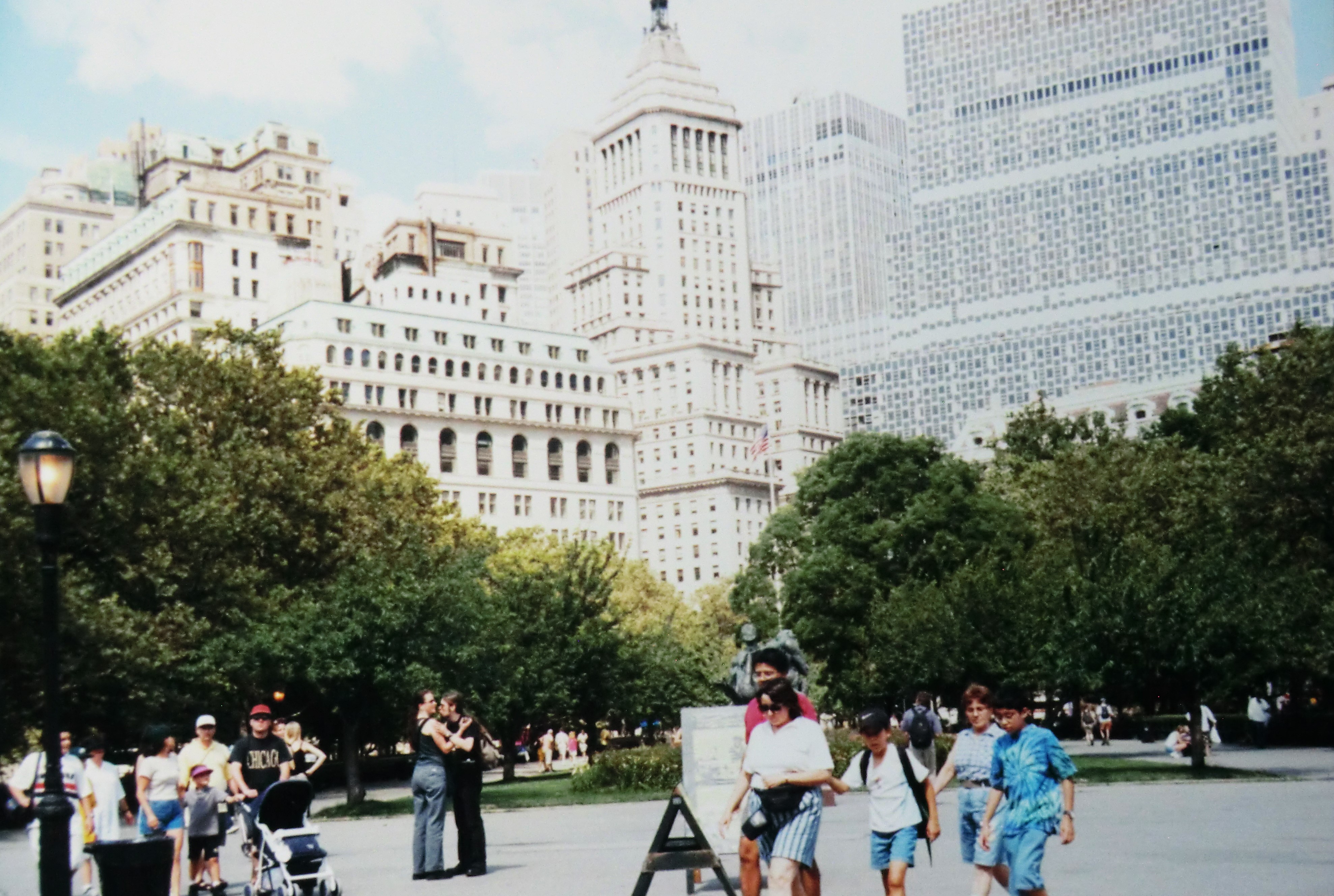
Union Square backed by the Consolidation Edison Bdg.


City Hall Building.


Memorial, Union Square.


Castle Clinton National Monument. 


Castle Clinton National Monument, Interior.


The Broadway Hike.

On one of the days I spent in New York, I wanted to try the Broadway Hike. Normally, this begins at Harlem and ends at Battery Park. But where I started was short of Harlem, at 104th Street. According to Google Maps, the hike is 7.2 miles long, but aware of the starting location, after reaching Castle Clinton National Monument, I carried on with the hike, making my way to the start of Brooklyn Bridge, and as I walked along the elevated boardwalk, I crossed the East River to Brooklyn. One of the first buildings I saw after crossing over was the Watchtower Headquarters, the source of all Jehovah's Witness governance and literature. Its huge Watchtower sign faced directly towards Manhatten, and I believe, it was lit up at night. (For the record, the Headquarters has since moved to a modernised facility in Tuxedo Park, close to the border with New Jersey.) In all, the hike, which lasted the best part of the day, was around nine miles, a tad shorter than the Bright Angel hike into the Grand Canyon.

To get to the start of the hike, I walked along 104th Street until it intersected with Broadway itself. It was there that I turned left and followed the street until I reached the Financial Centre at the southern tip of the island.

Broadway doesn't comply with the rest of the city's symmetrical grid, instead, it transverses diagonally eastwards. Hence, Columbus Circle is where Broadway intersects with 8th Avenue marking the western edge of Central Park, and 59th Street. As I was crossing the Circle, I literally felt the ground shake very slightly as a fast subway train was passing through directly under where I was walking.

Boardwalk, Brooklyn Bridge.


Montague Street, Brooklyn Heights.


Other landmarks I saw during the hike include 72nd Street subway station, so far the only station with a building instead of a hole in the sidewalk. Then I passed through Times Square - where Broadway intersects with 7th Avenue at 45th Street, although the subway station serving this area was under 42nd Street and it was called that - 42nd Street.

Further down, where Broadway crosses 5th Avenue at 23rd Street, I pass Madison Square Park which was backed by the white stonework of the Metropolitan Life Building. This was followed by the Flatiron Building, New York's first official skyscraper before its height was overtaken by the Chrysler Building. The Broadway then continued on until it crossed 14th Street, where Union Square is located. This open space was backed by another white edifice, the Cosmopolitan Edison Building. Finally, I divert off the Broadway to arrive at Castle Clinton National Monument in Battery Park, on the southern tip of Manhatten.

I turned around to head northeast to the start of the Brooklyn Bridge and crossed the East River until I arrived at Brooklyn itself, and I wandered into town. Although I said that the hike was nine miles long, that didn't include the return walk to Battery Park where I caught the evening train back to 103rd Street Station and a short walk back to the hostel.
----------------------------------------------------------------------------------------------------------------
Next Week: A look at Central Park and a boat trip with great significance.

Saturday, 29 October 2022

Travel Biography - Week 20.

Some Grand Canyon Information.

The Grand Canyon of the Colorado River is one of the World's Natural Wonders, and another is the Great Barrier Reef, off Queensland. I had the incredible privilege to visit both, the latter in 1997.

My first visit to the Grand Canyon was in 1978, and my second visit was in 1995. During my first visit, the Instamatic 110 camera, which I had at the time, failed to take proper photos of the experience. Therefore the need for another stop in the next convenient year, which was in 1995. Therefore, the photos included in this week's blog are from the 1995 visit. Since I will be concentrating on the 1978 visit, again, like last week, I apologise if you feel that the originality of this article was compromised.

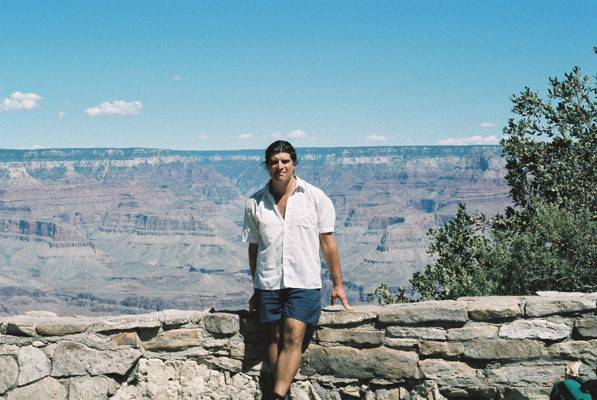
Grand Canyon 1995. In 1978, I looked a lot younger!


The Canyon is a 217-mile, 350 km long, steep-sided gash cut into the Colorado Plateau by the Colorado River. It's up to 18 miles, 29 km wide, and approx 1,600 metres, or over a mile deep. Because the whole of the Colorado Plateau, which extends into the States of Utah, Colorado, and New Mexico, as well as Arizona itself, slants towards the southerly direction, the North Rim, at 1,680 metres above the River, is about 300 metres higher than the South Rim which is approx 1,380 metres high. That means the UK's highest mountain, Ben Nevis in Scotland, peaking at 1,345 metres above sea level, if relocated inside the Grand Canyon, then both rims would look over the summit height of Ben Nevis.

Due to the southward slope of the Colorado Plateau, the River is considerably closer to the South Rim than the North Rim. This is due to the direction of the rainwater draining southwards, causing a greater rate of erosion of the north wall. Hence the mountains within the Canyon, knowns as buttes, along with the valleys separating them, are mainly on the north side of the river, thus the south wall, although lower than the north wall, is steeper.

One of the most remarkable features making up the Grand Canyon is the stratified layers of different rocks consisting of a horizontal, sandwich-like formation that applies to both rims and to all the buttes and the larger mesas within. The perfectly tidy yet distinct layers indicate that they were laid down by the water that once covered the area, a theory agreed upon by both secular geologists and Creationists alike.

Forming the upper rim edge is Kaibab Limestone. Below that is the Torroweap Formation. Next, the Coconino Sandstone rests on Hermit Shale. Below this, is the Supai Group of rock layers. Beneath is the Redwall Limestone. This rests upon Temple Butte Limestone, which itself lies on a layer of Muave Limestone. As the cliff lowers further still, next is Bright Angel Shale. Finally, Tapeats Limestone completes the upper section of the stratification. This series of layers, each bedding plane perfectly horizontal, was laid between 260 million years ago to 550 million years ago, according to secular geologists. However, beneath the Strata and forming the bedrock is the Vishnu Schist, along with Granite, both of volcanic origin which, according to geologists, was formed some 1.6 billion years ago.

Hence, where the water-laid Tapeats Sandstone meets the Vishnu Schist, there are around 550 million years of rock layers missing. This is known as the Great Unconformity. Yet the bedding plane between the Schist and the sandstone looks as normal and without incident as all the other layers above.

South Rim View. Tonto Plateau is centre-left.


Grand Canyon in the evening.


Grand Canyon Village on the South Rim marks the location of the Bright Angel Trailhead. This path, known as the Bright Angel Trail, is 9.6 miles, 15.5 km in length as it reaches Phantom Ranch on the floor of the Canyon. The Ranch is located a half-mile inside the mouth of Bright Angel Canyon, a side gorge leading up to the North Rim. Bright Angel Creek flows through it to join the Colorado River, a short way downstream from the Ranch. A couple of miles east of the Village, South Kaibab Trailhead begins a 7-mile trail which eventually joins the Bright Angel Trail at Phantom Ranch, then continues on for another 16 miles as North Kaibab Trail to the North Rim. Thus, this Y-shape trail configuration is known as the Corridor, and it's this part of the Canyon that's gazed upon by countless numbers of visitors at and around the Village.

Arrival at the Canyon Village.

Having arrived at the South Rim after a two-hour bus ride from Flagstaff, I was taken aback by the sight. Spread before me, was the Canyon in all its splendour. The North Rim appeared as a straight line on the horizon, totally unaware that it was at a higher elevation than where I was standing. When I arrived there in 1978, I knew virtually nothing about the Canyon. Thus, the information I can provide was learned since I visited the National Park, and not whilst there or beforehand.

Grand Canyon Village.


My plan was to spend just the day at the South Rim, absorb the glory into my memory and camera alike, and then return to Flagstaff to resume the long journey to Los Angeles. In the meantime, even as an untrained eye, I could make out, far away, what looks like a long side Canyon leading away from us and towards the North Rim, it was later that I learned that this was Bright Angel Canyon, a tributary of the Inner Gorge in which the Colorado River flows. On either side and below eye level, I would have looked at Buddha Temple Butte directly in front, to the left of it, Cheops Pyramid, with Isis Temple Butte just behind it. On the other side of the tributary gorge, Zoroaster Temple Butte dominates with Brahman Temple Butte next to it.

All these features were on the other side of the River, hidden from view at the Village area of the South Rim. If one is mystified by such Eastern names, then it was Clarence Dutton, a mid-19th Century geologist who had an interest in Eastern religions, who gave names to these pinnacles as he surveyed the Canyon.

At Indian Gardens on the Tonto Plateau.


Off from the South Rim and from where I stood, a small pinnacle, known as Battleship Rock overlooks Tonto Plateau, a level shelf of Bright Angel Shale on which Indian Gardens sits. A side trail branching off the Bright Angel Trail leads to Plateau Point, adding 1.5 miles to an Inner Gorge overlook over the River which is directly below, and the first sight of it after a downhill hike from the Village. Had I known about the South Kaibab Trailhead a few miles east of the village, I would have been taken aback by the impressive O'Neil Butte leading off the South Rim near Yaki Point.

Preparing for the Hike.

As I strolled west, I came across what looked like the start of a trail leading down into the Canyon. A flash of excitement took hold of me as I watched one tired and sweaty hiker after another reaching the end of their journey, exiting the trail and arriving back into the safety of the Village. This, I learned, was the Bright Angel Trailhead, and this was the most popular of all hiking trails within the national park.

I approached Bright Angel Lodge, which wasn't far from the trailhead, to ask more about the trail. The lady at the counter quickly responded that she had just received a cancellation at Phantom Ranch, and a bed has become available on the Canyon floor. Asking me if I would take it, without hesitation, I said, "Yes, yes, yes!" And so, I bought a bed reservation ticket, and my plan for the day instantly changed. My luggage will now have to spend a second night at Flagstaff Bus Station as I made my way to a nearby kiosk to hire a rucksack, the first one I ever wore over my shoulders, and a pair of hiking boots, both items marking a start to something of a personal revolution for future travel. I then found the site superstore, and in it, I bought various items for the coming hike. It was a while later, as clouds were gathering in the sky, that I set off on my hike down into the Canyon.

Zoroaster Temple Butte dominates the River.


As I zig-zagged down the cliff switchbacks, I encountered more and more hikers coming the other way. One of them even stopped me and asked if I had a Camper's Pass. I answered that I had a reservation ticket for Phantom Ranch which I showed him. He then let me go with a wish of good luck.

The switchbacks continued, back and forth, rounding bends as I descended the south wall. It wasn't too long before Battleship Rock towered over me. From the Rim, this pinnacle was way below me. Now I was below it. And from this angle, the rock actually resembles a ship. 

By the time the footpath began to level out at the start of Tonto Plateau, three miles into the hike, the area was deserted. There were no more hikers coming the other way. One can say that the Tonto Plateau resembles a large field, possibly a meadow. Yet, the sky was overcast and a peal of thunder rolled across the valley. I was alone, all alone in the strange environment. I paused to look around. Looming behind me were the high cliffs of stratified rocks topped by the South Rim. In front, the straight line of the North Rim has distorted, with Buddha Temple Butte now towering over me, along with Cheops Pyramid to the left of it. Nearby was a notice warning of flash floods in the area that can endanger lives. Wow! Just what I need. Alone in the desert, a clap of thunder rolled and fear gripped me. But would I turn back? No! Instead, I was determined to press on with the hike.

I approached Indian Gardens which had a rest stop with a water tap. A good source of refreshment. It was here, too, that the trail divided, with the Plateau Point path branching off to my left. Presently, the trail began to plunge into the Inner Gorge in a series of lengthy curved switchbacks known as the Devil's Corkscrew. Another thunderclap rolled, but at least it wasn't raining. As I again paused to look around, the high cliffs of the harder Vishnu Schist volcanic rock loomed high, making me feel like a tiny dwarf. I suppose this was why the Inner Gorge was considerably narrower than the Outer Gorge. The harder the rock, the slower the rate of erosion.

Bright Angel Creek.


Unlike at Tonto Plateau, here, near the bottom of the Canyon, the whole area was buzzing with life. Countless numbers of crickets were chirping in the bushes, their combination creating a continuous hum, backed by rolling thunder. It was quite a fascinating scene as I walked on.

After a while, about eight miles into the hike, I approached a hut. Two young men were looking as if preparing a meal on a camping skillet. Feeling relieved at the sight of another human, I called out as I approached the hut.

The two men, whom I could see were Frenchmen, warmly welcomed me into their company. We talked and I too was served a portion of their dinner. They said that they couldn't reserve a bed at the Ranch, so they decided to settle down here in the hut for the night, where it would be unlikely to be spotted by a passing ranger. After thanking them, I was preparing to leave, to complete the final leg of the hike. They begged me to stay for the night with them. Despite how tempted I might have felt to remain with them, my desire to finish the hike was stronger, and they had to let me go, but not without expressing my gratefulness.

It was the right decision. I rounded a bend and lo! There was the River, flowing at speed through the Grand Canyon. The trail, officially known as the River Trail but very much Bright Angel still, hugged the riverside as it wounded its way along the irregular surface of the Vishnu Schist valley. 

As I looked ahead, the looming shape of Zoroaster Temple Butte began to dominate the sky above the River. Resembling a white limestone head resting on red sandstone shoulders, this mountain, or so I thought, was all left of the North Rim. What a difference from when I looked at it from the Village! From there, the North Rim was a straight line making up the horizon. Down here, all that was left of it was a solitary mountain peak surrounded by the sky. At the time, I was still unaware that what I was looking at was a butte, a pinnacle rising well inside the Canyon, and not actually part of the North Rim, even though the butte is on the north side of the River.

As I was walking towards the butte, another appeared from behind the valley bend. This was Brahman Temple Butte, although roughly the same height as Zoroaster, it was much more stout in appearance.

Presently, Silver Bridge, one of only two that cross the Colorado River with the Canyon, appeared, just as it was getting dark. Silver Bridge was to first one to appear. The second one, Black Bridge, was about a mile further on and served the South Kaibab Trail before the twain joined Phantom Ranch to become the North Kaibab Trail leading to the North Rim.

Phantom Ranch.


Eventually, after another half-mile within the mouth of Bright Angel Canyon, I approached Phantom Ranch with its number of huts amidst a copse of Cottonwood trees. Nearby, the creek of the same name as the valley it flows through, gurgled along its course to join the Colorado River at the mouth of the gorge. The Ranch is classified as a hotel, with a restaurant house and eleven separate cabins, nine of them accommodating up to four people whilst the other two cabins took in ten guests, one for men and the other for females. At the Ranch reception, I handed in the reservation ticket and I was given the key to one of the larger cabins. When I got there, I saw that there was a young German hiker and two American hikers, making, so far, four occupants. We were to wait for the other six. 

After the German had a shower and then left the cabin to join his girlfriend outside, it was my turn to take a refreshing shower. After this, I took a stroll around the site before retiring to bed. The two American hikers, whom I found out lived in Los Angeles, the German, and I, all waited for the occupants of the remaining six beds to arrive. So far, no one else entered our cabin.

----------------------------------------------------------------------------------------------------------
Next Week: A Test of Endurance.

Saturday, 3 October 2020

Why Laugh at Creationists?

Browsing the Internet can be an interesting experience whenever something totally unexpected comes up on the YouTube dashboard. Such is the title of a whole series of videos bearing the one title, Why do people laugh at Creationists? 

Laugh at Creationists? That's new! I thought we Creationists are ignored. Like good old Alfred Wegener. This son of a clergyman theorised that rather than remaining permanently fixed, the continents of our globe are on the move. Yet he was totally ignored by all the geologists of his day. Moving continents? How ridiculous could he get? He was ignored, maybe even laughed at. That was because Wegener was not a geologist, but a meteorologist who had an interest in geology from an amateur's perspective. According to contemporary geologists, anyone who is not in their profession should not stick his oar in. It took quite a bit of persuasion and thorough research before realising that Plate Tectonics is to accepted as valid science.


Or the case of one young doctor who, in the 1840s, was put in charge of a maternity ward at one of the top teaching hospitals in Vienna, Allegemeine Krakenaus. Here, this medic was very disturbed by the rate of mortality taking place on a regular basis - one out of every six women died, as was the case of all other hospitals of the day. Then this doctor, Ignaz Semmelweis by name, believed that some invisible agent or element was passed around from patient to patient.*

He thought up the idea that after each patient was examined, whether it was an autopsy carried out on a dead patient or checking out a living patient, the medic must wash his hands before examining the next patient. Immediately, the death rate dropped significantly from one out of every six to one out of 84.

But poor Semmelweis didn't get the praise he so richly deserved. Instead, it was scorned and belittled by lazy and prejudiced colleagues and jealous superiors. Perhaps they believed that Semmelweis had some supernatural power or that there is something magic about this constant washing, washing, washing which does not tie with science. Had he wrote and published a book on his discoveries, chances were that such a book wouldn't sell well, if at all, in the medical profession. After all, invisible element? Mythology has no place in the hard realities of science.

After such hostile treatment, Semmelweis lost his contract, and after watching the mortality rate rise again, he lost his mind and he was committed to an institution where he ended his days with a mental breakdown. Who would have ever thought that with the linking of bacteria, discovered in mould growth as early as 1676, with infection and disease could be the cause of such a high mortality rate? And Alfred Wegener, who was also ignored by his contemporaries, such life was not made easy for him either. What a ridiculous theory, this nonsense of moving continents!

Going back to YouTube. As already mentioned, there is a whole series of videos, looking to be as many as 45 of them altogether, themed Why do people laugh at Creationists? Checking the author's stats, at this time of writing, he has 276,621,362 views and 960,000 subscribers, his field also covers a much wider range of topics including his support for the UK to remain in the European Union. 

Indeed, his first video featured a student who used three false arguments to support his view of favouring Creationism. One was that the spherical orbit of the Earth around the Sun was within the Goldilocks zone, the second was that the Grand Canyon of the Colorado River was cut in just five minutes, and his third argument was that water is unique to our planet only, and does not exist elsewhere. As such, together with Flat-Earthers, we Creationists deserve to be laughed at. But on a more serious note, if I were to write a paper supporting Divine Creation which would satisfy the demands of Creation Research, then submit the paper to a team of secular scientists, one or two might give some time to answer, the rest would just ignore it altogether.

It was the student's "Grand Canyon in five minutes" theory which caught my attention and decided to answer in the comment forum. But it was not only to "prove myself" but also use this opportunity to confess my allegiance with Creationism, just as I would freely confess Jesus Christ as my Saviour. No matter, this video alone has 2,508,131 views. Therefore, I felt it was worth giving it a go if Creationism is to gain any creditability.

How wonderful it is for YouTube to allow quite a large margin to comment without being cut off. Because I had quite a bit to say. 

Firstly, I explained that the Earth's orbit around the Sun is not spherical at all, but follows the edge of a slightly elliptical plane, with the Sun not quite at the centre. Therefore, where one side of the orbit is at the Perihelion, that is, nearer to the Sun, it's winter in the UK and summer in Australia. At the other side of the orbit, known as the Aphelion, our planet is further away from the Sun during the UK summer. 

Whether this is a work of a Designer or just mere chance, I left for them to decide. But since the Southern hemisphere is mostly ocean which takes longer to warm up than the landmasses of the Northern hemisphere, if this slight eccentricity did not exist and the orbit was perfectly circular, then it's likely that much of the Southern hemisphere would be covered with a permanent ice sheet, very much like the one which covered the Northern hemisphere during the Ice Age. This could have a big impact on the existence of life, particularly with the oxygen output from the oceans.

Then, together with my hikes into the Grand Canyon and thus, my observation of the rock strata resting comfortably on granite bedrock, I concluded that these layers of limestone and sandstone were laid down by the waters of a long-gone ocean, and put forward the idea of the Noachian Flood, along with the theory that the Canyon was cut in months, possibly years, as the floodwaters drained off the rising continent, and not in five minutes. As for extraterrestrial waters, I reminded the student that since boyhood, I was aware of frozen water polar ice caps on Mars and elsewhere, and after conversion, hadn't changed my mind on this.

At the Grand Canyon, 1995.


Then about three weeks later someone contributed, asking me how vast limestones rock layers form, considering that limestone is formed out of calcite, a material gotten from the shells of marine life, if not taking millions, or even billions of years to accumulate into such rock layers.

Here I have always found this to be a problem, to be honest. Here in England, one particular type of limestone, chalk, is very common here. This stone makes up the rolling hillsides and downs of, for example, the Chilterns, the South Downs, the White Cliffs of Dover, and the rolling coastal hills which includes Ballard Down in Dorset and the Isle of Wight. I have always thought that during antediluvian days, the oceans must have had a tremendously vast population of such marine life to form such landscapes. Not forgetting the chalk seabed under the English Channel which makes the cutting and maintenance of the Channel Tunnel viable. And I haven't even included hard limestones such as Portland Stone, often used for construction.

How much easier it must be to assume such huge formations must take multiple millions of years for such rock layers to build up than for it to rapidly form under the intense pressure of a fast-moving global flood. But a Flood-based origin I'm willing to accept, whichever way it happened. To believe in the historicity of the Bible does involve swimming hard against the current of Charles Lyell's uniformitarian geology and Darwin's organic evolution which remains universally acceptable.

I'm one of a small number of Creationists who is willing to stick my neck out. Indeed, I might just be ignored, teased, laughed at, or to be made to look ridiculous but to be honest, I'll rather be a fool for the glory of God than be wise in the eyes of the world. Even in my own church, I'm not taken as seriously as a brother who is a graduate, especially in the realm of leadership or even delivering a preach. Or maybe there is this train of thinking going around among those who know me well - the "he's not capable" or "I don't think he can do that" or "I doubt he'll be successful". The reason for this is straightforward. I don't come across as one who is articulate or well educated. Fair enough.

But "in Christ, I can do all things" (Philippians 4:13.) Yea, I hold on to that. One example of this occurred back in 1980. Just a year before I was made redundant as a semi-skilled machinist in an aircraft factory (British Aircraft Corporation, which was later renamed British Aerospace) and I had trouble looking for suitable work until someone suggested going self-employed. Indeed, one or two of the Elders did not believe I could manage that, but I went ahead anyway and formed my own window-cleaning business. Yes, it was difficult at first. I struggled to make ends meet. I upset a few of my clientele. I was on the verge of throwing in the towel. I even applied for another job. When I didn't get that job and instead returned to my business, I decided to keep on persevering.

Eventually, it paid off. Throughout those 35 years, I managed to make enough not only to live reasonably well, but I was able to save up for travel. Flying to destinations such as to Israel in 1993, and then to New York in 1995 to backpack across the USA to Los Angeles, and then in less than two years later, to fly to Singapore, and then onward to Cairns in Queensland, then after backpacking the Pacific Coast with its glorious Great Barrier Reef, on to Sydney, then from there direct to Los Angeles, before returning to London on a Round-the-World experience in 1997. It was those glorious days, the explosive climax of my bachelorhood before I met and married Alex. Those days when I didn't claim a penny in benefit or low-income allowances. It pays to persevere against the odds and not throw it all in.

Another area where starting up was difficult and discouraging, and it's writing for this Blogger page! Indeed, at first, viewer numbers remained low, and it was very discouraging to see all other bloggers captivating readers by the thousands while I only picked up around 20-30 each week. Indeed, I thought, what's the use? I was even tempted to throw in the towel in this area too. After all, I'm a labourer who failed at school. Who am I, pretending to be someone I'm not?

Yet I enjoy writing, and I have always enjoyed writing since boyhood. Later, the advance of the Internet has open doors which before I could only dream about. Therefore, something of addiction grew within, until every Saturday afternoon is Blogging day. As for readership, at this moment of writing, I have more than 150,000 views. This I consider this to be a respectable number and its growing by the hundreds each week.

And now I have launched into something very new. It began while I was sitting at a Costa Coffee bar in Bracknell Town Centre with a croissant and a cappuccino coffee. There, I thought about opening a YouTube account and making videos of easy walks which older people would appreciate. And so, at Bournemouth and Swanage, I shot my first two videos. When they came out, I knew that I have a lot to learn! My camera was shaking, I got my fingers in front of the lens, I breathed heavily after climbing a hill, and maybe the video was rather monotonous, filming the same scene all the time. To a professional, these were rubbish and I knew it. But I still published them to see what happens.

The exact camera I use for YouTube Videos


Lessons learned from the past taught me not to throw in the towel. If I fail, I fail. If absolutely nobody clicks onto my channel, well, at least I gave it a go! I've tried it. Indeed, right now I can visualise with clarity all my church Elders and brothers shaking their heads in their plea to give it up now to save myself from getting hurt. This was the discouragement I have received from other church members for many years. 

But no, instead, I will carry on making videos and publish them. And as I make each one, I learn from my mistakes. And with learning and experience, real enjoyment will also bud and blossom into a beautiful flower.

Perseverance is hard. It's difficult. It can get very discouraging. But eventually, it can pay off. The same goes with my conviction that Divine Creation as recorded in Genesis will eventually pay off, despite being ignored or laughed at present. My vindication will await me in Heaven. 

----------------------------------------------------------------------------------------------------------

* S.I. McMillen, None of These Diseases, 1963, 1980, Lakeland Publishers.

Saturday, 5 October 2019

Bored at Bournemouth?

There is always a risk when it comes to planning holidays, and especially when the oncology consultant comes to us with his answer to my question: Is it okay to take a break overseas?

Then comes his answer: No, we don't recommend any overseas travel at this stage.

Then the blood test result comes in. Bad news. Her white blood cell count is below the lower limit for chemotherapy. Therefore we must postpone the treatment until the following week. That is, she'll be here on the ninth of October instead of on the second. This will allow an extra week for the cell-count to reach an acceptable level in the meantime. 

Damn it! That means, instead of a trip to Brussels on the Eurostar on the 9th as originally planned, on that day it will be a much shorter and far less exciting trip to Frimley Park Hospital. Both my wife and I were downhearted but nevertheless, we both realise the wisdom of his advice. Furthermore, the fare we had already paid when booking the Eurostar will be lost, for the tickets are non-refundable. Also, according to the small print in the insurance policy, this too will invalidate any claim, simply because my beloved has been on chemo already before the booking was made.

As we both felt crushed and disappointed, my father-in-law drove us back home. Having arrived home, rather than sit around and mope, I decided to go swimming at our local leisure centre. Alex was at least pleased about this, as she knows that any physical exertion will do me much good, especially when feeling down.

It did. Whilst swimming in a designated lane, I toyed with the realisation that the second day of October will now be free. And it was less than 48 hours away. My hopes were lifted at the idea of a four-day break in Bournemouth which would include October 2nd - our 20th wedding anniversary. All I need to do was to book a room at an accessible hotel for that period and leave the very next day.

View from our hotel room balcony.


The booking at the town centre Premier Inn on the internet was successful, and with breakfast included, I didn't consider this as too expensive. Suddenly things have changed - for the better. Although I grieve over the loss of the Eurostar fare, this was offset by the fact that our actual wedding anniversary will be spent on the beach rather than in a hospital.

This is a good time to explain my love for this part of the world. I got to know this Dorset holiday resort as a teenager. I could add that I "discovered" Bournemouth on my own rather than taken there by my parents, who always took us boys - that is, my brother and me - to Brighton nearly every Summer Sunday, and later to Portsmouth. By contrast, Bournemouth is close to Swanage, itself at the start of the 96-mile 154 km Jurassic Coast, a world heritage site. It was Swanage where I was taken to by my primary school around 1960, and from childhood, I was always fascinated with the geological features surrounding this coastal town. On the north side, the chalk hill of Ballard Down slopes towards the coast to end as spectacular chalk cliffs, tapering at the Foreland alongside different chalk stacks, including the Old Harry Rocks, which can be seen from Bournemouth seafront. The continuous squawking of seagulls echoing around the stacks creates an atmosphere unique to the area. 

Since Bournemouth Station is the nearest coastal stop to Swanage, onward from my late teen years, I alighted at Bournemouth and looked around for a suitable hotel. Then I walked along the beach until I reached Sandbanks, a rich man's estate built literally on a naturally-formed sand spit. Then the chain ferry across the mouth of Poole harbour, to Studland Bay, then on foot into Swanage after crossing the spine of Ballard Down which, on a clear day, offers magnificent views of Poole Harbour, the second largest natural inlet after Sydney, along with Bournemouth and its apparently thin coastline. And I then just turned to face the opposite way towards a panoramic view of Swanage, with Peveril Point and Durlston Head forming the backdrop for the eastern coastline of Purbeck.

It was such walks I did during my late teenage years and early twenties which set the precedent for world travel and backpacking. Although I have in the past received criticism by other Christians for being a loner, I have never regarded myself as unsociable, it was after I became a Christian, when I began to enjoy solitude to a greater extent as I began to link such astonishing phenomena with God's creative handiwork.

Alex and I arrived at Bournemouth on the eve of our anniversary. Being off-season, it was quite different from when we were there in July 2014 - in the thick of Summer, with the sun beating down. Back then, the tourist crowds and foreign students kept the tills constantly ringing. Food stalls such as ice-cream parlours, hot-dog stands, pasty bakeries, soft drink kiosks, all drawing in the crowds. Music drifted from the bandstand overlooking the central gardens, which itself was bustling with the crowds - cramming the wide footways, dotting the lawns with picnic sheets, the beach was packed with little space in between, a large crowd swam out into the gently lapping waves, the pier was alive with jostling crowds despite the entrance toll. Indeed, the whole town was thriving in a cheerful holiday mood, with every retail merchant glowing with joy as he checks his swelling bank account. And in the evenings, the bustling noise of nightlife was thriving, with crowds lasting into midnight, and on the sandy beach, foreign students cooked over lit bonfires.

Chalk cliffs and stacks of Ballard Down, Swanage.


What a contrast we felt this time, off-season. The sky was overcast, the winds blew. As we stood on the pier (free entry during the evenings) - I watched a club-group of surfers ride the waves. We were rather hungry, but not an open stall to be seen. Just as the beach was deserted, save for the surfers, so the promenade and all the stalls were closed, all of them boarded up. The Square, which before in 2014, was packed out, including a queue for the spinner, now lies deserted, with just a small group of youngsters sitting on one of the benches, chattering. Indeed, the whole town looked a dismal sight, yet the waves of the sea kept rolling in, the sight of Ballard Down in the distance remains unmoved, the seagulls continue to squawk, and so the world turns, as the warmth of Summer gradually drops away during this Autumnal intermediatory period before Jack Frost arrives to carpet the streets, the rooftops and the beach above the splash zone with Winter snow.

Alex and I enjoy just being together, even if the resort looks bleak and lifeless. That is the most important thing - the two of us together and furthermore, not confined to a hospital building. Fortunately, a Tesco Express store was open for trading with the locals, and we bought some snacks to take back to our hotel.

I stood at our room balcony, looking out across the night, with countless light bulbs illuminating the resort with a vast array of spotlights, yet all coming to an abrupt end at the beach, which beyond, the darkness hanging over the sea also enveloping the faraway Ballard Down with invisibility, save for an array of far-distant streetlights of neighbouring Swanage.

It was then I had to face reality. This was still England. It was still very different from where we went to for our honeymoon and for our tenth anniversary. Those dates were at the Greek island of Rhodes. As I said to my beloved exactly ten years earlier, whenever our anniversary hits a zero, we would return to Rhodes. But ten years ago we were both reasonably healthy. Little did we know, as God certainly knew, that Alex would be confined to a wheelchair, and furthermore, we'll be celebrating our 20th halfway through chemotherapy treatment.

I recall how on both occasions we strolled along the Greek beach, especially after nightfall, and listening as the Mediterranean waves lapped gently upon the stone beach. A shooting star streaked across the sky as we stood in each other's arms. In addition to this, there was this unique herbal aroma in the warm, still air. And the sky remained cloudless during each day, every night the stars shone brightly. It almost felt that the Garden of Eden was already restored. And I expressed my desire to return to Rhodes every ten years.

These thoughts went through my mind as I stood on the balcony. No matter how much I may love the Dorset coast, it's not the Mediterranean with its own atmosphere. But throughout the last twenty years, our marriage, no doubt like any other, has had its ups and downs. The ups including watching her give birth, and to hold our newborn daughter in my arms as her tiny figure slept soundly. Yet I have wept aloud during a church service here at Ascot, of shattered dreams and of blasted hope. I have watched my beloved's health deteriorate, I have watched as she was near to paralysis. For four whole months, she was an inpatient with a neurotic disorder with which the medical team wasn't able to treat save a lifelong prescription. Each day I did not fail to board a train to spend a couple of hours together.

Then the news of her cancer and the appropriate treatment which followed, which at present, includes chemotherapy. Yet it's my constant prayer that God will always give me the power and strength to love her to the full, unconditionally.

And so as I stood on the balcony, I overcome such thoughts by thanking God for this holiday in Bournemouth. Thanking God that here we are, in a hotel and not in a hospital, despite that there is an NHS hospital nearby in case of an emergency. In fact, directly below where I was standing, an ambulance was parked. I thanked God that it wasn't for either of us.

The goodness of God was demonstrated by waking up on our anniversary to a clear sky and the sun shining. After breakfast, I strolled, pushing my wife's wheelchair, along the level esplanade towards the neighbouring resort of Boscombe, a pleasant 35-40-minute walk of 1.5 miles. Amazingly, it was warm enough for a good swim in the sea. At first, I was totally alone in the water, but apparently, I must have set an example for a few other men to follow. I must have bathed for a better part of an hour, but it was enough to reminiscence on Rhodes. Boscombe was almost as good, it is a much smaller and more sedate resort than Bournemouth, therefore I had a preference for this spot. 

The next day brought overcast skies, wind and a driving drizzle. But still, no time for boredom, as we visited the Oceanarium, located on the esplanade just west of the pier. True enough, it doesn't hold a candle to Sea World of 1995 San Diego splendour, but it was good enough to stay out of the weather. And at least we both stayed dry. Back in 1995, I got thoroughly soaked through and through as I sat in the audience, watching an orca perform. But it wasn't the soaking which bothered me. It was the thought of a killer whale held in captivity, along with the seals and the dolphins. They shouldn't be there. They should be out in the open ocean, enjoying the boundless freedom for which God had created them. The thorough soaking, whilst fully clothed, might have been the message the orca was trying to tell us all! I have to admit, that evening I left Sea World with mixed feelings.

Over here, all aquatic life seems to be happy in their confined environment. Perhaps born in captivity or brought in while very young (the black-tip sharks were rather small) at least they are used to being where they are.


 Bournemouth Oceanarium, taken October 2019


Outside the waves were high on the sandy beach, creating a continuous, non-stop roar. But there is one other spot I would have liked to have been at that moment. That is at Anvil Point right next to Tilly Whim Caves, on the other side of Swanage. These caves are not natural, but they are what's left of a long-disused quarry for Purbeck Stone, a very hard and resistant rock, very different to the soft clay and sandstone rocks which makes up the cliffs of Bournemouth.

When the wind is blowing and the tide is in, massive waves from the open Channel crashes hard against a natural ledge which juts out from the cliff face. The tremendous power and force as the rock remain uneroded, sending the swell sky-high with a thunderous noise. I have stood there in the past and watched with excitement at the demonstration of God's power over the seas, which is a fulfilment of what the Scripture says:

Or who shut up the seas with doors, when it brake forth as if it had issued out of the womb?
When I made the cloud its garment thereof, and thick darkness a swaddling-band for it,
And brake up for it my decreed place, and set bars and doors,
And said, Hitherto shalt thou come, but no further: and here shall thy proud waves be stayed?
Job 38:8-11 AV.

It's so true! Powerful waves crash against the rocks, and I might even get splashed, yet the sea cannot reach out its arms to drag me into it and drown. Why? Because I'm just out of its reach. I'm was standing just on the safe side of the "bars and doors" God had already decreed. Instead, this spot is one of many places where I can worship the Creator with reverence and fear at his workmanship.

Saturday, 5 January 2019

Fascinating Facts, Another Year...

Another year over and a new one had just begun. And as I take a stroll outside, I thank God for allowing me to remain alive to see this particular day in human history. Yes, I thank God for just being alive. And that after considering how many people who were considerably younger than me, yet have already met their end, in many cases, unexpectantly. As the apostle James once wrote that I ought to consider the will of God when making future plans because nobody knows what's just around the corner (James 4:13-17). 

Therefore, I have come to learn over the years how precious life really is. I remember so well during my younger years how vain I felt over certain issues. The biggest was probably my position on the social stratum. Working class? Or should I say, a mere pleb? And I looked up to the middle classes with an element of envy. Maybe it was because my parents wanted to produce a successful son who would have lifted his family's social status to a higher plane. When I failed at school my parents were disappointed. Bless them. Who wouldn't be disappointed? Without a doubt, I would have loved to have seen my daughters attend university. I would have been so proud, witnessing my own offspring achieve a level I failed to achieve myself. And so it was no surprise having known how my own parents had felt.

Looking back, I have always believed that world travel has always been intrinsically linked to my social dissatisfaction. And who knows, I might not have been alone with this idea. For example, the Round-the-World backpacking trip I made in 1997 was partially inspired two years earlier by an Aussie builder who had a temporary job in the USA. When he shared his experience with me at an HI hostel in San Diego, not only did he inspire me to visit Australia myself but also reminded me of an Irish builder I had a lengthy conversation with at the backpacker's hostel in Jerusalem a year earlier in 1994. He related his experience to me of his year's contract as a construction worker in the Middle East, most likely on one of the new high-rise hotels which had back then recently sprang up in resorts such as at the Dead Sea and Eilat. 

San Diego Harbour, taken 1997.


However, my curiosity about Australia may have also been stirred a decade earlier during the mid-eighties when I was a member of a triathlon club in Reading, known as Thames Valley Triathletes. That was when a new member suddenly appeared at the swimming pool changing room. A tall, slim but very fit-looking athlete with longish hair and a high-pitched voice, he quickly made known his country of origin, and his six months stay in the UK sustained by his temporary work. What job he had I cannot at this point fully recall, but I think it was to do with computers. However, my dominant thought was, if he could travel halfway around the world, could I too? And if not, why not? In those days, after two trips to North America and to Israel in the 1970s, I was working to build my own window-cleaning business, and therefore I considered myself fortunate at that time to just cross the English Channel. Indeed, the mid-1980s was my "bleakest" decade for travel, if it can be classed in this way.

How I wished that I was more mature in Christ during those days as a singleton! Such would have saved me from much of this emotional turmoil. But I guess being in a healthy and robust marriage goes a long way towards a better sense of self-esteem. And with this heightened sense of self-worth as a husband, comes my greater appreciation of God's goodness. And when it came to retirement, a permanent ceasing of work, I knew that I had arrived at a major turning point. It was a reminder that I wasn't getting any younger, but more of the feeling of having one foot already in the grave. I guess I have achieved a new title based entirely on my present income - a pensioner.

And by my sudden realisation that I'm in this present phase of life has come a long way in my acknowledgement of God's goodness, his grace and mercy. Knowing that since gestation, my heartbeat was sustained by him together with the bloodstream in full flow, along with all other involuntary functions such as digestion, organ secretions such as from the liver, spleen and pancreas, the ability to see and hear, and (most of the time) involuntary breathing. And also the immune system, still little understood by science, and the vast complexity of the brain and nerve function, and the skeletal structure providing such an adequate framework. Then not to mention the dizzying complexity of every living cell, its nucleus being the home of the genome, the very essence of our existence. Such as admission to God's magnificent design. Indeed, if the Father saw fit to send his Son to atone for us, then we must be highly esteemed in his creative powers.


In divulging into this, during the Christmas holidays, we watched a programme on the television, A Day in the Life of Earth, presented by Dr Hannah Fry. Just by watching I caught the significance of how God remains committed to sustaining all life on our planet, even over just 24 hours. There is volcanism, for example. Usually perceived as such a destructive force if too close, even wiping out expanses of woodland as well as burying whole villages under a flow of lava. Yet, according to the programme, volcanism is one of the main forces in creating land and balances out the rate of erosion. This sort of negentropy versus entropy keeps our planet from ending up as a universal ocean. Then there is another issue which fascinated me. That is, not only oceanic tides at work to sustain life, but the moon also has an effect on land too. Known as solid earth tides, the land which we actually stand on literally rises and falls by a metre every day. Yet it remains totally unnoticeable.

Also according to the documentary, volcanism is the result of Plate Tectonics, the moving of the continents caused by radioactive decay deep under the earth's crust, of the heavier elements to lighter elements, releasing energy equivalent to 27,000 Hiroshima bombs each day.

Then the daily growth of phytoplankton in the oceans, five billion tonnes of it each day. This absorbs carbon dioxide and releases oxygen, as all plants do. There is so much of it worldwide, that literally speaking, every second breath we take is directly linked to this ocean phenomenon. Also, the presence of phytoplankton is the cause of the largest animal migration taking place daily. That is of the zooplankton which rises from the seabed each day to feed on these minute plants, therefore keeping the oxygen content in our atmosphere well balanced. 

Then the discovery of a fine dust layer deep in an ocean cave in the Bahamas was identified as from the Sahara Desert. Each day, up to 500,000 tonnes of mud dust is blown across the Atlantic Ocean to fertilize the Amazon rainforest, another sponge for carbon dioxide absorption and a vital source of oxygen. I wasn't aware of any of either of these two issues. But God is, for it was he who initiated it.

Then, by using satellite technology, it was worked out that if the growth rate of all the trees in every forest around the world were assimilated into just one tree, then each day the tree would grow by three kilometres. A very important fact considering that our lives and that of all fauna depend on the forests.

Finally, the programme focused on our planet's relationship with space. Its orbit lies within the Goldilocks Zone, that narrow path where water can be frozen, liquid and vapour all on one planet at the same time. Its satellite has a size and mass just right to keep the Earth's rotation steady and to avoid wobbling like a spinning top slowing down. In turn, the sun is one of a great many stars orbiting the core of the galaxy at a velocity of 828,000 km/hour, or 19,872,000 km every 24 hours, or approximately 12,266,667 miles each 24-hour day. In turn, the whole galaxy itself is moving through the cosmos at a velocity of 2,000,000 km per hour, or 48,000,000 per 24-hour day (approx 29,630,000 miles).

That means if at 12.00 noon today I was at a particular location in the universe, that means I will not be at the same location at twelve noon tomorrow. And never again shall I be at that same spot, even after a full year - ever again!

In the beginning, God created the heaven and the earth. - Genesis 1:1.

True science provides the most fascinating facts proving that everything around me, including myself, was by intelligent design, a divine Creator. Yet most people believe that all this came about by pure chance! Amazing, coming to think of it. Really, the only difference between the majority of mankind and of Creationists such as myself is that we acknowledge God as the Creator.

This should give me the right perception for the coming year. This great God who created everything fine-tuned to perfection, is his arm too short that he cannot save? Is his ear so dull that he cannot hear? Or am I lacking faith in him? I need to look back on my life, all sixty-six years of it. Have I ever ended up homeless, naked, starving or in prolonged poor health? Have I ever lacked resources to pay my creditors? If I can answer "No" to all these questions, then I can testify that God has looked after me well, even during the days I didn't know him. Therefore he who keeps the Universe and the Earth tuned to a fine perfection, why should he not take care of us in the coming year? 


Living as a Christian is not easy. It can be quite difficult. It has always been hard and this coming year will be no exception. I have already been diagnosed with heart failure. I have to spend the rest of my life on medicine, particularly on anticoagulants. At the same time, my love for my wife Alex will always bid me to remain her full-time carer as well as a husband. She will most likely suffer episodes of intense pain. She may be in-and-out of a hospital. And on this day, as I write this, it is Sunshine Saturday, the peak time after Christmas when Britons book their summer holidays abroad. The thought of a booked vacation greatly helps in bearing the long cold "Winter block of weeks" (as I call it) which follows the end of the Christmas break and can last up to Easter.  

But with Alex's condition, and perhaps mine too, the thought of foreign travel is out of the question. Yet we both miss it, especially when foreign travel is in my genes! But by trusting God, he will fulfil the desires of our hearts without the risk of putting ourselves in jeopardy while out in a foreign country. Then again, this line of thinking could be stemming from a lack of faith in God whilst abroad. And here is the difficult bit: Am I confusing faith with presumption? I don't know unless we both have a definite revelation that it will be okay to travel and be safe.

In the meantime, I'll make it my intention to trust in God in all things and be dependent on his goodness. Like that we can't go wrong.