Marriage and Travel
Alex and I had a wonderful honeymoon after we married in 1999. Furthermore, I reassessed the quality of package holidays. With some self-control from excess alcohol consumption and room for some independence (rather than fully escorted tours), this package was very enjoyable.
From Day One, I learned that marriage meant a change of plans, especially with travel. One example of this was my intention to travel around the world for the second time, possibly around 2000 or 2001. When we returned from our honeymoon, I knew that this would never be fulfilled. For a start, my beloved would never sleep in a single-gender dormitory of a hostel. As such, not only would I need to double the funding, but the price of hotel rooms is generally more expensive. In addition, currency inflation needed to be factored in.
But my love for backpacking never waned after the wedding. During our first months of marriage, we talked about future backpacking trips together. One ambition I held was - if we have children - to visit the Grand Canyon and show them the trail I hiked on, and the magnificent views seen from deep below the rims.
 |
| Corfe Castle Ruins. Stock photo. |
However, there was one country Alex longed to visit, and that was the Holy Land. If we decided to go, this would be my fourth visit to the Beautiful Land after my first visit in 1976, then seventeen years later in 1993, and then as a volunteer for three months in 1994. This latest trip would be exceptional, as unlike the past three trips which I made on my own, this time it would be with my wife, and we chose to celebrate our first wedding anniversary there.
The Middle East has always been a turbulent area, especially at present when both Hamas of the Gaza Strip and Hezbollah of Lebanon are out to wipe Israel off the map, with Lebanon receiving support from Iran. Therefore, I was very thankful for the window of relative peace that followed the ceasefire in 1967, as I just mentioned already, allowing me the fortune of setting foot in Israel, particularly in Jerusalem, previously, and as Alex was proposing, again for me in 2000 which would be the first time for her. But since 1967, tensions between Israel and the Arabs simmered, with Yasser Arafat leading his Palestine Liberation Organisation in wanting to reclaim territory from Israel's domain.
In 1976 and 1994, I witnessed signs of these simmering tensions. In 1976, I had just landed at Tel Aviv Ben Gurion Airport. It was late evening and there were no buses to Jerusalem. So I took a taxi. The driver recommended what was then the Ron Hotel, but it was my choice to walk into its reception and ask if there was a room. After settling down for the night in the room offered, there was a very loud gunshot which echoed through the streets of the city. It was brought home to me that this was no holiday resort (more of this in Week 4 of this Biography).
The other occasion took place in 1994. Outside the same hotel where I stayed in 1976, President Yitzhak Rabin was holding a meeting with the PLO leader Yasser Arafat, who wanted to make East Jerusalem a site for his PLO headquarters. While the talks were happening in the hotel, outside, crowding Zion Square, thousands of Israelis assembled in an angry protest. Palestinian flags and other banners were set alight among several TV cameras placed at strategic spots around the crowded square. And all that followed countless Orthodox Jews assembling at the plaza of the Western Wall and devoting themselves to prayer. And so, by listening, the Holy Land was, in a sense, speaking to me.
And such memories, both good and challenging, passed through my mind as Alex asked me to take her to Israel. So, during the early spring of 2000, we took a train to London and together, booked two weeks in Israel for our first anniversary. How coincidental! In 1993, the first of the seven years of Travel, I flew out to Israel after receiving a remarkable vision in 1992 while I was at work. After the 1994 flight to the Holy Land which followed the 1993 trip, I backpacked America in 1995, then Around the World in 1997. In 1998, I flew to New York to escape the international football. Then, in 1999, we had our Honeymoon. in Rhodes. Now we were about to visit Israel - the first visit for Alex.
Some weeks after the booking was made, Tim, my friend and accountant, asked if I would like a weekend camping at Corfe Castle, Dorset. Although camping was not my thing, I agreed to accompany him. While we were away, Alex agreed to spend her time with Tim's wife, Sharon.
I loved that part of the world, the Isle of Purbeck, although not an island but a peninsula, surrounded by Poole Harbour to the north, Studland, the Chalk Foreland of Ballard Down, and the resort of Swanage, all facing east towards the Isle of Wight, and to the south faces the English Channel. To the west, the land strip continues towards the holiday resort of Weymouth. A hiking trail, known as the Dorset Coastal Path, provides a dramatic but strenuous clifftop walk from Swanage to Weymouth, a 31-mile, or 50 km ramble along the Jurassic Coast. I recall completing this distance in two days in 1996, after returning from the Grand Canyon hike in 1995, but before snorkelling over the Great Barrier Reef in 1997.
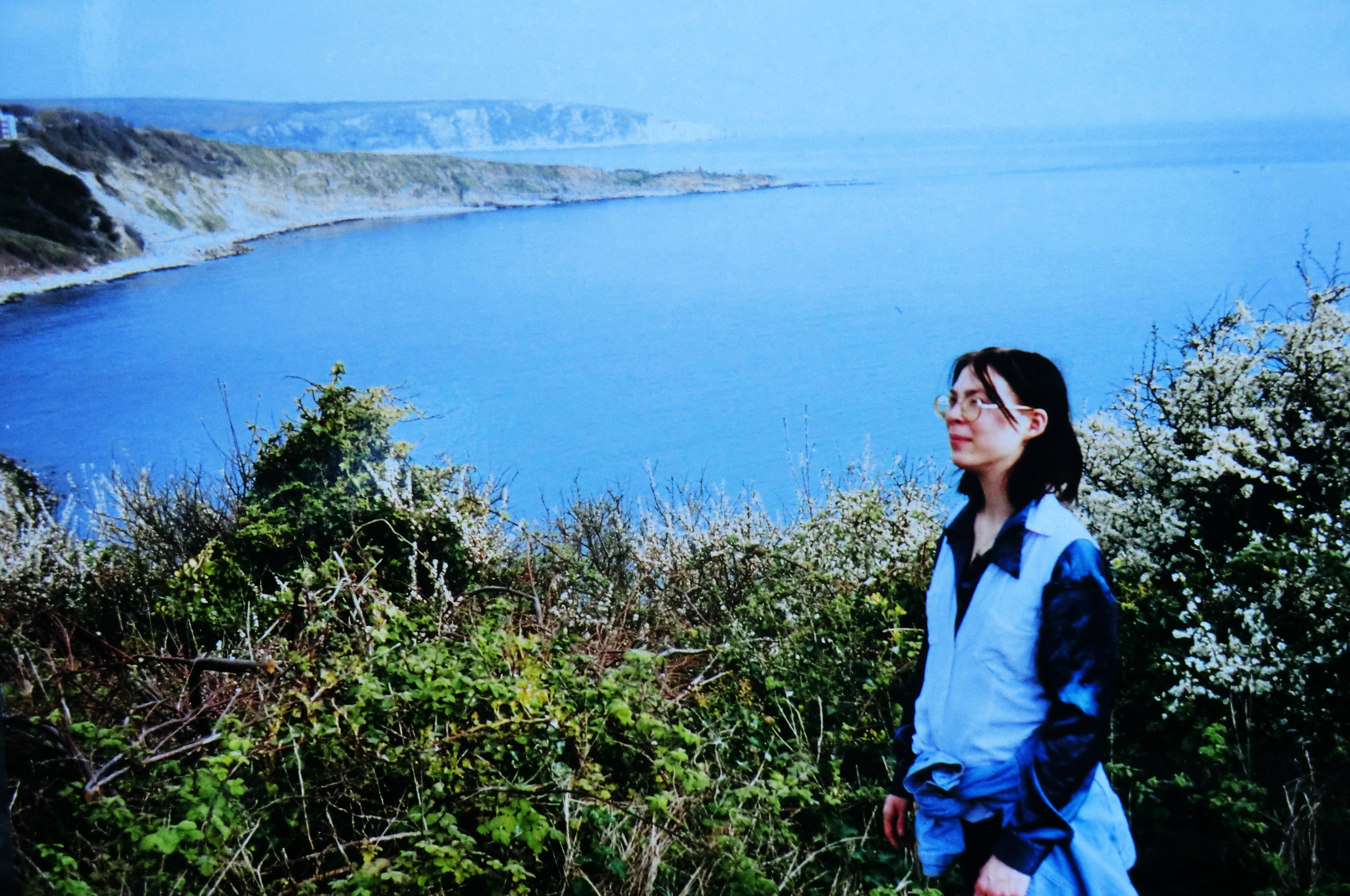 |
| At Durlston Head, Swanage, Easter 1999. |
 |
| At Dancing Ledge, Swanage, 1999. |
The Jurassic Coast, like the Grand Canyon and the Great Barrier Reef, bathed in natural tranquillity, the lack of a boisterous crowd, no threat of war, and no intense commercialism make such a location a quiet retreat, even if engaged in strenuous activity. As I tackled the steep clifftop hills between Kimmerige Bay and Lulworth Cove, there was peaceful silence, even when I had to tackle Flowers Barrow, the western end of the chalk ridge stretching the whole length of the Isle of Purbeck to end at Ballard Down in Swanage, and tapering to the famous Old Harry Rocks. On the second day, I hiked the shorter, easier route into Weymouth.
That was in 1996. In the spring of 1999, during our courting days and around six months before the wedding, Alex and I went to spend a long weekend (Easter) in Swanage. Originally, we were meant to camp, as Alex always loved camping even if I didn't. Earlier, Tim lent us his tent. When I had difficulty erecting the tent, I felt my patience drain and feeling flustered, set off to a nearby hotel. That was before I bought my own tent to camp at Stoneleigh in August of that year. During that break, we went out hiking from Swanage to Chapmans Pool, then turned inland, and returned to Swanage via the Priest's Way, passing through a lovely little village of Worth Matravers, and we completed a circuit of 14 miles or 22.5 km. The photos in this week's blog are from that 1999 Easter break.
Two Married Men on a Weekend Break.
It was a beautifully sunny Saturday morning when Tim began his drive to Corfe Castle during the Whitsun weekend in 2000. While we were on our way, Alex joined Sharon and her young children and together they spent the day at Legoland, near Windsor. Eventually, when we arrived at the campsite, I was impressed with the site which was located at Bucknowle Farm, just over a mile from the castle ruins and a half-hour walk.
We set up our tents. I remember Tim's as he set it up. It was the same tent that was lent to us a year earlier before the wedding. The tent I had was the one I bought secondhand from a customer in readiness for the Stoneleigh Bible Week the previous summer.
As our friendship went back many years, whenever he teased, I playfully wrestled him to the ground. We were no longer adult men with responsibilities, but two boys who enjoyed pitting ourselves to each other. Yet, each knew of our closeness. There was no animosity.
Although the weather was fine during the day, it was very different at night. Torrential rain fell across Dorset. The raindrops falling on my tent were amplified to a loud, continuous clatter. It wasn't long before Tim approached my tent door with a plea to share mine. The roof of his was leaking.
As we lay close to each other in a confined space, I knew why I disliked camping. The clatter of raindrops was loud, I was shivering cold and damp, even if the roof of my tent held well. I hardly slept.
On the same day we arrived, that afternoon, a Saturday, we strolled into the village, but we didn't enter the castle itself, even as it loomed on an area of high ground which was part of the chalk ridge from Ballard Down in Swanage to Flower Barrow near Lulworth Cove.
The following night was the same as the first. The lovely sunshine gave way to a thick cloud, and once again, after dark, there was a torrential downpour which lasted most of the night. Again, Tim had to share my tent, as his shelter was practically useless in wet weather. However, on one of the evenings, Tim took his car and drove me to Swanage. At one of the fish & chip bars, we enjoyed an outdoor meal as we strolled along the esplanade. As I looked around, the white cliffs of Ballard Down towards the north, and Peveril Point jutting out to sea just south of us, make for this extraordinary geological phenomenon that has not only attracted geologists from far and wide but has been so familiar to me since I was eight years old. Indeed, I was on a primary school two-week trip like the school journey made to Llangollen a year later in 1962.
On the second day, a Sunday, we went out on a coastal hike. Unfortunately, I never brought my camera with me for that holiday, therefore I cannot relate exactly where along the Dorset Coast path we hiked. But at least it was sunny once again. But since the hike took much of the day to complete, it must have been a circuit similar to the one Alex and I did the previous year. Wherever we went, I remember the stretch of the coastal path we covered both on the outward and return walks.
It was not long after the start of the hike when I saw a patch of mud and water interrupting the trail. I took a leap and cleared it while my accountant friend simply walked through. That was when a more serious conversation arose. I admitted my fear of mud patches since I was a child. In his characteristic British manner, he fobbed off my complaint as silly. I then explained that as a boy, I once watched a Western on our little monochrome TV where the villain's life ended when he sank into a patch of quicksand and was fully submerged.
Does quicksand really exist? I asked my father. He answered that quicksand does exist in real life, but never added, But not in this country. Not long after, my primary school class was taking a morning walk through Richmond Park in west London. I stepped onto a mud patch and immediately both my feet began to sink into the mud. Remembering the fate of the villain, I panicked in terror until a teacher arrived and pulled me free. This just goes to show how long-forgotten childhood fears could suddenly surface given the right circumstances, something Tim needed to realise.
 |
| Approaching Chapman's Pool. |
 |
| Chapman's Pool, Dorset. Spring 1999. |
The third day, Bank Holiday Monday, followed another stormy night in the tent. But as the sun once again appeared in the clear sky, I felt relieved to return home. In all, it was an enjoyable holiday. Two grown married men, both church-goers, both having competed in sports - Tim in football and rugby games while I swam, cycled, and ran in Triathlon events held across the country. Tim was a father, and I wasn't, but that didn't matter to me. After our wedding, my own perception has changed rapidly, as the saying goes, he who loves his wife loves himself.
While we were away, Alex was with Sharon and her children (now all grown up). But how the conversation went between Tim's wife and my wife, I will never know. But something was happening inside her which she didn't yet know, let alone me. While I was wrestling with Tim on the ground after a bit of teasing, little did I know that inside Alex's womb, a tiny new life was taking shape.
--------------------------------------------------------------------------------------------------------------------
Next Week: The Flight to Israel.


