Total Pageviews

Showing posts with label Haifa. Show all posts

Saturday, 2 November 2024

Travel Biography - Week 124.

Stella Carmel - Any Difference Since 1994?

I brought my beloved to Israel to celebrate our first wedding anniversary in 2000. After arriving at Ben Gurion Airport, we took a bus to Tiberias Bus Station. We settled in a hotel for the next three days. However, the Jewish New Year, or Rosh Hashanah, was about to begin, thus every shop closed, and every bus and sherut service ceased for the national holiday. We were also cashless due to a lack of proper foresight and planning. By the time we arrived at Haifa on our way to Stella Carmel Christian Conference Centre in Isfya, Israel's third largest city was more of a ghost town.

We were then left stranded on the crest of Mt Carmel ridge, in the summit town of Merkaz Hakarmel. Thinking that the tall block of Haifa University was no more than a mile or so further along the road, from where we were, it came into view - over 7 km away, or four miles. We realised that our destination must have been twice that distance, and I was shocked about how I had grossly underestimated the route using memory from 1994, alone.

On my own, I quite likely accomplished the eight-mile hike, no matter how tired I might have been, knowing that dusk wasn't far away. But not with Alex. I would never encourage her to hike that distance while she was 18 weeks pregnant, even if the trail was mostly level and relatively easy.

We were rescued by the driver of a passing taxi. Seeing that we were cashless, he gave us some money and drove us to the centre. We were safe at last!
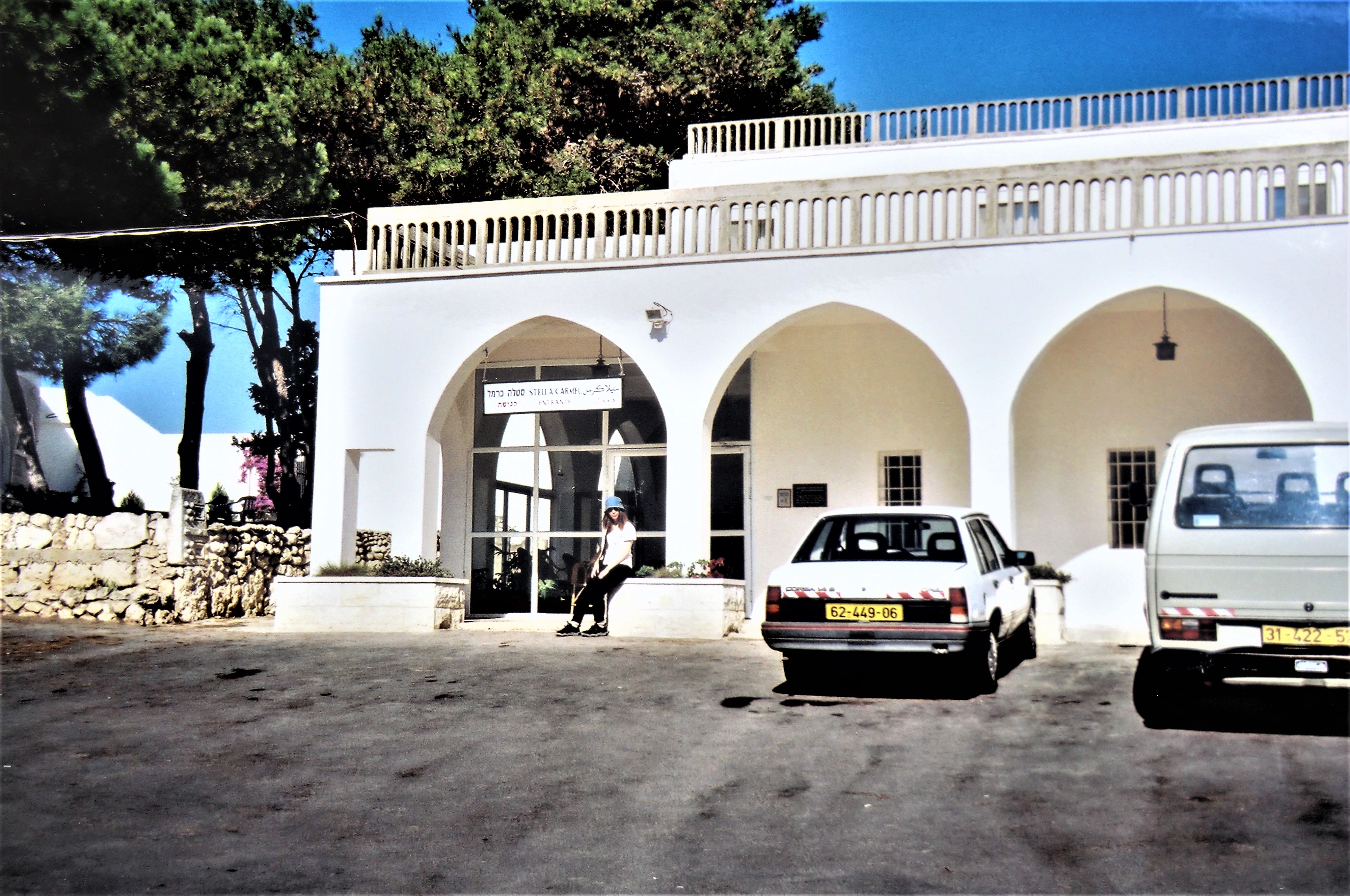
Stella Carmel Christian Conference Centre.


A view of Isfya from Stella Carmel.


Front Porch of Stella Carmel.


At Stella Carmel, we had a twin-bedded room booked. Trevor, whom I knew from 1994, was at the reception and he assigned an upstairs room for us. Somewhat reluctantly, as we were the only guests, Margaret cooked us a meal. After that, we were left to ourselves.

Margaret, Trevor, and Andrew were three of the original seven full-time staff members who had remained at the Centre over the past six years. Margaret either noticed or somehow sensed Alex's pregnancy but there were no words spoken of congratulations. If anything, Trevor and Margaret, then a childless married couple, remained apathetic towards us, as if the disaster of 1994 still lingered in the air. However, Andrew was more talkative, as we got on well back in 1994.

There was one big change that transpired over the last six years, and that was the construction of the new D-shaped church building to accommodate the Kehliat Ha-Carmel Congregation who worshipped every Saturday. In 1994, I became familiar with this group of Messianic Jews and actually attended several of their weekly services held at the Centre itself. The only downside was that stacking away the chairs and cleaning the floor was down to us volunteers. It was tedious work. With the new building where everything remains set up, by 2000, the pressure on volunteers had been relieved.

The day after we arrived, it was a Saturday, and we participated in the service. People from all over the Haifa area gathered here, as they did in 1994. The service hadn't changed, even if the environment had. During both the songs and the sermon, both English and Hebrew were used, as the speaker spoke in Hebrew, and each sentence was translated into English by the interpreter who was next to him. After the service, we enjoyed some cold refreshments outside.

However, I was glad that our stay was at most four days, including the day we left for Jerusalem. Amidst the quietness, the oppression I felt in the air in 1994 lingered on, although Alex wasn't too aware of it. Indeed, everything they did by the rules of the Anglican Church was right. For example, co-habitants without a marriage certificate were banned from renting any rooms - even if the couple lived together for years and had children. Fair enough, perhaps, but the same couple might have been offered a double bedroom at the New Swedish Hostel in Jerusalem, and experience the sense of warm welcome from the Arab hosts, hence endearing greater respect. Here at Stella Carmel, all the staff were British, efficient, but cool of heart.

Another View from Stella Carmel


Church of the Kehliat Ha-Carmel Congregation.


Worship within the Kehliat Ha-Carmel Church.


However, two Arab youths visited Stella Carmel daily in 1994. They were Rami and Nadal, both Christian believers. Back then, they were teenagers. On one occasion, Rami singled me out from everyone else and asked if we could pray together, as he was in some form of distress. I was happy to oblige. Six years later, I tried to track them down. I found out that Rami had since moved to Tel Aviv and worked in Security at Ben Gurion Airport. But Nadal was still living at home. We approached his house, a short walk from the Centre. He was there and he greeted us warmly, remembering who I was, and invited us into his house. We were welcomed by the rest of his family as we enjoyed some refreshments.

Another Mistake.

On one of the days we spent at Stella Carmel, we decided to return to Haifa with the erroneous idea that the holidays were over and the city would be alive and bustling. On a normal Israeli working day, Haifa is a great place to be, throbbing with life and vigour. And also to visit a bank to cash a cheque or two for some much-needed money.

A taxi pulled in where the sherut normally waits, just outside the driveway entrance. Using the last of the cash given to us by the taxi driver, but were optimistic that we would quickly find a bank, we paid the last of our cash to the driver. He then dropped us off at the city centre.

Oh no! The entire city was dead, a ghost town. The holidays weren't over but carried on into the next day. No one warned us at Stella Carmel, even if told them of our intentions. Once again we were stranded in Haifa with no money for a taxi back to Isfya.

Feeling panicky, we walked along the deserted streets. At first, I thought I saw what looked like a bank, and I made a quick dash towards it, only to find that it wasn't a bank but an administration office - and it was closed. We carried on walking, climbing the hill towards the summit of Mt Carmel. Near the Temple of Bahai were some shops - all closed except one, a pharmacy - the only shop open for trading in the whole city!

We walked in and I think the assistant saw I much in despair I was. I then explained (in English) that we were stranded in the city and we needed to get to Isfya. But we were cashless to pay the taxi fare. Would she accept a traveller's cheque? She gave me a cautious look as I produced the book and passport. She then took the countersigned cheque and gave me some cash in the equivalent currency. I felt an overwhelming relief. I soon found a taxi and paid the driver to take us back to Stella Carmel.

Preparing for Jerusalem.

The third day in Isfya was our anniversary, our first one after our wedding, and once over, it would never return. Therefore, we decided on a quiet day we could spend together. Whether it was still a national holiday or whether Israel had returned to work, it didn't matter, as we were not going further than a reasonable walking distance, and that was a stroll in the nearby forest of Mt. Carmel National Park. Here, the tranquillity of the area matched the inside of the Grand Canyon, the Dorset Coast Path and even the Great Barrier Reef. Yet, the stroll reflected the ups and downs of independent travel compared to a package holiday such as our honeymoon. The Jewish holiday is taken more seriously than in the UK. Here in England, our superstore is closed for only two days a year, Christmas and Easter. It remains open on all other Bank Holidays throughout the year. By contrast, the whole of Israel shuts down at least once a week, during the Sabbath.

As such, we hoped that on the day after our anniversary, Israel would be open to trading once again. I walked into Isfya town and found a bank - open. It was a relief to countersign a couple of cheques for some ready cash, which was a necessity for the bus fares to Jerusalem and the accommodation fees to cover us until we flew back to the UK.

We vacated our room and waited for a sherut service to Haifa Bus Station. Once we arrived, we boarded the Egged Bus service to Jerusalem. The Egged Bus is Israel's Greyhound, plying up and down the country from Acre north of Haifa to Eilat, near the border with Egypt. A domestic airline also connects Haifa and Jerusalem with Eilat.

Scene of the Mt Carmel National Park.


Forest at Mt Carmel National Park.


In Jerusalem, Alex got to grips with backpacking.


We arrived at Jerusalem. Immediately, I noticed that the Egged Bus Terminal had moved from its original site on Jaffa Street to a new site further north, but still on Jaffa Street. In 2000, Jaffa Street was still a throughway for motorised traffic. But at present, Jaffa Street is now closed to traffic as it accommodates tram lines, nonexistent in my day.

From the bus station, we made our way through Jaffa Road, crossing over Zion Square fronted by the Ron Hotel (now the Jerusalem Hostel), where I stayed in 1976, and witnessed a demonstration outside of it in 1994. Eventually, the west wall of the Old City came into view and having navigated across a busy road, we entered the enclosure via Jaffa Gate. We made our way down Souk David, so familiar to me but so new to Alex, and arrived at the New Swedish Hostel, a place of refuge and consolation after the 1994 Stella Carmel disaster.

We entered and climbed the familiar stairs to reception. At the counter, a young Arab man was ready to serve us. I asked whether there was a bedroom with a double bed, and at first, he showed us an unoccupied dormitory with single bunk beds - perhaps thinking that "double bed" refers to a bunk bed. It doesn't, therefore we refused to accept the dormitory. He then led us to the room next door to the dormitory. It was a hotel room with a proper marriage bed and other facilities, along with privacy. It was perfect for us, and paid in advance for the remainder of the holiday, the second week. It was here that Alex was to get to grips with independent backpacking. The hostel has a member's kitchen.

Just a couple of doors away from our hostel was the currency exchange office, and it was here where I cashed the remaining cheques, not all at once, but one at a time every other day for safekeeping and to avoid carrying too much cash at once. Also nearby, a minimarket kept us fed, and both breakfast and evening meals were plentiful for both of us, with Alex taking over the domestic chores of preparation. It was off-season, hence we both avoided the long wait for the stove to be freed from another user - a problem in the past unique to this hostel.

But what we loved as well was the early mornings just before we got up for the day. From a couple of blocks across the Old City - which was free from traffic noise - the melodic sound of bells chiming from the Church of the Holy Sepulchre (the traditional site of Christ's crucifixion and burial) rang through the streets outside. This, combined with the Islamic call to prayer blaring aloud from the minarets dotted across the Muslim Quarter of the city, makes Jerusalem Old City the most unique location in the world. As far as my knowledge is concerned, I know of no other city where Christianity, Judaism, and Islam mingle within the tight confines of a city wall as in Jerusalem's Old City.
-------------------------------------------------------------------------------------------------------------
Next Week: How we witnessed the Jewish Yom Kippur ritual and the Feast of Tabernacles.

Saturday, 17 June 2023

Travel Biography - Week 53.

Arrival at Stella Carmel Christian Guesthouse and Conference Centre.

The few photos from the 1994 trip aren't available at the moment.

Back in 1994, who would ever think that I would "work abroad" - an ideal reserved for gap-year students or highly skilled workers. But for Israel in 1994, I was not allowed to use the word "work" when filling in any legal forms or to Passport Control. Instead, I'm to present myself as a volunteer. In-group, I was known as a "volly" (plural: "vollies.")

On the first day after arrival at Stella Carmel, I was given a day off, as was the custom for all new arrivals. That day, I spent at Haifa, and I climbed up Mt Carmel to get a splendid view of the city sloping down to the harbour. On the hill, below me, was the temple of Bahai with its surrounding gardens. The whole site looked beautiful under the Mediterranean sunshine.

I was impressed with the city but it still doesn't hold a candle to Jerusalem, where my heart really was. Yet, to me, I felt it to be a wonderful privilege just to be in Israel, therefore I would never consider looking down my nose at any location here in the Holy Land - unless I happen to be up the slopes of Mount Carmel, as was the case this time.

The Gardens of Bahai, Haifa. Stock photo.


Daily Life as a Volunteer.

Stella Carmel was a former hotel converted into a Christian guesthouse and Conference Centre. Located on the summit of Mt Carmel, it's in the small town of Isfya, not far from Haifa. With its two floors, its 16 bedrooms received groups rather than individuals or families, although an occasional family did arrive from time to time, the centre catered mainly for groups. There were no double beds at the Centre, just single or twin beds. The eight upper-floor bedroom windows opened out onto a wide veranda offering a splendid view of the village. This veranda, special occasions, such as weddings, were held here.

Among the eight bedrooms on the lower floor, these were separated by a wide corridor from the combined dining room and lounge. From the main entrance, one passes the Reception to the right, and the kitchen to the left, its access to the dining room. The tables and chairs in the dining room were arranged in a long row, thus ensuring inclusion for all, staff and vollies alike. However, midway through the corridor was the self-service tea buffet, which anyone could use. For me, a regular mug of tea was most refreshing in the hot June weather. And I always recall the protest I once made to Margaret the cook when she chided me about the tea mugs.

It's not my fault that those tea mugs seem to love my bedroom! They keep finding their own way there!

But the cook didn't believe me, and I wondered if she thought I was joking or being serious.

Regular day groups assemble in the lounge. On Fridays, a small group of Christian Druze Arabs meet in the lounge for their weekly church service. Among them were two teenagers who were close friends, and their homes were near to each other. They were Rami and Nadal. Nadal was a fun-loving extrovert who, on one occasion, accidentally broke a window pane whilst messing around with a couple of our members. Rami took life more seriously. Of all the people there, Rami had a special respect for me, and I would never forget one evening when he was troubled, he singled me out for prayer with him. The fact that he went away edified and encouraged had always been one of my life's brighter moments.

On Saturday mornings, a much larger crowd gathered in the lounge for their weekly service. These were members of the Kehilat Ha-Carmel Congregation, a group consisting of Messianic Jews, some from Russia, along with some Arabs and Europeans. As far as I recall, I was the only volunteer who attended the service, including listening to the sermon first delivered in English, then, line by line, translated into Hebrew by one of the assistants who also stood in front, next to the preacher.

On Sunday morning was our own Christian service which was held in an upstairs chapel, designated for us only - the staff and volunteers of Stella Carmel, although any guest wishing to join would have always felt welcomed.

Part of Stella Carmel, taken 2000.


Each volunteer had to work six days a week with a mandatory day off, normally between Monday to Friday. Saturday was the busiest day of the week, with a cleaning programme carried out before the start and after the end of the Kehilat service, along with putting out and stacking away the chairs. On Sunday, after the service had ended, we all had to play a role in general house cleaning, including sweeping and polishing the floor tiles. After all that, it was our Sunday treat, a trip to Dado Beach, south of Haifa, in our van driven by one of our staff members or a senior volunteer.

A typical weekday always began with a Bible reading in the chapel. Every volunteer was assigned a morning to read the Bible and deliver a short speech to all staff and volunteers. Every few days, my turn came up. Then we filed down for breakfast.

The day's duties were split into two rotas, house and maintenance. House duties included making up the beds, including a change of sheets and towels, the laundry, cleaning toilets and washbasins, and sweeping and polishing the floor on both levels. Traditionally, the females were assigned house duties whilst the males were given heavier outside jobs and repair duties, including shifting heavy boulders as part of landscaping. With a paintbrush, even facelifting jobs were included in the maintenance rota, a duty I particularly enjoyed. It's also worth noting that our boss Peter didn't verbally tell us what to do. Rather, a daily rota notice was posted on the kitchen door. On it, each of our names was assigned to a rota, along with who will be leading the morning Bible reading, who will wash the pots and dishes after breakfast, lunch and dinner, (by hand) and who is off duty that day.

There were two married couples on site, the manager or director and his wife, and two elderly volunteers. The rest of us were all single. Heather took care of Reception. She was the one responsible for taking group bookings and assigning dates of accommodation availability. She was also responsible for the centre's finances. Margaret was the cook, and on a typical day, a volunteer of either gender was assigned to assist, although she refused to have me assist her. Patricia was the head of all domestic duties, and she hadn't been around that long, as she recently replaced her predecessor who was transferred by the committee of ITAC to the London office. Aside from Peter the director, the only male staff member was Andrew, head of maintenance, whose West Country cider-producing vocal accent stood him in good stead.

The volunteers consisted of five males and six females. Among us, there was one married man, David. Then there was Trevor, a fellow in his forties. And graduates Scott and Richard, both on a gap year. It was posh Richard who shared my bedroom while right next door, Trevor shared his bedroom with Scott. Except for David's wife, all the female vollies were of graduate age, with one prominent character, Josephine, or Jo for short, as a strong-willed but fun-loving self-made group leader and a staunch feminist who loved using the phrase the New Man to mean that we males should be more domestic-minded and having less of a masculine front.

There were also two guard dogs whose shared kennel was between the centre's main entrance and the volunteer's accommodation building, separate from the centre, and itself relatively new. Every volunteer was given a turn to feed the dogs first thing in the morning. I too had my turn. 

The volunteer's accommodation block had its own kitchen, a TV room and a lounge combined, the two male bedrooms on one side of the lounge, and female bedrooms on the other side. At the door leading to their bedrooms from the lounge was a notice written in bold, To the Airport. This puzzled me at first before I learned that any liaison between a male and a female volunteer resulted in instant dismissal, and the offender was booked on the next flight out of Israel.  

The centre had its own van. This had a combined use of bringing in stock every week and conveying us as passengers, especially on our weekly trip to the beach. Of the volunteers, only David and Trevor were allowed to drive it, along with Margaret, and Peter, our boss.

During the week, every volunteer has a day off. Although allowed to remain at the centre, the off-duty volunteer was encouraged to go out and either explore or engage in some leisure activity. With eleven volunteers, on each day, at least two vollies had a day off, a male and a female. On one day, three of us shared the day off. But on each of my off-duty days, I always went out on my own. Directly outside the main gate, there was a stopping point for the local sherut. A sherut is a communal taxi, unique to Israel, where the driver waits until the car fills up with passengers. Then each of us pays a small fee (ten shekels) to be taken to central Haifa. A short walk to the bus station, and it's off to Tiberias, either for a swim in the Sea of Galilee, or to hire a bicycle and do some local exploration.

On one occasion, I hired a bicycle from a hotel in Tiberias and cycled clockwise the entire 64.5 km, or 40-mile route encircling the Sea of Galilee. This was quite a challenge, especially for the first few miles northwards out of Tiberias, where I rode over hilly terrain. However, by the time I arrived at Capernaum, the terrain was reasonably flat and offered some fast riding. En Gev, a kibbutz on the east side of the lake, was a welcome stop. Also, thanks to the 1967 Six-Day War, when the Golan Heights fell into Israeli hands from the Syrians, such a ride as this was made possible. Otherwise, I would have been stopped at the border of Syria just a few miles east of Capernaum, and be forced to turn back. Before 1967, virtually the whole of the eastern coast of the lake was in Syria.

A view of Isfya from a volunteer's bedroom, 2000.


On another day off, after arriving at Haifa by sherut, I boarded a bus to Acre, a Mediterranean port north of Haifa. I then found myself walking through the Old City, with narrow souks resembling those of the Old City of Jerusalem. But with Acre, one of its perimeter walls was lapped by the sea directly below where I was standing. The site featured a tunnel which looked a little like Hezekiah's Tunnel in Jerusalem, only that this one was much shorter, and it was dry, but I still enjoyed walking through it.

Acre was the most northerly venue I had visited in Israel, and putting it all together, up to 1994, Masada, near the tip of the Dead Sea, was the most southerly point I ever visited. Between 1976 and 1994, I visited Masada, the Dead Sea, Hebron, Bethlehem, Jerusalem, Tel Aviv, Nazareth, Tiberias, En Gev and Capernaum of the Sea of Galilee, Haifa, and finally, Acre. Thus, it was Trevor who referred to me as a man of Israel. Although I never got to know the travel background of either volunteers or staff, chances were that for them, this was their first visit to the Holy Land, and centred their stay around ITAC, opening the possibility that I have seen more of Israel by 1994 than the rest of the team.

However, Acre wasn't a big town. After seeing the most interesting parts, I walked south to one of the bathing beaches, relaxed and swam in the sea. To the south, Mt Carmel dominated the horizon and I could even make out the village of Isfya on its summit.

Eventually, as evening was drawing near, I boarded an Egged bus at a bus stop near the beach and headed back to Haifa, where a sherut for Isfya awaited.
--------------------------------------------------------------------------------------------------------------
Next Week: How did Israel in 1994 end up as a disaster?

Sunday, 6 January 2013

Travels - When Things Go Wrong...

On my last post, Travels - Looking Back, someone posted a comment saying that there are many who travel long distance, but know little of their own local environment. Reading this comment has given me an idea for this blog, as my memory is full of travel experiences. However, some of the most cherished were those which did not require the boarding of an airline. This was because I was fortunate enough to find time indeed for more localised areas, places of interest closer to home. But where is the connection between local travel and things going wrong? Let's see as we go along.

My home town is Bracknell, some thirty miles (48km) west of London. It was one of several built under the New Town scheme of the early 1960s with the purpose of drawing the population out of London to settle into a fully functional community, which has all the facilities required for a decent standard of living, including a sport and leisure complex, parks and open spaces, as well as a modern industrial estate. But the downside to this is that Bracknell is, and has always been, as touristy as a metal scrapyard. As one friend of mine used to answer when I asked,

Is there anything of interest in Bracknell?

Yes, the road out!

But where we live, Ascot is nearby, the next town rather, itself of no tourist interest, unless one is into horse racing. The modern grandstand is the home of Royal Ascot, called that because it's the venue where our Queen attends annually in June. About eight miles (13km) from Bracknell is Windsor, the nearest Royal and historic town, built on the River Thames, which can be truly classed as touristy. It is dominated by the world's largest fully functional castle, which building began by William the Conqueror in the 1070s with construction continuing into the centuries following.

Windsor Castle

Before the fire which destroyed a section of the castle in November 1992, there were many occasions when I cycled up to Windsor castle and went in, free, to gaze across the panorama, taking in the sports fields of nearby Eton from the castle parapet. Here I would meditate, away from the busy world while also taking in the nearby River Thames. But since the restoration was completed in 1997, having to now pay as well as the need to pass through tighter security to get to the same spot is a deterrent.

The UK is an elongated island north of the European mainland, separated by the English Channel, a finger of the Atlantic ocean making one of the busiest seas for shipping. So what is determined as "local"? The holiday resort of Blackpool, on the Irish Sea, is about the same distance from home as Paris. If I were to travel as far north as John O'Groats, on the Northern tip of  mainland Scotland (which I did in 1990) - this would still be classed as a British holiday, home holiday or "staycation" - but geographically, I would be further away from home than much of France, Germany, Switzerland and Denmark, and the whole of Ireland, Holland and Belgium.

So I recall in 1985, the year I decided more of a "local" destination, Rouen. This French city, made famous by the execution of nineteen year old Jeanne d'Arc in May 1431, is about two thirds of the way north between Paris and the coastal port of Dieppe, one of several which receive passengers from ferries plying across the Channel. (For comparison, Rouen is about the same distance from Bracknell as Manchester.) Once having found a room at a small hotel close to the station, I was able to take a train into Paris Gare St. Lazare several times during my stay at Rouen.

But on one of those days, I decided to visit Dieppe on a more leisurely pace than that of catching a ferry back to the UK. Foolishly, I decided to keep my banking cards safe in the hotel room, optimistic that such a short train ride to Dieppe would be uneventful. As the train was about to pull into the terminus, it passed under a long tunnel, something which stuck in my mind. Towards the end of the day, I made my way into Gare Dieppe for the return train to Rouen. Seeing one destined for Paris, as I supposed, all trains from Dieppe to Paris must stop at Rouen, I did not give it any more thought.

That is until the express train gathered speed and shot through a number of village stations. Then I realised that the train did not pass through the long tunnel just outside of town. I broke into a sweat. Were there more than one line linking Dieppe to Paris? Did I board the wrong train? And was I hurtling towards Paris with absolutely nothing to fall back on? My banking cards were at the hotel. I had just a few coins in my pocket. Not enough to pay for a ticket from Paris to Rouen. I dreaded the thought of being marooned in Paris, with no money and nowhere to stay! I started to panic as the train flew through another station without any hint of slowing down.

Then the conductor arrived to inspect the tickets. I showed him mine and stammered, "Rouen?"
The guard looked puzzled, shook his head and walked off, as if I asked for Timbuktu. He hadn't a clue what I ought to do, so surprising to me of one who ought to have known something of the network in his area.

But I was not alone in the carriage. Opposite my seat sat three or four teenagers. The one who sat the nearest to me asked in French if there was a problem. I simply answered, "Rouen?" - "Treno, Rouen?
The lad, realising that I could not speak French, carefully pronounced, "Serqueux." He then recited,  gesticulating like he would to a child, taking in the whole train we were on, "Dieppe, Serqueux, Paris." Then pointing to me, recited, "Serqueux." - "Amiens, Serqueux, Rouen."

He then offered me a peppermint as I began to feel a rush of relief. Change at Serqueux for Rouen. When at last I felt the brakes applied in preparation to stop at Serqueux, I could not thank the lads well enough. The ninety-minute wait all alone in the well-decorated waiting room was something I would never had swapped for being helplessly marooned in Paris.

Beautiful at it is, Paris is no place to be marooned with no money!

For me, train travel is just as exhilarating as flying. Holidays taken to the Continent (i.e. mainland Europe) were mostly done by boat-train, as I preferred to fly over longer distances. But train travel did have its drawbacks. Like in 1981 when I was backpacking northern Italy. One Friday evening I was standing in a crowded train from Pisa to Firenze when a professional pickpocket successfully emptied my pocket of my wad of Traveller's Cheques. So successful was his endeavour that I knew nothing of it until after reserving a bed at a city pensione (a hotel where several guests share a room, dormitory style. It is close to being a hostel, but without the self catering facilities.) It was while I was checking everything that I discovered that the chequebook was missing. With absolutely no money at all, first I had to spend a couple of hours waiting at the city police station for an interview, instead of spending time exploring the city. Then I had to depend on the generosity of the proprietor, who fed me each morning with a little piece of bread and some coffee until the banks re-opened on the Monday. Believe me. Being stuck in a foreign city without any money, not even to buy a snack, was certainly no fun!

I had no money here in Florence, but at least I had a place to stay.

Then the third occasion, years later in 2000. On this occasion Alex and I were celebrating our first anniversary with a holiday in Israel. But what I was not aware of, was that their New Year celebrations, or Rosh HaShannah, was at the start of October that year instead of the normal September. As usual, due to an overlook on my part, I did not cash enough traveller's cheques when I had the chance earlier on in Tiberias. We alighted the Egged Bus at Haifa, which by then had totally shut down ready for the Jewish national holiday. By then we have had a room booked at a Christian Conference Centre in a village of Isfyia, on the summit of Mt. Carmel, a good several miles away from where we were. I reasoned that such a distance can be covered by foot, so Alex and I, laden with heavy rucksacks, made our way from the bus station, through the city, and then we started on a stepped path up the hillside. We could not help but admire the stunning views of the city and the sweeping Bay of Akko.

On the summit of Carmel, we walked a little further until the Haifa University tower block came into view - a good few miles away. The village of Isfyia was an equal distance further away, making it practically impossible to venture any further. We found a roadside bench, and we sat down and stayed put, with my face buried in the palms of my hands in hopelessness. With me, I was used to sleeping under the stars. I did this a number of times when away from home in my bachelor days. But I would not let my wife sleep outside. I was worried, very concerned.

The tower block of Haifa University can be seen for miles.

Presently an empty taxi heading for Haifa stopped, and the driver poked his head out of the window and called out, asking if there was a problem. I called back saying that we need to get to Stella Carmel in Isfyia, but we had no money. He then told us to wait there, and drove on, only to re-appear on our side, and beckoned us in, while loading our rucksacks into the trunk. When we repeated that we had no money, he gave us ten shekels with the explanation that he was a pastor of a Christian church in Haifa, and he would not allow himself to drive past us if he suspected that we had a problem.

These experiences testify such foolish or ignorant decisions made as a backpacker, much due to lack of proper research, or as in the case of the Italian train journey, lack of proper looking after of my belongings, especially money. It goes to show, no matter how experienced or enthusiastic over something I love doing, mistakes can so easily happen.

But how reassuring it is to know that God is watching over us as believers. Due to some young people, the taxi driver and the hotel proprietor all being at the right place at the right time, God can demonstrate his promise:

Casting all your cares upon him, for he cares for you. (1 Peter 5:7)
Then you shall walk in thy way safely, and thy foot shall not stumble. (Proverbs 3:23)

Certainly, God keeps his word.