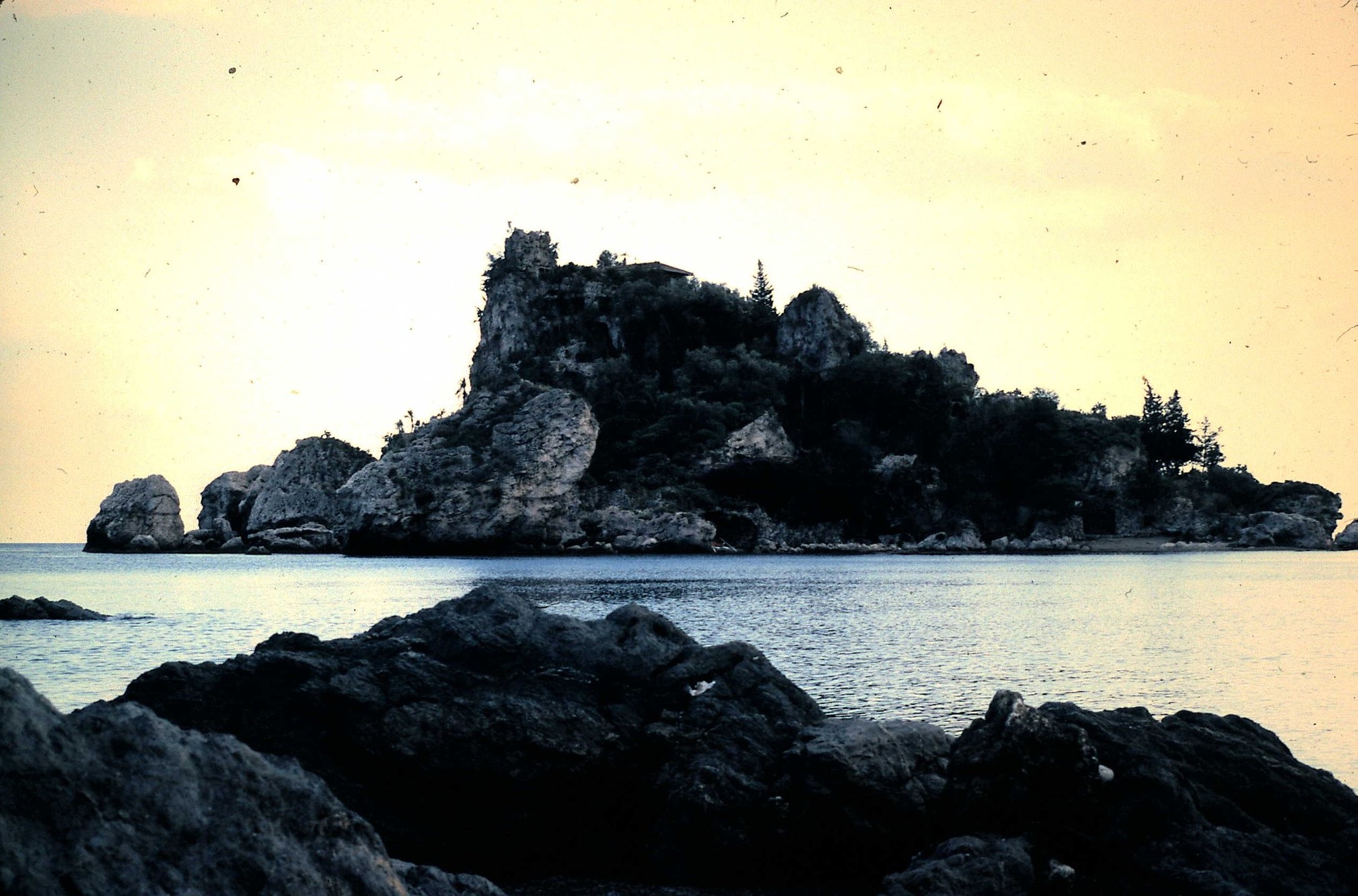
Arrival in Sicily.
The train I was in took the rest of the night hugging the coast as it moved along the "arch" of the "foot" of Italy before passing under its "toe" to arrive at Reggio Calabria, on the most southernly point of mainland Italy, and the port for the ferry to Messina, on the northeast corner of Sicily.
The journey from Brindisi could have been more uneventful. Earlier, I had to change trains at Taranto on the "heel" of the mainland "foot". While waiting for the train to arrive, I decided on a quick tour of the harbour town, only to see a large Rotweiller dog blocking the narrow street. I quickly made my way back to the platform with no further ado.
 |
| The Messina Strait seen from Calabria. |
It was daylight when the train terminated at Reggio Calabria. But the station was not a terminus but a through-station. The line continued onto the ferry itself, a very unique arrangement, the only one of the kind in Europe, if not the world. Express trains from Turin, Rome and Naples were shunted onto the ferry to continue its journey through Messina, with one branch heading west to Palermo Termini. The line I used headed south to call at Catania Central Station, Sicily's second largest city after Palermo, for the line to end at Syracuse or Siracusa in Italian. In 1982, Siracusa had a through station, but all mainline trains terminated there. By the time I revisited this historic city in 2007, the station was converted into a terminus, with the approach route diverted, tunnelling under the city.
However, the train I was on that morning ended its journey on the mainland, and I boarded the ferry on foot and found myself looking down at the deck below, with the feeder track dividing into three sidings parallel to each other. The ferry then sailed across the Messina Strait, a neck of the Mediterranean Sea about ten miles, or over 16 km wide along the ferry route. Around an hour later, I, along with a few other people disembarked to board a connecting train waiting for us.
The beach along the east coast of the largest island in the Mediterranean looked unattractive and less inviting than other beaches I have seen elsewhere. The pebbly shoreline was regularly interrupted by groynes, one barrier after another unceasingly as I travelled south. As the train journeyed on, I watched as the distant mainland peninsula of Calabria faded further away in the distance as the strait widen to open out, very much the same way as a river estuary empties into the sea.
Eventually, the train pulled into Catania Central Station, and I alighted there to look for a suitable hotel. To the north, the summit of Mt Etna loomed in the distance, a plume of steam rising from its summit. I made it my ambition to ascend this live volcano, just as I did on Mt Vesuvio in 1973. In the meantime, I did come upon a hotel and I asked about its price, and it sounded expensive. I chose to move on. But that was not entirely due to the hotel tariff. It was the city itself. Many structures were of black basalt rock from near the volcano. This gave me the impression of gloominess, and so, I headed back to the station. Siracusa looked to be more promising.
Onward to Siracusa.
I didn't have to wait long before another train pulled into the station, and I boarded. With no ticket barriers, it was easy to board a train straight from the street, as was the case of most Italian stations. Even with the city termini, in the seventies, one was able to board a train without the need to pass through a barrier. However, by 1982, both Rome and Naples's main termini had barriers installed for the first time ever. I was massively disappointed! The presence of the barriers tells of the declining morality and the lessening of the sense of honesty in society. However, even in the shortest local journey, the conductor was always thorough with onboard ticket inspection. Hence, both my three-week pass ticket and passport were essential for all travel.
I arrive at Siracuse Station, a handsome edifice as if built of consolidated sun's rays. From it, a quiet street, Via Francesco Crispi, took me to a family-run hotel almost directly opposite the station, Hotel Aretha. It was perfect for me. I was offered a room, and this became my living quarters for a week. Across the road and at the station itself, I had breakfast and snacked for the rest of the day rather than having large meals.
Siracusa was a better town to live in than Catania, although while I was staying at the hotel, I boarded a train to Catania several times. However, Siracusa had echoes of ancestry, with the Neapolis Archeological Park with its 2,500-year-old Greek Theatre, still in use today, the Roman amphitheatre, an ancient Greek water chute, still functioning at present, and the Ear of Dionysius, an artificial cave dug as a quarry, but which a legend says that it was used as a prison under Dionysius 1 of Siracuse, around 350 BC due to its acoustic qualities which amplify sound, thus enabling him to eavesdrop on the prisoners' conversation.
First Trip up Mt Etna.
Although I have a lot more to say about the city of Siracusa, the major highlight of this trip was ascending Mt Etna. In 1982, the height of the mountain was around 3,350 metres high (now 3,332 metres, due to the collapse of the Northeastern Crater during an eruption.) With the base circumference of the mountain being around 93 miles, 150 km, Mt Etna is basically a shield volcano, that is, a wide, gently sloping cone in contrast to Mt Vesuvius having steeper sides. With the lava having a lower mix of silicone, it tends to be less viscous, more incandescent, and runnier, hence the creation of a shield-like cone of black basalt, in contrast with the explosive viscousness of silicone-rich lava characteristic of the steep-sided Andesite volcano.
 |
| Distant view of Mt Etna. |
By making enquiries, I was able to find the official way to get up the mountain. Being a much larger natural phenomenon than Mt Vesuvius, where in 1973, I hiked from sea level to the crater and back in a day, with Mt Etna, a bus journey was made between Catania city central (after boarding a train from Siracusa) to a mountainside village of Nicoloso, then onward to Rifugio Giovanni Sapienza, way up on the mountainside, where the bus journey ends. There were only two bus journeys each day in 1982, therefore it was a must to catch the evening bus bound for Catania.
At the Refuge, we as separate individuals began to assemble into several groups ready to board the three or four jeeps to (what I thought) was the summit. But before the ride up, we hired thick weather jackets to cope with the cold wind blowing across the peak.
We, as a group, rode up in several jeeps, not to the summit itself but to a wall of hard basaltic rock, about a mile or so down from the summit, which serves as the lookout. It was a complete waste of both time and money. By the time we got up there, the mountain became shrouded in fog, and we couldn't see anything. I returned to the hotel in Siracusa feeling bitterly disappointed and frustrated!
The Second Trip - With an unexpected Meeting.
It can be amazing how personal history repeats itself, especially when it comes to outdoor activity. For example, in 1973, my first attempt to hike to the crater of Mt Vesuvius ended in failure, as I was caught in a rainstorm whilst on my way up. Therefore, a day or two days later, I tried again and yes, success on the second attempt. The same with Mt Etna. The first attempt was a washout, leaving me with a thinner wallet. Now, on the next day, I'm going to try again, a make-or-break attempt to take some stunning photos.
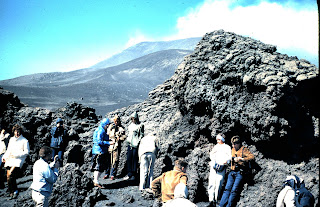 |
| Our group gathered at the basaltic rock wall. |
And so, after a train ride to Catania from Siracuse, the bus bound for Mt Etna pulled out of the city centre. The weather looked good, giving me some hope that this attempt will be a success.
As the bus pulled into Nicoloso, a young man, tall, slim, and good-looking, boarded the bus, paid his fee, and settled in a seat behind me but on the other side of the bus. I quickly forgot about him as we made our way up the mountainside until the bus came to a halt at Rifugio Sapienza. Then, as previously, we all hired the same jackets before boarding the jeeps. Again, near the summit but still, considerably below it, we all alighted from our jeeps to assemble at the wall of basalt rock which acts as a natural lookout.
This time, the sky remained clear and we were able to view the outline of Sicily far below. I admit it was an impressive view. We all milled around the lookout, some of the people taking short circuitry to walk around the site, with everyone apparently happy. Above us, the summit loomed, the huge white plume of steam emitting skywards from the central crater, a feature I wasn't able to see through the thick fog on the first visit. This time, the surrounding blue sky enhanced both the whiteness of the steam and the blackness of the basalt mountain peak.
 |
| We were above cloud level as Miguel followed me up. |
The handsome young man from the bus approached me. He looked frustrated. He then asked me to accompany him to the summit crater. As he spoke, he drew his face close to mine. Despite his good looks, his tall height and his slim physique, his breath was foul. Eventually, he pointed to a trail that led towards the summit from the basalt lookout. Again, he pleaded with me to accompany him. It was then that I realised that I too was curious about the summit, and I agreed to go with him.
We left the lookout and started our hike upwards, expecting a call from one of the staff members on the lookout. But no call came. Instead, all was silent as we trod on the black sand, the steam plume gradually getting closer. I was leading the way, and despite his insistence on ascending this mountain, he felt safer following me. We didn't even walk side by side.
However, I did find out that his name was Miguel, but knew little of his background, as my mind was set on the task ahead. We passed a large sign with the emboldened words, Molto Pericolo. We both knew what those words meant. We were on a very dangerous mission. Then again, isn't a bit of risk-taking adding a sparkle to life that can be quite rewarding?
We kept on hiking up. From time to time, I looked back to see whether Miguel was following. Also to ensure there was no one from the authorities attempting to turn us back, even to prosecute. Nope. Just the two of us.
Eventually, we arrived at a side crater. From it, plumes of steam were rising from various nooks and crannies in the crater. There was also a layer of yellow sulphur lining its inner walls, indicating that this crater was alive, although silent.
We walked further. As the ground levelled off, its texture changed from dry basalt sand to that of a wet beach texture. In front of us was a cliff drop, the ground was literally shaking and as the steam rose right in front of us, a continuous hollow thunder rumbled from within, with an occasional noise of an explosion coming from deep within as the steep inner walls amplified the noise. We had arrived at the Central Crater, the main vent at the summit of Mt Etna. As we approached the edge, the smell of sulphur was overpowering. As we retreated, Miguel took out two woollen scarves. He wrapped his face with one of them. He then stood behind me and gently covered my nose and mouth with his spare scarf. Perhaps, I was happy to be babied at that moment. We stood at the edge of the live crater.
 |
| On the edge of Central Crater, Mt Etna. |
On our right was a rise, a small hillock, and Miguel felt curious about climbing that for more views. But just as I said it may not be a wise move, there was a loud explosion inside the main crater. This boom, louder than the others, spooked my friend, and it was he who insisted on making our way back to the lookout for the jeep ride down to the refuge. We then left the crater behind as we started our hike back down.
--------------------------------------------------------------------------------------------------------
Next week: A dangerous incident on the descent. The Catacombs, White Beach resort.