"Vanity, all is vanity!" cries the Preacher. So the Old Testament book of Ecclesiastes opens. Penned by King Solomon the son of David, Solomon was the ancestor of Joseph the husband of Mary, the mother of Jesus. Solomon had a far less known brother Nathan, who was the ancestor of Mary herself, making King David the father of Jesus Christ in both the royal and biological lineage.
Having just completed the short book in daily morning Bible reading and meditation, I have found this book very pessimistic and if I would say, discouraging - throwing cold water on anyone who is bubbling with ambition and to the goal achievers. For those not so acquainted with Old Testament Scripture, what is Ecclesiastes all about?
That life without God is meaningless. A man works hard under the sun to enjoy the fruits of his labour, yet his days are few, and the same fate awaits him as it does to all. All the ambitious are toiling hard to achieve their goals but all they do is chase the wind. He cannot take his earnings or his rewards to the grave, but leave them for others to enjoy. So what is the use of wearing oneself out in heavy toil under the sun? Is he more wise than the lazy person who spends his time twiddling his fingers? Because both will die, the wise and the foolish alike, therefore the industrious wise man is no better off than the lazy fool, as the grave will swallow them both, and their names forgotten afterwards. So someone is born into a family with wealth and possessions, yet God has deprived him from enjoying what he has, instead he hurries around in anxiety in protecting everything he owns, for he knows that his wealth can disappear in a sudden. Someone else may work hard and gain wealth, but what would happen to it after he dies? Would the heir take care of the property and invest wisely, or squander it all away?
And so, Solomon writes,
What does man gain from all his labour at which he toils under the sun?
Generations come and generations go, but the earth remains for ever.
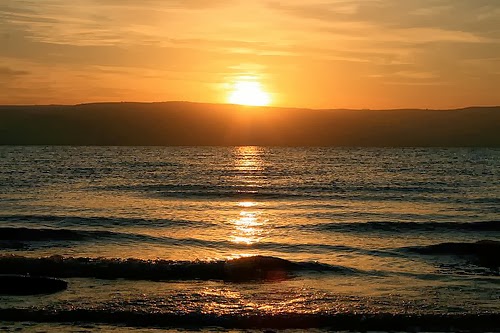
The sun rises and the sun sets, and hurries back to where it rises.
The wind blows to the south and turns to the north; round and round it goes, ever returning to its course.
All streams flow into the sea, yet the sea is never full.
To the place the streams come from, there they return again.
(Ecclesiastes 1:3-7)
In a world where universal belief was that every natural occurrence is a result of many moody deities in the heavens interfering with the elements, this Scripture is of true wisdom which is wholly backed by science. King Solomon could not have been truer when he described the reality of the earth's rotation and the atmospheric activity of the cyclone, or what we at present call a low pressure system, and the mechanics of the hydraulic cycle. That the sun rises and sets is scientific fact, even though it only appears that way due to the Earth's rotation. It was quite a contrast to the universal view, originated from ancient Egypt and adopted by the Babylonians, that the sun is a deity who dies at dusk, and it is either re-born at dawn, or a new sun-god is born every morning.
And so the UK media has put our recent storms and flooding as newspaper headlines and top priority story in our news bulletins. Talking in Solomon's poetry language, when the homes of the working classes up in the North of England were destroyed by flooding within the last couple of years, yes there was news coverage, but nothing as intense as in the present, as the Media goes hysterical when the prosperous South gets flooded. This is another evil, Solomon would have said, when our Prime Minister declares that "Money is no problem" when it comes to funding in resolving the crisis. Was it a coincidence that he came out with that statement on the same day as when news of a flood over the sports grounds of Eton was broadcast? And as far as I'm aware, I don't recall him declaring this infinite money resource when the floods hit the North a couple years earlier.
The floods over the Somerset Levels had been with us since Christmas, but it appears that not too much fuss was made over them, as much of the deluged land was farmland. It took weeks, even months, before our Government ministers turned up to show their support. But when the River Thames had burst its banks, particularly over Berkshire and Surrey, threatening towns such as Henley, Marlow, Datchet, Windsor, and Shepperton, all wealthy upper-middle class settlements, there was panic in Downing Street, and a voice was heard at Parliament. And so our Ministers squabble about one thing over another, yet are powerless to make any real tangible inroads, since how could man, puny as he always have been, tame the violent forces of nature?
And so street interviews follows one after another, victims of the flood giving their opinions and points of view of the conveyor belt of storms, persistent rain and gales, homes destroyed by flood waters, stinking sewage, along with power supply failure, fallen trees, abandoned cars and other damaged properties and businesses. Yet one of things I have noticed which is so distinctly British, is that of the sheer stoicism among the interviewees, the containing of emotion when, after years of working so hard and spending so much, to see such a beloved home destroyed along with treasured possessions, family heirlooms, and so on. Oh, isn't the stiff upper lip so admirable during a crisis as intense as this one, a characteristic so unique to Britain, so the newspaper journalists insist, that the UK, especially the English, appear culturally superior to the rest of the world. So our newspaper reporters love to boast on how the British were fit to expand and run an empire, according to them, the greatest and the most extensive in human history. This is another evil under the sun. For when human stoicism was seen outside the UK, such as at a mining crisis in South America a few years ago for example, our newspaper reporters not only remained quiet, they even disappeared from their desks during the occasion when all the victims were successfully rescued under a very meticulous operation.

So this is what I have observed: that when the ordinary plebs and the working classes suffer a crisis, then the media reports in a calm, business-like manner, one of several articles and not even making the headlines. But if the wealthier, upper or upper middle classes suffer the same sort of disaster, then both the Media and Government ministers throw themselves into an emotional turmoil, running around in circles in trying to find a solution to the crisis. On a Daily Mail Online website, there was a picture post showing all the posh homes lining the banks of the River Thames under threat of flooding. Maybe I might be wrong here, but so far I have not come across anything of this kind on the Media from up the more industrial, working class North.
So a boy receive a top-class education, attending an institution such as Eton, Harrow, Rugby, or Winchester public school, and graduates in readiness for Oxbridge, where he collects a highly valued degree. Then into the world of work where his degree earns him a high income which, in turn, lays a deposit on an exclusive, expensive riverside property with stunning views. But as the river rises and flood his home, he sees the whole of his lifetime achievement go to pot, despite all the media attention he gets. This is a terrible evil. As he gets old, his health gives in, and he spends his last days in a nursing home before giving up the ghost. How very, very sad and pathetic. He leaves nothing but his name, his date of birth and of his death etched on his tombstone, and nobody remembers him, save his family. The world simply moves on. Anyone passing his tombstone and reading his epitaph will not have a clue on how he looked, let alone how he acted in life.
Am I being cynical? Maybe so, maybe not. But these ideas are not my own. King Solomon had already observed very similar things and recorded them. That includes class bias, which some readers might have come to believe I have an obsession with. Yet Solomon also wrote:
I also saw under the sun this example of wisdom which greatly impressed me:
There was once a small city with just a few people in it. And a powerful king came upon it, surrounded it and built huge siegeworks against it.
Now there lived in that city a man poor but wise, and he saved the city out of wisdom. But nobody remembered that poor man.
So I said, "Wisdom is better than strength."
But the poor man's wisdom is despised, and his words are no longer heeded.
Ecclesiastes 9:13-16.
Oh, how we British, who claim that our Constitution is based on the Bible, yet follow the very same folly as those inhabitants in that city which was saved by the wisdom of the poor man. Maybe if I had titled this page Christian Thoughts: By Dr. F. Blasi M.D.- I would have a much wider audience of readers! Even if all my words were exactly the same, I was tempted, at one point, to title myself Dr. - just to see what might have happened. But God would never be glorified by deception.
Ecclesiastes is about daily life under the sun, without God, with the grave and judgement awaiting all. Without God, life is indeed meaningless, a hopeless folly. But, and yes praise God, there is a but, through faith in Jesus Christ there is hope - eternal life given freely to all who believe. That is good news. And this is the reason why I have placed the folly of life through the present flood crisis on the same par as Solomon's writings. We British may with stoicism face up to the disaster, and draw up plans on how to deal with it. But that is where the problem lies. The victims keep a stiff upper lip, count the cost of his loss, and attempt to move on without falling on his knees and calling on God for mercy. Given the right instructions on faith in Jesus Christ Resurrected, this soul would receive something much more worthy of value than mere restoration of his home and possessions. A heavenly home, glorious, eternal, without money and without price - hence no mortgage or rent - reserved for him in Heaven. A home and property that will never ever be spoilt by any form of disaster.

It is something to be cheerful about, and the reason for a much greater hope.


