Total Pageviews

Showing posts with label Volcanoes. Show all posts

Saturday, 6 November 2021

A Car Exhaust and a Large Hole...

One of the benefits of retirement is that I can take a weekday leisure trip to London to do the early Christmas shopping. That's hardly ever been the case with me shopping at the start of November. Normally, I carry out this particular errand at dusk on Christmas Eve. However, due to the threatened shortages of imported goods due to the combined issues of Brexit and Covid, I thought it was better than to take any chances.

Therefore, on a typical weekday, I can be assured of a complete train journey without the need to alight at a midway station to board one of those replacement buses - a weekend arrangement that has been ongoing for several months as our line shuts for planned engineering works.

I live in the town of Bracknell, about eleven miles east of Reading. The line that serves our station is the commuter line, where stopping Southwest Train services brings the commuter into London Waterloo Station. However, our line runs parallel to the Great Western line, roughly eight miles distant from ours. Fast, non-stop trains connect London Paddington to the West Country, with the majority of trains out of London making their first stop at Reading Station, a principal centre for changing trains.

Newly-developed shopping mall, Bracknell.


Therefore, I took a train to Reading Station on this occasion, and I didn't have to wait long before a non-stop to London Paddington pulled in. Thirty minutes later, I found myself walking on the platform at the London terminus, having taken a quicker journey than had I taken a direct train from Bracknell to Waterloo - the public service I affectionately dab, The Southwest Snails. 

I'm not being cynical here. I recall the 1970s when our line, then under the national umbrella of British Railways, laid on fast, efficient services. For several years, I was able to board a train at Bracknell for a fast ride into London with just one stop. That was at Staines, a large town roughly halfway between Bracknell and London, marking approximately the outer boundary of Greater London.

So, what is this all about? Why all this background detail? Well, compared with the 1970s, when our trains were no more than eight carriages long, at present, our trains now have up to ten carriages. And what's so ironic was that on this particular occasion, the off-peak service from Bracknell to Reading was almost entirely empty of passengers. Therefore, within the midst of rows or unoccupied seats came the announcement from the overhead tannoy:

Passengers leaving the train at the next station must be in the first eight coaches of the train. This is due to the short station platform.

I couldn't help but smile. Why on earth was the need for ten carriages when the train was virtually empty? And knowing full well that there are some stations on our line with short platforms that are unable to accommodate the entire length of the train. Then, to broaden my smile even further, the same female voice announces;

The next station is... Then gives the name of the wrong station. No help at all for a tourist or backpacker who had just entered the UK and is trying to navigate our public transport system! Or the one occasion, when the train was approaching the London station of Clapham Junction whilst heading towards Waterloo, the tannoy buzzed on with the announcement:

We are now approaching Ryde, Isle of Wight.

Never mind that Ryde Station is some eighty miles and a ferry sailing away from where I was, but also on a completely different line to the one I was using. While I was sniggering at such a blatant error, the rest of the passengers around me kept their cool, and I was wondering how their upper lips could be so stiff as to prevent them from even smiling. And so, that's what it means to be British.

This is a phenomenon that I had never seen or heard about anywhere else, whether in the UK or abroad. Some of the most memorable journeys I have ever completed were by train, both at home and across Europe and even in Australia. But nowhere else have I heard passengers hear such wrong announcements or be told to move through the train to alight. 

I have wondered who would I see if I walked into the management office of Southwest Trains. Young graduate men in their suits? Ambitious young women pursuing a career path? It's into such an environment like this one I would walk into and ask the question: Why?

Why what?

Why do you run trains that are longer than the station platforms they're supposed to serve? Don't you realise that during the day you can get all the passengers in just five coaches? That's just half the length of the train. And why are the announcements over the tannoy so fickle that they often spout the wrong information? And yes, I have seen and heard passengers asking for information regarding whether they were on the right train. Indeed, I would like to hear what they in the office would answer.

As I write this, at this moment there is a major international conference taking place among national leaders over climate change. Known as Cop26 taking place in Glasgow, the leaders of 75 different nations, including Joe Biden of the USA, Emmanuel Macron of France, and our host PM, Boris Johnson, have all assembled to discuss ways of putting the brakes on our planet getting hotter due to the emissions of carbon dioxide and other atmospheric impurities. And such changes as replacing fuel-powered motor vehicles with electric, reducing airline travel, doing away with coal-fired power stations and replacing them with renewable energy such as wind and solar power, along with our dietary conversion from eating meat to vegetarianism, even veganism, and the reforestation of areas previously devastated by deforestation for commercial purposes.
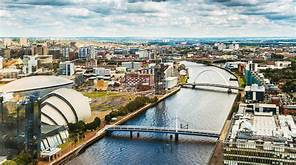
At or near the Armadillo, Glasgow is the Conference.


As I sat on the train heading towards Reading, I was pondering on all this. Then I allowed my thoughts to drift. What if a volcano erupts. You know, those mountains with a very big hole at the summit. During an eruption, a volcano spews out a large percentage of water vapour which is harmless in itself. However, more harmful gasses such as carbon dioxide, sulfur dioxide, hydrogen sulfide, and hydrogen halides, all are emitted during an eruption.

Here, I would like to do some maths for a bit of fun comparison. Let's say that an average diameter of a car exhaust pipe is 2 inches, approx 5 cm. The diameter of the crater at Mt Vesuvio in Italy is about 2,000 feet, 610 metres across. That would mean up to 113,256,000 tubes with the same diameter as a vehicle exhaust pipe would fit comfortably inside the crater of Mt Vesuvio. That is more than the 38,600,000 vehicles in the whole of the UK in March 2021.* That is, at any given moment, the volcano would spew almost three times the gases produced by every vehicle out on the road throughout the whole of the UK!

Fortunately, at present, this particular volcano is dormant. But it could blow at any time. However, when I stood at the rim of the crater of Mount Etna in 1982, the Central Crater was spewing steam, itself harmless, but with it, a powerful odour of sulfur dioxide was so strong that unless we covered our faces several times with a woollen scarf, the two of us most likely would have choked with asphyxiation. The air above the crater was otherwise unbreathable. The name of a nearby crater, Bocca Nuova, is quite appropriate, as it too is like a newly-opened mouth breathing out foul-smelling breath.

And so, we have a neighbouring volcano, Mt Stromboli, which is constantly active. Whether it's Stromboli or Etna known as the Lighthouse of the Mediterranean, really, it doesn't matter. Both are constantly active and their lava fountains are seen from a distance during the night. Then, not to mention Hawaii, La Palma, Lewotolok in Indonesia, Sangay in Ecuador, Aira in Japan - along with other active volcanoes around the world to make a present total of around fifty peaks presently spewing lava and toxic gasses. Call me wise or foolish, depending on your point of view, but I have serious doubts whether the Cop26 Conference will make any difference to the future of our planet. 

Volcanism has been ongoing since the time of the Flood. Looking at the total number of volcanoes, particular in the Andes of South America's west coast, along with those lining the Ring of Fire surrounding the Pacific Ocean, starting at New Zealand, up through the Philippines and along the Southeastern coast of Asia, then down the west coast of the Americas to end at Southern Chile, it seems that volcanism was far more intense during historic times than they are today. Yet, as far as I know, within the last four thousand years, give or take, is there any real evidence of dramatic climate change after the demise of the Ice Age?

One can look at the point of view of Nature. A volcano spews toxic gasses into the atmosphere. But with those gasses, the crater also spews out pyroclastic flows, consisting of clouds of ash and pumice. This is more so among the more explosive Andesite volcanos, from which lava tend to be more viscous, due to a higher silicone content. Such ash, when entering the atmosphere and dispersed by the wind, tends to cool the climate. As one example, the 1883 explosive eruption of Mt Krakatoa, located at the Sunda Strait of Indonesia. The overall temperature of the Northern Hemisphere fell by 0.4 degrees Celcius, and rainfall intensified as far away as California.

Therefore, it looks to me that volcanic eruptions balance a kind of equilibrium in global atmospheric temperature. As various gasses such as carbon dioxide, sulfur dioxide etc, tend to warm the air, then this is offset by the presence of micro-particles floating in the upper atmosphere, cooling the planet and therefore sustaining the essence for life.

When considering what looks to be a puny effort to "save our planet" - really, what is needed is to acknowledge the Creator, the one God who can resolve all issues in regards to our planet. Not that our leaders are completely wasting their time sitting at the conference. Rather, it's good for us all to take responsibility. For example, I'm all eyes and ears for tree planting and reforestation, especially on a global scale. I think that great efforts should go into this, the reforesting of vast areas spoilt by commercialisation, particularly with the destruction of the tropical rainforest of the Amazon region of Brazil, to give way to palm oil crops.

Reforestation will take a lot of effort, but with dedication, I think this can be done. One attribute to this possibility is that the general population is in favour. But when it comes to transport, I doubt that the majority of the population will be as keen to give up their mode of travel so easily. The car is seen as a status symbol, and there is that sense of power associated with having control of a fossil-fuel-powered motor vehicle. I doubt very much whether electric-powered cars will have the same effect. And holiday flights? Again, that's one thing people will not be keen to give up. Foreign holidays are part and parcel of making our lives far richer and meaningful. Just ask me!

And I can't see many benefits in wind turbines and solar energy, either. Imagine a "city of windmills" out to sea and across open fields on a calm day - or even a calm, windless week. As the blades remain still like a solid rock, the need for a nuclear power station will kick in if no coal-fired stations are in use. 

On a calm day, these generators will be virtually useless!


And here is where I find the connection between the Cop26 Conference and the running of Southwest Trains, at least on our line. Both have good ideas but tend to fall short in practice. There was a time when shorter trains ran fast services into Waterloo and stopped at scheduled stations without the need to "move to the front eight coaches" to alight. And back then, passengers knew exactly where they were without any announcements giving out misleading information. Even without any announcements, we all knew where to get off.

Both Southwest Trains and the Cop26 Conference have one thing in common - both have great ideas but both fall short in practicality. 
------------------------------------------------------------------------------------------------------
*From various Internet websites.

Saturday, 23 September 2017

That Universal Question...

I recall 1978. Or it might have been 1979. An ordinary working day and lunchtime at what was British Aircraft Corporation, near a small town of Weybridge in Surrey. This rather spacious aeroplane-manufacturing works complex, consisting of several large buildings, each arranged symmetrically to form a grid of streets not unlike a typical American town layout, was built on a former motor-racing track, the then nationally famed Brooklands, with remnants of the racing track still visible throughout the seventies. The complex featured two large canteens, across the street from the factories, and built back to back with each canteen housed under the same roof. One was the worker's canteen with no staff, where cold snacks were available from vending machines lining the wall. The other canteen was fully staffed and served hot dinners for a discounted price. Before the Trade Union intervened, manual employees, such as skilled and semi-skilled precision machinists from the factory shop floor, such as myself, would have been forbidden to enter the restaurant where hot food was served, but instead had to be content with the cold snacks from the vending machines.  

A VC 10 under construction at Weybridge.


But by the mid-seventies the Union was successful in its campaign. And so, by the time I joined British Aircraft Corporation in the Autumn of 1977, we machinists and labourers alike were allowed to mix freely with the suited office staff, which before were the sole users of the canteen. Therefore, being such a free-thinker back then as I am now, and without isolating myself entirely from my work colleagues, I tended to avoid the cliche-culture of manual workers remaining in their groups, and tended to "invade" office staff whilst assembling among themselves at table. With a tray of hot food in my hands, I chose a table where I knew was a favourite among office staff. Sure enough, about half an hour later a group of suited men around my age or a tad older piled around me. Although I keep saying that they were suited, in reality they were allowed to work in the office without the need to wear a tie. By going by my experience with them, with a few exceptions, these more casually-dressed individuals tended to show a greater sense of camaraderie towards the likes of myself. 

I was quite popular among them, although there will always be a few who resented having a manual worker sitting at their table. Only once was I ordered to move by one angry office pen-pusher. Since this occurred very soon after returning from backpacking the USA in 1978, and going by the timing of this incident, his anger and consequential rejection of my presence might well have been motivated by jealousy. Otherwise, among them I was quite popular. On this occasion, I was alone at a table which accommodates six people. This particular group of office staff, seeing me sitting alone, all rushed to occupy the remaining five seats. Not only had I felt welcomed by them, but had the impression that they wanted to be in my presence to ask me some questions.

The one with the most pleasing personality and was sitting right next to me, turned and asked:
If your God is such a God of love, then why does he allow such suffering in the world?
Oh gosh, here we go again! Then I turned and asked:
Do you believe God himself had ever suffered?
He could not answer, but still stuck to his thinking that the existence of a loving God couldn't be reconciled with the reality of the world's sufferings.

And so within the last few weeks the news media pumps out disaster after disaster. After all, what is it about the Caribbean region and Mexico becoming the victim of two tropical storms (so far) along with two earthquakes, both hitting Mexico City with intensity? The storms, with both hurricanes reaching magnitude five, which is at the top end of the intensity scale, had devastated the islands of the Caribbean. This, together with the two earthquakes had caused a high rate of fatalities and many more homeless. Then in addition, right on the other side of the globe, an earthquake hits Japan within the same time frame. Yet it is the islands surrounding the Caribbean Sea which are worst affected, whilst the UK seemed to enjoy immunity from such forces of nature. After all, with just one centimetre of snow covering our land, the whole nation comes to a standstill - schools close, trains remain stranded between stations, roads turn into skidpans and traffic builds up into a snarling congestion. After all, nature mustn't be too hard on us British! If half-an-inch of snow can cripple us, heaven help us if a magnitude twelve earthquake was to strike, or be hit by an intense Force Five hurricane.

Indeed, how can a God of love allow for all this? And then only at some parts of the world and not in other parts? To add salt to the wound, it does look as if nature is far more harsh towards the poorer tropical nations, while the richer nations such as the UK and Northern Europe seem to escape from such disasters. Even then, sitting on a throne in Heaven, God and his heavenly population aren't at all affected by these disasters, are they? And yet we earthlings are, and it does look as if God's arm is too short to intervene. Yet the question remains: Has God himself ever experienced suffering?


By reading the Internet lately, a plethora of blogs, articles and comments began to appear as if a by-product of these catastrophes. These contributions generally centres on the concept that as these disasters grow more and more frequent, this is the sign that the Rapture and the Second Advent of Christ are rapidly approaching. Even as I write, there is talk of the world ending today, a theory advocated by some christian crackpot, and therefore giving our faith a bad reputation. The fact that I'm right at this moment typing on the computer testifies that I'm still here and this present world hadn't ended, nor are we about to face Antichrist and the Great Tribulation.

This idea of the imminent coming of Christ is taken from Matthew chapter 24. Especially in the case of this generation in no way passing away until all these things - earthquakes, disease, global warfare, etc - are fulfilled, then the end will come (Matthew 24:34). The trouble is, when did this generation came to be? Was it those born before or even during the Great War of 1914-1918, as advocated by Tim LaHaye, Hal Lindsey, and perhaps Norman Robertson? The snag with that idea is that those alive during the Great War, even children alive during 1914, have long passed away. And the end still hadn't arrived. Or what about the generation who were alive when Israel became a sovereign nation on May 14, 1948? Yes possibly, because among the veteran population, there are many still alive to this day. Even more so who were alive when Jerusalem became the capital city of the restored nation of Israel. That took place in July 1980. This may indeed be a point worthy of consideration, because Jesus began his discourse on the Temple in Jerusalem, which stood at that time, and he foretold its destruction by the Romans some forty years later. If Jesus was speaking specifically about Jerusalem, and this present generation is the actual one Jesus was referring to - the generation who saw Jerusalem declared the capital city of Israel in 1980 - then I'm one of this generation, since I was already 27 years of age when this declaration was ratified. Indeed, the Rapture could occur within my lifetime, assuming that I could have up to thirty years left to live (taking me into my nineties!) But whether plausible all this may be, my generation have not seen the beginning of "wars and the rumours of wars...nation rising against nation and kingdom against kingdom, famines, pestilences and earthquakes in diverse places, which are the beginning of sorrows (or birth pains)." Rather, the beginning of all these was seen by those alive around 1914.

Therefore a counter-argument had arisen among more recent authors, such as Benjamin L. Corey, who wrote and published books as well as posted on the Internet. These authors specify that "This generation" of Matthew 24:34 refers to his disciples who were alive in his day, and were still alive during the razing of Jerusalem to the ground by the Romans in AD 70, and this event referred to as "The Great Tribulation". This carried with it the argument that the eruption of Mount Vesuvius in AD 79 resulted in the sun turning dark and the moon blood red, and the cloud of ash obscuring the stars at night - giving the effect of "falling from heaven" as the cities of Pompeii and Herculaneum were wiped out.

I think I can see where this author is coming from. First of all, Jesus was talking specifically about Jerusalem, with its destruction in AD 70. This was nine years before Mt. Vesuvius erupted and wiped out cities which had nothing to do with Jerusalem, the two locations being about a thousand miles apart, neither had the eruption brought the Second Advent nor the end of the world as we know it. Then throughout history, volcanic eruptions of greater intensity occurred, blackening the sun rays in the atmosphere, causing the moon to turn red and taking the lives of multiple thousands. One striking example was the explosive eruption of Mt. Krakatoa in August 1883. The resulting dust cloud blown out from the caldera has created a belt of darkness around the globe, but this didn't bring the return of Christ either. And of the many, many cases of widespread famine and diseases throughout all history, none had brought the present world to its climax. So in one sense, Benjamin Corey and his ilk may have a point in their argument. But the question of This Generation still remains.

Corey bases his argument on Jesus's words, this generation - that is, the generation alive during the Lord's ministry and the immediate years to follow, that is, his disciples. It's true that some of Jesus' followers might have still been alive during AD 70, although I tend to believe that the majority of Jesus' immediate disciples were martyred long before Jerusalem was razed. Therefore could he be referring to my generation, who saw Jerusalem restored as Israel's capital? Or thirdly, could this generation be a reference to the Jewish race? 

The footnote in the Revised Standard Version of the Bible has a footnote under Matthew 24:34, which reads, or race. The late Dave Hunt, who among other books, also wrote How Close Are We? - also believed that the term this generation was a reference to the Jewish race, at present existing in unbelief for up to two millennia after the Crucifixion, and tied to Jewish culture and traditions, kept alive despite its attempted annihilation by the Roman Catholic Church over the centuries as well as by the Nazis during the Holocaust. The Jewish race lives on to this day, even in unbelief. If Jesus' meant this generation not passing away as referral to the Jews as we know them, then he is absolutely right! The Jews are with us to this day, and they will not cease to exist after the Second Advent! Rather, the whole of Israel will be converted at his coming, as these verses testify:

And I will pour out upon the house of David, and upon the inhabitants of Jerusalem, the spirit of grace and of supplications: and they shall look upon me whom they have pierced, and they shall mourn for him, as one who mourneth for his only son, and shall be in bitterness for him, as one that is in bitterness for his firstborn.
Zachariah 12:10.

And so all Israel shall be saved: as it is written, There shall come out of Sion the Deliverer, and shall turn ungodliness away from Jacob:
For this is my covenant unto them, when I shall take away their sins.
Romans 11:26-27, AV.

The idea that this generation is a referral to the Jewish race as it stands at present in unbelief certainly makes sense, and eradicates any theory of which generation will see the signs ushering the end of the age. Because, in all truth, nobody knows. But the Rapture is imminent. That is, it can happen at any moment, totally unexpected. His return has been imminent since the day he ascended up to heaven. Nobody knows when he will come back, and God himself does not wish to give any dates either. So nobody should even guess. To guess the date is not the will of God for us. 

But as we await his coming, suffering continues. Physical suffering, especially around the Caribbean Sea and the Gulf of Mexico. Earthquakes, hurricanes - demolishing property and taking lives. People suffering, both physically and mentally. And are we immune here in the UK? By no means! Statistics have shown of a rise of mental illness, with a significant rise of depression rising among the young, both boys and girls, by as much as 70% in the last 25 years.*


So the key question is: If there is such a loving God existing, then why does he allow so much global suffering?

The question can be faced with a counter-question: Has God himself ever suffered?

The answer to that is - Yes! God knows everything about both mental anguish and physical suffering. To wit, that God was in Christ, reconciling the world to himself, not counting their trespasses against them. 
2 Corinthians 5:19.

Jesus Christ, whilst at the Garden of Gethsemane, was so mentally anguished, that he literally sweated blood. Then at the cross, his physical suffering combined with the reality of being abandoned by his Father for the first time in all eternity has made his suffering the worst in history, and no other person in the whole of history had ever suffered to such an intensity. Especially among Christian martyrs, whose hearts were ablaze with the joy of the Lord in their spirits, already equipped with the knowledge of an eternity in glory. 

Is God fully acquainted with suffering? Yes, absolutely. A worthy revelation for those who sat with me at table back in the seventies.

-------------------------------------------------------------------------------------------------------------
* The Independent, 27th Feb, 2016.