Total Pageviews

Showing posts with label Swanage. Show all posts

Saturday, 19 October 2024

Travel Biography - Week 122.

Marriage and Travel

Alex and I had a wonderful honeymoon after we married in 1999. Furthermore, I reassessed the quality of package holidays. With some self-control from excess alcohol consumption and room for some independence (rather than fully escorted tours), this package was very enjoyable.

From Day One, I learned that marriage meant a change of plans, especially with travel. One example of this was my intention to travel around the world for the second time, possibly around 2000 or 2001. When we returned from our honeymoon, I knew that this would never be fulfilled. For a start, my beloved would never sleep in a single-gender dormitory of a hostel. As such, not only would I need to double the funding, but the price of hotel rooms is generally more expensive. In addition, currency inflation needed to be factored in.

But my love for backpacking never waned after the wedding. During our first months of marriage, we talked about future backpacking trips together. One ambition I held was - if we have children - to visit the Grand Canyon and show them the trail I hiked on, and the magnificent views seen from deep below the rims.

Corfe Castle Ruins. Stock photo.


However, there was one country Alex longed to visit, and that was the Holy Land. If we decided to go, this would be my fourth visit to the Beautiful Land after my first visit in 1976, then seventeen years later in 1993, and then as a volunteer for three months in 1994. This latest trip would be exceptional, as unlike the past three trips which I made on my own, this time it would be with my wife, and we chose to celebrate our first wedding anniversary there.

The Middle East has always been a turbulent area, especially at present when both Hamas of the Gaza Strip and Hezbollah of Lebanon are out to wipe Israel off the map, with Lebanon receiving support from Iran. Therefore, I was very thankful for the window of relative peace that followed the ceasefire in 1967, as I just mentioned already, allowing me the fortune of setting foot in Israel, particularly in Jerusalem, previously, and as Alex was proposing, again for me in 2000 which would be the first time for her. But since 1967, tensions between Israel and the Arabs simmered, with Yasser Arafat leading his Palestine Liberation Organisation in wanting to reclaim territory from Israel's domain.

In 1976 and 1994, I witnessed signs of these simmering tensions. In 1976, I had just landed at Tel Aviv Ben Gurion Airport. It was late evening and there were no buses to Jerusalem. So I took a taxi. The driver recommended what was then the Ron Hotel, but it was my choice to walk into its reception and ask if there was a room. After settling down for the night in the room offered, there was a very loud gunshot which echoed through the streets of the city. It was brought home to me that this was no holiday resort (more of this in Week 4 of this Biography). 

The other occasion took place in 1994. Outside the same hotel where I stayed in 1976, President Yitzhak Rabin was holding a meeting with the PLO leader Yasser Arafat, who wanted to make East Jerusalem a site for his PLO headquarters. While the talks were happening in the hotel, outside, crowding Zion Square, thousands of Israelis assembled in an angry protest. Palestinian flags and other banners were set alight among several TV cameras placed at strategic spots around the crowded square. And all that followed countless Orthodox Jews assembling at the plaza of the Western Wall and devoting themselves to prayer. And so, by listening, the Holy Land was, in a sense, speaking to me.

And such memories, both good and challenging, passed through my mind as Alex asked me to take her to Israel. So, during the early spring of 2000, we took a train to London and together, booked two weeks in Israel for our first anniversary. How coincidental! In 1993, the first of the seven years of Travel, I flew out to Israel after receiving a remarkable vision in 1992 while I was at work. After the 1994 flight to the Holy Land which followed the 1993 trip, I backpacked America in 1995, then Around the World in 1997. In 1998, I flew to New York to escape the international football. Then, in 1999, we had our Honeymoon. in Rhodes. Now we were about to visit Israel - the first visit for Alex.

Some weeks after the booking was made, Tim, my friend and accountant, asked if I would like a weekend camping at Corfe Castle, Dorset. Although camping was not my thing, I agreed to accompany him. While we were away, Alex agreed to spend her time with Tim's wife, Sharon.

I loved that part of the world, the Isle of Purbeck, although not an island but a peninsula, surrounded by Poole Harbour to the north, Studland, the Chalk Foreland of Ballard Down, and the resort of Swanage, all facing east towards the Isle of Wight, and to the south faces the English Channel. To the west, the land strip continues towards the holiday resort of Weymouth. A hiking trail, known as the Dorset Coastal Path, provides a dramatic but strenuous clifftop walk from Swanage to Weymouth, a 31-mile, or 50 km ramble along the Jurassic Coast. I recall completing this distance in two days in 1996, after returning from the Grand Canyon hike in 1995, but before snorkelling over the Great Barrier Reef in 1997. 
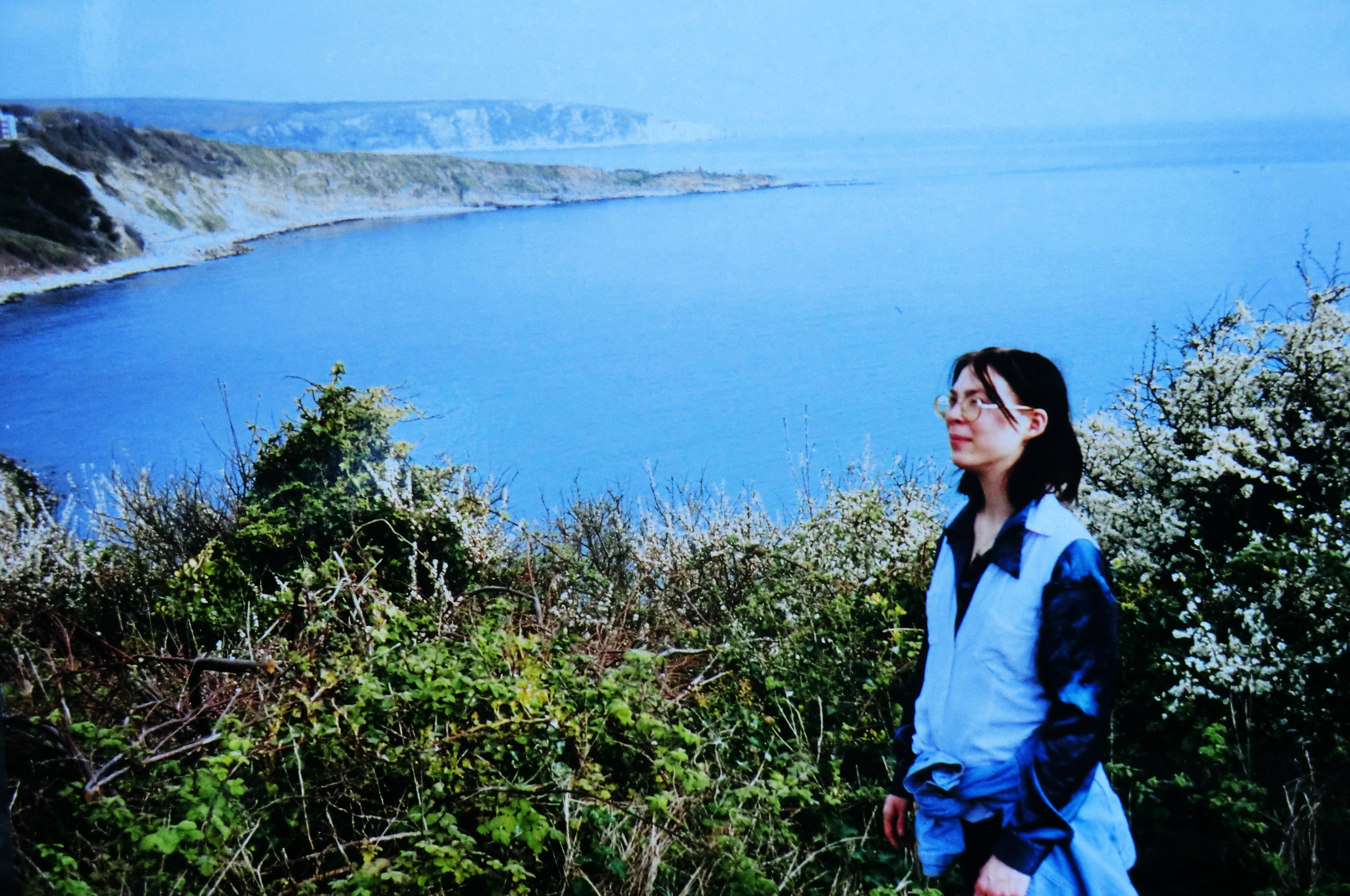
At Durlston Head, Swanage, Easter 1999.


At Dancing Ledge, Swanage, 1999.


The Jurassic Coast, like the Grand Canyon and the Great Barrier Reef, bathed in natural tranquillity, the lack of a boisterous crowd, no threat of war, and no intense commercialism make such a location a quiet retreat, even if engaged in strenuous activity. As I tackled the steep clifftop hills between Kimmerige Bay and Lulworth Cove, there was peaceful silence, even when I had to tackle Flowers Barrow, the western end of the chalk ridge stretching the whole length of the Isle of Purbeck to end at Ballard Down in Swanage, and tapering to the famous Old Harry Rocks. On the second day, I hiked the shorter, easier route into Weymouth.

That was in 1996. In the spring of 1999, during our courting days and around six months before the wedding, Alex and I went to spend a long weekend (Easter) in Swanage. Originally, we were meant to camp, as Alex always loved camping even if I didn't. Earlier, Tim lent us his tent. When I had difficulty erecting the tent, I felt my patience drain and feeling flustered, set off to a nearby hotel. That was before I bought my own tent to camp at Stoneleigh in August of that year. During that break, we went out hiking from Swanage to Chapmans Pool, then turned inland, and returned to Swanage via the Priest's Way, passing through a lovely little village of Worth Matravers, and we completed a circuit of 14 miles or 22.5 km. The photos in this week's blog are from that 1999 Easter break. 

Two Married Men on a Weekend Break.

It was a beautifully sunny Saturday morning when Tim began his drive to Corfe Castle during the Whitsun weekend in 2000. While we were on our way, Alex joined Sharon and her young children and together they spent the day at Legoland, near Windsor. Eventually, when we arrived at the campsite, I was impressed with the site which was located at Bucknowle Farm, just over a mile from the castle ruins and a half-hour walk.

We set up our tents. I remember Tim's as he set it up. It was the same tent that was lent to us a year earlier before the wedding. The tent I had was the one I bought secondhand from a customer in readiness for the Stoneleigh Bible Week the previous summer.

As our friendship went back many years, whenever he teased, I playfully wrestled him to the ground. We were no longer adult men with responsibilities, but two boys who enjoyed pitting ourselves to each other. Yet, each knew of our closeness. There was no animosity.

Although the weather was fine during the day, it was very different at night. Torrential rain fell across Dorset. The raindrops falling on my tent were amplified to a loud, continuous clatter. It wasn't long before Tim approached my tent door with a plea to share mine. The roof of his was leaking.

As we lay close to each other in a confined space, I knew why I disliked camping. The clatter of raindrops was loud, I was shivering cold and damp, even if the roof of my tent held well. I hardly slept.

On the same day we arrived, that afternoon, a Saturday, we strolled into the village, but we didn't enter the castle itself, even as it loomed on an area of high ground which was part of the chalk ridge from Ballard Down in Swanage to Flower Barrow near Lulworth Cove.

The following night was the same as the first. The lovely sunshine gave way to a thick cloud, and once again, after dark, there was a torrential downpour which lasted most of the night. Again, Tim had to share my tent, as his shelter was practically useless in wet weather. However, on one of the evenings, Tim took his car and drove me to Swanage. At one of the fish & chip bars, we enjoyed an outdoor meal as we strolled along the esplanade. As I looked around, the white cliffs of Ballard Down towards the north, and Peveril Point jutting out to sea just south of us, make for this extraordinary geological phenomenon that has not only attracted geologists from far and wide but has been so familiar to me since I was eight years old. Indeed, I was on a primary school two-week trip like the school journey made to Llangollen a year later in 1962. 

On the second day, a Sunday, we went out on a coastal hike. Unfortunately, I never brought my camera with me for that holiday, therefore I cannot relate exactly where along the Dorset Coast path we hiked. But at least it was sunny once again. But since the hike took much of the day to complete, it must have been a circuit similar to the one Alex and I did the previous year. Wherever we went, I remember the stretch of the coastal path we covered both on the outward and return walks.

It was not long after the start of the hike when I saw a patch of mud and water interrupting the trail. I took a leap and cleared it while my accountant friend simply walked through. That was when a more serious conversation arose. I admitted my fear of mud patches since I was a child. In his characteristic British manner, he fobbed off my complaint as silly. I then explained that as a boy, I once watched a Western on our little monochrome TV where the villain's life ended when he sank into a patch of quicksand and was fully submerged.

Does quicksand really exist? I asked my father. He answered that quicksand does exist in real life, but never added, But not in this country. Not long after, my primary school class was taking a morning walk through Richmond Park in west London. I stepped onto a mud patch and immediately both my feet began to sink into the mud. Remembering the fate of the villain, I panicked in terror until a teacher arrived and pulled me free. This just goes to show how long-forgotten childhood fears could suddenly surface given the right circumstances, something Tim needed to realise.

Approaching Chapman's Pool.


Chapman's Pool, Dorset. Spring 1999.


The third day, Bank Holiday Monday, followed another stormy night in the tent. But as the sun once again appeared in the clear sky, I felt relieved to return home. In all, it was an enjoyable holiday. Two grown married men, both church-goers, both having competed in sports - Tim in football and rugby games while I swam, cycled, and ran in Triathlon events held across the country. Tim was a father, and I wasn't, but that didn't matter to me. After our wedding, my own perception has changed rapidly, as the saying goes, he who loves his wife loves himself.

While we were away, Alex was with Sharon and her children (now all grown up). But how the conversation went between Tim's wife and my wife, I will never know. But something was happening inside her which she didn't yet know, let alone me. While I was wrestling with Tim on the ground after a bit of teasing, little did I know that inside Alex's womb, a tiny new life was taking shape.
--------------------------------------------------------------------------------------------------------------------
Next Week: The Flight to Israel. 

Saturday, 29 April 2023

Travel Biography - Week 46.

Note: All the photos displayed here were taken on the 1991 holiday. No stock photos.

                                                                 *******************

Our 1990 End-to-End bicycle ride through the length of Great Britain was a success. The ride, starting from John O'Groats to Lands End, was accomplished with one other person, a long-standing friend, Gareth Philips, with whom I still keep in touch to this day.

The 1991 Coastal Cycle Ride from Lulworth Cove to Dover.

As one who always loved being independent, it would have been natural to love travelling on my own. However, when I had to go through a period of a more restricting budget, there were options to experience travel, both overseas and at home, accompanied by one or more friends. And such characterised the late eighties into the nineties. With four other people, namely Keith White, Paul Hunt, Gareth Philips, and Tim Kingcott, I have completed a couple of cycling circuits through Holland, Belgium and Germany. This was followed by a cycle ride in 1989 along the French coast from Cherbourg to Paimpol and back in a week. Like the End-to-End cycle ride a year later, I shared this particular holiday only with Gareth.

At the Fossil Forest, Dorset, 1991.


However, in this blog, I would like to concentrate on the one solo cycle ride here in England. It was 1991 and for the first time since 1985, I took a week off work to first cycle the 105 miles from my apartment in Bracknell to Lulworth Cove in Dorset. Setting off at 6.00 in the morning, I arrived at Lulworth Cove around four in the afternoon. From Lulworth Cove, I then cycled the approx 230 miles from Lulworth Cove, which is near the Dorset ferry port and seaside resort of Weymouth, to the ferry port of Dover in Kent. Although I completed the ride on my own, there were three unusual features on this ride.

First, I was joined by Tim Kingcott at YHA Swanage on the third evening after leaving home. This was after he asked me if he could ride the Isle of Wight leg of the journey with me before boarding the train for home at Portsmouth. Secondly, my first full day in Swanage was taken up by the Swanage Triathlon, an annual sea swim event corresponding to the Swanage Summer Festival. That year, I competed in the triathlon. Tim arrived at Swanage in the evening after I had completed the triple-mode sport. Thirdly, after spending a night at YHA Dover, I boarded a cross-channel ferry to Calais to complete a cycling circuit from the French port to the small town of Ardres, 16 miles inland.

Stair Hole.


Here is a list of overnight stops I made during this short break, all at YHA hostels:

Lulworth Cove
Swanage - 2 nights
Totland Bay
Arundel
Eastbourne
Dover 

With Tim Kingcott:

2nd night at Swanage
Totland Bay.

I saw Tim off at Portsmouth Harbour Station whilst I continued eastwards to Arundel.

Approximate total miles cycled: 
My apartment - Lulworth Cove: 105 miles.
Triathlon cycle route - 12 miles.
Lulworth Cove - Dover: 230 miles.
In France, Calais - Ardres: 32 miles round trip.
Total miles ridden on two wheels: approx 380 miles, 614 km.

After arriving back at Dover from the cross-Channel crossing, I boarded a train at Dover Priory Station for the homebound train on the Charing Cross line to Waterloo East Station, where I changed trains at Waterloo Main Line. I didn't have either the energy or the mood to cycle homeward. 

So, why I have included this short break in this Travel Biography? Mainly to centre on the Dorset Coast with its dramatic cliff formation, along with participation in a sporting event.

Stair Hole with Lulworth Cove in the background.


In the world of Geology, the hard and resistant Portland Stone on this stretch of coastline was eventually breached by the sea, exposing and then eroding the softer rock layers behind. These softer rocks include the Purbeck Beds, with the Wealden Beds further inland. Behind the Wealden Beds, the Chalk landscape continues inland. There are three stages of erosion, each represented by three different locations, making this part of the Dorset coastline so spectacular. Stair Hole is the youth stage, where the sea had "recently" breached the Portland stone to form two arches under the cliff. The middle age is Lulworth Cove itself, where the erosion of all four rock layers had formed an oval bay penetrating inland. At the east end of the cove, a ledge protrudes from the cliff, on it are the remains of circular burrs surrounding what used to be antediluvian trees. This area is known as the Fossil Forest. It is reached by a short flight of steps.

The old age of coastal erosion is at Durdle Door, a famous arch a mile west of Lulworth Cove, which is a 61-metre-high bridge of limestone that still bear remains of an ancient forest. I have visited this natural wonder several times and actually completed a circuit swim passing under the arch. Unfortunately, during the heat of the summer, there have been serious injuries occurring at the site by those tombstoning into the sea from the crest of the arch.

At Stair Hole.


The Swanage Triathlon 1991.

After arriving at the hostel from my hometown of Bracknell, I spent that night at YHA Lulworth Cove, which is part of a school, and therefore with restricted opening times. It's quite a walk to get to it from the coast. But with the rolling hills plunging into the sea and with such dramatic cliff formations, it looks to me like this is one of the wonders of Great Britain.

It was the next day after I arrived that I explored the coastline, including a visit to Fossil Forest. By late afternoon, I began the ten-mile ride to Swanage and checked into the YHA hostel there, a large country house that's open throughout most of the year. That night, I spent alone. However, the next morning, a Sunday, I assigned my bike to one of the pegs reserved for me. A crowd of nervous athletes were gathering on the beach. Yet, the air was electric.

Here we were, all dressed in a lycra tri-suit, a one-piece, tight-fitting garment that's compatible with swimming, cycling, and running. I was in my late thirties by this time, and I was at the peak of my fitness.

We all plunged into the sea from the moment the starter's gun fired. It must have been quite a spectacular sight - a crowd of athletes literally running into the sea and throwing themselves forward to a front crawl stroke. With hundreds of arms swinging in and out of the water all around me, I kept my eyes on the Ballard Down chalk cliff directly ahead whilst on this 400-metre swim. Eventually, we neared a buoy placed there to turn us around as we headed back to the beach.

Back at the beach, it was a dash across the road to the bike park. After slipping on some footwear and a mandatory helmet, I was off. No messing about with a towel or having a shower or a coffee break. In a triathlon, the transition would make all the difference between you holding up the winner's trophy or watching somebody else lift it.

The twelve-mile (20k) bicycle leg was fast but very demanding, as the terrain was very hilly. The 6-mile (10k) run that followed included a very steep climb up Ballard Down, then a downhill fast run into Studland Bay. Then its route passed through a gap in the hills before winding through the town to finish by the beach. In all, I probably completed the whole event in around one hour and fifty minutes.

Durdle Door, Dorset.


The Coastal Ride Resumes.

That evening, after most of the athletes had gone home, I was greeted by Tim as he checked into the hostel. The next day, we decided to walk along the cliffs to Old Harry Rocks, a series of chalk stacks at the tip of the Foreland Point, the angle of the mainland where Studland Bay begins, and on a clear day, it's clearly seen across 15 miles of sea from the Isle of Wight. After returning to our bikes, we both made off for Totland Bay on West Wight, the very same hostel where Tim first introduced me to this shared form of accommodation six years earlier in 1985.

Lulworth Cove.


The next day we hugged the south coast of the Isle of Wight as we made our way from Totland Bay to Ryde Pier, one of the very few piers in Britain that carries a railway, the Island Line from Ryde Pierhead Station to Shanklin, where the line ends, although it once carried on further to Ventnor.

We crossed the Solent back to the mainland again by ferry, just as we did the evening before when we used the Lymington-Yarmouth ferry. At Portsmouth Harbour Station, I saw Tim off as he boarded a train for home. Alone once again, I carried on the ride for an overnight stop at Arundel. The next morning, from Arundel, I made my way to Eastbourne, stopping at Brighton on the way.

The YHA Eastbourne is a couple of miles out of town, as the hostel actually serves hikers using the South Downs Way, a hiking trail from Eastbourne to Winchester. Therefore, I arrived at the hostel before reaching the resort. But once at the hostel, I stayed there rather than wander into town. 

The Pinnacles, Swanage.


By the next day, a strong westerly started blowing. This gave me a great advantage. For example, the road from Hastings to Rye, then on to Folkstone, was flat and very fast! Indeed, fast enough to overtake a lorry, after making sure that the oncoming lane was clear and safe enough for me to make the manoeuvre. It was exhilarating! Had I ridden that fast at the Swanage Triathlon, indeed, I wonder whether I might have won overall?

At the YHA in Dover, I wasn't too impressed with the member's kitchen. It looked more like a corridor than a proper room. However, like at all other hostels, I managed to prepare a decent meal to refuel all my energy.

The next morning, after checking out of the hostel, I made my way to the docks and bought a return ticket to board the ferry to Calais. This wasn't spontaneous, rather, it was planned, as I had my passport on me in readiness. I boarded the ferry and parked my bike in the car hold without a hitch. This was one of the benefits of membership in the European Union. The freedom of movement such membership offered made it so easy and effortless for a cyclist to cross the Channel.

At Calais, I turned off the motorway that took traffic to Paris and rode on a quiet, traffic-free road. I eventually arrived in the small town of Ardres.

The most famous Old Harry Rocks, Swanage. 1991.


There I was, across the English Channel on my own for the first time since 1985. Will I revert to travelling overseas solo like I did before? 

That was when I had as if a divine vision of standing on the Mount of Olives in Israel, and looking down towards Jerusalem. That occurred in October 1992, after turning 40. That vision I had whilst at work, and it was proved to be a Morning of Destiny. Little did I know that this very vision opened up what I call the explosive climax of world travel, covering seven years before I married Alex.
---------------------------------------------------------------------------------------------------------------
Next Week: On the Throne of England and more about the vision.

Saturday, 11 March 2023

Travel Biography - Week 39.

A Paranormal Incident?

In last week's post, whilst I was narrating my 1985 visit to the Paris Catacombs, I mentioned whether any discarnate souls were present and whether they would feel frustrated or angry at my presence. Indeed, some, or even many reading this biography may be wondering how someone living in the 21st Century could hang onto superstitious nonsense as this - a throwback from the Dickensian era when grown men were afraid to walk through the narrow, medieval streets of London during a foggy night, believing that the murk in the air is the gathering of lost souls looking for somewhere to rest.

Therefore, I have to admit how I was feeling towards those skulls and femurs that lined the walls of the ossuary. Feeling sad for them, I approached one of the skulls and gingerly stroked its cranium. I then made my exit without giving it any more thought.

Notre Dame, Paris. Visited 1985. Stock photo.


Within two weeks after that particular holiday ended, whilst nipping to the superstore to buy some bread, some youths in their late teens or early twenties were sitting on the wall just outside the supermarket doors. One of them threw a verbal insult at me. When I should have ignored him and simply head for home, instead, I threw one back at him. A big mistake. The gang arose and pushed me into an alley where more youths were already gathered as if waiting for my arrival. Some young women were also there, watching.

Then one of the youths, the ringleader I believe, floored me with a single punch. I was the butt of around ten to twenty youths, who all delighted at my hurt. There was not a hint of sympathy or a twinge of compassion among any of them, not even among the females. What a dynamic contrast to the recent compassion I felt from a group of young people whilst on board the wrong train as it raced to Paris from Dieppe! As I stumbled home from the alley, one of them asked where I live. Would they follow me to my apartment? Being three floors up, the only damage they could have done was to the front door. However, a second punch was thrown at me before their interest in me began to wane and I was left alone once again.

But why?

Was I a random target to relieve their boredom and add some excitement to an otherwise uneventful evening? No, for I was well-known in the neighbourhood for my domestic window cleaning business. It was not that long before when I received a phone call from one of my customers, asking whether I was quitting the business. When I replied, You what? - she became very apologetic and explained that a man called with a message that I had sent him, and gave him permission for him to take over. I became angry and explained that I would never send anyone on my behalf. If I had a message to deliver, I would deliver it myself in person. The elderly lady then reassured me that I was still in her books and will be waiting for my next call.

That this poacher could have been the ringleader's father or brother was well within plausibility, and once verified by being watched on one occasion by the same gang whilst I was at work. In turn, my other clients in the same street confirmed that he called all the houses and each one turned him away, either saying that I'm their window cleaner, or they don't want the service at all, the latter group having turned me away too during my canvassing evenings. 

Whether that particular set of events was tied to my stroking the cranium of a dead person beneath the streets of Paris or not, what Paul wrote to the Ephesians opens the possibility of a supernatural drive behind the emotions of the gang members who attacked me, when he penned, In times past you walked according to the course of this world, according to the prince of the power of the air, the spirit which now works in the children of disobedience. Other than this, the only alternative to the sheer timing of the beating would have been a mere coincidence.

How an Accountant changed my Travel Habits.

My friendship with Tim Kingcott goes back to the late seventies, especially after he left university. A schoolboy or college rugby player, he became the manager of a football team, also the crew leader of a hospital radio station (cf, Week 30) and one of the elders at Ascot Baptist Church. He also loved the great outdoors, and, like I do, loves the dramatism of a cliff face, especially in the Dorset/Isle of Wight areas of the English coastline. He also has a good knowledge of birds and a fondness for flowers, particularly of the Pansy variety - a cause of much teasing between us, along with a few other friends. Yet, we are still friends to this day.

The Dorset Coast, Swanage.


Tim also loved camping and hostelling, back then both outside my realm. For me, however, a private hotel room was always my means of accommodation when away from home. Yet, according to hostelling records, my first experience in a Youth Hostel was in the Spring of 1985, a few months before my third trip to France. Hence, it's true to say that there was an overlap between the hotel and the hostel eras.

It was Tim who introduced me to the world of the Youth Hostel. This one was at Totland Bay on West Wight. Unfortunately, this hostel, among others, closed permanently during the nineties and the property resumed its original purpose as a private residence.

Some Youth Hostel Information.

The Youth Hostel may be unfamiliar to a certain percentage of my readers, as during my younger years I too was unaware of its existence. Therefore, I would like to enlighten you on what hostelling was all about, for the matter of interest.

In Germany, in the 1930s, the idea of taking children for a break out of their heavily-industrialised hometowns into the countryside to experience nature was the concept behind the rise of Youth Hostels. Back then, it was exactly what was said on the can. It was for city children and their adult supervisors to experience country life. There were no private bedrooms. Instead, each hosteller was assigned a bed in a single-sex dormitory. To economise on room space, the beds were usually in bunk form, with an upper and a lower bed sharing the same frame.

Post War, the Youth Hostels Association, or the YHA England & Wales, and also North of the Border SYHA was fully established in Britain by the 1950s. This had the same purpose as those in Germany, to bring young people out of their urban areas for a taste of the countryside or to sites of special interest. Hence, for example, Brighton hostel was not actually in Brighton itself. Rather, in 1985, it was housed in an 800-year-old mansion, Patcham Place, four miles inland from the beach and on the foot of the South Downs. Likewise, the Dorset port and resort of Weymouth does not have a hostel in its urban vicinity, but Lulworth Cove, Litton Cheney, and Bridport hostels are not far from the town, instead, they are all on the West Coast Path.

However, both Swanage and Winchester had a hostel within the town. Although it's a short but steep downhill walk to Swanage beach and town from the hostel, the main purpose for the YHA was to study the dramatic Jurassic Coast on which Swanage is based, including Old Harry Rocks, Ballard Down, Peveril Point, and Durlston Head. As for Winchester, again, sad to say, this hostel, set in a watermill over the River Itchen, closed down several years ago. I recall the weekends I stayed there on the eve of the annual Winchester Triathlon, listening to the river rushing under the floorboards of the empty mill. At national parks such as the Lake and Peak District NPs, hostels were aplenty, some of them only a mile or two apart, and such a welcoming place for a tired hiker.

During the eighties, YHA England & Wales classed each hostel into three categories: Simple, Standard, and Superior, depending on bed capacity and facilities offered. A Simple hostel was usually found far out in the sticks and it was little more than a shelter for the night, even without hot running water. In a Simple hostel. the warden may or may not be a resident. The Standard and Superior hostels had all the necessities, including a resident warden who is normally one of a married couple. Breakfast and evening meals were served in the dining room, each meal pre-paid at registration. Alternatively, there was a member's kitchen where the hosteller cooked his own meals and ate in the member's dining room which was often separate from the hostel dining room.

The Standard and Superior hostel often boasted a classroom, as these were ideal overnight stays for school field study trips. Each group had to be accompanied by a supervisor, himself a hostel member, and in charge of up to 15 students. If the group is mixed gender, then there were two adults, one of each gender.

Every bed at the hostel was of the regulation size of 210 cm, or 6.9 feet in length and 80 cm, or 31.5 inches in width, thus able to accommodate children and adults alike. Mandatory lights out were at 23.30 hours. In the morning, usually after breakfast, each hosteller was assigned a duty by the warden. The idea of that was not only to keep the running costs down (the YHA is a charity) but to teach the kids discipline and responsibility. Such duties usually involve cleaning, whether it's washing the breakfast dishes, mopping the kitchen or bathroom floor, hoovering the carpet, sweeping the dormitories, or wiping the window sills. The maximum stay at a YHA hostel was normally three nights.

Inside a typical YHA dormitory.


Thus with enough information, I hope, given, I would never forget my first night spent at Totland Youth Hostel in West Wight. It was Tim who booked us in, and there was a third person with us, Keith White. In all honesty, at first, I didn't like the hostelling regime, especially the mandatory duty, in my case, the hand washing of all the dining room dishes, quite a big task, with Tim and Keith doing the drying and the stacking away. 

This was after a rather flimsy meal, indeed, suitable for a child, thus still feeling hungry afterwards. The three of us then went out and bought a pizza each, which filled our stomachs for the rest of the evening. Then, what I found insulting as an adult (I was in my thirties in 1985) was to be told that it was bedtime! If only the YHA would differentiate between a child and an adult, as we were all adults at the hostel, the normality I would find out in the years to come. Tim cracked a joke to encourage me. He got me to imagine a burly truck driver in his mid-forties, his biceps as big as barrels, being told by the warden in a childish tone that it was bedtime. We both laughed.

I wasn't impressed with the hostelling. I felt no compunction to take it up. Back to the hotel with me. At least, if I want to bed down at 2.00 am in the privacy of a hired room, there would be no one to tell me otherwise.

Little did I know then that the so-called Youth Hostel would set the pace for a future global Travel Explosion of the nineties.
-------------------------------------------------------------------------------------------------------------------
Next Week: No longer by myself.


Saturday, 12 September 2020

A Staycation Under a Pandemic

At last, schoolchildren don their uniforms once again after nearly six months of freedom in casual wear as they all return to the classroom. At the same time, employees return to their offices, well, at least some of them do anyway, whilst others see the pandemic as a good excuse to carry on working from home. After all, who wants to have a truculent boss breathing down the back of the neck with the words, Is that the best you can do? - thus raising stress, anxiety, even panic levels?

With one of my best friends away in Italy visiting I Scavi de Pompeii with Oak Hall, a Christian holiday group, and advising him not to dig his heel into the ground when addressing a hill with a hole at the top as Mount Vesuvius, but instead, address it as Monte Vesuvio whilst over there, Alex and I enjoyed a few days on the East Dorset coast. A staycation, one of those newly defined words which its true meaning remains unclear. Does it mean to go anywhere for more than 24 hours within the UK, or even just in England, or does it mean a respite from having to go to work yet not leaving home for more than twelve hours at a time?

Pompeii with Monte Vesuvio, visited 1973, 1982. Stock photo.


And such as the meaning of the word holidays as evolving in its original meaning from a day or a week of special religious observance to that of a week or two by the seaside, to a trip overseas to a foreign resort, usually at the Mediterranean, and lately, a long-haul international trip. At least in America, the word holiday means exactly that - a day of special religious observances such as Easter or Christmas. For trips away, they use the word vacation - to vacate the home for leisure purposes, and a word we nicked from them to use as a root word to mean to holiday in the UK.

And so the newspapers deliver one distressing news story after another. Such as today, when our Government announces with a very short notice that from tonight everyone who returns from Portugal must self-isolate for two weeks, whether anyone has the virus or not. And the amount of stress that alone inflicts. Many who have to return to work, now have to announce to their employer that they can't return on the agreed date, thus putting their jobs at greater risk. And yet, ministers from all parties, including the Tories, have cried out for our Prime Minister to have these quarantine issues replaced with individual testing at border entry, like with all other countries. Like that, everyone who is tested negative can live on as normal. But instead, our PM remains obstinate, despite the cries from the public and ministers alike.

Yet, despite the need for passports, tests for the virus, the likelihood of quarantine, the filling of entry forms and other border issues, there is nothing more exuberant than relaxing as the plane takes off and soars into the air, passing through thick cloud and emerging from above it, the clear sunshine overhead causing the cloud to reflect in brilliant eye-dazzling whiteness, thus quickly forgetting the grey dullness and drizzle underneath. Or on a clear day, watching the English coastline recede as the plane flies over the Dover Straits of the English Channel, only to watch the French coastline approach whilst the English side is still in view. That sensation that the UK is behind as a reminder that foreign soil is already beneath and the holiday is well underway.

I suppose it has all to do with our British cool temperate climate, which features cool wet Summers, particularly in August, in the midst of the English school holidays. Indeed, where resorts such as Morecambe, Blackpool, Filey, Brighton, Bognor Regis and many more traditional resorts were in their heyday thriving with holidaymakers as they flocked into penny-machine amusement arcades whenever it rained, the consumption of cod and chips wrapped in a couple of sheets of white paper, and the daily stroll along the windy beaches was at its heights during the fifties, the quest for sunshine opened up a world of package trips throughout the sixties.

And so the foreign holiday became less as a reserve for the well-to-do and became reachable to the common people. Ah! For the daily dose of uninterrupted sunshine! And the need for passports, visas (in some cases) the growing threat of airline strikes, watching travel companies rise and then fall (as one major aviation company, Court Line, which was also the parent company of Horizon and Clarkson Holidays, went bust in 1974) and the rise of tourist rip-offs which left many as victims of an unexpected expense, including those paid for the treatment of uninsured victims of accidents or illness whilst abroad, or not properly covered by their insurance policies, those wretched clauses found in the Small Print and easily overlooked by the holder.

At least with us, with a staycation, there are no worries about any of these border-control issues, rip-offs, airline strikes or health insurance, although it's my opinion that train travel will never hold a candle to the smoothness of a flight. I say this, although a recent change in the timetable has allowed the running of faster trains, with fewer stops and quicker journeys.

And so we arrive at Bournemouth Station after a fast and flawless journey. When we arrive at our hotel, a Whitbread-owned Premier Inn pile right in the town centre and with clear views of the coast, there were alterations which I have found to be annoying, yet realising that such is necessary during this COVID-19 pandemic. And one of these alterations was for compulsory booking for breakfast, already paid for, when checking in at reception.

A view of Bournemouth Beach from East Cliff.


Since all the more popular timeslots were already taken, we booked for 08.15 for each morning. Which means we had to wait to be seated at the entrance like at any Pizza Hut restaurant. When we were seated, it was no longer the well-cherished self-serve system characterised with this major hotel chain. Instead, it was waitress service, for which to order the food was a prerequisite. And confusion.

For two mornings in a row, due to a mix-up with another customer, the food failed to arrive. And on one of the mornings when again we had to re-order, Alex's serving arrived but not mine. When I asked about my order, I received an apology and soon after, it, at last, arrived, only it wasn't quite what I asked for. However, I just smiled and thanked the young lady for her efforts, as I have found out, the hotel restaurant had only recently re-opened after a long lockdown and the staff was barely trained. However, mornings are not the best times of the day and to one man I estimated to be in his late twenties or thirties, I had a bit of a moan.

After breakfast, I apologised for being so grumpy, just as my beloved had said recently, that I tend to be moodier in my old age than I was in the past. He turned out to be the hotel manager, and I showed interest by asking various things about running a hotel, particularly when facing extra but unnecessary expenses such as loss of keys, door lock replacements and so on. The way the conversation went, I got the impression that I was the first customer ever to see him as a human being and not as merely an object of convenience. In the end, we weren't that far from becoming friends.

But the difference between waitress service for breakfast and the normal self-service is as wide as the Grand Canyon. For me, there is something special, indeed, even romantic, about walking towards the large array of choice to fetch breakfast for my beloved, who prefers to remain at the table in her wheelchair. If there was a queue, the waiting was only momentary, for the choice was wide and easy to access. However, going back to my backpacking days, nothing was so adventurous and thrilling than to buy my own groceries to take back to the member's kitchen, then cook my own meals while at the same time talk to and make friends with a fellow traveller who is also cooking at the next stove. 

Or going back to the seventies, when all the hotels I was staying did not serve breakfast. It was easy for me to find a nearby coffee bar and bought and ate what I liked and needed. Plenty of those coffee bars in both Italy and in the USA, although back in the seventies, in America I found Greyhound Bus terminal cafeterias were great places for meals at any time of the day. Both in 1977 and 1978, no matter which city I stayed at, each morning it was straight out of the hotel, to the nearby Greyhound Bus self-service cafeteria. It was heaven!

Oh, those days. Indeed, those were the days, my friend, I thought would never end. That is, until the onset of the Coronavirus pandemic. 

This new world of facemask-wearing in enclosed spaces including all shops, trains and buses, social distancing, to be reminded not to get too close to a stranger (as I did in neighbouring Swanage) the fixed bookings for breakfast, can't shake hands (as I would have done with the hotel manager when checking out) along with the inability to hug, all makes this beautiful world of humanity a mere shadow to what it was and which I'm so used to.

As someone recently wrote in a newspaper, encouraging us to pray hard that no world war would break out, as this generation of snowflakes, so he says, would not be able to handle it. Personally, I'm extremely fortunate to live in a war-free era of British history, and grew up to take for granted all the niceties I described above, therefore I have much to be thankful to God for. I guess much is to do with personality or temperament. The vast majority of my brothers in Christ I have ever known seem to prefer escorted or group travel, Oak Hall being on top of their list. If that is what they desire most, then may God bless them richly. For me, I prefer lone travel, which can have its own pitfalls, which are left for me to resolve.

Like the day Alex and I took a bus to Swanage. The 66-minute bus journey included the chain ferry crossing to Studland Bay, a very different scenery to Sandbanks on the other side of Poole Harbour, the world's second-largest natural harbour after Sydney Harbour. Sometime after arrival, Alex agreed to remain at the harbour for an afternoon kip while I set upon a dayhike around Peveril Point, that part of the geological phenomena I have been familiar with since I was a schoolboy.

Peveril Point, Swanage. Stock photo.


This involved going all the way around the peninsula instead of staying on the official footpath which cuts across it, in order to maximise the rewarding views across the bay. Therefore I was confronted with a challenge to scramble over some large boulders which, with a bit of calculation plus a good dollop of agility, I manage to scramble up successfully without hurting myself. The views across the fully-inhabited Swanage Bay on one side of the Point and the view of the uninhabitable Durlston Bay on the other is for me, breathtaking scenery.

And I had my video camera. For the first time ever, I hope to post the video onto YouTube. But I may need some advice from those with the experience to show me the right way to do it.

All these scenic coastlines witness of God's love for aesthetics when creating this dramatically beautiful world. And even if the pandemic has made the day-to-day living that little bit awkward, slightly less comfortable, and an apparent curtailing of our precious freedoms, yet it goes to show that God still holds the reigns, his sovereignty is fully trustworthy, and his salvation is offered to everybody who wants it. Indeed, I can be thankful in every way for our dear Lord to allow us to have a staycation in the first place, and to reveal his goodness towards us regardless of the pandemic restrictions.


Saturday, 29 February 2020

Educational School Trip or a Holiday?

The daylight was already filtering through the closed curtains of our small dormitory. A quiet conversation was whispered between us boys when either something was said or something happened which made me let out a whine. Afterwards, I felt nothing more of it, that is until Mrs Brown, fully dressed, strode into the bedroom with her repeated question:

Who squealed? Who squealed?

I admitted that I did. Mrs Brown, a rather tall, choleric primary school teacher then pulled back the bedclothes in which I was under and smacked my exposed thigh. Then she threw the covers back into place and walked out of the dormitory. At least I didn't cry.

Such an act of corporal punishment for what I have regarded as an insignificant offence was quite common around the late 1950s, into the 60s. But we, as the fledgeling Baby-Boom generation, regarded all this as normal, to be expected. Where was I back then? It was our primary school Summer-term two-week trip to Swanage in Dorset. As the school takes some pupils away every year, I remember at least two of these trips. To Swanage in Dorset. The other was at a hostel in Llangollen, North Wales.

Ballard Down cliff from Swanage beach.


Both these trips, which were paid for by my already hard-up parents, were meant to be both educational and for a chance of us inner-city Londoners to acquaint ourselves to the countryside and to the coast. And with quite a high level of disciplinary attitude. Whenever we were out and about, it was compulsory to walk in line with each pupil partnered up into twos, with the staff checking us over before told to move. In the evenings, before bed, we all had to fill in a diary we were each given, describing the place we had visited, even detailing the morning and afternoon weather.

At Swanage, I was immediately struck by the chalk cliffs of Ballard Down. I thought it was some kind of magic as we walked along Peveril Point from the esplanade, and watch from across the bay Old Harry Rock, the two Pinnacle Stacks and the southeast-facing cliffs beginning to unfold from beyond Ballard Point, as if like a telescope. As for being educational, up to this day, it's difficult to work out how knowledgeable our teachers were. Indeed, even at that young age, I was able to identify Ballard Down as a chalk headland, but geological terms such as Purbeck Stone and the very hard Portland Stone, both making up Durlston Bay, south of Swanage, as well as the coastline beyond, I doubt if our teachers knew anything of it all, let alone me. 

View of cliffs from Peveril Point, not seen from the beach. 


Like the time we were at Llangollen. The hostel is towered over by a high hill rising on the other side of the River Dee which flows through the town. The hill was topped by the ruins of Castle Dinas Bran, which gives a spectacular sight from our dormitory window. I asked the headmaster himself if he knew any history of the ruin. He apologised, unable to answer. But to be fair on him, which was long before the invention of the Internet, such research on the castle's history was very hard to come by.

When considering my own childhood experiences of school trips during term time - half-term in my day consisted of just Monday and Tuesday off, thus just a long weekend - I can't help having mixed emotions over those public schools and grammar schools sending their pupils to a skiing holiday in the Alps. Either I was grossly misinformed, or such holidays - and that's what they are, holidays in contrast to educational trips - I have thought such holidays had never existed during my boyhood days.

Physical activity? As a schoolboy, this meant long walks. And in Swanage, this included bathing in the sea at high tide, when there's hardly a beach between the lapping sea and the promenade wall. Although it was late Spring, it was cold and I couldn't swim. Furthermore, I was afraid of the abundance of seaweed washed up on the beach, discarded kelp fronds. From within the pile, (so I thought) some nasty creature may come out and bite! (And for the record, such abundance of kelp and sargassum fronds are now non-existent at our beaches. Indeed, I miss them.) 

What I thought was merely a day of leisure, a day at the (virtually non-existent) beach, it was much later I came to realise that this was part of a toughening up process the staff felt was a necessity in preparing us to face a challenging world as adults. And this included cold sea bathing with practically no other option. Even when we were staying at Llangollen, we were taken by coach to a beach which was infested with live jellyfish. We were still encouraged to swim. As far as I'm aware, there was no record of injury among us.

Kelp seaweed, abundant during my boyhood days.


Wind forward more than five decades and here I am, in full retirement. Although over such a timespan, memories linger. And so we are all under threat of a coronavirus epidemic, and it won't come as a surprise when this crisis is declared a global pandemic. What I have found so infuriating is that posh pupils from grammar and public schools have flown for a half-term skiing holiday to Northern Italy where unknown to them, the COVID-19 virus has already taken a foothold with the infection rapidly spreading.

These trips were proper holidays which, to me, are quite different from the school educational trips I had to go through. At all other times, I would have given them no other thoughts other than to wish them well. How they must have enjoyed themselves as each of them hurtling down a snow slope on two rails fixed to their feet. Then in the evening, it's the bar. Although too young for alcohol consumption, no doubt nightlife was provided for them. All paid for by parents who can afford the exorbitant price.

Apparently, say at a school of 300 students, about thirty go on such trips. Then at the start of the second half of term, a couple of students becomes unwell. The whole school is shut down and all 300 students quail with fear, pondering whether they might have picked up the virus, even if they did not fly out in the first place. And after the school closes down, those living within the vicinity start worrying. Then the rest of us begin to worry.

Maybe it's just me, who knows. But I believe that I would feel far more sympathy had those returning had been casualties of a Middle East war, who caught the infection whilst on the front line. Or volunteering medics out to lend assistance to Third World families suffering from malnutrition, who had picked up the virus. Or Christian missionaries and their volunteers unfortunate enough to become infected. I would even have greater sympathy towards those who flew out to be reunited with their families, or for those who were sent out by their employers to fulfil a contract. But a group of well-off students out on a skiing holiday? I think this what irks me most of all. The fact that skiing is quite an expensive activity which is patronised mainly by the middle-classes is the root cause of the rub.

And here I am, shaking in my shoes with fear, anxiety. Not just for me but for my beloved wife as well. Yes, I know. The death rate is only about 2% of all infected. But the majority who has died was mainly among the elderly and among those with existing health risks. Then what a shock when a newspaper announces that if the infection becomes widespread here in the UK, it's the younger and stronger patients who will be given priority for treatment, ahead of the elderly and the more vulnerable. A revival of eugenics in its own country of birth!

With my wife on recovery from breast cancer and myself, a senior citizen living with permanent heart failure, the risk from such an infection would be considerably higher. Therefore it really irks me to read that NHS doctors will give priority to treat a young student with wealthy parents and just back from Italy over my beloved who is in a worse condition due to an immune system weakened by chemotherapy.

But one thing I must be clear here. I'm fully aware that these pupils had no idea they were flying into an affected area. If they knew beforehand, no doubt they would have cancelled the trip or consider a switch to a safe destination. Therefore, with this in mind, I can't blame any of them. Not individually anyway. But I do blame the system. I know this is quite difficult, this blaming of an abstract quality instead of a person or a group of people. But I guess this is our British culture. Pampering the well-off student instead of throwing him into a cold, rough sea with piles of floating kelp and a few live jellyfish!

The ruin of Dinas Bran dominated our dorm window...


But holding resentment against the British class system will neither benefit nor hurt anyone other than myself. Such irksomeness will only destroy me, no one else. As far as I know, school trips of this calibre will continue to be organised, there will always be parents willing and able to pay. There is no hint whatsoever that skiing will go out of business - unless, of course, global warming will put and end of mountain snowfalls. But even if that was to happen, these elite bunch of pupils will find alternate activities in different destinations. It's all part of once privileged always privileged. 

Therefore, there is no benefit in holding a grudge, nor is there anything good in worrying or feeling anxious, having fears of the future. Instead, I can follow the footsteps of Jabez, an otherwise unknown Israelite found among a long list of names detailed in the first ten chapters of the Old Testament book of 1 Chronicles. In 4:10 an interruption of the long list of names is given for this Jabez, the wisest of a family of brothers. The name Jabez means pain in Hebrew, although it can also mean sorrow as in the KJV, as a more intense birth pain was felt by his mother at his birth, hence was given this name.

He simply turned to God and uttered this prayer:

Oh that you would bless me and enlarge my territory! Let your hand be with me, keep me from harm so that I will be free from pain.

And God granted his request.

This verse has been turned into a popular song which we sing at church. However, an extract from the Lord's prayer has been added to the original verse: Let your kingdom come, Let your will be done, On earth as it is in heaven...

It looks as if there is a hint of human nature within the thinking of the songwriter. Jabez prays: "Oh that you bless me and enlarge my territory! Let your hand be with me, keep me from harm so that I will be free from pain." And that's it. Jabez did not condition his prayer with any form of a promise. A very simple request passed on to God, and this request was granted with no strings attached. That is the object of grace, undeserved mercy!

For everyone who calls on the name of the Lord will be saved. Romans 10:13.

Either this is true or it isn't. The only requirement is to believe that this Jesus of Nazareth crucified is the risen Christ. It's a heart belief, a conviction that Jesus has risen from the dead physically. And from such a heart, just call on God to rescue you, and that's it. Paul promises that all who call on the Lord will be saved.

Of course, Paul is applying this to salvation, but not necessarily Jabez. Instead, he asks God for earthly blessings, the enrichment of this life, the here-and-now. I don't think there's any difference between praying for salvation or earthly enrichment. By calling upon God's name both were answered. Jabez may not fully understand about the afterlife in the same way we do, but having called upon God, he was saved as well as looked after whilst alive.

I have been in fear of this coronavirus. Mixed with this fear was my anger directed at those posh pupils arriving back from a skiing holiday now spreading the virus and threatening us all. It was in this pit of darkness when I remembered this piece of Scripture and I read it. And then I prayed:

Oh Lord, bless us (Alex and myself) and protect us, O Lord, from the threat of this virus. May you guard us, protect us and keep us free from this infection and from all illness relating to it.
Bless us, O Lord, and keep us financially secure. In Jesus' Name. Amen.

As the weeks come and go, we'll see whether God will answer our prayer. In the meantime, I have felt relief from such fear and anxiety.  

Saturday, 5 October 2019

Bored at Bournemouth?

There is always a risk when it comes to planning holidays, and especially when the oncology consultant comes to us with his answer to my question: Is it okay to take a break overseas?

Then comes his answer: No, we don't recommend any overseas travel at this stage.

Then the blood test result comes in. Bad news. Her white blood cell count is below the lower limit for chemotherapy. Therefore we must postpone the treatment until the following week. That is, she'll be here on the ninth of October instead of on the second. This will allow an extra week for the cell-count to reach an acceptable level in the meantime. 

Damn it! That means, instead of a trip to Brussels on the Eurostar on the 9th as originally planned, on that day it will be a much shorter and far less exciting trip to Frimley Park Hospital. Both my wife and I were downhearted but nevertheless, we both realise the wisdom of his advice. Furthermore, the fare we had already paid when booking the Eurostar will be lost, for the tickets are non-refundable. Also, according to the small print in the insurance policy, this too will invalidate any claim, simply because my beloved has been on chemo already before the booking was made.

As we both felt crushed and disappointed, my father-in-law drove us back home. Having arrived home, rather than sit around and mope, I decided to go swimming at our local leisure centre. Alex was at least pleased about this, as she knows that any physical exertion will do me much good, especially when feeling down.

It did. Whilst swimming in a designated lane, I toyed with the realisation that the second day of October will now be free. And it was less than 48 hours away. My hopes were lifted at the idea of a four-day break in Bournemouth which would include October 2nd - our 20th wedding anniversary. All I need to do was to book a room at an accessible hotel for that period and leave the very next day.

View from our hotel room balcony.


The booking at the town centre Premier Inn on the internet was successful, and with breakfast included, I didn't consider this as too expensive. Suddenly things have changed - for the better. Although I grieve over the loss of the Eurostar fare, this was offset by the fact that our actual wedding anniversary will be spent on the beach rather than in a hospital.

This is a good time to explain my love for this part of the world. I got to know this Dorset holiday resort as a teenager. I could add that I "discovered" Bournemouth on my own rather than taken there by my parents, who always took us boys - that is, my brother and me - to Brighton nearly every Summer Sunday, and later to Portsmouth. By contrast, Bournemouth is close to Swanage, itself at the start of the 96-mile 154 km Jurassic Coast, a world heritage site. It was Swanage where I was taken to by my primary school around 1960, and from childhood, I was always fascinated with the geological features surrounding this coastal town. On the north side, the chalk hill of Ballard Down slopes towards the coast to end as spectacular chalk cliffs, tapering at the Foreland alongside different chalk stacks, including the Old Harry Rocks, which can be seen from Bournemouth seafront. The continuous squawking of seagulls echoing around the stacks creates an atmosphere unique to the area. 

Since Bournemouth Station is the nearest coastal stop to Swanage, onward from my late teen years, I alighted at Bournemouth and looked around for a suitable hotel. Then I walked along the beach until I reached Sandbanks, a rich man's estate built literally on a naturally-formed sand spit. Then the chain ferry across the mouth of Poole harbour, to Studland Bay, then on foot into Swanage after crossing the spine of Ballard Down which, on a clear day, offers magnificent views of Poole Harbour, the second largest natural inlet after Sydney, along with Bournemouth and its apparently thin coastline. And I then just turned to face the opposite way towards a panoramic view of Swanage, with Peveril Point and Durlston Head forming the backdrop for the eastern coastline of Purbeck.

It was such walks I did during my late teenage years and early twenties which set the precedent for world travel and backpacking. Although I have in the past received criticism by other Christians for being a loner, I have never regarded myself as unsociable, it was after I became a Christian, when I began to enjoy solitude to a greater extent as I began to link such astonishing phenomena with God's creative handiwork.

Alex and I arrived at Bournemouth on the eve of our anniversary. Being off-season, it was quite different from when we were there in July 2014 - in the thick of Summer, with the sun beating down. Back then, the tourist crowds and foreign students kept the tills constantly ringing. Food stalls such as ice-cream parlours, hot-dog stands, pasty bakeries, soft drink kiosks, all drawing in the crowds. Music drifted from the bandstand overlooking the central gardens, which itself was bustling with the crowds - cramming the wide footways, dotting the lawns with picnic sheets, the beach was packed with little space in between, a large crowd swam out into the gently lapping waves, the pier was alive with jostling crowds despite the entrance toll. Indeed, the whole town was thriving in a cheerful holiday mood, with every retail merchant glowing with joy as he checks his swelling bank account. And in the evenings, the bustling noise of nightlife was thriving, with crowds lasting into midnight, and on the sandy beach, foreign students cooked over lit bonfires.

Chalk cliffs and stacks of Ballard Down, Swanage.


What a contrast we felt this time, off-season. The sky was overcast, the winds blew. As we stood on the pier (free entry during the evenings) - I watched a club-group of surfers ride the waves. We were rather hungry, but not an open stall to be seen. Just as the beach was deserted, save for the surfers, so the promenade and all the stalls were closed, all of them boarded up. The Square, which before in 2014, was packed out, including a queue for the spinner, now lies deserted, with just a small group of youngsters sitting on one of the benches, chattering. Indeed, the whole town looked a dismal sight, yet the waves of the sea kept rolling in, the sight of Ballard Down in the distance remains unmoved, the seagulls continue to squawk, and so the world turns, as the warmth of Summer gradually drops away during this Autumnal intermediatory period before Jack Frost arrives to carpet the streets, the rooftops and the beach above the splash zone with Winter snow.

Alex and I enjoy just being together, even if the resort looks bleak and lifeless. That is the most important thing - the two of us together and furthermore, not confined to a hospital building. Fortunately, a Tesco Express store was open for trading with the locals, and we bought some snacks to take back to our hotel.

I stood at our room balcony, looking out across the night, with countless light bulbs illuminating the resort with a vast array of spotlights, yet all coming to an abrupt end at the beach, which beyond, the darkness hanging over the sea also enveloping the faraway Ballard Down with invisibility, save for an array of far-distant streetlights of neighbouring Swanage.

It was then I had to face reality. This was still England. It was still very different from where we went to for our honeymoon and for our tenth anniversary. Those dates were at the Greek island of Rhodes. As I said to my beloved exactly ten years earlier, whenever our anniversary hits a zero, we would return to Rhodes. But ten years ago we were both reasonably healthy. Little did we know, as God certainly knew, that Alex would be confined to a wheelchair, and furthermore, we'll be celebrating our 20th halfway through chemotherapy treatment.

I recall how on both occasions we strolled along the Greek beach, especially after nightfall, and listening as the Mediterranean waves lapped gently upon the stone beach. A shooting star streaked across the sky as we stood in each other's arms. In addition to this, there was this unique herbal aroma in the warm, still air. And the sky remained cloudless during each day, every night the stars shone brightly. It almost felt that the Garden of Eden was already restored. And I expressed my desire to return to Rhodes every ten years.

These thoughts went through my mind as I stood on the balcony. No matter how much I may love the Dorset coast, it's not the Mediterranean with its own atmosphere. But throughout the last twenty years, our marriage, no doubt like any other, has had its ups and downs. The ups including watching her give birth, and to hold our newborn daughter in my arms as her tiny figure slept soundly. Yet I have wept aloud during a church service here at Ascot, of shattered dreams and of blasted hope. I have watched my beloved's health deteriorate, I have watched as she was near to paralysis. For four whole months, she was an inpatient with a neurotic disorder with which the medical team wasn't able to treat save a lifelong prescription. Each day I did not fail to board a train to spend a couple of hours together.

Then the news of her cancer and the appropriate treatment which followed, which at present, includes chemotherapy. Yet it's my constant prayer that God will always give me the power and strength to love her to the full, unconditionally.

And so as I stood on the balcony, I overcome such thoughts by thanking God for this holiday in Bournemouth. Thanking God that here we are, in a hotel and not in a hospital, despite that there is an NHS hospital nearby in case of an emergency. In fact, directly below where I was standing, an ambulance was parked. I thanked God that it wasn't for either of us.

The goodness of God was demonstrated by waking up on our anniversary to a clear sky and the sun shining. After breakfast, I strolled, pushing my wife's wheelchair, along the level esplanade towards the neighbouring resort of Boscombe, a pleasant 35-40-minute walk of 1.5 miles. Amazingly, it was warm enough for a good swim in the sea. At first, I was totally alone in the water, but apparently, I must have set an example for a few other men to follow. I must have bathed for a better part of an hour, but it was enough to reminiscence on Rhodes. Boscombe was almost as good, it is a much smaller and more sedate resort than Bournemouth, therefore I had a preference for this spot. 

The next day brought overcast skies, wind and a driving drizzle. But still, no time for boredom, as we visited the Oceanarium, located on the esplanade just west of the pier. True enough, it doesn't hold a candle to Sea World of 1995 San Diego splendour, but it was good enough to stay out of the weather. And at least we both stayed dry. Back in 1995, I got thoroughly soaked through and through as I sat in the audience, watching an orca perform. But it wasn't the soaking which bothered me. It was the thought of a killer whale held in captivity, along with the seals and the dolphins. They shouldn't be there. They should be out in the open ocean, enjoying the boundless freedom for which God had created them. The thorough soaking, whilst fully clothed, might have been the message the orca was trying to tell us all! I have to admit, that evening I left Sea World with mixed feelings.

Over here, all aquatic life seems to be happy in their confined environment. Perhaps born in captivity or brought in while very young (the black-tip sharks were rather small) at least they are used to being where they are.


 Bournemouth Oceanarium, taken October 2019


Outside the waves were high on the sandy beach, creating a continuous, non-stop roar. But there is one other spot I would have liked to have been at that moment. That is at Anvil Point right next to Tilly Whim Caves, on the other side of Swanage. These caves are not natural, but they are what's left of a long-disused quarry for Purbeck Stone, a very hard and resistant rock, very different to the soft clay and sandstone rocks which makes up the cliffs of Bournemouth.

When the wind is blowing and the tide is in, massive waves from the open Channel crashes hard against a natural ledge which juts out from the cliff face. The tremendous power and force as the rock remain uneroded, sending the swell sky-high with a thunderous noise. I have stood there in the past and watched with excitement at the demonstration of God's power over the seas, which is a fulfilment of what the Scripture says:

Or who shut up the seas with doors, when it brake forth as if it had issued out of the womb?
When I made the cloud its garment thereof, and thick darkness a swaddling-band for it,
And brake up for it my decreed place, and set bars and doors,
And said, Hitherto shalt thou come, but no further: and here shall thy proud waves be stayed?
Job 38:8-11 AV.

It's so true! Powerful waves crash against the rocks, and I might even get splashed, yet the sea cannot reach out its arms to drag me into it and drown. Why? Because I'm just out of its reach. I'm was standing just on the safe side of the "bars and doors" God had already decreed. Instead, this spot is one of many places where I can worship the Creator with reverence and fear at his workmanship.