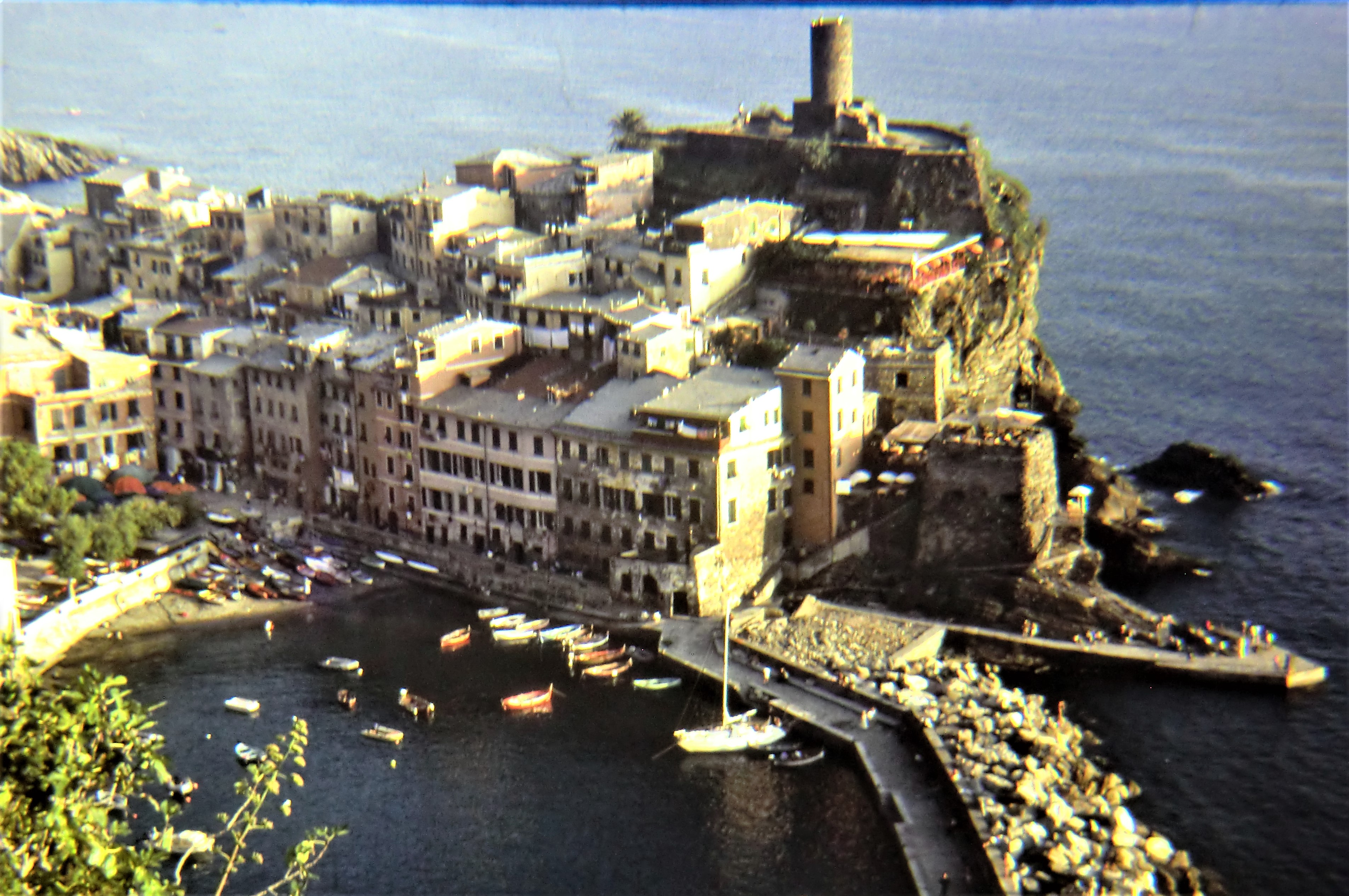
Note: All the photos displayed here were taken on the 1991 holiday. No stock photos.
*******************
Our 1990 End-to-End bicycle ride through the length of Great Britain was a success. The ride, starting from John O'Groats to Lands End, was accomplished with one other person, a long-standing friend, Gareth Philips, with whom I still keep in touch to this day.
The 1991 Coastal Cycle Ride from Lulworth Cove to Dover.
As one who always loved being independent, it would have been natural to love travelling on my own. However, when I had to go through a period of a more restricting budget, there were options to experience travel, both overseas and at home, accompanied by one or more friends. And such characterised the late eighties into the nineties. With four other people, namely Keith White, Paul Hunt, Gareth Philips, and Tim Kingcott, I have completed a couple of cycling circuits through Holland, Belgium and Germany. This was followed by a cycle ride in 1989 along the French coast from Cherbourg to Paimpol and back in a week. Like the End-to-End cycle ride a year later, I shared this particular holiday only with Gareth.
 |
| At the Fossil Forest, Dorset, 1991. |
However, in this blog, I would like to concentrate on the one solo cycle ride here in England. It was 1991 and for the first time since 1985, I took a week off work to first cycle the 105 miles from my apartment in Bracknell to Lulworth Cove in Dorset. Setting off at 6.00 in the morning, I arrived at Lulworth Cove around four in the afternoon. From Lulworth Cove, I then cycled the approx 230 miles from Lulworth Cove, which is near the Dorset ferry port and seaside resort of Weymouth, to the ferry port of Dover in Kent. Although I completed the ride on my own, there were three unusual features on this ride.
First, I was joined by Tim Kingcott at YHA Swanage on the third evening after leaving home. This was after he asked me if he could ride the Isle of Wight leg of the journey with me before boarding the train for home at Portsmouth. Secondly, my first full day in Swanage was taken up by the Swanage Triathlon, an annual sea swim event corresponding to the Swanage Summer Festival. That year, I competed in the triathlon. Tim arrived at Swanage in the evening after I had completed the triple-mode sport. Thirdly, after spending a night at YHA Dover, I boarded a cross-channel ferry to Calais to complete a cycling circuit from the French port to the small town of Ardres, 16 miles inland.
 |
| Stair Hole. |
Here is a list of overnight stops I made during this short break, all at YHA hostels:
Lulworth Cove
Swanage - 2 nights
Totland Bay
Arundel
Eastbourne
Dover
With Tim Kingcott:
2nd night at Swanage
Totland Bay.
I saw Tim off at Portsmouth Harbour Station whilst I continued eastwards to Arundel.
Approximate total miles cycled:
My apartment - Lulworth Cove: 105 miles.
Triathlon cycle route - 12 miles.
Lulworth Cove - Dover: 230 miles.
In France, Calais - Ardres: 32 miles round trip.
Total miles ridden on two wheels: approx 380 miles, 614 km.
After arriving back at Dover from the cross-Channel crossing, I boarded a train at Dover Priory Station for the homebound train on the Charing Cross line to Waterloo East Station, where I changed trains at Waterloo Main Line. I didn't have either the energy or the mood to cycle homeward.
So, why I have included this short break in this Travel Biography? Mainly to centre on the Dorset Coast with its dramatic cliff formation, along with participation in a sporting event.
 |
| Stair Hole with Lulworth Cove in the background. |
In the world of Geology, the hard and resistant Portland Stone on this stretch of coastline was eventually breached by the sea, exposing and then eroding the softer rock layers behind. These softer rocks include the Purbeck Beds, with the Wealden Beds further inland. Behind the Wealden Beds, the Chalk landscape continues inland. There are three stages of erosion, each represented by three different locations, making this part of the Dorset coastline so spectacular. Stair Hole is the youth stage, where the sea had "recently" breached the Portland stone to form two arches under the cliff. The middle age is Lulworth Cove itself, where the erosion of all four rock layers had formed an oval bay penetrating inland. At the east end of the cove, a ledge protrudes from the cliff, on it are the remains of circular burrs surrounding what used to be antediluvian trees. This area is known as the Fossil Forest. It is reached by a short flight of steps.
The old age of coastal erosion is at Durdle Door, a famous arch a mile west of Lulworth Cove, which is a 61-metre-high bridge of limestone that still bear remains of an ancient forest. I have visited this natural wonder several times and actually completed a circuit swim passing under the arch. Unfortunately, during the heat of the summer, there have been serious injuries occurring at the site by those tombstoning into the sea from the crest of the arch.
 |
| At Stair Hole. |
The Swanage Triathlon 1991.
After arriving at the hostel from my hometown of Bracknell, I spent that night at YHA Lulworth Cove, which is part of a school, and therefore with restricted opening times. It's quite a walk to get to it from the coast. But with the rolling hills plunging into the sea and with such dramatic cliff formations, it looks to me like this is one of the wonders of Great Britain.
It was the next day after I arrived that I explored the coastline, including a visit to Fossil Forest. By late afternoon, I began the ten-mile ride to Swanage and checked into the YHA hostel there, a large country house that's open throughout most of the year. That night, I spent alone. However, the next morning, a Sunday, I assigned my bike to one of the pegs reserved for me. A crowd of nervous athletes were gathering on the beach. Yet, the air was electric.
Here we were, all dressed in a lycra tri-suit, a one-piece, tight-fitting garment that's compatible with swimming, cycling, and running. I was in my late thirties by this time, and I was at the peak of my fitness.
We all plunged into the sea from the moment the starter's gun fired. It must have been quite a spectacular sight - a crowd of athletes literally running into the sea and throwing themselves forward to a front crawl stroke. With hundreds of arms swinging in and out of the water all around me, I kept my eyes on the Ballard Down chalk cliff directly ahead whilst on this 400-metre swim. Eventually, we neared a buoy placed there to turn us around as we headed back to the beach.
Back at the beach, it was a dash across the road to the bike park. After slipping on some footwear and a mandatory helmet, I was off. No messing about with a towel or having a shower or a coffee break. In a triathlon, the transition would make all the difference between you holding up the winner's trophy or watching somebody else lift it.
The twelve-mile (20k) bicycle leg was fast but very demanding, as the terrain was very hilly. The 6-mile (10k) run that followed included a very steep climb up Ballard Down, then a downhill fast run into Studland Bay. Then its route passed through a gap in the hills before winding through the town to finish by the beach. In all, I probably completed the whole event in around one hour and fifty minutes.
 |
| Durdle Door, Dorset. |
The Coastal Ride Resumes.
That evening, after most of the athletes had gone home, I was greeted by Tim as he checked into the hostel. The next day, we decided to walk along the cliffs to Old Harry Rocks, a series of chalk stacks at the tip of the Foreland Point, the angle of the mainland where Studland Bay begins, and on a clear day, it's clearly seen across 15 miles of sea from the Isle of Wight. After returning to our bikes, we both made off for Totland Bay on West Wight, the very same hostel where Tim first introduced me to this shared form of accommodation six years earlier in 1985.
 |
| Lulworth Cove. |
The next day we hugged the south coast of the Isle of Wight as we made our way from Totland Bay to Ryde Pier, one of the very few piers in Britain that carries a railway, the Island Line from Ryde Pierhead Station to Shanklin, where the line ends, although it once carried on further to Ventnor.
We crossed the Solent back to the mainland again by ferry, just as we did the evening before when we used the Lymington-Yarmouth ferry. At Portsmouth Harbour Station, I saw Tim off as he boarded a train for home. Alone once again, I carried on the ride for an overnight stop at Arundel. The next morning, from Arundel, I made my way to Eastbourne, stopping at Brighton on the way.
The YHA Eastbourne is a couple of miles out of town, as the hostel actually serves hikers using the South Downs Way, a hiking trail from Eastbourne to Winchester. Therefore, I arrived at the hostel before reaching the resort. But once at the hostel, I stayed there rather than wander into town.
 |
| The Pinnacles, Swanage. |
By the next day, a strong westerly started blowing. This gave me a great advantage. For example, the road from Hastings to Rye, then on to Folkstone, was flat and very fast! Indeed, fast enough to overtake a lorry, after making sure that the oncoming lane was clear and safe enough for me to make the manoeuvre. It was exhilarating! Had I ridden that fast at the Swanage Triathlon, indeed, I wonder whether I might have won overall?
At the YHA in Dover, I wasn't too impressed with the member's kitchen. It looked more like a corridor than a proper room. However, like at all other hostels, I managed to prepare a decent meal to refuel all my energy.
The next morning, after checking out of the hostel, I made my way to the docks and bought a return ticket to board the ferry to Calais. This wasn't spontaneous, rather, it was planned, as I had my passport on me in readiness. I boarded the ferry and parked my bike in the car hold without a hitch. This was one of the benefits of membership in the European Union. The freedom of movement such membership offered made it so easy and effortless for a cyclist to cross the Channel.
At Calais, I turned off the motorway that took traffic to Paris and rode on a quiet, traffic-free road. I eventually arrived in the small town of Ardres.
 |
| The most famous Old Harry Rocks, Swanage. 1991. |
There I was, across the English Channel on my own for the first time since 1985. Will I revert to travelling overseas solo like I did before?
That was when I had as if a divine vision of standing on the Mount of Olives in Israel, and looking down towards Jerusalem. That occurred in October 1992, after turning 40. That vision I had whilst at work, and it was proved to be a Morning of Destiny. Little did I know that this very vision opened up what I call the explosive climax of world travel, covering seven years before I married Alex.
---------------------------------------------------------------------------------------------------------------
Next Week: On the Throne of England and more about the vision.