Total Pageviews

Saturday, 17 December 2016

Santa's Biggest Mistake!

I could I ever forget one particular incident some twenty-four years ago, give or take. When my two nieces, who were my younger brother's daughters, along with myself, were all at my parent's house together with my father's older brother and his German wife, all sitting at table celebrating Dad's birthday, which happened to be exactly two weeks before Christmas Day. The older pre-teen niece was acting rather boisterously, which brought attention from my uncle, who looked directly at her and delivered this warning:

Unless you behave yourself, young lady, Father Christmas will not deliver any presents! He likes only good children, so you better behave! 

I watched her face cringe, but not from as if about to cry, but more of a sense of disgust, as if she was thinking:

In that case then, he can stuff his presents up where the sun doesn't shine!


And I would have fully agreed with her. For I was thinking on how could he have spoken this way. For it conveys the message that giving of gifts is conditioned on behavioural reform and day-to-day performance, and not on unconditional love. Or going further back in time by another 28 years, when I was twelve years old. I recall walking home from school and I caught my left arm on a sharp twig protruding from a front garden hedge, tearing a hole on the sleeve of the heavy grey overcoat I was wearing in this chilly late-Autumn afternoon. Unfortunately, by the time I arrived home, I had already forgotten the incident and therefore did not approach Mum to apologise. Instead, the next morning, whilst dressing to go to school, suddenly out of the blue, Mum shrieked:

What have you done to your best coat? You can forget having any presents for Christmas!

That was when I remembered the tear on the left sleeve. But fortunately, my lack of sleep during the small hours of Christmas morning was well justified. For like all other children across the land, a pile of gaily-wrapped presents were awaiting both my brother and myself. But the attitude of both my mother and uncle could well have been a very-distant reflection of what St. Jerome wrote as he translated the Bible some 1,600 years earlier, as detailed in last week's blog, One Word, Just One Word. That is, anything which is good is given on the condition of behaviour modification, staying free from sin. And having started to play our Christmas album on the run-up to the festival, one song sung by the Jackson Five has proven a popular 1970's chart-bounder:

You'd better watch out! You'd better not cry.
Better not pout, I'm telling you why,
Santa Claus is coming to town.

He's making a list, and checking it twice;
Gonna find out whose naughty or nice.
Santa Claus is coming to town.

He sees you when you're sleeping. He knows when your're awake.
He knows if you've been bad or good so be good for goodness sake! Oh,
You better watch out! You better not cry...

Not only is Santa Claus is narrated here as omnipresent, omnipotent, and omniscient, but it looks as if keeping a British stiff upper lip is also a condition of behavioural reform. And he will give presents only to good Christian kids. Never mind that his generosity is limited to rich, First World countries, but also it is a crying shame that he is almost totally oblivious of whole continents such as the Far East and Africa, where the population of the former is predominantly non-Christian, whilst many families in the Earth's second largest continent remains gripped in poverty, disease, and malnutrition, even if some of them may claim a Christian background. Children suffering and dying by the thousands, yet Santa's team of flying reindeer completely boycotts the poorer areas of the continent - except for some better off, healthy Christian families living in certain cities. And even within the same city, good old Santa is far more generous to those living in an exclusive middle class area than he is to those living in shanty settlements. Somehow, I can't help seeing a strong parallelism between Santa's picky generosity and that of our churches being predominantly middle class.


And the comparison of the middle classes' less-hostile attitude to God was brought home only yesterday evening at the sauna. After a vigorous two-hour workout at the gym, on Friday evenings a relaxing couple of hours in the sauna follows. One of the regulars there is a blue-collar manual worker, older than me, who I will call Fred. Fred is what you can refer to as extroverted, very talkative, and filling his gaps with repeated 'F' words, even if he says that he never swears at home. Last night, there was just the two of us relaxing in the sauna cabin, and I had the opportunity to ask him how he feels about Jesus Christ, whilst stating that the Lord was everything to me, and I couldn't live without him.

He had something like a wild look on his face as he admitted that he had no time for such things, and this Jesus can get lost as far as he's concerned, as he needs to keep on overseeing his family, particularly his grown-up son who, after University, had "boomeranged" to his parent's home, according to what I thought he was telling me. I felt sad. He gave no consideration over his present spiritual state and its consequence in the afterlife. He then left the cabin, leaving me alone inside to contemplate over the conversation. I felt sorry for him. Assuming that he is Church of England, as most of us living in England must have had contact with, especially during childhood. At least in my opinion, there is a parallelism between Fred and what he thought about God's gift of salvation, to that of my niece over Santa's picky generosity. Both preceded by the need for some sort of behaviour modification.

As stated in my last blog, this need to "repent" is the most misunderstood word in the English language. Right from pre-conversion, the false meaning for repentance was instilled in my sub-conscience to mean a turning away from sin, or to be willing to turn from sin before believing and receiving salvation. In other words, behaviour reform is required as a condition for receiving salvation. No wonder, over many generations this had created fear or hatred, or one leading to the other. Fred was one typical example, and I am convinced that just about everyone who was born in England with Anglican parents had at one time of their life at least, came face-to-face with the prospect of behaviour reform in order to go to Heaven after death. Roman Catholics in particular, like myself, faced the prospect of living a sinless life, or face at best the promise of time served in Purgatory. Salvation as a free gift was as far from a possibility as East is from the West. No wonder, like my niece was thinking about Santa all those years ago, Fred reckons that God can stick his salvation up where the sun doesn't shine.

Christmas is a time and season of goodwill, even though it's incredibly short compared to the rest of the year. It is a time for giving. As already mentioned, as a child I have always received toys and games for Christmas despite my undeserving behaviour. It was a visible demonstration of undeserved grace, an expression of my parent's love. For example, I was never required to sew up and repair the hole in my coat sleeve before receiving the presents. Instead, Mum had already done that some time earlier. Neither were any of my presents taken away as a result for misbehaviour. Once received always mine. Continual access to them wasn't dependent on my behaviour.

And that is how Jesus Christ is so willing, so keen to give the free gift of eternal life to anyone who asks. One of my favourite verses in the Bible is Luke 11:13, where the narrator records Jesus saying that if we, who are evil, know how to give good gifts to our children, how much more will the Father give the Holy Spirit to those who ask him! Those who are evil receiving the Holy Spirit! Who would ever thought of coming up with that? Without behaviour modification to precede the receiving. It is another way of saying, Whoever wills, let him come and take the water of life freely - Revelation 22:17. And the whole of the Gospel of John is centred on the fact that Jesus of Nazareth is the Christ, the Son of God who promises the free gift of eternal life to all who believe. So all it takes is a change of mind from seeing Jesus as an imposter or even merely as a good teacher, to that of the risen Messiah, and asking him to give life as promised, and he will be eternally saved. Or to put it another way, from unbelief to believing. That is repentance, a change of mind. No reformation of behaviour is required beforehand. In fact, the word repent or repentance does not even appear at all in John's entire Gospel.

If only my friend Fred at the sauna realised this when he was a boy, or even older. That in AD 380 St Jerome, in translating the New Testament from Greek to Latin, used the Latin word Paenitentiam Agite - Do Penance, instead of the Latin words Mutare animum tuum - Change your mind, whenever the Greek word Metanaeo appears in the Greek, meaning change of mind, and translated into the English word Repent. Would my friend be as equally hostile against Jesus Christ of Nazareth as he is now? Could such a mistranslation be the bottom cause of Fred's eternal state, growing up thinking he had to reform his life before any hope of receiving eternal life? Really, doesn't he believe at all that salvation is a free gift?

Really, I give presents to those I love without any preconditions. My nieces receive a free gift at Christmas because I love them unconditionally. I have never asked them to reform or modify their behaviour before receiving presents. I give them with the hope that they will appreciate what I'll give them. But even if they don't think much of my gifts, and that has happened at least once in the past, my love for them will never diminish. And there is something else. Once the presents are given, I don't expect them to feel that they "must be obliged to commit themselves to me." Furthermore, I would never say to them that if they misbehave, or show no appreciation, that I would take their presents away from them. No. Once theirs always theirs.


But there is one difference with God. Like my presents, God's free gift of eternal life is given to all who wants it, a free gift of love given with no strings attached. With this new life the Holy Spirit comes in and gradually changes the recipient's heart with new desires, to love and serve God, motivated from within, from his heart. This willingness to submit to the Holy Spirit becomes a source of joy, not a spirit of slavery or fear. This process is known as Sanctification, and has no part in keeping or losing salvation. Rather, the recipient only wants to know what the will of God is, and his desire to fulfil it in his life.

I hope that every reader who reads this blog has received the free gift of salvation. If not, then why not believe in your heart that this Jesus of Nazareth is the risen Christ, the Son of God (e.g. Acts 8:26-40, Romans 10:9-13, John 3:14-18), and ask him to forgive all your sins, and to receive his free gift. I can guarantee that you won't regret your decision.

Having said this, I wish all my readers a very merry Christmas, and a prosperous year ahead. May God bless you richly. Also look out for my next blog for Christmas Day, which will, God willing, be a pictorial blog with little wording.

Saturday, 10 December 2016

One Word - Just One Word...

It wasn't long since I read the following story, whether it was true or made up. But it is an interesting case on how I, and probably many others, perceive on how we feel about God:

A local newspaper editor noticed each morning a road sweeper at work keeping the kerbside clear of litter. He was dressed in rags and unbecoming clothes, and his hair was constantly untidy. The editor wanted him featured in an article about the town on which his paper covered. So finding a way to contact him, the road sweeper was invited to the office for a series of photos to be taken of him, in preparation for publication. Feeling rather excited, the sweep turned up at the agreed time - dressed in a suit and tie, his face washed, and his hair combed. The editor immediately dismissed him from his office without a single snapshot taken. His explanation was simple. He wanted the sweep to arrive as he was, without any self-reform to precede his visit. In other words: Come as you are.


And that is one of the biggest problems I face in the Christian life. For example, difficulty in prayer due to the presence of sin in my life, and the need to "clear the air" before asking anything from God - especially during a prayer meeting. Being aware that God does not listen to sinners. He listens to the godly man who does his will. - John 9:31. I wonder just what level I must reach in order to be seen by God as doing his will in a godly manner? There is where I find the snag: just where is the line drawn before the presence of sin turns godliness into ungodliness? It has always been this sense of uncertainty which has cast a shadow over my spiritual life. Is that the same with you? Maybe so. Or maybe you are one of those fortunate ones who lives in constant victory over the dark shadow within, and comfortably revelling in the joy of remaining in his will.

And I wonder just how many of you had at times have been troubled by those statements made by Jesus towards the end of his hillside sermon:

Not everyone that saith unto me, 'Lord, Lord,' shall enter into the kingdom of heaven; but he that doeth the will of my Father which is in heaven. Many will say to me on that day, 'Lord, Lord, have we not prophesied in thy name? and in thy name cast out devils? and in thy name done many wonderful works?' 
And I, will profess unto them, 'I never knew you: depart from me, ye that work iniquity.'
Matthew 7:21-23 AV.

I must admit, I have been troubled by these verses. And although I tried to wrangle my way out by explaining that those standing outside must have been Jehovah's Witnesses, Mormons, Christian Scientists, even Freemasons, Spiritualists, and all others who held false doctrines; I couldn't help feeling that there will be far more than just these. After all, the percentage of all heresies set against Christian belief has always been very small by comparison to the history of human population. And by careful reading, those who remain standing outside professed Jesus Christ as Lord, not Buddha, Shinto, Mohammed, or any other non-Christian leader. They were addressing Jesus. But worse was to come. At our church in Ascot, I was personally judged by another member with these same words. Not that I was guilty of any overt sin. Rather it was because I don't keep the British stiff upper lip, and therefore seen as not conforming for the benefit of all other men around me. Thus I was seen as not living out God's will.

Evidence that not everyone has that confidence and peace in the Lord seems manifest in many churches, if my own experience of them can testify. And to add to this, I have read other people's blogs, watched their videos on You-Tube, and have seen for myself the apparent unhappiness among other believers, especially of a quick arousal to anger when doctrinally challenged. As for an example, I was once shouted at my face by another Christian - a married father of one - for admitting that I believed in Once-Saved Always Saved. I guess this rage between two parties within the Reformed churches has been on-going for centuries. One of the most noted examples took place at a holiday resort of Minehead Somerset, in 1994, when an Arminian speaker had very nearly caused a  mass riot to erupt within a theatre audience - after rebuking them for believing in Eternal Security of the Believer and, very much like I was, they were judged by him to eternal hell-fire for anyone who has married a divorced partner.

I guess this kind of fear - fear of eternal punishment - is thought to keep all Christians living a holy life, with efforts to keep all sin at bay. I could say that in addition, the above mentioned speaker, David Pawson, insists that fear of punishment is the right motive for Christian service, as none of us are yet mature enough to be fully motivated by love, as quoted in 1 John 4:18. Because only perfect love casts out all fear, therefore he assumes that since we don't yet have this perfect love, fear is the acceptable motive. Such is the fruit of his Wesley House of Cambridge University training. As one who came from a Catholic background, I could not help but ponder whether there was something disastrously wrong with the whole Reformation. As I have come to gradually realise over the years, I have eventually concluded it's to to with the meaning of the word Repent, and its derivation - Repentance.

The best way to look into this is to take an example. In this I could say that a little booklet containing a cartoon strip This Was Your Life, drawn and narrated by the late Jack Thomas Chick, which had a massive influence on me since 1972, and it had played a major role in my conversion to Christ. Some influence globally it must have had, for over 46 years since publication began in 1970, around 500,000,000 copies has been distributed, with This Was Your Life being the most famous of all Chick's publications. But rather than this tract stirring a love for the grace and mercy of God, it has instead aroused an awareness of future punishment.


What it says at the back cover gives the reason:

The way to Heaven is:
1. Admit that you are a sinner - Romans 3:12.
2. Be willing to turn from sin (repent) - Acts 17:30.
3. Believe that Christ died for you, was buried, and rose from the dead - Romans 10:9-10.
4. Through prayer, invite into your life to become your personal Saviour - Romans 10:13.

When I read that, of course everything looked reasonable and solid, as it has always been with me to subconsciously absorb as truth everything stated here. But it wasn't long when I realised that the true peace and joy in the grace of God was lacking, and I couldn't understand why. Has God really forgiven all my sins, and furthermore, has set me free from them? Obviously he hadn't, and for decades I have questioned my own salvation as a result. And on top of all this, I have both heard and read testimonies of devoted church-goers feeling queasy over their certainty of salvation - quite a number of times. 

The problem lies with Chick's statement # 2: Be willing to turn from sin, the meaning of the English words Repent, Repentance. I have recently discovered that this is a heresy, and a dangerous one at that, because it has all the hallmarks of Biblical orthodoxy. The English word Repent is seen as meaning forsaking sin, or to be willing to forsake sin, and is used as a condition for receiving salvation. When I read Scripture, especially the Book of Acts, I could see no substance to support this. The truth is, when Peter preached at Pentecost (Acts 2), then to the house of Cornelius (Acts 10); or the evangelist Philip to the Ethiopian eunuch (Acts 8:26-40), there is no mention of any of them told to be "willing to turn from sin". Later, Paul and Silas, as they were singing whilst confined in jail, the jailer also wasn't told to "be willing to turn from his sins" either. Instead he was told to believe on the Lord Jesus Christ, and he will be saved (Acts 16). The same in Athens, when many thought that by quoting the Resurrection of Jesus Christ, his listeners believed that the apostle was introducing another god to add to their pantheon (Acts 17). There was no mention of "having to turn away from sin" as a condition of salvation.

The idea that the English word Repent meaning a change of mind, a change of opinion, has been with me for the last few years. And I have used this definition several times before on this blogger page. This week I have done some research on this, and one thing is for sure - Repentance does not mean Turning from sin in the New Testament.

The word repent is an English word, and its used as a translation from the Greek Metanaeo, a change in the course of one's thinking, a change of opinion, a change of mind. Putting into context in the second chapter of Acts for example, the people were instructed by Peter to change their minds concerning Jesus of Nazareth, from the thinking that he was an imposter who deservingly died a criminal's death, to that of their risen Messiah and Lord, whom God has raised up. And all the other testimonies of conversion found in the New Testament follows the same procedure: for the sinner to change his mind about the risen Jesus of Nazareth being the Christ whom God has raised up.

It is wonderful good news, and gloriously simple! Change your mind about Jesus Christ of Nazareth and be saved. Such simplicity. And that was when the trouble began. It seemed too simple. So simple in fact that some Judaists had trouble with it, and presumed that some work of a kind had to be added as a condition. To them this felt much better, more sensible. Then this teaching began to be spread across the churches in Galatia. Changing your mind about Jesus of Nazareth is not enough. You need to be circumcised as well, and obey the Law of Moses. So they told these churches. But Paul called these perpetrators Cursed. Such teachings nullified the Atonement made on the cross (Galatians 1:6-9).

For the next three centuries the Church, which by the 4th Century, was already had its headquarters in Rome, was struggling with the idea of the Gospel being effective only through a change of mind by the believer. By 382 AD, Pope Damasus commissioned St Jerome to translate the Bible into Latin. In the Greek New Testament, he had trouble with the word Metanaeo, which he already knew that it meant a change of mind. The direct Latin translation of Metanaeo is Motos animi - "a change of mind," or Mutare animum tuum - "Change your mind". Instead, he inserted another word: Paenitentiam Agite, which is literally translated as Do Penance. By the 16th Century, the Latin Vulgate became the official translation of the Catholic Bible, and when the Bible began to be translated into English, especially by John Wycliffe in 1384 and William Tyndale in 1526, the Latin word Paenitentiam was by then so entrenched in the minds of theologians, that by then became the standard meaning for Repent by the Reformers, who were responsible for the translation of the King James Version in 1611, which not only incorporated the original Hebrew and Greek texts but also from nine other versions, including the Latin Vulgate.


This may be a good study during my research, but it wasn't enough to convince me. I wanted independent evidence. It is so wonderful how the Internet can be such a limitless storehouse of knowledge, so with it I had no problem in finding a Latin Vulgate translation of the Bible. I then selected three verses at random which contains the English word Repent or Repentance. They were:

Acts 2:38,
Acts 17:30,
2 Peter 3:9.

In the Latin, all three verses contained the word Paenitentiam instead of Motus Animi or Mutare Animum Tuum - the proper translation of the Greek Metanaeo. However, it must be said that St Jerome had by no means acted maliciously. Rather, he felt that gaining salvation by changing the mind about Jesus of Nazareth was too simplistic to swallow, so he substituted Change of mind with Doing Penance - an act of promising to turn from sin in order to receive salvation, rather than to believe in Jesus of Nazareth as the Messiah who died, was buried, and on the third day risen from the dead, according to the Scriptures (1 Corinthians 15:4). In other words, the idea of behaviour modification as a condition for receiving eternal life has become so entrenched in our subconscious, that it has unwittingly replaced the simple truth that Jesus of Nazareth is the Christ, the Son of God, and that by believing you may have life in his name (John 20:31, also 1 John 5:1).

It is a tragedy to think that substitution of one word for another early in the Church's history could have such a catastrophic consequence throughout the last two millennia. The rise of the Dark Ages, the Spanish Inquisition, social evils such as piracy in the Caribbean, the need for the Reformation, the Calvinist-Arminian debate, the feeling of uncertainness among many believers, the rise of Darwinism to discredit Creationism, and the present-day spirit of agnosticism and atheism existing in modern society - I believe, can all be traced down to the Latin word Paenitentiam, translated into the English word Repent, and allowing the need for behaviour modification as a precedence for receiving salvation. And since it's very difficult to imagine a holy and pure God justifying a sinner who is wicked and having no righteousness in himself, therefore allowing such need for behaviour modification to become entrenched in our minds to the extent that we don't even give it a second thought.   

Saturday, 3 December 2016

Wow! A 120-Mile High Cliff!

I could consider that the Baptist Church at Ascot as my second, or "spiritual" home. Renamed Ascot Life Church after moving into a restaurant located at the actual racecourse in 2013, its Sunday congregation had since doubled in size, making its original building within a residential estate now too small to accommodate the main morning meeting with reasonable comfort. And helping to swell the numbers, an alliance with Royal Holloway College, an annexe or outpost of the University of London, has resulted in remarkable growth of student numbers in our midst, most likely aided by the generally warm atmosphere of fellowship among regularly-attending believers. And unlike most other churches which is normally led by a senior Pastor over a team of deacons, ours is led by four married Elders, each one of equal standing.

We meet at the restaurant here on the right.

We take a serious view of the Bible as the Word of God, with each author writing under the inspiration of the Holy Spirit, and therefore with our belief that the whole book being free from error. And no doubt, all of us, including myself, have a personal desire to live out our lives in alliance to what the Bible teaches, commands, and advises. But like with all churches everywhere, it is unfortunate that perfection remains non-existent, leaving God with the only option of using those who are willing to avail themselves to him. In the Old Testament we read about how Noah had gotten himself intoxicated with alcohol due to his post-Deluge loneliness; and how Abraham lied twice about his wife Sarah to heathen kings out of fear and a lacking of faith in God's promises; how Joseph's ten brothers conspired to get rid of their father's favourite son and had brought Jacob to a life of mourning and sorrow, himself continually looking down at mud instead of up to heaven; how Moses lost his temper and forfeited his right to enter the Promised Land; how Samson slept with prostitutes; how David committed adultery and sanctioned murder; and how Solomon was a persistent womaniser.

In the New Testament, we read about how Peter, after the Resurrection, behaved hypocritically when he and Barnabas withdrew from non-Jews who sat at table with them, and how he was sternly rebuked by Paul; and how Paul himself had a mighty row with his mate Barnabas over young John Mark, who in turn was known for quitting when the assigned work had gotten too much for him; and some time later, how the apostle angrily shouted at the High Priest, an offence against a law written in Leviticus, calling him an "Whited Wall" in effect, a bloody hypocrite. Indeed, we could say that in his younger years, Paul had an anger problem, still ongoing long after his conversion.

Then the matter of the church in Corinth. This was a New Testament church, of which I have heard modern leaders wishing that we as present day churches could go back to "New Testament times". Really? First of all there was rampant fornication going on within the Corinthian church, including a case of someone sleeping with his married stepmother. Then there were at least two believers in dispute with each other, with one taking the other to Court, to try and get justice from an unbelieving, pagan magistrate. Then, what we now call the Holy Communion was abused, with some in the assembly gorging themselves while others remained hungry. Aside from minor issues on whether a man should have long hair, women to wear hats, or whether to eat good, nutritious meat that was unfortunately prepared on a pagan altar, another major issue this Greek church faced was the threat of splitting, and each of the four going in different directions. One group declared Peter as the authoritative leader, whilst another group believed that Paul was. A third were followers of Apollos, while the rest, just 25%, insisted that Jesus of Nazareth should be the only leader and head of the church. Yet I'm happy to say that all these people mentioned, both from the Old and New Testaments, were true saints through faith in God.

But the very first issue with which Paul opens his first letter must have been that of a high level of snobbery found within the church, their dependence on a high secular education and wisdom. They must have been very proud of it, and probably quite arrogant, which could have been the underlying attitude beneath all the other shortcomings they suffered as a church. As with the present, being well schooled was seen as the one aim to aspire to, and it was a marked distinction between a prosperous Greek citizen winning respect from all, and a slave, who had no rights to think for himself, and whom no one would accept his opinion with any level of seriousness. Then Paul comes along to burst their balloon, insisting that the God they now profess to worship delights in overturning the cultural table, using the unlearned to confound the wise and the educated, and to use those who are not wise, to confuse those that are. 


Perhaps with a risk of boasting, by comparison with the Church in Corinth, Ascot Life Church would appear to be a model of godly virtue! We don't have the problems these early Greek saints faced. Especially on constant marital unfaithfulness, splinter groups, and disrespect for the Eucharist. But we do still see at times divorce splitting families, grit within the fellowship and - echoes from the ancients - a greater respect for the better educated. As a matter of fact, throughout my forty-plus years as a Christian believer, I don't think I recall any sermons ever preached on the first chapter of 1 Corinthians. It is as if this subject is taboo, such would rock the cultural boat within the danger of sinking. This idea of God using those who are not, to confound those who are, surely cannot be the same God as today. He could never dream of doing such a thing! It is greatly unfortunate to say here, that Ascot Life Church, among all other modern churches, had never been set free from this ancient cultural attitude, particular when taking someone's opinion seriously.

So I write as one being on the wrong end of the stick. That is, until I was given a journal on Biblical Creationism by a very good friend whom I knew since when he was a newborn, and who now holds a Ph.D. in Genetics. May I just add quickly here, that whenever he is around, I go slightly weak at the knees in admiration. Why? Because this young Doctor has high respect for who I am, and honours my opinions and my contributions, as demonstrated at our monthly home Bible study. So one evening he gave me this booklet. The rather academic and scholastic journal has published, among other articles, a Paper written by geologist Dr. John D. Matthews, explaining how adherence to the Uniformitarian concept of the geological time column has resulted in the most bizarre theories when faced with contradictory evidence. To be honest, if it wasn't so serious, these theories would be comical. Yet they are advocated by respectable men whose opinions would not only be taken seriously, but our churches would not hesitate to have preaching or testifying at the front, especially if since converted to faith in Jesus.

The Paper covers a subject known as the over-thrust, a theory put forward when stratified rock layers are found which contradict the geological time scale, the physical proof of progressive Darwinian Evolution as meant to be found in the fossil strata. That is, when an "older" rock layer is resting comfortably on a "younger" layer, such age is determined by the fossils found in these rocks, and in contradiction to the Geological time scale. As such, the "contradiction" to the accepted theories, is in this case an "upside down" sequence of strata layers which has caused academic heads to be scratched for many decades, if not centuries. Thus the over-thrust theory was developed in favour of upholding the geological time column instead of throwing the latter into the proverbial bin as an unsustainable theory. Take one example: The mountainous area of Moine in Scotland, which consist of metamorphic rock - normally perceived as the bedrock of all sedimentary strata and too old to contain any fossils - resting on non-metaphoric rock, such as fossil-bearing limestone. Geologists has come up with a theory that this phenomenon is the result of an over-thrust, when the "older" metamorphic rock was moved uphill to rest upon the "younger" non-metamorphic bedrock.

Moine, Scotland.

To achieve this, first the sliding plane must be so smooth as to minimise the friction between the layers. Suggestions of high pressure water or gas (known as hydrocarbons) which allows the upper layer of rock to virtually float over the underlying bedrock, therefore greatly reducing if not eliminating the friction. But even if friction is eliminated, a force so tremendous would be required to move the older rock against gravity to its present position. So, according to Dr. Matthews, something of an out-of-this-world phenomenon would have been required. So I try to visualise a roller-coaster, with a long drop before turning back upward. The car would gather speed under its own weight, the velocity and inertia would allow the car to roll uphill, when the next but lower summit would be reached before the gravitation pulling on the rear of the vehicle would stop the car.


But if there was a whole line of cars, each touching each other, then it would take far more cars on the downside slope to move those on the following uphill ramp. And to add to this, every car must be touching each other end-to-end in order for the front cars to move uphill. Now if the same illustration was to be applied to the massive metamorphic slab at the Moine, then according to Dr. Matthews, two other slabs would have been involved, with the middle slab being in a plastic-like state, and therefore pliable enough to navigate the lower bend without breaking up or to buckle between the two harder rocks on either side. However, the ratio of weight balance needed on the downward slope to move the metamorphic rock uphill to its present position would require an angled cliff up to 120 miles high! When considering that the world's highest mountain, Mt. Everest, is just over 5.4 miles high, too bad that such an enormous high precipice is no longer with us. How it has disappeared in its entirety without leaving a trace we are so far not told.

This is the end result of pushing away the truth of Scripture, the Creation, and the Flood, in favour of an argument that cannot be substantiated, yet promoted not my men like myself - from a working-class background and upbringing, whose opinions would not be taken seriously, or even ignored altogether - but from well-educated men of science whom society holds with much respect. When they pipe, we dance. When they say "Jump!" we jump. And even in such a church  as ours, whose desire is to bring honour to God, and without doubt, in accordance with most if not all other churches here in the UK, what I contribute or make any expression of opinion is generally passed over. But let us not forget that the high respect given to these academics, who are often out-and-out against the truth of Scripture, Divine Creation, and Salvation through faith in the risen Christ, have put a block in the minds of many from seeing the truth, and eventually pass on into a totally unnecessary lost eternity.

Us British churches may indeed, have shaken off much what impeded the spiritual progress of the church in Corinth, but it does look as though Corinth has not fully left us. 

Saturday, 26 November 2016

Overconfidence - A Potential Danger?

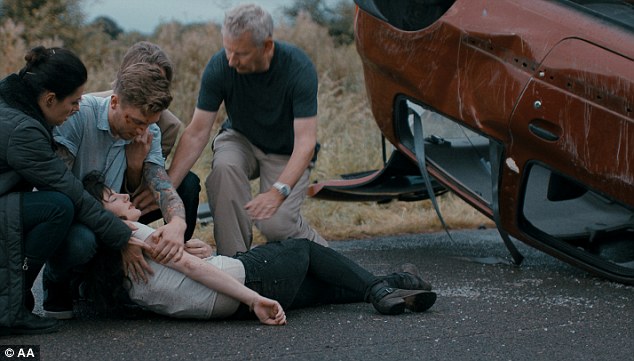
Earlier in the week, the AA (Automobile Association) released a eleven-minute video of a young couple, he as an aspiring musician and with big promises for his future, and her occupation unspecified, although she had a wealthy background. On one occasion he came across a pregnancy test strip in her handbag and took a look at it while her back was turned. The expression on his face told us immediately that the strip showed a positive result. The prospected of fatherhood had certainly lifted his mood to even higher levels. The smartly dressed couple presented themselves at certain high places, including a wedding. Then, on another occasion, the pair were out on a drive through a narrow country road.

He was exuberant and confident of his superb driving skills. So whilst driving, he took out his mobile phone and started texting. After all, his skills behind the wheel were so finely tuned, he knew that nothing bad could happen to them. He started his sentence with something like:
I'm so happy to have such a wonderful partn...

He failed to see that his vehicle has swerved on to the adjoining lane. A car was fast approaching in the opposite direction. The other driver had no time to stop or swerve. As our driver continued texting, there was an almighty head-on collision. The music-loving driver survived, as did the oncoming driver. His partner however, remained unconscious in her front passenger seat. After climbing out of the wreckage and ensuring that both the other driver and himself were reasonably okay, he turned his attention to his girlfriend, still sitting unconscious in her seat. As the other driver dialled for the ambulance, he managed to free her from the wreck, and carefully laid her on the ground. He kept on calling her name and pleading to wake up as her life slowly ebbed away. When the ambulance arrived and the paramedic confirmed that she was gone, he cried aloud and calling out her name whilst cradling her head in his hands, with his broken mobile phone lying on the ground next to him, still displaying his unfinished text. His life forever changed, including his promise of parenthood suddenly snatched away. All because of a grossly inflated confidence of his driving skill, along with persistent optimism that "It will never happen to me."


Above and below: Stills from the Video.

Although the cast in the film were all brilliant in their acting, I still felt deeply moved over the whole incident, especially if she was my wife who was laying unconscious on the road, then slowly passing away as I watched. This video has hit me hard when considering that in real life, Alex was actually unconscious for a couple of hours one Sunday evening, and like in the video, she too was attended by paramedics as well as a GP who all arrived in an ambulance, as fully documented in my previous blog When The Unexpected Happens...and like with the film, I too was filled with dread of the possibility of her passing away.

The video appeared in the Daily Mail Online page. The forum which trails the article was full of comments about answering a call as being the instinctive reaction when the mobile rings whilst at the wheel. At first I thought that his decision to text at that moment was totally without any prompt, except a feeling of exuberance of his future career in music and parenthood, along with his confidence while he was in charge of a vehicle. But a closer watching of the film on the second view shows that he was distracted by an alert from the phone. But then, when as a passenger, she should have dealt with the alert, instead, she allowed him to take the call, with full confidence in his skills. She was one of the 6% of all passengers who does nothing when the driver answers a call on his mobile. That is a total of 2,000,000 passengers of the UK population. But according to an AA poll result, of the 23,141 drivers polled, 59% would ask the driver to stop, and a further 30% would offer to take the call on their behalf. Of drivers who insist in answering the phone, eight out of ten of passengers had said that they would snatch the phone away, while a further one in twelve would refuse to get into the driver's car ever again.

In the days when I earned a living cleaning windows, seeing drivers on their mobiles while they were on the move was very common. Actually I could say that I have even seen up to two vehicles, one behind the other, drive past whilst the driver was on his mobile - that is fully hand-held. Young career women in particular were just as bad as the men, and I have watched them drive rather large vehicles such as the Volkswagen Caravelle, the Toyota Pro-ace Verso, or the Peugeot Traveller, sometimes even with children inside, using a mobile while they were at the wheel.

Peugeot Traveller

I guess there are times when it's good to have some optimism and confidence. Like how the surgeon must have felt when last year he carried out open-heart surgery on me to replace a faulty aorta valve with a new one. If I had doubted his abilities, I would have ran to the exit of the hospital - and still kept on running! But considering so many inventions, such as the TV, the telephone, the radio, recorded music, not to mention horseless chariots themselves, and a vast host of other commodities which has made our lives far more comfortable - all must have been invented with a certain level of optimism. But all these projects, I think, were achieved with a level of cautious optimism, that is with the awareness that the project in mind could well have failed.

Cautious optimism should have been shown on both sides of the June Referendum. The Brexiteers said with full confidence that Leaving the European Union would make Britain great again with a booming economy and a remarkable reduction of immigrants, and up to now this confident optimism is daily splashed across the front pages of our newspapers. The proverbial "I told you so" uttered with pride and smug satisfaction. And that's the way it looks at present with the news just in, that the car makers Jaguar has plans to open a new plant here in the UK, with the creation of 10,000 jobs. Yea, victory for Brexit! Lest it be forgotten, we are still at the moment within the Union, and according to the Media, Article 50 won't get under way until March 2017, and even then it could take two years or more for the "divorce" to be completed. And this is where I feel that cautious optimism would be far more sensible, allowing room for any potential downturn of events after leaving the Union.

On the other side, "Britain Stronger in Europe" Remain supporters, especially within Parliament, were equally optimistic with confidence. This was well demonstrated by our former Prime Minister, David Cameron, feeling smug with optimism during the early half of that night when the votes were counted, with the Vote Remain looking to be in the lead. It was only later, when the numbers for Vote Leave, particularly from the Northern working-class area of Scunthorpe, brought a shocking defeat to the over-confident Government which ushered in the Prime Minister's resignation - a crashing down, not without parallel to the auto-crash which featured in the video.

It does look to me that cautious optimism is okay for achieving many things, whether its governing a country, inventing a product, running a business, performing a surgical operation, climbing a mountain, running in a race, and especially within the Arts. After all, for example, there are many entries for a photography competition, there will always be only one winner, and the same is true in the sporting world. Cautious optimism seem to be the best line of thinking to hold on to - except using a mobile phone whilst driving, or for that matter, driving under the influence of alcohol or drugs.

There is only one area where a more confident optimism is allowed for, and that is with a revelation from heaven. Biblical prophecy is a good example of this. If Isaiah wrote that, way in the future from his point in time, God's servant will be, "Oppressed and afflicted, yet did not open his mouth; he was led like a lamb to the slaughter, and as a sheep before her shearers is silent, so he did not open his mouth." (53:7) - then Isaiah, who wrote this prophecy, can be confident that this will certainly happen in its proper time. Likewise, when Jeremiah and Ezekiel both wrote that the nation of Israel will be gathered to its own land and experience a universal conversion to Jesus Christ as their Messiah, and then Jesus himself will return to Jerusalem to reign as King on his father David's throne - still future from our point in time - then we can be confidentially optimistic that this series of events will take place. The only thing we don't know is when - only God himself knows (Jeremiah, chapter 33; Ezekiel, chapters 36-37).

Then the Lord Jesus Christ had every reason to be confidentially optimistic. From eternity past, he knew that one day he would be born of a virgin woman for the specific purpose to die a criminal's death, and three days later rise bodily from the dead - the very first person in the whole of human history to do so! So at exactly the right time he made the journey to the Cross, completely refusing to be swayed from his mission - despite that at least on one occasion, Peter tried to dissuade him (Matthew 16:21-24). Jesus was confident and optimistic that after his Resurrection, he will be richly rewarded by the giving to him of countless saved souls by the Father (John 6:37; 17:1-6), as the Bride of Christ, before returning to his Kingdom here on Earth crowned with glory and splendour.

After his Ascension, the Apostles, along with all believers, were confidently optimistic that salvation is in no other than through the risen Jesus of  Nazareth. And because of the very omniscient nature and character of the Eternal God who never changes, we can be confidentially optimistic about our Once Saved Always Saved imputation of Christ's righteousness into our accounts. We as a church can have optimistic confidence that through the promises of God, we will be the Bride of Christ, as we are his body already. That's why I always like to say, that after his Resurrection, Jesus had two bodies: he took one to heaven, leaving the other behind - for now.

We can have full optimistic confidence in the promises of God, even if at this point in time there is little to see of it. But God is gracious, very gracious. If faith - the hope in things still unseen (Hebrews 11:1) is weak or failing under doubt or confusion, then a trip to the Holy Land, for me anyway, was a tremendous faith booster, especially walking through the Old City of Jerusalem, watching the Jews gather at the Western Wall at the start of every Sabbath, and visiting other ancient and Biblical sites across Israel and Palestine.


So I would say: Be totally confident and fully optimistic about God's promises; let's be cautiously optimistic in daily business affairs, allowing room for error or failure, and don't be optimistic at all about something as incredibly stupid as using a mobile phone whilst driving.

Saturday, 19 November 2016

When the Unexpected Happens

A typical Sunday evening. When I was a schoolboy, it was the ushering in of that time of day, marking the end of Alan Freeman's Pick of the Pops, faithfully broadcast weekly on BBC Radio 2, to give way to Cliff Adams' Sing Something Simple, with its gentle theme choir oozing from the mono radio speaker. This, in turn, signalled Mum's taking out the ironing board from the cupboard to press my school uniform in preparation for another week. It was that time of the weekend when my heart dropped at the prospect of facing our P.E. master three times a week, who seems to have gotten a thrill in whacking forgetful pupils across their buttocks with a size-eleven sole of a plimsoll, and to cause the four walls of the spacious gym to resonate at his booming voice. It also reminded me of muffled instructions from the rest of the staff which sometimes I didn't fully comprehend, along with verbal teasing from other pupils in the classroom. And oh yes, not to forget: The daily morning assembly where I was under compulsion to sing hymns under threat of punishment and to pretend to pray to a Christian god I denied ever existing, let alone knowing personally. That awful Sunday evening feeling which, except during school holidays, had always arrived as regular as clockwork.

The exact kind of radio unit we had in the 1960's. 

Fast forward half a century. Alex and I are on our computers, with myself enjoying retirement and without that anticipation of that Monday morning feeling encroaching into my soul. Just another Sunday evening spent quietly at home. That was when my beloved started to complain of a growing pain throughout her thigh and lower leg, and after taking several painkillers, her slipping into unconsciousness. Unable to wake her up, I tried not to panic, but instead phoned the non-emergency, out-of-hours number to speak to the G.P. After getting through and carefully describing her symptoms, an ambulance was dispatched to our home. It arrived shortly after, with a crew of three paramedics and a doctor, who all remained at our home with their failed attempts to revive Alex back into consciousness.

During their attempts, whilst waiting about twenty minutes give or take, I sat in the armchair, close to tears. One of the paramedics, seeing my distress, tried to soothe me. Terrible fears gripped my soul. The fear of her death and an ensuing life of widowhood. Not that I cannot cope in living on my own. I lived that way for nearly a quarter of a century after flying the nest in 1976. So it wasn't that.

It was the threat of going through the rest of my life without her company. Without her love, without her devotion to me, without that deep, thankful appreciation for me, and without her reassurance. And without returning this equally strong love and commitment. Living in crushing loneliness and utter silence, except when broken by the sounds of recorded music or broadcasting live voices issuing from inanimate plastic, wood and glass cabinets. But from such sources I could never enjoy intimacy, a hug, an affectionate gesture, a word of appreciation, the feeling of love, or just company.

The love we have for each other has always been unmatched by anyone else. Not even from my parents as rightfully, Mum and Dad were devoted to each other, as we are at present, and they have put their children - my brother and myself - in second place in the family. So the love we have for each other remains unrivalled. So how distressed did I feel as I watched my wife remaining unconscious whilst the paramedics tried unsuccessfully to revive her? More thoughts entered my mind while I was sitting in the armchair. Why is she unconscious?

The thought which tormented me most was the possibility of an overdose of painkillers in her attempt to ease her aching leg. She took some Tramadol and Ibuprofen pills together, both medicines prescribed by her doctor. The Media is good in passing on stories of cases of drug overdosing, causing the patient to fall unconscious before silently passing away. Could Alex be another statistic? A song came to mind, a popular number of the 1970's: Cat Steven's Lady D'Arbanville. It was a reminder of this song which brought me close to tears. A short extract is quoted here:

Lady D'Arbanville, why do you sleep so still? I'll wake you tomorrow...
Lady D'Arbanville, your lips are like winter...
Lady D' Arbanville, why do you breathe so low?...
I loved you my lady, though in your grave you lie, I'll always be with you...

The description in the song sounds shockingly like my wife's condition, and I hope it was just a song. Before then, I knew nothing about how Steven's relationship with the real Patti D'Arbanville ended, which was the inspiration behind the song. Because of my ignorance of its background, the song kept on giving me feelings of torment. Now, after checking on the Internet in preparation for this blog, I'm happy to say that not only is she alive at present, but also has four children.


As I sat there, I tried to reason what life as a widower would be like. Within the last few years I have had a number of near-identical dreams of moving back into my old bachelor pad to resume life as a single person. The worst thing about these dreams was that they kept recurring, with some so startlingly vivid, I have never forgotten them to this day. Was I spoken to by some entity in those dreams? The idea of fulfilment intensified such fears. And as she was being attended to, I tried to visualise what life as a widower would be like. Anything resembling my former life as a singleton? In some things, yes. Chances would be that our landlord, Bracknell Forest Homes, may decide that our three-bedroom abode is too big for a single tenant, and offer me an apartment as an alternative. 

Then would I find comfort in Travel? Could a life of long-haul travel be revived? As I have always said to my wife: If ever she was to die before me, I'll find comfort by passing through the airport. Closely connected with travel is hosteling. It was at these hostels where I always found company, especially at the Member's Kitchen, where I often talked with someone at the next cooking stove. Travel and hosteling were in those days a panacea to the waves of loneliness I often felt as one free and single. But I also know full well that Travel would never be the same again. The times I look back at our honeymoon in Rhodes, where we strolled along the deserted beach under a night sky, occasionally seeing shooting stars streaking across the heavens, and listening to the gentle lapping of the sea. The times when we hiked together, cycled together, sailed together, boarded the train together, as well as flying together. The times we dined as a couple, even al fresco under a warm, starry night sky. And the times without number when we looked into each other's eyes with the beach, palm trees, or even an archaeological site in the background.

No, travel would never be the same. Alone, such has lost its appeal. But supposing that I have never met Alex or married her. Sure enough, by now I would have a much larger photo album library, depicting snapshots of parts of the world I haven't so far got round to visiting, such as India, South Africa and New Zealand. But again, what would have been the purpose? Once dead and gone, what would have become of these albums? Most likely all going up in a big bonfire, as it would have been unlikely any member of our extended family ever wanting to keep them. Then not to forget that famous king of Israel writing about "Vanity of vanities, all is vanity, a chasing of the wind".

But most of all, I looked upon the threat of widowhood as a life without love. Real love. To be looked at as "Gorgeous" and constantly reminded so. Loved and accepted as I am, without the need for any change, whether physically, mentally, or emotionally. With her gone - this - above all other things, will be sorely missed. It is the sort of love none of my family members can give. Sympathy, yes, if I find myself forever alone, but nothing of the love I have enjoyed as one of a couple.

The doctor decided that Alex is to go into hospital, and she was laid on a stretcher and taken to the ambulance waiting outside, with myself sitting next to the driver. The blue lights were blazing and the sirens wailed at every junction and red traffic light. At the Resuscitation Ward, there she lay, still unconscious, while I leaned over the safety rail fitted alongside her bed. But by then I had lost faith in prayer. That's one of the reasons why I seldom attend prayer meetings at our church. In the way it often appears, prayers - which in themselves can be hard work - are constantly offered towards heaven which at times seem to hit a bronze shield of a sky, and return unanswered. But that evening, as I watched Alex slowly gain consciousness, I leaned on the railing and had a desperate chat with God. 

First I began thanking him for his gift of life, and that it was he, God, who brought us together in the first place and gave us to each other, as I belong to her as much as she belongs to me. Then I began to acknowledge the Sovereignty of God, his omniscience, his omnipresence and omnipotence. I thanked him that long before either of us were ever born, he already knew us. And furthermore, as I spoke softly, I declared my thankfulness that the exact number of days we are to live has been decided in Heaven, and sealed from eternity past. Also from eternity past, every work, plans, thoughts and feelings were already recorded long before we were even born. And that includes our decision for each of us to turn to Christ for salvation. Hence God's predestination to life was out of his foreknowledge of the choice we would make. 

Then I remembered the statement which appears in Psalm 139:16, which reads:

All the days ordained for me were written in your book before one of them came to be.

As I watch Alex regain her consciousness, I felt fortified in Christ. And a reminder that Once Saved Always Saved being so reassuring. By then it was half-twelve in the morning. One of the doctors affirmed that she will spend the night as an in-patient, and further tests will be carried out on the next day. I booked a taxi to take me home, which was about one in the morning.

At home, alone in the dead of silence, I thanked the lord for his goodness, and even reminded aloud to any evil entity within the house that this risen Jesus of Nazareth is the Christ. Why have I said this? Because I'm fully aware that every evil entity in this world is terrified of God, and also in the past, when we were in bed together, our Hi-Fi unit downstairs in the lounge has, on occasions, turned itself on by itself. Several times, and always between 1.00 and 2.00 am. Any CD left inside started to play. On one occasion, it tuned into a radio station which we never listen to, and the crackly sound floated upstairs. Fortunately, nothing out of the usual happened that night Alex was away.


Suffice to say, all the tests carried out proved to be negative, and she was discharged from hospital by the following evening. Her recovery was quick, and it didn't take long before life as a couple returned to normal. However, I still have one regret. That is, the doctor's inability to find something positive, and therefore presenting a case to zero into the problem for proper treatment. Instead, her life outdoors confined to a wheelchair continues, as no proper diagnosis and cure has so far been found. This has tested our faith from time to time, causing me to ask: "If Alex had been alive when Jesus was around, no doubt He would have healed her totally there and then, simply by a word from His mouth. Why doesn't it happen now?" This is what makes prayer difficult. A lack of miraculous results. At least it's still edifying to know that indeed, regardless of how much or little faith we have, if God is with us, who can be against us?


Saturday, 12 November 2016

After Queen Elizabeth II Dies...

Queen Elizabeth II has been the longest and most successful reigning monarch of the United Kingdom and its Commonwealth in all of British History, beating her closest rival, Queen Victoria, by a considerable number of years. Now that she is gone, a strong rivalry had arisen among her offspring. Prince Andrew, the Queen's second son, suddenly arose from his obscure position and killed his older brother Prince Charles, along with his wife Camilla. Then, in a fit of rage, he had both of Prince Charles' sons executed, William, along with his wife Catherine, and their two offspring George and Charlotte, along with William's brother Harry. Then as Prince Andrew went up to Westminster Abbey to claim the Throne, his younger brother Edward arrived at the imposing London Abbey and ordered a servant to assassinate his older brother to avenge for the murders of his own siblings. Then the youngest of the three male Princes would have the power to claim the Throne to became King Edward IX.

Prince Andrew, left, and Prince Charles.

Such a terrible scandal is fiction of course! But if such a conspiracy, which had its beginnings within Prince Andrew's ego was to see its actual fulfilment, how would the rest of the world react? And the shocks shaking the Church of England to the core, starting with the Archbishop of Canterbury, second to the Queen herself, and trembling violently through the entire ecclesiastical structure, along with every church of all denominations in the UK, Europe, and North and South America alike, along with all the churches in Australasia, together with every citizen in the western world, and even in the Middle and Far East would recoil with horror. Let's face it, Britain would never be the same again. More than likely the scandal would create a great victory for the Republicans who, like Oliver Cromwell before them, would have the King ousted, if not executed, but this time around, the UK and its Commonwealth would join countries such as France, Italy, Germany, the USA, and Russia in having a President as a permanent Head of State. From then on, such a scandal would feature in school history books for generations to come.

Not that something in that direction has never happened in British history. For example, of King Henry VIII's six wives, he had two executed and divorced two more, with another dying shortly after her childbirth of Edward VI. Only the sixth wife, Catherine Parr, outlived her husband to enjoy her latter days of widowhood. Yet this was the guy who fell foul of the Pope in Rome over the latter's refusal to grant permission to divorce his first wife, Catherine of Aragon, for failing to produce an heir to the Throne. So he thought: "I'll be the Head of the Church across England instead! To hell with the Pope!"

But such history is mild compared to the days of the Roman Empire. Because those were the days when bloodshed among the Heads of State were quite common. In fact, far more akin to the fictional tale of Prince Andrew's treachery described above. But back then it was all for real. One good example of a series of treachery has been recorded concerning the Julian-Claudius Dynasty. Emperor Claudius (41-54 AD) was himself murdered by his 4th wife Aggrippina, most likely by serving him a dish of poisonous mushrooms. This was done to make way for her own son Nero, a great-nephew of Claudius, who in turn killed his own dominant mother. Preceding Claudius was Emperor Caligula, whose reign of less than four years between 37 and 41 AD ended when he was slain by a Praetorian guard. Rather than rule over the Empire with dignity, Caligula was known for his womanising, particularly in sleeping with his own sisters, along with paedophilia with both boys and girls. 

Then the life of Emperor Tiberius is well documented. Reigning between 14-37 AD, this fellow was on the Throne during the time Jesus grew up, died, buried and Resurrected. Rather than fulfil his role as Head of State, he spent much of his reign at the island of Capri as a paedophile, particularly with young boys, swimming in the sea and having sexual relations with them. Then there was Emperor Nero, with his unsubstantiated rumour that he played on the fiddle whilst Rome was burning. Reigning between 54 and 68 AD, when he committed suicide, he was regarded as one of the most cruel rulers in the Empire, willingly killing everyone who disagreed with him. So much blood was there in his hands that by the year 68 AD, the Senate eventually had to disown him, and refused to accept his authority, a decision which led to his suicide. It was during his reign that Saul of Tarsus was called by the Lord to minister as the Apostle Paul.  

Killings among Roman Emperors

Because of the Pax Romana instituted by Caesar Augustus (27 BC-14 AD), quelling the tribal wars which occurred frequently in the past, the people were so grateful that they wanted a form of worship. Unable to bow down to an abstract quality, it wasn't too long that the Emperor was deified, and eventually it became the custom for every Roman citizen to swear allegiance to Rome with the Emperor as Lord. And Lord as being more than mere employer or even Head of State, but Lord of all, as a god or divinity.

And that was why a true Christian believer was persecuted. First by the Jews for insisting that Jesus of Nazareth being their true Messiah has fulfilled the Law of Moses and thus making the Temple obsolete. But outside Judea, the Romans began to persecute Christian believers for saying that Jesus is the true Lord, the Eternal God, and not Caesar. Here was the conflict: Either one or the other was Lord - Caesar or this Jesus of Nazareth. If one declared Caesar as Lord, that was fine, the individual was allowed to carry on living normally. But if the person declared Jesus Christ as Lord, then he was seen as a traitor and faced the death penalty. Little wonder that Paul wrote on one occasion that no one can say Jesus is Lord except by the Holy Spirit (1 Corinthians 12:3). The stakes were high. Confessing Jesus as Lord instead of Caesar in those days resulted in death.

But what I can see as something of an oddity is Paul's instructions to the church in Rome that everyone must submit to the authorities, as there is no authority that has not been established by God. And to add to this, the paying of taxes is a legal requirement (Romans 13:1-7). Paul then explains that the reason human governments are in place is to keep evil in check, with their servants punishing everyone who does evil, but offering praise to those who do the right things. For, he explains, the peacekeepers at the time did not carry their swords for nothing, neither does all the Police Departments in America at present carry guns in vain, nor do our forces here in the UK carry batons without a purpose. Therefore, although I do find it difficult to realise, the vote for us to leave the European Union has apparently been given the okay by God himself, even if I voted in preference to remain. Likewise, reports came out that many are shocked at the surprise victory of Donald Trump at last week's U.S. Presidential election. Reports of anti-Trump protests taking place at various cities - New York, Chicago, Los Angeles, Oakland, San Francisco, and other cities, with a feeling of deep apprehension on what the future of the country under Donald Trump's administration will be like.  

Even with my own reservations over the future of the USA, I grew up with the notion that all those in authority, particularly in a Christian country, must be icons of Biblical morality. And so, over recent centuries they were, to a greater or lesser degree, with something as mild as a single case of adultery within Government making news headlines. But I wonder, with no fear of persecutions and with comparatively comfortable living we enjoy as Christians, does this make Christian living more difficult? Or put it another way, does our comfortable living weaken or even nullify the power of witness and evangelism? I imagine a believer standing at the Roman Senate, being asked who is Lord, with the death threat hanging over his head, or someone tied to a stake and literally being burned alive - just for declaring that through faith in Christ alone, without works, acquittal from God is available. Then I imagine a modern Christian professional, dressed in suit and tie, and totally indistinguishable from the moral atheist living next door, leaving his detached suburban home to climb into his flash car for a short drive to the office. Then he moans that prayer is hard work!

Prayer is hard work! And that is not from me, it was a statement made by one of our church Elders a few years ago. I think the churches of ancient times had much to pray for. They knew that no matter how evil and wicked their Emperor was, he was placed in authority by God. And they prayed for both the unsaved to believe, and for the believers to remain close to their Lord and to lead holy lives, not at all from a threat of losing their salvation, but as a shining example for their fellow men, drawing more to the faith. It was part of what they believed in, that the Roman Empire was not their home. They were seeking a far better country, a city whose founder and maker is God himself (Hebrews 11:10-16).


Seek ye first the Kingdom of God and his righteousness, and all these things shall be added to you (Matthew 6:33). This, I think, should be the life pattern for all believers in Jesus Christ. Seeking for God's Kingdom and his righteousness. Not seeking earthly nationalism. For it looks to me that commitment to nationalism, whether it be for Brexit over here, or for Donald Trump as the next American President, will spawn hatred and division. Over here, the Far Right has already made its mark, bringing division, misery and fear, especially to those born overseas. In turn, Trump, during his election campaign, has vowed not to allow Muslims into the USA and also to build a wall on the USA/Mexico border. Hatred, fear and division - for something which is earthly and transient. We as true believers in Christ should set our minds on the things above, where Christ is seated, and not on things of the earth (Colossians 3:2). Like that, love, peace, and joy of the Holy Spirit should reign in our hearts, regardless of how evil future Governments may turn out to be. Even if another Caesar would one day arise.

Saturday, 5 November 2016

Christians - With Lower Intelligence?

It was early Sunday morning of last week, just a few hours after publishing my last blog, that an article making news headlines from the bedside radio shook me fully awake from my dawn snooze. Its BBC newscaster passing on the thrilling revelation that scientific research done in Finland has revealed that religious people have in general a lower intelligence quotient than non-religious people.

My first instinctive response to such a revelation was: Don't be so stupid! This was followed by: From where did these scientists get such evidence from to support their conclusions? After further thinking, and recollection of all the Bible teachings I have received, both from books and orally from the pulpit, had afterwards led me to conclude: Maybe theses Finnish scientists have a point after all! 

Then I had this visual imagination of Richard Dawkins, author of his popular book, The God Delusion, grinning from ear to ear in smug satisfaction, while in the USA, if the same revelation from Finland was broadcast across the Atlantic, neuroscientist Sam Harris would revel in his victory after declaring in his little book, Letter to a Christian Nation, that the whole of the United States, as he wrote:

Among developed nations, America stands alone in these convictions. Indeed, I am painfully aware that my country now appears, as at no other time in her history, like a lumbering, bellicose, dim-witted giant. Anyone who cares about the fate of civilization would do well to recognise that the combination of great power and great stupidity is simply terrifying, even to one's friends.

Neuroscientist Sam Harris.

Despite what my brothers and sisters in my own church would think by reading this, I have also come to the conclusion that the opinions of both Richard Dawkins and Sam Harris are not far from the truth. Let's face it: where scientists over the decades, even centuries, had researched all evidence and recorded such results in volumes seldom available to the public, if a discrepancy occurred, these researchers would quietly go back to the drawing board and start over again, or to redirect their conclusions if such new evidence were to fit in their previous results. Laboratories exist to put a theory to the test, to see whether practical experimentation upheld or denied a given theory. But when it comes to religion, different groups holding different beliefs continue to fight against each other, with each side refusing to give in to the other.

And that applies within the Christian faith itself, that particular religion both Dawkins and Harris were really aiming at, along with the late Christopher Hitchens with his book, God Is Not Great. These authors were aiming their arrows at Christianity, even if Islam and other religions had a mention in these books as well. Among this in-fighting within Christendom, Scripture quotes from the Bible are thrown at each other, very much like what children do at a snowball fight in the school playground, except that these quotes are hurled with anger, where in the playground, the motivation behind each snowball flight would be fun, maybe with an edge of teasing. But seldom, if any, of hatred.

Little wonder that with such a testimony, scientists up north in Finland has concluded that we who have a faith also have lower IQ's. Obviously, the rift between Roman Catholicism and Protestantism has never been about whether God exist as a Trinity, the Creation and Fall of mankind, the Virgin Birth of Jesus Christ as Messiah, his death by Crucifixion, his Burial, and his Resurrection three days later, and his Ascension. There has never been a dispute between the two parties, whether the Church existing was started by Jesus himself, along with the Resurrection of the Dead. Nor has there been any dispute whether the Bible is the Word of God. In all these key doctrines, both Rome and the Reformers fully agree with them all. The rift between these two has to do with how a sinful person is redeemed. Is it by faith and works, as Rome insists? Or is it by faith in Christ alone, as Reformer Martin Luther taught, and as his followers teach to this day?

Perhaps all that should have been it. But instead, no. Even among Reformers there is a split whether a sinner who has faith in Jesus Christ can lose his salvation and be lost again, or whether the saved believer is an adopted son of God with the righteousness of Christ imputed into him, and therefore eternally secure. Then to add to all that, the question of whether the Biblical Young-Earth creationism should be upheld over the Darwinian concept of a very old Earth with its Evolution of Species.

In my forty plus years as a believer, I have seen it all. I have read both books written by Dawkins and Harris. And by reading these books, it was no mystery to me where they were coming from and where they were going. They were ridiculing us for believing in a vengeful God, in a Young-Earth Creation, and infighting among denominations. But with Creationism in particular, we are accused of being "willingly ignorant" of scientific facts, and therefore have restricted our intelligent learning, held in check by sincere belief in what they call laughable fantasy errors.

Our belief in Creationism is the real target for their fiery darts. These people of high intelligence and learning just don't understand how any person with a sound mind can believe in a six-day creation, when all around us, so according to them, there is evidence everywhere around us that the Earth is billions of years old. They even point to the Grand Canyon as evidence of a gradual up-building of sedimentary strata as proof of uniformitarian geology taking millions of years to achieve, before the plateau was cut through by the Colorado River in comparatively recent geological times. I have stood inside the Grand Canyon myself. And from the vantage of Plateau Point, halfway down to the River from the Rim, I couldn't help but stare at the ledges of Tonto Plateau, the southern ledge of which I was standing on. The northern series of ledges gave me every impression of being raised beaches, because that is exactly what they looked like.

Raised beaches. Does that indicate that there was a time when the Colorado River was much greater in the past than at present? Did the waters of the River lap at the beaches on both sides of the rift, where now are left suspended halfway up inside the Canyon? Maybe the aftermath of the draining away the waters of Noah's Deluge into the Pacific ocean? Dawkins and his ilk may laugh at such a suggestion, or worse, turn away, completely ignoring me as too unworthy of any discussion, a waste of his time. But does this demonstrate my ability to think and analyse the scene according to the record in the Bible? Conversely, does this make me less intelligent than the atheistic Uniformitarian Geologist who holds opinions more in line with unbelieving society? Maybe in my analysis of the Tonto Plateau, I was wrong, and to this day I may be still holding on to error. But otherwise, I would never turn away from or shun the historicity of the Bible.

North and South Tonto Plateau, Grand Canyon

And that was the problem I faced in our church, especially during the 1980's. As our town developed high-tech industry, and became a hub for computer companies to trade, it has also became a magnet for a large influx of graduates. And they began to fill our churches, no longer the exclusive club for established families and senior citizens. Instead, singles groups began to grow and flourish, particularly after the end of the Sunday evening service, when each of us met in someone's private home. Also weekend trips for singles were organised as well, with myself going on one of them around 1980.

These unmarried graduates all believed in Theistic Evolution, that is, Darwinism under the direction of God rather than out of pure chance as advocated by Charles Darwin and his followers. But none of them would embrace a literal six-day Creation as a historical fact. To them, as I saw it, taking the Biblical record in a historical sense was a slur to their IQ's and their impression to the unbelieving world around them. If this is anything to go by, there seems to be some kind of contest between acceptance of secular knowledge and faith in Holy Scripture, creating a compromise between the two views which fails to impress the secularist and the atheist. Also, such a compromise between Creation and Evolution robs the Gospel of all its power. And this form of compromise does not look as if it's confined just to the high-tech computer programmer either.

In refutation of the scientists in Finland, British members of the established clergy are usually of above average intelligence. Take for example the last three Archbishops of Canterbury. They are:

1. George Carey - April 1991-October 2002.
2. Rowan Williams - December 2002-Dec 2012.
3. Justin Welby - February 2013-Present.

George Carey attended Kings College, of the University of London, and achieved a Bachelor of Divinity before ordination. His successor, Rowan Williams, attended Christ College in Cambridge, followed by Wadham College in Oxford, and achieved a Doctor of Divinity before his ordination; while our current Archbishop, who attended the world famous Eton College, afterwards was a student at Trinity College, Cambridge, and achieved a Master of Arts in Theology. It is also interesting to read that Archbishop Rowan Williams was against the teaching of Divine Creation in schools and instead, advocated the "truth" of Darwinism, and therefore this should be taught in schools without the alternative. As for the other two, we are not told of their stance in Creationism as a historical fact or whether they held to the idea of Theistic Evolution, as did the Christian graduates did back in the 1980's. But at least George Carey has testified of his conversion to Jesus Christ as a very enlightening, life-changing experience.

Archbishop Rowan Williams - Denies historicity of Creation.

Another theological "great" is, in my mind, David Pawson, now in his eighties, but according to what I have read about him, is still going strong. Pawson, unlike the three aforementioned Archbishops, is from a Methodist background, with one of his ancestors on his father's side personally knowing the founder of the denomination, John Wesley. For his Further Education, Pawson first attended Durham University, then went into further studies at Wesley House of Cambridge University to achieve a Bachelor of Arts in Theology. For the last couple of decades, Pawson wrote many books and made recordings, both read and listened to by many churches, not only in Britain, but around the western world, even as far as Australia. By browsing through one of his other books, Unlocking the Bible, he seemed unsure of the historicity of Noah's Flood being universal, having preference for John Pye Smith's Local Flood Theory, that is, the idea of the Deluge being confined to the Mesopotamian Basin. Yet indeed, Pawson, like the Archbishops, can be perceived as having higher-than-average intelligence, yet maintains his religious stance.

And I say "religious". Because Pawson, like Wesley before him, is a follower of Jacob Arminius, a 16th Century Dutch theologian who refuted Calvinism, and especially Eternal Security of the Believer. Unfortunately for Wesley and Pawson, there is a shady story about Arminius of having lied under oath in order to achieve his place in the church ministry. Throughout his life, Pawson has always been hard against Once Saved Always Saved, with his belief that such doctrine has caused most churches to compromise with the world instead of remaining devoted to God. This made him rather critical of other churches, and so in a belief that by publicly refuting Once Saved Always Saved, he could bring these churches to a closer devotion to God and personal holiness for each individual believer. In short, he uses the fear of Hell as a psychological tool to reform the churches, even expressing in his book, On the Road to Hell, that there are many Christian saints who has died in the past and are now in Hell.

The danger with such theology is that the atonement made at the cross by Jesus Christ is robbed of its power, the believer is left with the Roman Catholic concept of infused righteousness instead of imputed righteousness. The former means that the sinner himself must work to a level of righteousness before being accepted by God. The latter means that God sees us as already possessing the righteousness of Christ here and now in this life, even if we are not yet actually righteous on a daily basis. According to Pawson's teachings, not only is the Crucifixion, Burial, and Resurrection of Christ is emptied of its atoning power, but also the omniscience of God is denied. That is, God himself does not know what's going to happen next concerning each individual believer. Also denied is the omnipotence of God, his hand being too short to save completely without our help and daily co-operation. Added to this is the question whether or not every believer is an adopted child of God, begotten here and now into his family. For these reasons, I have always perceived Arminianism to be a heresy made potentially dangerous by its subtlety to being orthodox, that there are many churches and individuals who are sucked in without realisation of the danger, usually out of admiration for its scholars, advocates and teachers. I have also seen over the years that this kind of theology tend to make its advocates more critical of the churches and of each other, and more prone to be judgemental. I have experienced this kind of abuse, even to a point of hostility, by these Christians on several occasions throughout my life as a believer, along with seeing other believers who had suffered the same. And I'm not exaggerating.

So here am I, actually challenging the knowledge and intellect of someone who is perceived as far more intelligent and knowledgeable than I could ever be. Where does that place me? But a few things I am aware of: That maybe watching our discussion and acceptance of Divine Creation over Darwinism, the history of a major church split from Rome by the Reformers, and then a division within the Reformation over the eternity of our salvation - maybe these scientists in Finland were right after all.