Total Pageviews

Saturday, 18 August 2018

"A" Level Results - and Stabbings.

Two pieces of news came to my attention this week. One joyous, the other very alarming. First the good news bringing joy to many. No, I'm not referring to the Gospel at this point. Rather, I'm referring to the multiple thousands of young people who have received their "A" Level exam results. For those who had passed their required grades, it is a time for partying. For those who had failed to meet their marks, it is a time of disappointment along with an awareness of feeling lost, confused, unsure in which direction to take. 

Then there is this issue of "Clearing". To be honest, I have not been familiar with this word when applied to university admissions. Clearing what? I'm familiar with clearing the floor of rubbish, or of a room of items not put away in their proper places. Or of clearing the table of unwashed dishes after a meal. I am also familiar with clearing the road of excess traffic stuck in a queue, for for that matter, a cough to clear the throat of phlegm. But what is the obstacle or disarray causing such "blockages" of the way to university? Could it be that inconvenience in failing the required set of entry exams? Are such school failures the "blockages" that needs to be cleared for university entry?

And to those who have passed, why does the media, both television and newspapers, always show girls jumping up an down, shrieking with delight? And why mostly girls? Where are the boys? Do these boys look at their successful exam results and in a very British way - nod, and say to Mum, "I've passed." And that's it, as each one carries on checking his mobile phone or tablet for any new messages as if nothing had happened? And so, as each successful male student stays at home, fixated to his computer screen in his bedroom, the girls go out to party at a local nightclub to deliberately stone themselves in anticipation of a glittering bright future. So one picture I saw at a Daily Mail online of a group with a high proportion of girls in Cardiff, as well as others in Leeds and Newcastle.

A group of successful students in Cardiff. The Daily Mail.


Of course I'm aware of boys also going out to celebrate as well. Who in his right mind wouldn't? It's only that the media, especially the BBC, which seem to have a preference for showing girls celebrating. I'm I showing bias here, perhaps even sexism? Maybe if the media showed more boys than girls rejoicing over their exam result, the feminists would be up in arms, with the BBC taking much of the flack thrown by them.

It is a vastly different world to what it was in my day. Let's see. Back in 1968 I left school on a Friday, to start my new job on a Monday. No kidding. I left school at fifteen years of age with absolutely no qualifications to show, and I was "condemned" to a life of manual labour, starting with sweeping the factory floor. That was more than half a century ago. There were no celebrations, not even among successful "A" Level candidates. There were no such thing as gap years, and only a small minority made it into university. And those who did were revered by the rest of society as academic icons, not far short of celebrity status.

Perhaps with then Prime Minister Tony Blair crying out Education! Education! Education! back in the late nineties and into the new Millennium, had brought about a "degree inflation", when up to 50% of the student population entered uni, quite a contrast from the less than ten percent who did in my day. Nowadays it looks as if these admissions are not only essential to a fulfilled life, but it looks as if it's now essential for survival. 

And how could this be made a clearer example than what the Daily Mail dub as "Wild West Britain" - meaning a growing culture of knife and gun crime. Only this morning, I turned the page to see a two-page spread of the gang stabbing which took place in Camberwell, Southeast London. Weapons used included zombie knives and machetes, and even a medical crutch used as a club. One victim lay disemboweled and screaming for his mother, a further two had gaping stomach wounds, several more were also slashed.

This was a result of gang warfare, and this particular brawl was about a leather belt and to whom it belonged. Predominantly male, I doubt that any of them involved ever succeeded at school, let alone ever entering university. As one writer in The Guardian once wrote, the underlying motive making the bedrock for gangland culture is the preservation of masculinity and with it, self-image, even if it means taking of another's life, often without a cause. If there is any truth to this, then it seems that to kill a rival boosts the ego, gains self-confidence and uplifts his own image of masculinity. And as I perceive, makes up the terrible sense of low self-esteem caused by poor home life and failure at school.

After the Camberwell brawl. Daily Mail.

If a person's level of education makes a great deal on his self-esteem, then I wonder how I managed during the formative years of my working life without killing someone. Well, no matter how I might have felt back then, at least I never had a debt of multiple thousands of pounds hanging from my shoulders after leaving college. And all these celebrations taking place at present makes me sit back, rather mystified, and wonder: How on earth can all these students celebrate, knowing that they will stack up massive debts? I have read tales of a fairly large percentage of graduates leaving further education to take up jobs which are beneath their degree level. And knowing that they each have a large debt to pay off. Yet at present these new candidates still see their futures as glittering and very promising.

As I see it, there are generally three groups of young people in the UK at present - those who did well at school and those who didn't, and some in between. Among those who did reasonably well, or even mediocre, there is this Clearing system for university admissions. Clearing allows some failed students into Further Education, so I understand. Then there are those, like me, who leaves school with nothing to show. It is among these, with very low self-esteem, who are liable to be sucked into crime and gangland culture, often involving drug rivalry and warfare. But there is a third group. These may not excel at school either, but for our society, they are the most useful and most needed.

I'm talking about builders, plumbers, electricians, gas engineers, carpet layers, and all other vocational apprenticeships. People we can't do without. If at home a pipe bursts, I don't call a computer programmer, instead I call a plumber. Or if our circuits blow, it's the electrician I call for, not an accountant. Without bricklayers, roof tilers, carpenters and window glaziers, I would not have a house to live in. As for computers, I may or may not have one. I didn't own an Internet-connected computer until I was well into my fifties. Before then, I lived quite adequately without one. And even now, I don't own a smartphone or tablet. Indeed, no one into I.T. or computer programming can thrive without the builders first constructing his workplace, whether it's at home or in the office. Indeed, these tradesmen can be seen as the backbone of modern civilization rather than the desktop employee, the latter favoured by the Daily Mail.

And here's the rub. In recent years I have noticed that many tradesmen are foreigners, especially from Eastern Europe. They don't seem to mind getting their hands dirty. It makes me wonder why so many indigenous Brits are vying for university? Could it be because they are too snobby to dirty their hands?

It's rather like what I have seen and experienced as a window cleaner. I have watched householders curtly greet a tradesman without giving anything other than pay his fee. But someone such as an accountant or even an estate agent were to call, and he is treated with coffee and biscuits and as much hospitality the customer can give. Indeed, there is much favouritism for the business suit over the boiler suit!

Of course, death is the Great Leveler of all men. One day our Queen will die along with the homeless tramp. But there is another Leveler all men of every social standing must face: the Judgement. But as the Gospel goes, Jesus Christ was crucified and died to atone for our shortfalls, he was buried, and on the third day Resurrected from the dead, and now gives eternal life for all who believe.

Wonderful stuff! Eternal life given to all believers on the basis of the Resurrection.

Which brings me to the confusion brought along by some preachers. Lately I have heard talks debunking this "Asking Jesus into my heart" business. It is based on Revelation 3:20, which reads:

Behold, I stand at the door and knock. If anyone hears my voice and opens the door, I will come into him and sup with him, and he with me.

To one graduate who was debunking this "asking Jesus into your heart" ethic, I then asked him:
What is the last word of Revelation 3:19?

He wasn't able to answer. Actually, the last word of Revelation 3:19 is repent, which has the same root word as given by Peter in Acts 2:38:

Repent and be baptised, every one of you, in the name of Jesus Christ, for the forgiveness of your sins.

The passage in question was about the resurrected Jesus speaking to a church in Laodicea, which consisted of all believers, and he rebukes them for their apathy. According to this preacher, it had nothing to do with unbelievers. But could there be a second application?

Take for example Isaiah 41:10-13. I have seen in the past where some Christians have highlighted these verses with a marker at the margin, or even crayoned over these verses with a light colour to bring out their emphasis. I myself felt that these verses spoke to me directly. What assurance of God's love! How keen God is to strengthen us and to help us, as well as holding us up in his righteous right hand. How reassuring it is to know that he will protect us and save us from our enemies, and therefore no need to fear them.


Until you come to verse 14, where he has been addressing his worm Jacob, his little Israel, just as verses 8-9 does in preceding the said text. Oh dear! Those verses from 10-13 does not speak to me at all, for I don't have Abraham's blood within me, and therefore I cannot be of Israel. So these reassuring verses does not apply to me unless there is a second application.

The idea of a second application makes the whole Bible relevant to all of us, Jew and Gentile alike. To both the student candidate for university and to the street gangster alike, Jesus said on one occasion that if anyone asks the Father for the Holy Spirit, God will be happy to grant such a request (Luke 11:13) - yes, to evil hearts! And Paul writes to his Ephesian readers to let Jesus dwell in their hearts (Ephesians 3:17) through faith. Therefore it does look as if asking Jesus into your heart of Revelation 3:20 is Biblical as a secondary application to that of speaking to a church of apathetic believers.

This is backed by the scores of testimonies I have read of other Christians. Tales of life-changing experiences after "asking God into the heart" or something similar, abounds, and it gave me joy to read of these. But to some it does not appeared to have worked, as one of our Elders have testified, and even I have found myself "asking Jesus into my heart" many, many times during my earlier years whenever I was gripped by fear or doubt. So where is the problem?

I had to sit and think about all these things. And I come to conclude on the object of faith. Which is it? (A) Heart belief in the death and resurrection of Jesus Christ? Or (B) asking Jesus into my heart? The answer is (A). Thus a diagram like this can be drawn:

(A) Believe----> (B) Ask----> (C): Baptism and commitment.

Salvation begins with (A) - initial heart belief. (B) is if the new convert wishes to ask in expression of his faith.

Where one might be in error is thinking that asking Jesus into the heart (B) initiates salvation. For some people this may do. But not necessarily for others. Maybe for the latter group, this ethic (B) is done to see whether it might work, like as if an experiment, or to test the formula without initial faith. To initiate salvation, one must have a heart belief in the death and resurrection of Jesus Christ to atone for their sin. I would go as far to say that asking Jesus into the heart is an act from an initial heart belief rather than itself the initiator of salvation, which seems to tally with Romans 10:9-13.

Yet there are many who prayed this prayer (also known as the sinner's prayer) and still experienced a radical change of life, a life favoured towards God and enjoying his salvation.

And that's what so important here. All university students are eligible for God's grace. And there are many who do turn to him. And God's grace is available to the vilest street gang member, as I have shown two weeks previously on the El Salvador blog.

University student, a doctor, a computer programmer, a plumber, a dustman, a window cleaner, and a former street gangster, all of one mind and one spirit as they share fellowship in the love of God through faith in Jesus Christ with no favouritism felt at all between them.

If only...

Saturday, 11 August 2018

With A Posh Politician in New York.

As much of June and July basked under a prolonged heatwave, I have wondered just how many school pupils confined in their classrooms across the land had daydreamed of the beach with gently-lapping waves of the turquoise ocean giving a relaxing background rhythm to the locality. Or the splashing of the cool waters of an outdoor swimming pool with sunshine rays making constant movement on the pool floor while the air above it carries a light pungency of chlorine. Nearby, families sunbathed, children running to and fro, a beach ball flies through the air, and the teacher suddenly raises her voice, shattering the dream into a thousand irretrievable pieces.

At last August arrives, all schools have broken up, and with it, the cool wet weather of a typical British Summer, with winds whipping up the grey sea into turbulence as its large waves hits the wall supporting the esplanade. From time to time a quick shower causes a forest of umbrellas to suddenly emerge from the crowd, but despite of all this, not a single school uniform, or equivalent, can be seen among the thousands of youngsters who passes along the esplanade throughout the day. Further inland, parents rack their brains in their attempts to try to keep their offspring entertained during the school holidays while the blustery drizzle continues to decorate the outside of the window panes with tiny raindrops.

Therefore was I astounded when a photo of Conservative backbench politician Jacob Rees-Mogg appeared in the Daily Mail Online posing with his wife Helena and what appears to be his two eldest children, Peter and Mary.

Jacob with wife Helena and children Peter and Mary.

Perhaps with a remarkable adult resemblance of the classic Beano comic character, Walter the Softy, the spectacle-wearing lad who has always been a contemporary of Dennis the Menace and Gnasher, here poses the politician with part of his family at the lookout of the Empire State Building in New York during their Summer vacation.   

Just as I stood at exactly the same spot twenty years earlier in 1998, just a few months before meeting my future wife Alex. However, Rees-Mogg's New York is somewhat different to the New York of my day. What I saw back then, as I faced south towards Downtown, were the original twin towers of the World Trade Center. These were skyscrapers resembling gigantic cigarette lighters which dominated the skyline, especially from the area of the Hudson River surrounding the Statue of Liberty. I have a mix of both gladness and regret when it comes to the World Trade Center. Gladness that I visited the rooftop observation deck on the South Tower back in 1978, but regretting not visiting the same location twenty years later in 1998. Instead, I decided on the Empire State Building, one venue I had never set foot on before then. Indeed, if only I had bothered to re-visit the World Trade Center in 1998 in addition to the Empire State Building. It would have been a way of saying a final goodbye before the 9/11 disaster in the year 2001.

Instead, what Jacob Rees-Mogg saw close to the same location was the new version of the World Trade Center, a single skyscraper of the same height as the original towers. However, if our present set of circumstances is anything to go by, from now on it remains unlikely that I would ever set foot again in New York, or for that matter, at any overseas destination, for the rest of our lives. Alex's health would not be able to take it and the resulting strain would be too much, ruining both our holiday or getaway.

Yet I can't help look at the above photograph with amazement. What I have read, it was around thirty degrees Celsius on that day, yet father and son are both dressed up in suit and tie - and it was neither a business or school trip, but a summer vacation. I'll be honest here, I have wondered what went through the boy's mind when the family arose for breakfast at their hotel. I can think of one of two types of tongue-in-cheek conversation having taken place that morning:

Dennis, Gnasher and Walter


Conversation A

Helena: Good morning. A new day of our summer holiday! I have been checking on the Internet, and there is a Six Flags Theme Park with Fun Fair, including spinners and gutsy roller-coasters, about a ninety minute drive from here, on the road to Philadelphia. Or there is a beach, accessible from here on the subway. What do you think?

Peter (eldest son): Fun Fair? Ugh, such money-wasting venues are for commoners, plebs with no education or culture. No, I'm not interested in these stupid spinners or roller coasters! Nor the beach either, coming to think of it! What an insult to my English upbringing such suggestions are!

Jacob (taking his wife aside then whispers): Darling, are you out of your mind?

Helena (vigorously shaking her head and whispers): Shh! Not in front of the children.

Helena (re-entering the bedroom): Where would you like to visit instead?

Peter: There is the Basilica of St Patrick, the main Roman Catholic church of New York. Please, Mum, I want to go there to admire its architecture. Then there is the Church of the Trinity in Wall Street. Not to forget St Peter's Roman Catholic Church, and if we still have any time left, there is St Thomas C. of E. to admire as well.

Mary (daughter): Peter is right. I don't care for those trashy parks either. I'm a girl of class.

Peter: And I want to wear my shirt and tie. Even if it's hot outside, I want to visit these churches with respect.

Jacob: My mind is made up. I would like to go up the Empire State Building, and if there is time, we'll visit some of the churches Peter had suggested, leaving the rest of them for tomorrow.

Helena, Peter, Mary, in unison: That is a brilliant idea!

Jacob: Dress up, and you Peter, put on your tie. We must be the best representatives of our country.

Conversation B

Peter: Dad! Dad! Last night, just before going to bed, I found the Six Flags Theme Park, which is about ninety minutes drive away. It looks exciting. Spinners and gutsy roller coasters! Can we go?

Jacob: No, absolutely not! Those venues are for commoners who have no more sense than that of mere indulgence.

Peter: But Dad, we're on holiday. My classmates have posted on Facebook of their trip to Chessington Theme Park. They had a lot of fun. They even got wet on a couple of water rides. Other friends of mine have posted themselves bathing in the Mediterranean. None of them wore ties, only tee-shirts and open neck Hawaii-type casuals. They were even topless on the beach. Yet we all attend the same school.

Jacob: Don't argue with me, son. Today, after visiting the Empire State Building, we will also be visiting the Basilica of St Patrick, followed by the Church of the Trinity.

Peter: Visiting churches? How boring!

Jacob: You do as you're told! Now do up your shirt button and put on your tie!

Peter: Aw, Dad. It's hot outside.

Jacob: Look, I'm wearing a tie. It's just as hot for me outside as it is for you. But we're English. We are representatives of Her Majesty the Queen in a foreign country. It's about time you starched your upper lip!

Jacob (downstairs at the breakfast table): Now let's say grace before breakfast. Dear Lord, for what we are about to receive, may to the Lord we be truly thankful. Amen.

Helena, Peter, Mary, in unison: Amen.

Jacob (to the waiter): I don't like bacon. Please remove the portion from my plate this instant and replace with two more sausages. Thank you.

The original World Trade Center, taken 1998.


Those two conversations were of course, tongue-in-cheek. But among those who voted to leave the European Union in 2016, as a politician, he has risen to prominence and popularity among his followers. As one friend wrote in Facebook, announcing Rees-Mogg as our Prime Minister-in-waiting, I should present myself to him fully dressed in suit and tie. Of course, that too was tongue-in-cheek, but I do get his gist.

But in real life, I would like to meet Jacob Ree-Mogg in person, if he isn't too snobby being at Starbucks, Costa Coffee, or even in a quiet pub. And who knows, I have a hint that he would willingly book a slot for us to meet, even if its a month, two months or later still due to his busy schedule. I have that hint that he would be happy to talk to me, despite how I might feel towards him. It is a matter of us both attending the same church. Like one of our Elders and I meeting at Starbucks approximately every three months for a good chat, including giving him advice as well as receiving edification. His humbleness as an Elder willingly meeting with a retired window cleaner old enough to be his father is worthy of commendation. But this involves attending the same church.

But with Jacob Rees-Mogg it would be most unlikely, even if our different churches are in the same town. Being a devoted Catholic, he would be as much uncomfortable in my Protestant-based church as I would be in his. As so, it remains wishful thinking.

But supposing Rees-Mogg and I did meet, facing each other at the coffee table. Would I feel any hostility towards him? Quite unlikely, but rather filled with curiosity on why England as a sovereign state is so important to him. Also I would ask him whether, once out of the EU, Britain would eventually develop a desire to convert every British Commonwealth nation back into a colony and reinstate the Empire, even if this would take up to a generation. I would be curious whether he really has feelings of xenophobia, which would also include asking whether he would sanction the closing of the Channel Tunnel. Also I'm interested whether he is devoted to supernatural Creation as recorded in Genesis, or is he a devotee of Charles Darwin. If he favours the latter, does this mean then that he believes in racial and ethnic superiority, not unlike that of the Nazis? But equally important is why does he feel the need to pray to the Virgin Mary to intercede for him if Jesus Christ has already atoned for his sins and salvation is readily available for all believers?

Furthermore, I would encourage him to quit trying to get right with God by practicing Roman Catholic customs, and believe that God has already made peace with him the day Jesus died on the Cross, was buried, and on the third day rose again from the dead. Thus atonement was made and fully completed. So there is no need for a priest to intercede. In fact, as a true believer, we are both priests, tasked with the privilege of being lights of our society, to shine as bright stars for God in this dark world.

Up to recently, Jacob Rees-Mogg has always been an obnoxious sort of person, to my mind. But lately, the more I think about him, and especially after looking at his holiday snap in New York, the more my dislike metamorphs into that of fascination and astonishment on why the English have so idolised him to the point of yearning for him to lead our country as Prime Minister.

Saturday, 4 August 2018

A Wonderful Miracle in El Salvador

When it come to browsing through Facebook, indeed the current excess feed on Playbuzz personality quizzes, BBC News, How Stuff Works, post ads for Blogging Circle and I'm a Blogger, as well as Suggested Posts, all this can fill the wall with material which seems to be irrelevant to life in the real world. To add to this, an apparent lack of communion among friends, friends of friends, or even the public, often makes Facebook somewhat impersonal at times. Except for one particular video which appeared a couple of weeks ago.

It was a video posted to the Guardian newspaper about a church planting taking place at El Salvador, a small country in Central America with the highest murder rate in the world. Since the Civil War in the 1980's, two rival gangs began to spring up. One is MS-13, the other 18th Street (from those who fled to Los Angeles and were later deported back to El Salvador). Infinite numbers of teenagers in the 14-15 age realm had died as a result of not obeying their ringleaders. One particular area, Distrito Italia, in a provincial town of Apopa, became so dangerous that Government officials refuse to enter the area to provide services.


Then at an El Salvador prison, many of the inmates were converted to Christ as a result of a visiting preacher. The converts quickly realised that there are only three ways out of the gangland culture - violent street death, death in a hospital, or through faith in God, so one interviewee said.

The video shows a congregation of exclusively male prison inmates singing praises to God and testifying how having faith in Jesus Christ have totally changed their lives. Elsewhere, church-based centres were established, offering dormitory-style accommodation in exchange for domestic duties to ex-gang members who have found themselves homeless. At another location, a church had grown from the initial seventy members to that of 1,500. I would say that the majority of these converts bear tattoos from their former lifestyles, making them look very different from the traditional English middle class churchgoer.

In fact, they admit this themselves. As one pastor quoted: We are not the typical Christian - in a sense if referring to our perception of what a Christian should be. But all testify to a strong love and passion for Jesus and a strong commitment to each other.

It is while dwelling on these things when I began to speculate whether they believe in Eternal Security of the Believer. Actually, if I were to approach any of these converts or their pastors with such a question, the most likely response would be that they would shrug their shoulders as they try to work out what I'm talking about, then simply say they are devoted to God and express their determination not to yield to temptation, simply because of their love and devotion to Christ. The concept of Eternal Security, in all probability, would be unknown to them.

Therefore I consulted a website on the religious background of El Salvador as a nation. According to the statistics (with some minor variances) approximately half the population, around 48-52% are Roman Catholics, a further 28-30% are Protestants, and the remaining 20% or so are of other diverse faiths, including Judaism. Among the Protestants, the vast majority are of the Pentecostal denominations, along with sub-groups including the Assemblies of God, the Church of Christ, some Baptists, even Jehovah's Witnesses and Mormonism making up a small minority, and there are others who have pagan or no religion at all.

If Britain can be regarded as a Western model to go by, chances are that the greater majority of El Salvador Protestants are from the respectable middle classes, worlds away from gangland culture. Their way of life are not much different from our own British Christians (except perhaps a little less reserved), well educated and with respectable careers allowing them to bring home an adequate income to support their families.

Although I cannot be cut and dried on these matters, chances are that these gangsters in general have a Catholic background. Having looked back at my own experiences, along with having spoken to nominal Catholics who were thoroughly hostile to their boyhood faith, together with watching their videos touching on such hostility towards their religious background, my assumption does not appear to look at all out of place. As a Catholic myself, I recall the Church teachings on infused righteousness, received at infant baptism, which means that if I commit a minor sin, then in the afterlife its some time spent in Purgatory, a temporary hell where such sins are purged out before entering Heaven. Then there is always that major or mortal sin knocking on the door, and to die with a mortal sin means Hell for all eternity with no chance of redemption. The trouble is, with no distinction between a "venial" sin and a "mortal" sin, no Catholic can be assured of Heaven after death. Instead, he must spend his whole life confessing to a priest, do penance, partake in the Sacraments, and to lead a sinless life to keep himself out of Hell. Little wonder that the God of the Catholic is either looked upon apathetically, or his existence denied. Or perceived as most feared, if not hated, for his truculence!

Basilica San Pietro, Rome. 


Therefore it comes to no surprise to learn that these dangerous gangs of El Salvador were most likely former Catholics. It was only after conversion when they learned that faith in Christ alone brings eternal life, and therefore able to love God with sincerity, rather than debating within their minds about their own fate in the afterlife. Hence the difference between infused and imputed righteousness. The first must be sustained by the believer, the second is being credited with the righteousness of Christ.

Oh, to be credited with the righteousness of Christ! That means God sees us in the same way he sees Jesus Christ. That is the meaning of the word Christian. It literally means Little Christ. Eternally Secure! No wonder I'm an advocate of such a wonderful doctrine. An adopted son of God, never to be disenfranchised. Born anew into God's eternal Kingdom. That is the meaning of Regeneration, the birth of the new man within me, one who is incapable of sin and has a desire for God's holiness.

As I sat at a Costa Coffee in Reading earlier this week, I felt my soul lift as I meditated on the love of Christ, and I expressed my longing for him to take me into his heart and be forever united with God. And by thanking him for my retirement, my wife and for all daily provisions. Even toward those who hate me, at that moment I felt no antagonism towards them. Instead, I felt wonderful peace and joy, an awareness of God's presence. My request is that I'll get closer and closer to God throughout the rest of my life. This is the fruit of Eternal Security. Knowing never to be lost again, ever. Is it this what those ex-gangsters are experiencing at El Salvador? After all, their love and commitment to God and to each other seem to reflect this.

The wonderful truth is that when a sinner turns to Jesus Christ for forgiveness, he is forever saved, whether he realises it or not. A Christian may not believe in Eternal Security, not too sure, or is unaware of it, but that does not change the facts. It's a bit like questioning whether my heart keeps on beating while I'm asleep. Despite my doubts, it still beats on as long as I remain alive.

And the problem of sin is why I have eternal security through the righteousness of Christ imputed into my account. James 2:10 says that if I keep the whole Law but stumble at just one point, then I'm guilty of breaking the whole law. Hence the massive problem facing Catholics. It takes just one sin committed and already he's in big trouble. Therefore Eternal Security as a result of a spiritual rebirth  in Christ can only in itself satisfy.

Therefore I can't help but pity those Christians who are convinced that salvation can be lost after believing. Known as Arminians, from the 16th Century Dutch theologian Jacob Arminius, they are faced with a massive problem when confronting sin. Arminius taught that by turning from the faith or to commit a serious sin or a large number of sins, salvation can be forfeited and the person ends up in Hell. Here lies the problem. Nobody knows where the line is drawn when once crossed, it's past the point of no return. Yet the Bible teaches that just one minor sin is enough for disenfranchisement. After all, the sin committed by Adam and Eve for eating the fruit of a certain tree does not look very serious, yet it was enough to bring about the Fall, and death to all men thereafter.

This leads to a very perverse view of God, not unlike with those gangsters before their conversion. If God is seen as truculent, then the believer will behave the same way. One striking example of this occurred a few weeks ago. When I greeted this Arminian with a light body touch, he immediately turned to me and shouted that he does not want to know me and I should consult the elders, thus disgracing himself before anyone who might be watching. He is certainly not unique. I have come across this sort of anger among Arminians quite a number of times before. What amazes me about all this is that by such action he has already sinned against God, therefore according to his theological viewpoint he might have already lost his salvation.

What a contrast between all this and the attitude of these El Salvador converts! These ex-gangsters are unlikely to be aware of Eternal Security of the Believer yet they act as if they were aware. They revel in God's love with a lasting wish for further closeness with God and the willingness to testify of his salvation. Among them there is no debate on eternal security - a debate which they may be better off without.

On top of their love and commitment to God, they were committed to each other as well as having concerns for the lost around them. And that has always been one of my concerns about unbelievers. Day by day I cross paths with other men, women, families, children. I watch television, listen to the radio, read newspapers, browse the Internet. To one blogger friend I have expressed my concern on her comments forum. In it I admitted my difficulty in praising God knowing that Hell exists and the lost are heading straight towards it. I think of my parents and my brother. My father has passed away a few years ago after admitting that he doesn't believe in the same way that I believe. My mother is still alive but suffering severe memory loss. My brother, once an atheist, might have second thoughts about God, especially after Dad died. Yet everyone who knows me, within the family circle and outside, are aware on where I stand in the faith.

My blogging friend's response was interesting. She wrote that since none of us are fit for Heaven, for a sinner to be saved is an even bigger question, with her explanation that entry into Heaven through the imputed righteousness of Christ is indeed worthy of praise. Such a response had altered my perception of God and his love. I guess I naturally take after my father, tending to see the glass as half empty. The grace of God is about the glass being half full, or better still, completely full. A sinner is saved because God loves him and is willing to show mercy. It's from this new perception that I have enjoyed the peace and joy of God whilst sitting alone at Costa Coffee.


And for his sake, not ours. I believed, received mercy and was saved for his sake. All the ex-gangsters at El Salvador were saved for his sake, not merely theirs. Really, I hope they all realise this and believe this. Because to know that we are all saved by grace for his sake and for the glory of God brings eternal security, and so the Bible tell us (for example: Ezekiel 36:22-28, Ephesians 1:3-14). We are saved for his sake. This truth is a good enough foundation for believing in Eternal Security of the Believer. 

Saturday, 28 July 2018

North Wales, Over Half A Century...

The two primary school teachers who supervised us both looked stern and serious as we were compelled to walk in an orderly double line along the quayside, each one of us having a partner, as we walked in almost military fashion towards what is to be the smallest house in Great Britain.

Of course, being just a boy with still quite a bit of growing up yet to accomplish, the property did not look that impressive. Rather it was big enough for me to enter easily, with plenty of room to spare. So concluded a coach trip to Conway, or as the Welsh spell it, Conwy, whilst staying at a special hostel, purposely built to accommodate city school children for up to two weeks at a time. The hostel was well-situated on the outskirts of Llangollen, another Welsh town crossed by the River Dee and towered over by the ruins of Dinas Bran Castle. 

The ruins of Dinas Bran dominates over Llangollen. 
Castelle Dinas Bran (possible meaning: Crow Castle), or rather what remains of it, sits on the summit of a hill overlooking the town of Llangollen, and therefore looking straight into our bedroom and lounge windows. Even while young, I was rather fascinated by the hilltop structure, and I even asked our teachers about any history of it. But without the Internet, they knew no more about it than this curious lad. At least, throughout the getaway, it was not military-style discipline all the time. After all, we were all children, and the staff were fully aware of this. And so, after a trip out, whether it was to buy candy with the pocket money supplied by our parents, a climb up the hill to play on the manicured lawn which was once the castle's flooring, or after a coach trip to Conwy, we were allowed some time at the swing park located nicely between the hostel and the fast-flowing river.

Of all primary school trips, this one, somewhere between 1960-1962, stands out in memory to this day. I always recall the excitement as we assembled at Paddington Station for the express train to what I believe was Ruabon Station, a few miles out of Llangollen. For the benefit of railway enthusiasts, in those days such a route was served by London Paddington. Nowadays it is served by London Euston. But as my father was so proud with owning and driving his own family car, it came as no surprise that as a child I hardly ever saw the inside of a train. Therefore such a journey made with the school was a unique experience. Other school Summer trips, such as to Swanage a year earlier, was always done by coach.

Whether Castelle Dinas Bran boded good or ill for me I cannot say. But in 1998, I made an effort to cycle all the way to Llangollen from my apartment in Bracknell. I did well as I passed through Henley on Thames, the posh venue for the famous annual Regatta, through Oxford with its magnificent University buildings, then through Stratford-upon-Avon, the birthplace of William Shakespeare, then through Birmingham as I headed towards Wolverhampton. It was while on a fast downhill burn-up when the bicycle frame suddenly snapped near the crankshaft, and I found myself wavering along the highway, on a zig-zag course which could have got me killed if another vehicle had gotten involved! Therefore I had no other option but to limp into Wolverhampton for an overnight stay at a pre-booked hotel to spend the night before locking up the crippled mount in the city centre and then finishing the journey by train and bus.

Gutted, utterly gutted, by thankful to God for sparing my life, or even from an ambulance trip to hospital. The break in the frame was a clean one caused by metal fatigue, and I wondered whether I could have had it welded back together at a bicycle shop. But not finding one straightaway, along with the possibly of the appropriate mechanic shaking his head in hopelessness, the cycle trip was therefore abandoned, but I still wanted to get to my final destination. This included passing through the Welsh town of Wrexham, which was actually on the scheduled cycle route.

From Wrexham station I sat alone in the train with my chin touching the floor in self-pity, leading to depression. I tried to convince myself that I did not abandon the ride out of choice or through physical or mental exhaustion, but through mechanical failure. Nevertheless, I felt as though I have failed.

 At the Smallest House to give the scale.


I eventually arrived at Llangollen, and claimed my bed at the backpacker's hostel which was quite a distance from town and even further away from our former school hostel. The place was almost empty of guests, except for one Spanish student who came into the UK to cycle around the country. When he saw me, he took an instant liking to me straight away, and at table, he began to talk to me with an endless torrent of incomprehensible Spanish. By asking him to slow down, I managed to pick out what he was attempting to tell me; that he was studying to be an accountant and was taking a break with a trip to the UK to see the sights on a bicycle. I cannot remember whether he brought his own bicycle here with him or whether he bought or hired a mount after arriving here.

At least he was able to raise my spirits, and gave me new hope. Even if I felt a failure, at least he didn't see me that way. Rather, he saw me as a source of encouragement, not to give up on his tour, even when feeling tired. The next morning he set off on his next leg of his journey on his bicycle while I sauntered into town on foot. As I looked up to Dinas Bran, it appeared at quite a different angle to the one so familiar, but as I walked on, this slowly changed. As I approached the town, feelings of reminiscence began to rise. After such a long time nothing had changed. The town remained the same, with the High Street continuing over the River Dee on a Medieval bridge. After crossing the river, it wasn't far to the start of a modern trail (which wasn't there before) leading up the hill to the ruins of Dinas Bran.

The setting was exactly the same as when I was a junior schoolboy. A sat there alone, meditating on my schooldays. From time to time families arrived and departed, but I remained on the summit for quite a while without any teachers or authority figures keeping an eye. After this, I walked on to find the very school hostel building I stayed at, and the swing park behind it. Sure enough, it was still there, unoccupied at that moment, but getting ready to receive another school group. It's original purpose hadn't changed either. Then I couldn't resist mounting one of the swings, perhaps the very same one I used some 36-38 years earlier. Not long after, I watched two elderly ladies, definitely pensioners, having a whale of a time laughing while swinging on the same swings! Without doubt, that hostel must have been serving its purpose long before I was even born.

Reminiscence! Reminiscence! How effective all this was. And just as well. For after just a few weeks after that failed bicycle ride, I met my future wife Alex.

And it was just this week when Alex and I boarded a fast train to North Wales from London Euston. Although we had to change trains at Chester, the remainder of the journey was uneventful. We arrived at Conwy station on time, which was just a couple of minutes walk to our hotel. 

Which goes to show how much love can overcome the problems a wheelchair can pose, especially laden with luggage. Guards were willingly at hand to help my wife to board and alight from each train using special ramps. Admittingly, we were both looked upon as someone special - or was it with a degree of pity? Either way, it was very helpful to see the work of Jesus Christ in action with these people, whether they were true believers or not.

She wanted to visit Conwy Castle, and I took her there. Fortunately for her, it was the time of day when she was partially mobile and she made an effort, unaided, to climb the spiral stairway in one of the turrets, quite an achievement for her. Then she returned to her wheelchair within the castle itself while I explored the rest of this Medieval fortress. Later, I took her to the Smallest House in Great Britain, which is built into the city wall, and facing the tidal estuary of the Afon Conwy with its many boats and a large sandbank island exposed during low spring tide. Indeed, everything seemed so different from the days of school trips. Even groups of young students in uniform appeared far more casual than what we had to go through, looking far more like a tour group than a school trip.

A short, ten minute train journey from nearby Llandudno Junction station to Llandudno terminus allowed a full day at this lovely Victorian seaside resort of Llandudno. From the pebbly beach I was able to bathe in the sea, as well as mingle in the thick crowds which populated the pier with its line of stalls selling anything between fish-n-chips to trinkets, both cheap and trashy to more expensive ornaments. Alex's wheelchair wasn't the only one there. We saw quite a number of disabled individuals in wheelchairs, some manual, some electric, as we strolled along the pier, and admiring the magnificent layered rock formation of Great Orme.

Great Orme, a mountainous headland which is difficult to believe that it was once an island before the formation of the peninsula on which the resort is now built. From its summit the Isle of Man can be seen, along with the Cumbrian mountains of the Lake District, on any clear day. Unfortunately, because of the wheelchair, we could not make it to its summit.

Great Orme Headland, taken July 2018. 

Then came the day we had to return home. Our train was not due to leave Llandudno Junction until mid-afternoon, and for a direct journey to London Euston without the need to change trains. Therefore, after checking out of our hotel in the morning, we had a few leisurely hours before making our way to the station. Once on board the train, at first all was well. However it was later in the journey when things began to go pear-shaped.

Alex developed a severe back pain which only Oramorph can relieve. Oramorph is actually Morphine, but taken orally rather than intravenously. When we left home a few days earlier, we left home prepared and made sure we were adequately stocked. The medicine we had did relieve the pain, but her back remained stiff, giving her much discomfort. After the train had pulled out of Milton Keynes station, the guard, who looked alarmed at the situation, offered to have the train emergency stop at Watford Junction. We declined the offer, saying that we much prefer to visit a London hospital. And so the train flew through Watford Junction station as scheduled. At London Euston Alex was as if paralysed in her wheelchair. The station staff helped us board a taxi to the nearest hospital, which was just around the corner from the terminus.

At Accident & Emergency, although the doctor visited, there was no treatment necessary. With my help, Alex was already recovering and her back muscles loosened. We agreed on a quick discharge in order to board the last train home from Waterloo Station. After our train was cancelled due to a signalling problem, we eventually arrived home near midnight, several hours later than originally planned.  

In such a condition, would we be able to travel long distance again in the future? Alex insist that we will. But I'm not too sure. To be honest, I'm now afraid to take her anywhere. I guess we have to wait and see.

Saturday, 21 July 2018

Wow! A Fossilised Pocket Watch.

As the plane soared above the stunning Scottish mountains, I sat there by the window with a sense of astonishment of the view as the airline soared some 35,000 feet 10,670 metres into the clear sky, with the sunshine contrasting the land with the almost black sea and lochs. But with the stunning beauty way below, I also felt a sense of apprehension on what would lie ahead, for this particular 1977 journey from London to Toronto was my first long-haul flight I had ever taken. 

Not that I hadn't flown before. The last trip I took was only a year earlier in 1976, a flight to Tel Aviv. But was that particular flight the longest short-haul flight classified, or the shortest long-haul? After all, a flight from London to Amman, only a small fraction longer, was - and I guess still is - categorised as long-haul. The two preceding flights out of London, one to the Spanish airport of Girona in 1972, and the other to Milan in 1974, were indeed short-haul. Even though I was already nineteen years of age when I first ever boarded a plane, due to my late father's averse to flying combined with his love for the steering wheel, I had never flown with any of my family members.

Therefore sitting alone inside a sealed capsule among complete strangers, I felt a need for divine assurance. And so, during the in-flight meal, I took the bread roll, broke it, and quietly proclaimed,
This is the body of Christ broken for me. And I ate whilst meditating. Then I took the glass of red wine and said,
This is the blood of Jesus Christ that was shed for me. I'll shall drink it in memory of Him, which I proceeded to do.

I did ponder whether I had bestowed a blessing on myself, or whether I had committed a deadly sin, for according to the Catholic Church, I have violated a sacred sacrament by taking it without priestly authority.

And if all that was not enough, a year later in 1978, once again I found myself on board a transatlantic flight, this time from London to New York. And during a mid-flight meal I repeated the sacrament of eating a piece of bread and drinking red wine symbolising the body and blood of Jesus Christ broken and shed whilst hanging on that cross.

Dripping with sweat, inside head of Statue of Liberty, 1978.

I'm glad to say that no harm had ever came to me as a result of these mid-flight self-administered Holy Communion meals, despite what the Church of Rome might think. So far I didn't die and then finding myself tumbling into the eternal fires of Hell. Rather, on both these backpacking trips I felt as if I was blessed. Being close to God, feeling his protective presence where ever I went, never coming across any difficulty in finding a room at every hotel reception I called at.

However, as I sat in the aeroplane full of strangers, there was another important reason on why I self-administered a Communion meal other than for seeking assurance. As a son of Adam and Eve, I was unfortunate enough to inherit original sin from them, which has caused spiritual death and separation from God, with physical death to follow, and a lost eternity spent separated from God's personal presence. But because of the death, burial and resurrection of Jesus Christ, through faith in him I was acquitted from the penalty with all my sins forgiven - past, present and future - and the Righteousness of Christ was credited to my account, and I was adopted into his family as a son of God.

The righteousness credited to my account was Christ's righteousness, not my own! As the Scripture says, 
Now when a man works, his wages are not credited to him as a gift, but as an obligation. However, to the man who does not work but trusts God who justifies the wicked, his faith is credited as righteousness.
Romans 4:4-5.

Therefore the truth of Eternal Security of the Believer, or Once Saved Always Saved, must stand with this truth of justification by faith because such emanates from this truth of the Gospel. Therefore the eating of the Body of Christ and the drinking of his Blood by means of bread and wine attest of eternal salvation gotten through Jesus Christ - a glorious truth in the face of the uncertainty facing me after landing.

But to take Holy Communion mid-flight with such conviction on both trips - surely such a sacrament must be based on factual history. Did Jesus Christ really exist some two millennia previously? Did the Last Supper, on which my in-flight Communion was based upon, itself actually took place? Furthermore, was it him who was crucified and died while still fastened to the cross? After all, Islam insists that it was Judas Iscariot who hung there. And after burial, did he actually rise from the dead? According to one national newspaper, it was thought that Jesus Christ did not actually die, but instead fell unconscious, and was buried in that state, as if he was suffering from catalepsy. Then after waking up, somehow with unimaginable strength, he managed to move the stone covering the mouth of the tomb, and then walked away, probably to a remote desert, never to be seen again.


If any of these things occurred, all which differed to what is recorded in the four Gospels, then really, our faith is in vain, remaining futile, there is no salvation, and all that time spent in church - even if I enjoy singing, praising, praying to God, and listening to sermons, as well as trying hard to love one another despite our different opinions - it would have turned out to be a total waste of time and effort. If I attend church for up to two hours every Sunday for fifty weeks of the year, that would be as much as an annual top up of a hundred hours, or four full 24-hour days where I would be better off spending at a luxury hotel by the seaside. Furthermore, those sacraments taken whilst mid-flight would serve no other purpose but to make a fool of myself in view of anyone watching.

All these things came to mind while we were watching a television documentary about the Jurassic Coast, presented by Dan Snow, Lucy Cooke, and wheelchair-bound Niall Strawson. This three-part series occupied an hour-long slot on BBC Four, therefore down from peak evening viewing of BBC One. As we were watching the third programme, I felt my spirit sink into sadness and hopelessness as the words evolve, evolution, and evolutionary were constantly repeated. Throughout the entire three hours of broadcast, not one word about God, Supernatural Creation or Noah's Flood was mentioned. However, it was Lucy Cooke who, with a moment of hesitation, used the word designed in her description of a fossil with intricate detail.

Perhaps the Lord, with a sense of humour, does allow the presenter to let her guard slip on occasions. And no doubt, as I see it, the Jurassic Coast is a testimony of the Biblical Deluge, which stretches from Old Harry Rocks which are the chalk stacks east of Swanage, all the way west to Exmouth, on the River Exe estuary. The resort of Lyme Regis, where many fossils are displayed and sold, lies on the Dorset side of the border with Devon, itself midway along the Jurassic Coast.

And so the public is fed to the hilt with how these fossils of mainly marine creatures, are out-and-out proof of organic evolution - despite that these lifeforms look to all have died together at one instance. And how my spirit sank in very much the same way those creatures sank to the bottom of the ocean. Because, like the newspaper testimony above, if evolution is a scientific fact, then my faith in Christ is a sham and the Christian faith is a worthless ideology. For Darwinism is a direct denial that Jesus is the Christ who atoned for our sins.

While Dan Snow dealt mainly with human history around that stretch of coast, particularly of wartime tanks and submarines, Lucy Cooke narrated on the fossils so frequently found here. A fossil expert who was with Cooke picked up what looked like a large rounded limestone pebble. He then struck it with a hammer, and the two halves came apart to reveal a beautifully-detailed fossil ammonite. When asked how he knew that this ordinary-looking pebble contained such a intricate fossil, his answer was that by looking at the surface, some detail of the edge can be seen. I guess this can be referred to as a ham-roll effect. Only the edge of the ham at the outer surface can reveal its presence between the two bread roll halves.

The ammonite remains represent the ideal fossil of a creature which lived in the Jurassic Period somewhere between 145,000,000-200,000,000 years ago. That's pretty old, and such remains found embedded in limestone are classed as a true fossil, a thought-view which carries the notion that it takes millions of years for a dead organism to fossilize. And this theory of tremendous longevity is essential for Darwin's evolutionary theories to hold true. And such theories are spoon-fed to the public which in turn accept without any ado. And furthermore, no one in his right mind would dare throw a challenge. If the challenger is a man in the street, he would simply be ignored. If a graduate or a university professor and civil engineering, such as the late Henry M. Morris, then its likely that he will be ostracised by the scientific community, who will write papers debunking his Creationist stance. 

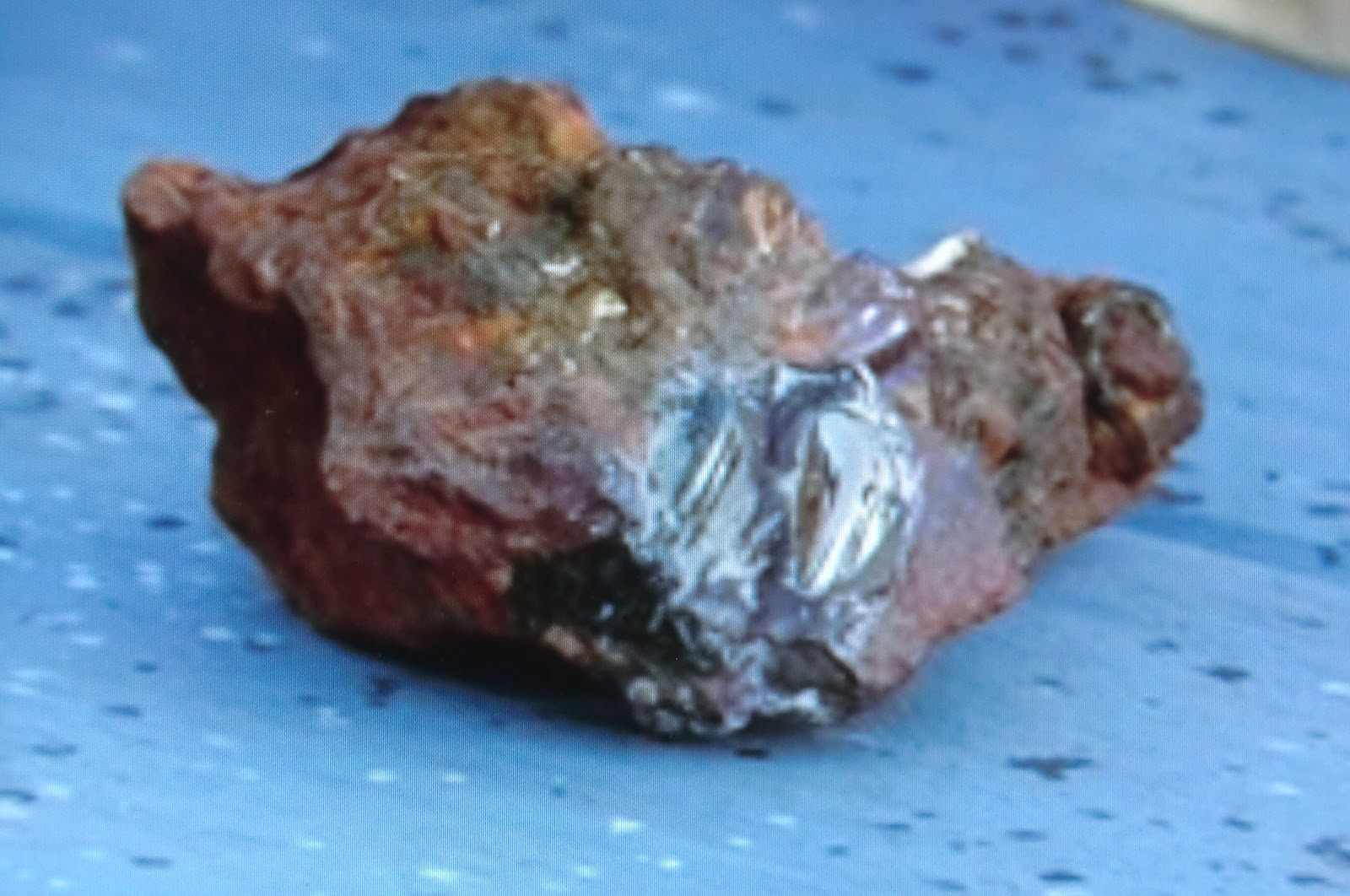
It was within the first fifteen minutes of the second show when something I consider to be very remarkable. Here stood Lucy Cooke talking to an expert about some sealed bottled perfumes, together with a couple of china vessels and statuettes, all of them around a hundred years old, found at a shipwreck off the coast of Dorset. And next to the porcelain was an insignificant-looking lump of rock. And fully embedded in the rock was what looked like a man-made artifact. After thorough cleaning and examination, the artifact turned out to be a pocket watch, almost entirely entombed in solid rock in virtually the same way the ammonite was entombed in a limestone pebble.

The rock featured on the BBC: A watch "fossilized".


A pocket watch embedded in "crud" - solidified mud.

Interestingly enough, Cooke remarks that it will take a further 130,000,000 years before the watch will be a "proper" fossil. But going by the hardness of the rock, isn't it a fossil already? What is the real difference between it and that of the ammonite? Except for its age and of different rock composition? The rock in which the watch is embedded is given a name "crud", which is mud consolidated into rock. What I find so fantastically remarkable about this exhibit is that if a man-made artifact of little more than a hundred years of age can be entombed in solid rock at an amazingly quick time, then why does the ammonite need millions of years to achieve the same result?

It is as if God is desperately trying to tell us something, and just by looking at all the fossils found around the coast and elsewhere, one obvious conclusion can be drawn, and that is all fossilised organisms - whether its marine life, plant and trees, birds, or land animals including Dinosaurs, must have died very quickly, were buried and preserved as fossils over a very short duration. At is as if God is saying, Hey, look guys. What I have written in my Book is historic and true. There was a universal Deluge in the days of Noah, and you are looking at the evidence right now. Oh, so you want more proof that fossilization is quick and recent? Well there you are, a watch preserved in stone. There you have it.

As I stand, this revelation is vital for the Christian faith. Mythologize any part of the Bible, especially the early chapters of Genesis, and the Christian faith will go down like a house of cards. But even the reality of Noah's Flood isn't by means all and end all. Rather it's the historical truth of Adam and Eve. For the reality of Jesus Christ can only stand if Adam and Eve were real too, along with Divine Creation and the Fall, as well as the Deluge, the cause of the formation of fossils. Because through their transgression sin entered the world and death to all men. This concept, which is within the very heart of the Christian faith, can only stand if there was an Adam and Eve, and they were created direct from the ground as the Bible teaches, and were not descended from a human line gradually going back to the primates, as all of these must have died already, before the Fall, therefore nullifying the purpose of Jesus Christ and the Atonement he made on the Cross. 

Saturday, 14 July 2018

The Moment a Ray of Light Shone

Wednesday of the past week was not untypical, at least for the last few weeks. Feeling depressed as I sat alone in the stationary train at a terminus platform of Reading Station, I watched as the carriage began to fill with other passengers. That is, except at my particular section, which consisted of two rows of triple seats facing each other, in which I remained a sole occupant. People passing through the central aisle seemed to glance at me sitting there, then quickly make up their minds to find other still-vacant seats elsewhere.

Am I imagining all this? Or is there a kind of negative aura surrounding my person in such a way that its affecting everyone who comes too close to its proximity? At last, a middle-age businessman, minus a tie, takes the seat directly opposite to where I was sitting, the two of us facing each other as the train began to pull out of its bay. A little way into the journey, as I looked out of the window towards the sky, he suddenly rose from his seat and moved to a vacant seat on the opposite side of the carriage without alighting at any scheduled stops.


Maybe the fellow has a preference for the more restricted airline seating arrangement fitted at the other side of the carriage. Or more disturbingly, could it be the energy generated by such a negative aura surrounding me to be strong enough to make this businessman decide to move away?

A state of depression. It was as if in the midst of deep darkness, imprisoned within the most gloomy chamber I can imagine. How strong and binding it was. Yet I wasn't even sure what was the cause of such emotions. I just couldn't put my finger on it. It seems that no amount of prayer or meditation can shift it. I was thinking whether I need counselling. Would talking to a stranger really unload my burdens? Yet it has been like this now for several weeks. It is as if something was slowly turning the screw, gradually intensifying the feelings of perpetual sadness, fear and trepidation. To the extent of impairing my judgement. As, for example, while fumbling about with this Blogger page on my laptop, I found myself staring at a prompt highlighted on the screen. I'm sure the prompt read, Comments awaiting moderation. Yes, I have a moderation system in place. This is not to dissuade any form of argument or disagreement with what I have written and posted. Rather, it is to keep off any input or contribution carrying links to other websites promoting product sales.

Seeing so many comments under the heading Comments Awaiting Moderation (so I thought), I clicked the Delete All prompt - then suddenly realised what I have just done. I have literally wiped out every comment that was ever posted on the page, probably numbering up to a thousand. It was a disaster, but one which occurred due to a befuddled judgement caused by constant depression. Not surprisingly, by that Wednesday evening such emotions reached near-panic stage.

We were watching Holby City (a soap based on a fictitious Bristol hospital) when I felt a need for both of us (Alex and myself) to pray, and to pray fervently. After the program ended, we both got down to prayer. Perhaps some 15-20 minutes into praying, a disturbance could be heard coming from one of our neighbours.

My heart fell.
"Someone has scored a goal!" I exclaimed, realising that the match between England and Croatia must have gone into extra time, it being rather late in the evening.

As the banging on the wall continued, I decided to put on some relaxing music to act as a background noise-shield for our praying. But after that incident, I couldn't pray anymore. I felt discouraged, and all I wanted to do was to bury my head into a corner of the sofa, which I actually did. But Alex kept on praying, asking God to help her husband find relief from his ongoing depression. She spent a considerable amount of time pleading to the Almighty on my behalf while the gentle music played. At last, after an undefined period, Alex ended her praying and asked if I can give her some refreshment.


I rose and walked into the kitchen and casually looked out of the window. I had to blink twice. I couldn't believe what I was seeing.

Those two houses on the opposite side of our street. For the last few weeks, giant English St. George flags were draped from the front bedroom windows. I stared at the properties. All the flags had gone! Suddenly it was as if a ray of light had pierced the darkness of my heart. Could it be? Yes, could it be...?

As I was preparing a snack for both of us, for the first time I began to feel my depression lift. But I was very cautious, reasoning to myself on why the flags were down if the World Cup Final is still a few days away. Could it be that such "underdogs" such as Croatia had knocked the mighty and proud Three Lions out of the tournament? Surely, this was too good to be true.

Until I checked the Internet. Sure indeed, the little nation of Croatia had eliminated England during extra time, and the timing of the deciding goal coincided with the disturbance heard from next door. The noise was not of cheering but of disappointment and frustration. By contrast, the depression which had me gripped in its power began to lose its hold, and with great surprise with the result, I began to feel a rush of relief, and for a first time after a long while, a sense of happiness.

The reader can be forgiven for wondering why I was so against England winning the World Cup. Simply this: with Italian origins, I felt threatened. And that despite earlier that evening, before kick-off, I actually posted a wish for England to do well on Facebook, as well as writing last week's blog in support. And there were other times when I spoke positively for our national team. But thinking back, I don't think my heart was in any of this well-wishing rhetoric. Rather it was done to save face if England made it into the Final and won. In other words, a form of self-preservation.

It was during the days following their 2-0 victory against Sweden in the Quarter-final when three words became apparent, according to Media outlets. Those words looking to be most appropriate are proud and arrogant. Over and over again, the phrase Football is coming home was constantly repeated as if a mantra. There was a high level of pride and optimism that the trophy will return home this time. And the semi-final against Croatia? Never mind about that. Croatia is a non-entity, we will wipe them out as easily as a cloth wiping water off a table. After all, what significance has such a small nation in a tournament of giants, with the Three Lions being the greatest giant of all? A giant which was motherland to history's greatest Empire, which remained ongoing for around four hundred years.

And also in a geographical sense, the motherland of the greatest Empire in history happens to be an island off the north coast of mainland Europe. This gives a mentality of isolation and with it the ability to rule from a distance, without the need for international borders which would encourage foreign invasion. The way I picture it, Britain is rather like a schoolmaster standing at a distance from all the young students, facing them and delivering his edict with full authority and a sense of unquestionable individual superiority, without a single student daring to butt in. As I see it, that's how the English have always perceived the rest of the world. One nation leads, the rest follow with subordination. Indeed, such source of pride is steeped in history.

And what pride! What optimism after defeating Sweden! It is as if such a tiny, insignificant nation such as Croatia had no relevance at all. An easy win. Yea! the Final, here we come! And return home with the trophy. Indeed. But God had other thoughts. As written in Scripture I happen to be reading by chance this morning:

For my thoughts are not your thoughts, 
neither are your ways my ways, declares the LORD.
As the heavens are higher than the earth,
so are my ways higher than your ways and my thoughts than your thoughts.
Isaiah 55:8-9.

And again:

For whoever exalts himself will be humbled, and whoever humbles himself will be exalted.
Matthew 23:12, also Luke 14:11.

Maybe Jesus had a foreknowledge of international football and all the self-exaltation and national glory-seeking which will go with it, even if it's two millennia after his time! Maybe England has a lesson here to learn, what it means to be humble. According to the Oxford Dictionary, the word humble is defined as, having or showing a low estimate of one's own importance. Maybe, who knows, if England had such a characteristic on a national scale, chances that it would have won the Cup several times in its long half-century history of dwelling in the sporting wilderness.


Which leads to thinking. When France beat Belgium in its 2018 semi-final, its fans showed quite a high level of arrogance by causing crowd havoc in the streets of Paris. Could this mean that France will forfeit its chances of taking home the trophy - which would be for the second time since only 1998? Yes, that is possible. But hand-on-heart, I would prefer Croatia to win. At least in its short history, for them it will be the first Cup victory since October 1991, when this small country gained independence from former Yugoslavia.

But at the time of writing, I have just less than 24 hours to find out. If Croatia does win, who knows, perhaps there is further truth in God showing mercy to the weaker side. But if France win - well, God's thoughts and his ways are higher than ours, who can fathom them?

Whichever way the coin will fall, this I know: after prayer that Wednesday evening, a ray of light pierced through the darkness of my heart, and the heavy depression started to lift. I have to wait to see what happens in four years from now.
  

Sunday, 8 July 2018

Comments - A Terrible Mistake I Made!!!

Dear all Blogger readers and followers who has commented on my posts,

BY MISTAKE I have deleted every comment published in all my posts by clicking a wrong key.

I have sent a request on feedback to the Blogger Administration asking whether all your comments can be restored.

Please note: This was a genuine mistake and there was no prejudice connected with the action.

Therefore I ask you with full sincerity to continue to comment on my posts.

Many thanks.

Frank E. Blasi