Total Pageviews

Showing posts with label Hostel Life. Show all posts

Saturday, 20 July 2024

Travel Biography - Week 109.

The Tale of Two Cities.

All Manhattan photos posted here are from the Broadway Hike, 1998.

Between 1997 and 1998, I visited two major cities. The two couldn't be more different, yet the principle for survival remains the same - the struggle for survival and the means for living at a given location, including stiff competition and even conflict among its inhabitants. Both have their share of aesthetics, yet they also have their share of danger. Yet, each remains suited to its environment, and I, as a visitor, was delighted to see both. 

I'm making a comparison between the Great Barrier Reef and New York City. Both are established settlements.

However, the reasons for visiting these two venues were also different. I visited the Reef simply because it was there and I had easy access to it. After my first visit to Green Island Coral Cay, I became an enthusiastic convert. By contrast, my initial reason for visiting New York City was to escape from the possibility of England winning the 1998 FIFA World Cup football. For the record, one afternoon, I was walking through Greenwich Village, and from a window of a tenement, someone was shouting loud cheers across the street. I knew what the commotion was about, so I looked up and called out, Who won the Cup?

France was his answer, after defeating Brazil by 3 goals to nil. I shouted my thanks to him, feeling relieved that it was all over, and the trophy was to remain in the host country rather than cross the Channel to England.

A view of Amsterdam Avenue from the Hostel Dorm.


Starting the Broadway Hike near 104th Street.


72nd Street subway Station (right).


Columbus Circle.


How do I think of New York City? Having grown up in London and loved it, I saw some similarities between our home capital city and New York (along with Brussels and Paris). However, since London's geological bedrock is Clay, skyscrapers didn't exist until far more recently, when their foundations penetrated far deeper into the harder rocks beneath the Clay bed. In turn, the geological foundation of New York consists of Gniess, Marble, and Schiss, all three very hard metamorphic rock beds suitable for supporting tall skyscrapers. Hence, the Flatiron Building was the first skyscraper to go up, followed by the Chrysler Tower in the 1930s, then overtaken by the Empire State Building, and eventually the Twin Towers of the World Trade Center, the second at the time in world height to the Sears Building in Chicago. 

This was my fourth visit to New York, after twice in 1978 and once in 1995. All three visits lasted no more than a day, although, in 1978, I stopped in New York twice on the same backpacking trip, the first time after arriving from London Gatwick, and the second stop a month later on the same day after a long bus ride from Miami Beach in Florida, before heading to the airport to fly back home. It was during this second, end-of-holiday visit that I stood on the rooftop overlook of one of the twin towers of the World Trade Center.

What's my opinion of New York? I liked the city very much. Although busy with traffic and urban, with many of its buildings looking blocky and lacking aesthetics, there were some natural areas without the need for a long journey to reach. Indeed, Central Park, known as the lung of the city, has its own natural beauty and is man-made. However, in the Bronx, north of Manhatten, the New York Botanical Gardens features the original forest that once covered the whole of Manhatten Island before the arrival of European settlers. However, for anyone into ancient history, New York is not the place to be. Even in London, there are remains of Roman ruins dating back to AD 47, along with the Tower of London which was completed by William the Conquerer in 1078. But even London pales in contrast with the Italian city of Siracusa with its ancient Greek ruins, and Jerusalem in Israel, dating back to Canaanite times, approximately 2,000 BC. Having visited all these sites around the world, no wonder that I feel there is something positive about independent travel!

Looking back at 8th Avenue from Colombus Circle.


Approaching Times Square.


Times Square.


Flatiron Building.


Hostel Life.

HI-AYH New York City on 103rd Street and Amsterdam Avenue was the largest hostel in the world with 624 beds in 1998. Due to the number of backpackers using it, it was almost like a small town in itself. Despite its population size, I didn't make any friends while I was staying there. Each kept himself to himself or within his group. The dormitory was fine, but what I found shocking was the member's kitchen. For the size of the hostel, the kitchen was tiny, and although it was stocked with cooking utensils, there were no cutlery, dinner plates, or cereal bowls. Although there was a large dining room adjoining the kitchen, it was, for some reason, closed and out of service. Thus I had to eat in the kitchen.

I managed to get hold of some plastic cutlery, but for the evening meal, I literally had to eat out of the frying pan, and breakfast out of a mixing bowl. Furthermore, I was one of very few, if any members, who used the kitchen for preparing and eating meals. It became obvious to me that New York wanted us all to sample their many restaurants, coffee bars, and eateries. And I visited coffee bars and eateries during the day, but stuck with self-made meals for breakfast and supper, as sticking with life on a shoestring.

New York Rapid Transit.

Throughout the nine days I spent in the city, I became more familiar with the Rapid Transit system, or the subway. The entrance to a subway station from the street is quite different from the shop-like entrance in London. In New York, the entrance is little more than a square hole in the sidewalk, with steps leading to the ticket hall underground. The subway consists of several underground railways patterned after the London Underground. But instead of each line having a name, such as the Picadilly, Northern, Central and District Lines that characterise the London system, New York lines are simply 1, 2, 3, etc, and A, B, C, etc. Hence, to get to 103rd Street from the airport, I took a train on Line A, which was a direct route between the two points. But for 42nd Street and Times Square, as well as to Battery Park, I used Lines 1 and 2, Line 1 trains were non-stop after 103rd Street to 42nd Street, while those on Line 2 stopped at all the other stations in between. One interchange station I became acquainted with was Columbus Circle on the southwestern corner of Central Park. It linked Line 2 with Lines A, C, B, and D, while the trains of Line 1 passed through fast without stopping.

As for the fares, the single price remains stable regardless of the distance covered, unlike that of Transport for London, whose fares increase with the length of distance covered. Hence, I was able to buy a small canister of tokens. Each of these was about the size and weight of a pound coin, and when I fed one into the barrier, a small sign lit with the word Go, and the gate opened. These canisters were on sale at all stations and newsagents. This does make me wonder: If the Rapid Transit system in New York was able to apply one fare for all journeys and apparently do well, why can't the Brits adopt the same idea? 
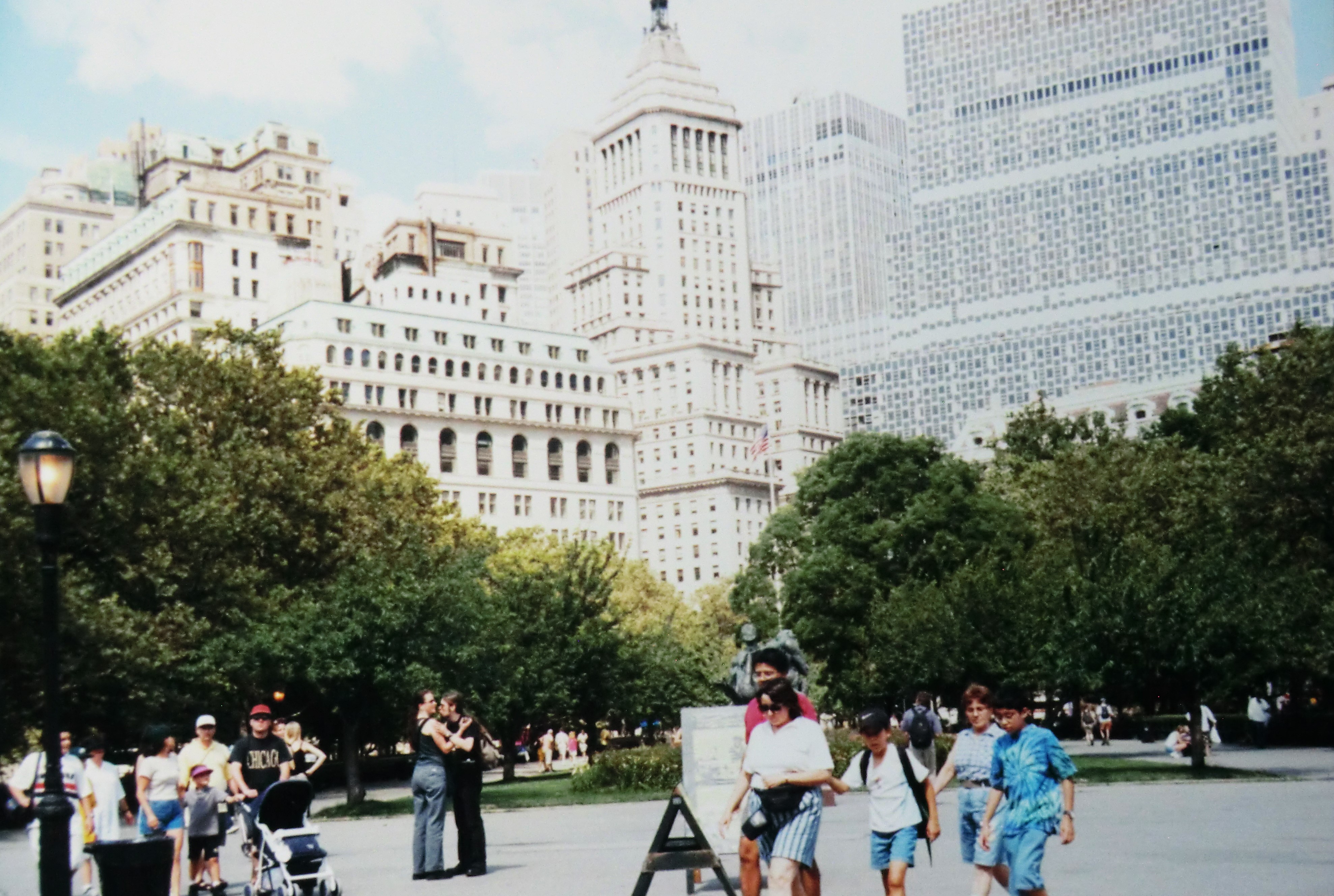
Union Square backed by the Consolidation Edison Bdg.


City Hall Building.


Memorial, Union Square.


Castle Clinton National Monument. 


Castle Clinton National Monument, Interior.


The Broadway Hike.

On one of the days I spent in New York, I wanted to try the Broadway Hike. Normally, this begins at Harlem and ends at Battery Park. But where I started was short of Harlem, at 104th Street. According to Google Maps, the hike is 7.2 miles long, but aware of the starting location, after reaching Castle Clinton National Monument, I carried on with the hike, making my way to the start of Brooklyn Bridge, and as I walked along the elevated boardwalk, I crossed the East River to Brooklyn. One of the first buildings I saw after crossing over was the Watchtower Headquarters, the source of all Jehovah's Witness governance and literature. Its huge Watchtower sign faced directly towards Manhatten, and I believe, it was lit up at night. (For the record, the Headquarters has since moved to a modernised facility in Tuxedo Park, close to the border with New Jersey.) In all, the hike, which lasted the best part of the day, was around nine miles, a tad shorter than the Bright Angel hike into the Grand Canyon.

To get to the start of the hike, I walked along 104th Street until it intersected with Broadway itself. It was there that I turned left and followed the street until I reached the Financial Centre at the southern tip of the island.

Broadway doesn't comply with the rest of the city's symmetrical grid, instead, it transverses diagonally eastwards. Hence, Columbus Circle is where Broadway intersects with 8th Avenue marking the western edge of Central Park, and 59th Street. As I was crossing the Circle, I literally felt the ground shake very slightly as a fast subway train was passing through directly under where I was walking.

Boardwalk, Brooklyn Bridge.


Montague Street, Brooklyn Heights.


Other landmarks I saw during the hike include 72nd Street subway station, so far the only station with a building instead of a hole in the sidewalk. Then I passed through Times Square - where Broadway intersects with 7th Avenue at 45th Street, although the subway station serving this area was under 42nd Street and it was called that - 42nd Street.

Further down, where Broadway crosses 5th Avenue at 23rd Street, I pass Madison Square Park which was backed by the white stonework of the Metropolitan Life Building. This was followed by the Flatiron Building, New York's first official skyscraper before its height was overtaken by the Chrysler Building. The Broadway then continued on until it crossed 14th Street, where Union Square is located. This open space was backed by another white edifice, the Cosmopolitan Edison Building. Finally, I divert off the Broadway to arrive at Castle Clinton National Monument in Battery Park, on the southern tip of Manhatten.

I turned around to head northeast to the start of the Brooklyn Bridge and crossed the East River until I arrived at Brooklyn itself, and I wandered into town. Although I said that the hike was nine miles long, that didn't include the return walk to Battery Park where I caught the evening train back to 103rd Street Station and a short walk back to the hostel.
----------------------------------------------------------------------------------------------------------------
Next Week: A look at Central Park and a boat trip with great significance.

Saturday, 24 February 2024

Travel Biography - Week 88.

Arrival at Byron Bay.

I finally arrived at Byron Bay, my first of the three stops in New South Wales. The stub of a peninsula jutting out into the Pacific Ocean is Cape Byron, named after James Cook's fellow sailor, John Byron, the grandfather of the more famous poet, Lord George Byron. The Cape not only boasts a lighthouse, but it's the most easterly point of the Australian continent, and it was here that my journey to Sydney changed from a southeasterly direction to a southwesterly direction as it rounds the curve of the continent's east coast.

Cape Byron has a beach leading to it from both sides, as anyone standing on a headland would expect to see, but here, the two beaches are ninety degrees from each other. The shore west of the Cape and facing north has a very sophisticated name of Main Beach. Directly south of Cape Byron is Tallow Beach, which faces east. Inland, the Cape is forested, and a short trail leads away from the lighthouse into the forest. On one of these hikes, I came across a female spider almost the size of an extended human hand, resting on the web it had spun among the bushes.

Main Beach, Byron Bay. Ahead is Cape Byron.


The Esplanade, Byron Bay.


Cape Byron Lighthouse.


From Main Beach, a group of wetsuit-clad surfers were enjoying themselves, and I believe they may be members of a local surfer's club. A coastal walk brought me from the hostel to Main Beach, and then onward to the Cape, from where I had a panoramic clifftop view of Tallow Beach. On the north side of the peninsula, a small headland separates Wategos Beach from Main Beach and a second headland encloses Little Wategos Beach before the coast takes a dramatic turn south at Cape Byron to begin the long curve of Tallow Beach. It was at these beaches, at the foot of the Cape cliffs, where I saw pineapple trees thriving.

From a point on the clifftop and near the lighthouse, I watched a paraglider hover over Tallow Beach as he allowed the cool breeze to carry him southward, away from us. With the surfers at Main Beach and a paraglider flying over Tallow Beach, I have gotten the impression that Byron Bay was home to a sporting community.

At the Hostel.

The hostel I was staying in was YHA-affiliated Jeff's Hostel in town. The town itself was just like Hervey Bay, with a grid layout of low buildings, each of them no more than two storeys high. The hostel was in a residential estate. It was here, while I was checking in after a journey from Brisbane, that I was offered a choice of dollar or duty. As expected, I chose to pay an extra dollar per night, just as everyone else did. To my knowledge, I saw no one carry out a duty either in this hostel or in any other Australian hostel. Actually, I was surprised to be asked when overwhelming evidence over some time shows a clear disdain towards mandatory chores which almost put the YHA out of business on a worldwide scale. We as adult backpackers were a far cry from urban schoolchildren growing up in deprived families, to whom these hostels were originally intended.

Once a week, the owners at Byron Bay laid on an evening buffet for a small fee, releasing us from the burden of buying and cooking meals. This particular evening, I was there, and I paid for my share, as most of the clientele did.

After filling my dinner plate with goodies, I sat next to a younger female, and soon we began chatting. We shared our travel experiences as we spoke to each other joyfully. There was a row of three chairs at one side of the dining room, and she sat at the one in the middle. From the buffet, a plain-looking man, not much younger than me, and with a generous waistline, emerged and took his place at the vacant seat on the other side of the young woman.

His apparent lack of good looks was compensated by his persuasive speech and his gift of the gab. While we were talking, he thrust his way into our conversation in such a manner that the female didn't take offence at his rudeness. He then began to dominate the conversation until I couldn't get a word in. His intention was to squeeze me out altogether, and she was charmed by his smooth tongue and forgot that I was sitting next to her and started our chat in the first place.

Feeling resigned, I rose up to go outside, fully aware of the chap's dislike for me and his chat-up lines motivated by jealousy rather than having natural affection for her. I could see that all he wanted was to prove himself against me. Yet, I still felt defeated. Defeated in sport, and now feeling small on a social side too. Outside, I made my way to the esplanade, a pleasant tree-lined grassy strip bordering the sandy beach. I looked up into the night sky at the zillions of starry bodies making up the Milky Way as it streaked from horizon to horizon across the heavens. The Southern Cross, having moved slightly towards the northwest since I landed at Cairns Airport, still held prominence among the constellations. Indeed, I hope the two I left behind at the hostel are enjoying a blossoming friendship!

A romantic scene at the Bay.


Tallow Beach from the Cape. Note the Paraglider.


A trail leads through the Cape forest.


On the trail, a spider almost as big as my hand.


However, as a traveller, I knew that a stone that is constantly rolling will never gather any moss, and so, I knew of the impossibility of permanence with holiday romances. As demonstrated at Hervey Bay after meeting Christine at Lake McKenzie, which ended on the same day, and any friendship between this lady I left behind at the hostel, and me, wouldn't have lasted. After all, she could have journeyed on the very next morning. This was something I had already experienced two years earlier when I met this young Jewess at HI-AYH San Diego. We became friends as we journeyed together to Santa Monica. By the next morning, she had gone.

Cycling Down Under.

During my three-day stay at Byron Bay, I hired a bicycle from the hostel. The mount had a permanent plate fixed under the saddle with the logo, J'S HOSTEL. Like this, the world knew who owned the bike.

This was the first time I cycled in Australia. This fact alone gave me an extra thrill as I rode on the left side of the road like we do in Britain, but unlike in continental Europe, Israel, or North America, where I had to cycle on the right side of the road. The main road I was on cuts through forested land. In total, I have cycled around 28 km or 17 miles, give or take, and I rode from Byron Bay to Seven-Mile-Beach, a strip of sand separated from Tallow Beach by a series of stubby headlands known as Broken Heads Nature Reserve.

I made my way to the beach, wheeling the bicycle. When I got there, I saw how deserted the beach was. The sea itself was stirred with white horses lapping at the sandy strip. The sea was far from inviting to a swimmer, but it might have suited a surfer dressed in a wetsuit. Indeed, my intention was to cycle further south until I arrived at the next resort, the village of Lennox Head, built on a bulge of land at the southern end of Seven-Mile-Beach.

Seven-Mile-Beach was a far cry from the beaches of Port Douglas or Arlie Beach. The whole environment was absolutely deserted, with no one else around. But that was not all. From the south, a spreading sheet of thunderclouds was slowly drawing in, darkening the horizon and looking in every way that the apocalypse was ready to begin. I knew that I was done for! If I had a fast racing car, I might have beaten the weather by arriving in Byron Bay in quick time. But on a bicycle?

Yet, I remained rooted on the beach. I simply wanted to absorb the experience of being there. It was a little more than a daily trip to the shops! I knew that I was in for a soaking and I couldn't escape from it. But in my small knapsack, I had my passport and airline tickets. Since I arrived in Singapore and then Australia, I always carried these documents on me, as I hadn't come across any luggage lockers in any of the hostels I stayed at. I was still on the beach when the rain started.

This was no light drizzle, characteristic of the English weather. Rather, this was a heavy downpour. I wheeled my bike back to the road and began the return cycle ride northwards towards the hostel.

I was drenched from head to foot by the time I arrived at the hostel. I managed to hand the bike intact to reception. Then I was for the hot shower and a complete change of clothing. But worse was to come. I opened the knapsack and took out the book of airline tickets. The most important documents of the pack were soaked through and through! Would I be marooned in Australia, unable to board my next flight to Los Angeles? Quite a point, that! Then again, remaining in Australia doesn't seem such a bad idea after all. Despite the NSW weather, I have loved every minute of it.

I examined the book of airline tickets. The print wasn't smudged. When the book arrived at my apartment, it contained four vouchers. The first was for the London-Singapore flight. The second was for the Singapore-Cairns flight. Those two vouchers were gone, leaving the remaining two left, the first for Sydney-Los Angeles, and the second for Los Angeles-London. Therefore, I laid the book open beside my bed. The air was able to reach both vouchers without them sticking together. However, although the cover of the passport was also wet, it was also waterproof, and all the pages within escaped the worst. The book of Traveller's Cheques also escaped the worst.

I hired the hostel bicycle for the day.


Seven-Mile-Beach. Looking north at Broken Heads.


Seven-Mile-Beach. Looking South.


Sunset over Byron Bay


When I compared Byron Bay with all the other stops I made so far, It's my opinion that the environment surrounding Byron Bay was the most dramatic coastline on mainland Australia I have so far seen, beating any of the Queensland coastal regions, although the latter take the extra credit for their connection with the Great Barrier Reef. Byron Bay holds the credit of being the most easterly point in the whole of the Australian continent. Therefore, by arriving in Byron Bay, I have broken two distance records: that of being so far the furthest location from home in the UK, and territorially the most easterly point furthest from the Greenwich Mean Line dividing the east from the west hemispheres. And this record will stay for life.

Back at the hostel, I felt that I had achieved something as I prepared supper. Personally, I prefer buying and cooking my own meals to being served food cooked by someone else for a higher payment. The sense of independence, a healthier budget, and sometimes, the start of new friendships.

The next day, I made arrangements on the Book-A-Bed-Ahead scheme for a reservation at YHA Coffs Harbour, my next stop on the NSW coastline. However, before progressing any further, I carefully examined my airline ticket vouchers. I breathed a massive sigh of relief. After leaving the book open next to my bed overnight, by morning the vouchers had dried out, and the print wasn't smudged but perfectly readable. Neither was the paper crinkled. It was safe. I was safe. Too bad, my excuse to remain permanently in Australia has evaporated - literally! 

As I travel further south, I see less of a tropical environment as I merge into a warm temperate climate. I saw no mangroves in or around Byron Bay. But once I arrive at Coffs Harbour, I will be in for a surprise.
-----------------------------------------------------------------------------------------------------------------
Next Week: A tear rolls down my cheek after settling at Coffs Harbour.